Encyclopedia/1. The Cosmos & The Natural World/1. Mathematics & Formal Systems/01. Geometry & Spatial Systems • Curated by Admin Timeline.sg
Computational geometry is the study of algorithms for solving geometric problems. Key milestones include the development of convex hull algorithms, Voronoi diagrams, and Delaunay triangulations, with applications spanning from computer graphics to geographic information systems.
Chronological Storyline (46 Milestones)
1644 CE
Descartes Uses Voronoi-Like Diagrams
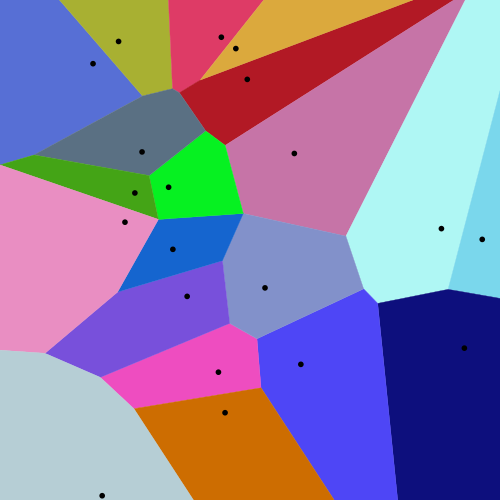
In his Principia Philosophiae, René Descartes describes the division of the universe into cells influenced by nearby stars, an early conceptual use of Voronoi-like spatial partitions. #computationalgeometry #voronoi
Descartes Uses Voronoi-Like Diagrams By Balu Ertl - Own work, CC BY-SA 4.0, https://commons.wikimedia.org/w/index.php?curid=38534275
1850 CE
Dirichlet Defines Dirichlet Tessellation
German mathematician Peter Gustav Lejeune Dirichlet studied Voronoi diagrams for point sets in the plane, now known as Dirichlet tessellation. This laid the mathematical foundation for spatial partitioning. #computationalgeometry #voronoi
1908 CE
Voronoi Generalizes Diagrams to Higher Dimensions
Russian mathematician Georgy Voronoi formally defined Voronoi diagrams for n-dimensional point sets, generalizing Dirichlet's work. This opened the door to applications in many fields. #computationalgeometry #voronoi
1911 CE
Thiessen Polygons Introduced in Meteorology
American meteorologist Alfred H. Thiessen used Voronoi diagrams to average rainfall measurements across irregularly spaced stations, coining the term 'Thiessen polygons'. #computationalgeometry #voronoi #meteorology
1934 CE
Delaunay Introduces Delaunay Triangulation
Russian mathematician Boris Delaunay introduced the Delaunay triangulation, the dual graph of the Voronoi diagram, maximizing the minimum angle of triangles. This became a cornerstone of computational geometry. #computationalgeometry #delaunay
Delaunay Introduces Delaunay Triangulation By Gjacquenot - Own work, File:Delaunay circumcircles.png (Nü es), Public domain, https://commons.wikimedia.org/w/index.php?curid=30370476
1972 CE
Graham Scan: First Convex Hull Algorithm
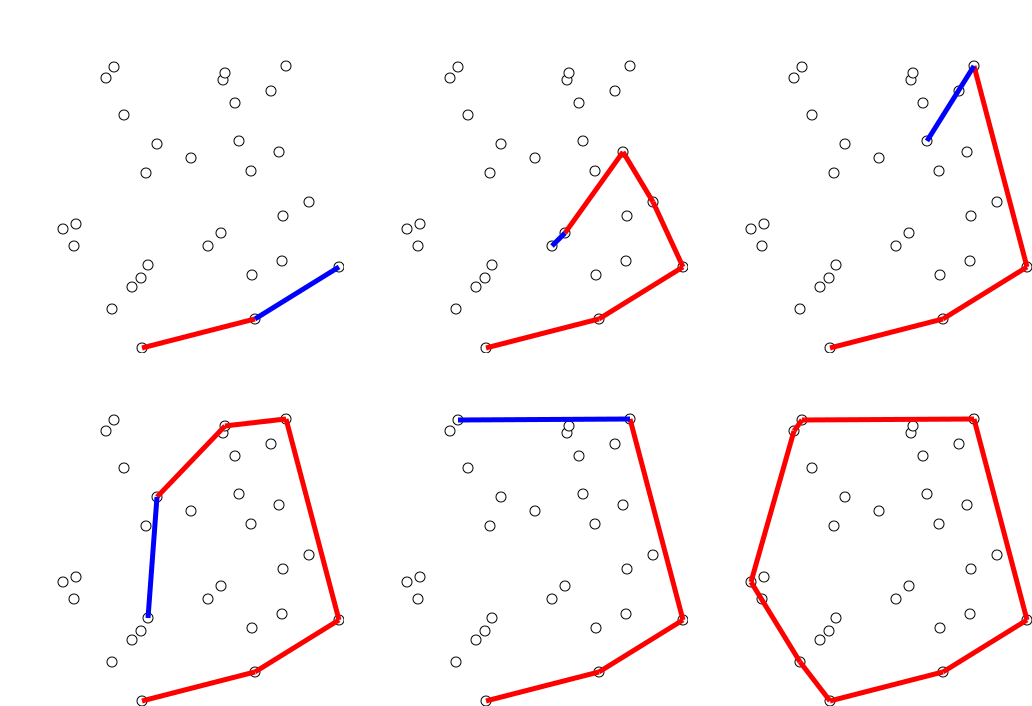
Ronald Graham published the Graham scan, the first efficient algorithm for computing the convex hull of a set of points in O(n log n) time, a fundamental problem in computational geometry. #computationalgeometry #convexhull
Graham Scan: First Convex Hull Algorithm By Shiyu Ji - Own work, CC BY-SA 4.0, https://commons.wikimedia.org/w/index.php?curid=54390512
1973 CE
Jarvis March (Gift Wrapping) for Convex Hull
Raymond Jarvis developed the Jarvis march algorithm, also known as the gift wrapping algorithm, for computing the convex hull with O(nh) time complexity, where h is the number of hull vertices. #computationalgeometry #convexhull
Jarvis March (Gift Wrapping) for Convex Hull By HeccinTech - Own work, CC BY 4.0, https://commons.wikimedia.org/w/index.php?curid=179327977
1975 CE
Shamos and Hoey: Voronoi Diagrams in Computational Geometry
Michael Shamos and Dan Hoey published the first computational geometry paper on Voronoi diagrams, presenting an O(n log n) divide-and-conquer algorithm. This catalyzed the field. #computationalgeometry #voronoi
1978 CE
Shamos Ph.D. Thesis on Computational Geometry
Michael Shamos completed his landmark Ph.D. thesis at Yale, formalizing the field of computational geometry and introducing many fundamental problems and algorithms. #computationalgeometry #history
1979 CE
Lee and Schachter: Algorithm for Voronoi Diagrams
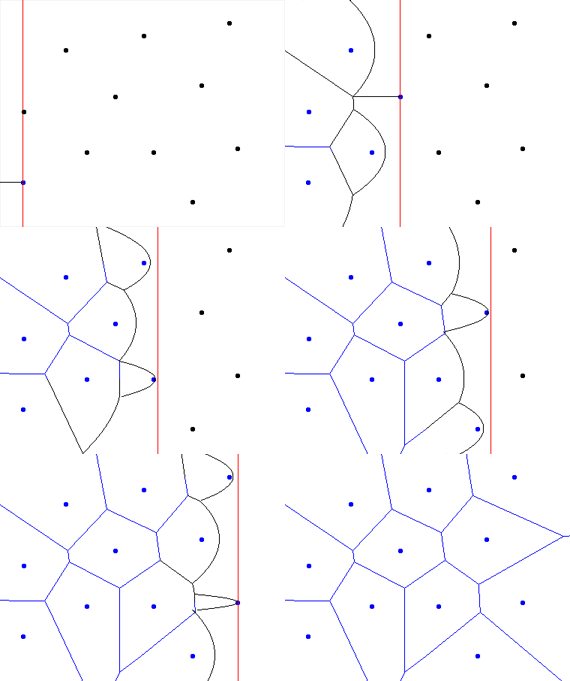
D. T. Lee and B. J. Schachter published a sweep-line algorithm for constructing Voronoi diagrams in O(n log n) time, later refined by Fortune. #computationalgeometry #voronoi
Lee and Schachter: Algorithm for Voronoi Diagrams By Mnbayazit - https://en.wikipedia.org/wiki/File:Fortunes-algorithm.gif, Public domain, https://commons.wikimedia.org/w/index.php?curid=32553992
1980 CE
Guibas and Stolfi: Quad-Edge Data Structure
Leonidas Guibas and Jorge Stolfi introduced the quad-edge data structure for representing planar subdivisions like Voronoi diagrams and Delaunay triangulations, enabling efficient topological operations. #computationalgeometry #datastructure
1981 CE
O'Rourke's Convex Hull Algorithm
Joseph O'Rourke published an algorithm for computing the convex hull of a set of points in 3D, contributing to growing interest in geometric algorithms. #computationalgeometry #convexhull
1983 CE
Edelsbrunner Introduces Alpha Shapes
Herbert Edelsbrunner introduced alpha shapes, a generalization of the convex hull that captures the shape of a point set, based on Delaunay triangulation. #computationalgeometry #alphashapes
1984 CE
Chazelle's Polygon Triangulation Algorithm
Bernard Chazelle presented the first linear-time algorithm for triangulating a simple polygon, a breakthrough in computational geometry. #computationalgeometry #triangulation
Chazelle's Polygon Triangulation Algorithm By Tosha - Own work, CC0, https://commons.wikimedia.org/w/index.php?curid=49071486
1986 CE
Fortune's Sweep-Line Algorithm for Voronoi Diagrams
Steven Fortune published a sweep-line algorithm that constructs Voronoi diagrams in O(n log n) time using a plane-sweep method, now widely used. #computationalgeometry #voronoi
1987 CE
Delaunay Refinement Mesh Generation
R. E. Barnhill and others developed Delaunay refinement algorithms for generating quality triangulations with guaranteed angle bounds, crucial for finite element methods. #computationalgeometry #delaunay
1988 CE
De Berg et al. Book 'Computational Geometry: Algorithms and Applications'
Mark de Berg, Otfried Cheong, Marc van Kreveld, and Mark Overmars published the seminal textbook 'Computational Geometry: Algorithms and Applications', becoming a standard reference. #computationalgeometry #education
1990 CE
Seidel's Randomized Triangulation Algorithm
Raimund Seidel presented a randomized algorithm for constructing Delaunay triangulations in expected O(n log n) time, using incremental insertion and flipping. #computationalgeometry #delaunay
1991 CE
Aurenhammer's Survey on Voronoi Diagrams
Franz Aurenhammer published a comprehensive survey of Voronoi diagrams in the ACM Computing Surveys, summarizing decades of research and applications. #computationalgeometry #voronoi
1992 CE
Voronoi Diagrams for Image Compression
Researchers applied Voronoi diagrams to vector quantization in image compression, demonstrating their utility in computer graphics and signal processing. #computationalgeometry #imagetcompression
1993 CE
Constrained Delaunay Triangulation Algorithms
Shewchuk and others developed robust algorithms for constrained Delaunay triangulation, allowing the inclusion of non-intersecting segments as constraints, vital in mesh generation. #computationalgeometry #delaunay
1995 CE
Voronoi Diagrams in Autonomous Robot Path Planning
Researchers used generalized Voronoi diagrams to compute collision-free paths for robots, a key application in robotics. #computationalgeometry #robotics #pathplanning
1996 CE
Okabe et al. Book 'Spatial Tessellations: Concepts and Applications of Voronoi Diagrams'
Japanese researchers Atsuyuki Okabe, Barry Boots, and others published a comprehensive book on Voronoi diagrams, covering theory and diverse applications in geography, biology, and computer science. #computationalgeometry #voronoi
1997 CE
Voronoi Diagrams in Molecular Biology
Voronoi diagrams were applied to analyze protein structures and molecular packing, enabling new insights in structural biology. #computationalgeometry #bioinformatics
1998 CE
CGAL Library Founded
The Computational Geometry Algorithms Library (CGAL) was initiated, providing robust, efficient implementations of many geometric algorithms, including Voronoi and Delaunay, under open-source licenses. #computationalgeometry #cgal
1999 CE
Shewchuk's Adaptive Precision for Delaunay Triangulation
Jonathan Shewchuk published algorithms for robust Delaunay triangulation using adaptive precision arithmetic, eliminating numerical robustness issues. #computationalgeometry #delaunay
2000 CE
Weighted Voronoi Diagrams for Geospatial Analysis
Weighted Voronoi diagrams, where each site has a weight, became popular in geographic information systems for modeling influence regions with varying importance. #computationalgeometry #gis
Weighted Voronoi Diagrams for Geospatial Analysis By SmallJarsWithGreenLabels - Own work, CC0, https://commons.wikimedia.org/w/index.php?curid=121491991
2001 CE
Voronoi Diagrams in Crystal Structure Analysis
Voronoi tessellations were used to analyze atomic environments in crystals, aiding materials science research. #computationalgeometry #materialscience
2002 CE
Incremental Delaunay Triangulation Algorithms
Optimal incremental algorithms for Delaunay triangulation in the plane were refined, achieving expected linear time for random point sets. #computationalgeometry #delaunay
2003 CE
Voronoi-Based Flow Visualization
Voronoi diagrams were applied to visualize vector fields and flow patterns in computational fluid dynamics, illustrating their versatility. #computationalgeometry #visualization
2004 CE
Vector Quantization with Delaunay Triangulation
Delaunay triangulation was used for efficient vector quantization in machine learning, providing a fast nearest-neighbor search structure. #computationalgeometry #machinelearning
2005 CE
Voronoi Diagrams in Clustering and K-Means
Voronoi diagrams were linked to k-means clustering, leading to new algorithms for cluster analysis based on spatial tessellation. #computationalgeometry #clustering
2006 CE
Delaunay-Based Remeshing in Computer Graphics
Delaunay triangulation became a cornerstone of surface remeshing algorithms, enabling high-quality mesh generation for 3D models. #computationalgeometry #computergraphics
2007 CE
GPU Accelerated Voronoi Diagram Computation
Algorithms for computing Voronoi diagrams on graphics processing units (GPUs) were developed, enabling real-time spatial analysis for large point sets. #computationalgeometry #gpu
2009 CE
Delaunay Triangulation for Big Data Sets
Efficient parallel algorithms for Delaunay triangulation of massive point clouds emerged, supporting applications in terrain modeling and LiDAR data processing. #computationalgeometry #bigdata
2010 CE
Voronoi Diagrams in Geographic Information Systems
Voronoi diagrams became a standard tool in GIS for performing spatial analysis, such as creating service area maps and proximity zones. #computationalgeometry #gis
2011 CE
Higher-Dimensional Voronoi Diagram Algorithms
New algorithms for computing Voronoi diagrams in high dimensions were developed, aiding machine learning and computational biology. #computationalgeometry #voronoi
2012 CE
Natural Neighbor Interpolation Using Voronoi
Natural neighbor interpolation, based on Voronoi tessellation, became widespread in geostatistics and data science for spatial prediction. #computationalgeometry #interpolation
Natural Neighbor Interpolation Using Voronoi By Markluffel - Own work, CC BY-SA 3.0, https://commons.wikimedia.org/w/index.php?curid=9094152
2013 CE
Voronoi Path Planning for Autonomous Vehicles
Voronoi diagrams were used in autonomous vehicle navigation to generate collision-free paths in dynamic environments, with real-time performance. #computationalgeometry #autonomousvehicles
2014 CE
Machine Learning with Voronoi Feature Partitioning
Researchers developed Voronoi-based feature space partitioning algorithms for ensemble learning and classification tasks. #computationalgeometry #machinelearning
2015 CE
Kinetic Voronoi Diagrams for Moving Points
Algorithms for maintaining Voronoi diagrams of moving points (kinetic data structures) were refined, enabling applications in animation and tracking. #computationalgeometry #kinetic
2016 CE
Delaunay Triangulation in Deep Learning for 3D Shape Analysis
Delaunay triangulation was used to represent 3D shapes as input to convolutional neural networks, advancing geometric deep learning. #computationalgeometry #deeplearning
2017 CE
Voronoi Diagrams in Cellular Network Optimization
Telecommunications engineers used weighted Voronoi diagrams to optimize base station placement and coverage areas. #computationalgeometry #telecommunications
2018 CE
Voronoi-Based Mesh Generation for Finite Element Analysis
Voronoi tessellation became a standard approach for generating high-quality meshes in computational engineering, especially for polygonal finite elements. #computationalgeometry #meshgeneration
2019 CE
Delaunay Triangulation in Computational Topology
The combination of Delaunay triangulation with persistent homology provided tools for topological data analysis of point clouds. #computationalgeometry #topology
2020 CE
Voronoi Diagrams in COVID-19 Spatial Analysis
Epidemiologists used Voronoi diagrams to model the spread of COVID-19 and allocate resources based on proximity and population density. #computationalgeometry #epidemiology