Complex Analysis & Special Functions: Euler, Cauchy & Riemann
Encyclopedia/1. The Cosmos & The Natural World/1. Mathematics & Formal Systems/03. Calculus & Mathematical Analysis • Curated by Admin Timeline.sg
This timeline traces the development of complex analysis and special functions from the 18th to the mid-20th century, highlighting key contributions by Euler, Cauchy, Riemann, and others, including the foundations of analytic functions, contour integration, elliptic functions, and the Riemann zeta function.
Chronological Storyline (42 Milestones)
1729 CE
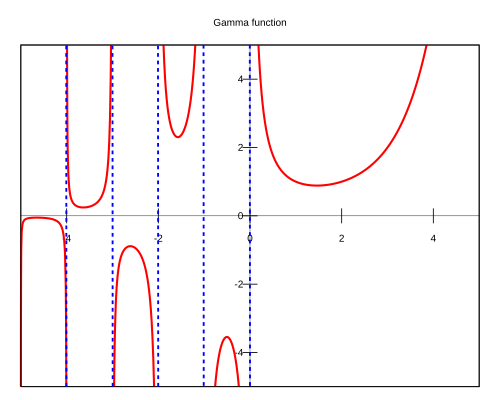
Euler Introduces the Gamma Function
Leonhard Euler defines the gamma function as an extension of the factorial to real and complex numbers. This function becomes fundamental in analysis and number theory. #specialfunctions #euler
Euler Introduces the Gamma Function By Alessio Damato - Own work (Original text: own work), CC BY-SA 3.0, https://commons.wikimedia.org/w/index.php?curid=365942
1748 CE
Euler's Formula Published
In his work 'Introductio in analysin infinitorum', Euler publishes the formula e^(iθ) = cosθ + i sinθ, linking exponential and trigonometric functions. This identity is a cornerstone of complex analysis. #complexanalysis #euler
Euler's Formula Published By Original: GuntherDerivative work: Wereon - This file was derived from: Euler's formula.png:, CC BY-SA 3.0, https://commons.wikimedia.org/w/index.php?curid=821342
1752 CE
Euler's Identity e^(iπ)+1=0 Appears
Euler notes the special case e^(iπ)+1=0, now known as Euler's identity, which many consider one of the most beautiful equations in mathematics. #complexanalysis #euler
1777 CE
Euler Uses i for √-1
Euler is the first to use the symbol i to denote the imaginary unit √(-1) in a published paper, standardizing complex number notation. #complexnumbers #euler
Euler Uses i for √-1 By Loadmaster (David R. Tribble) This image was made by Loadmaster (David R. Tribble). Email the author: David R. Tribble Also see my personal gallery at Google Photos - Own work, CC BY-SA 3.0, https://commons.wikimedia.org/w/index.php?curid=9696627
1799 CE
Gauss Proves Fundamental Theorem of Algebra
Carl Friedrich Gauss provides the first rigorous proof that every non-constant polynomial with complex coefficients has at least one complex root. This theorem is central to complex analysis. #complexanalysis #gauss
1799 CE
Wessel Publishes Argand Diagram
Norwegian surveyor Caspar Wessel presents a geometric representation of complex numbers as points in the plane, similar to the later Argand diagram. #complexnumbers #geometry
Wessel Publishes Argand Diagram By Unknown author, CC BY-SA 3.0, https://commons.wikimedia.org/w/index.php?curid=1616112
1806 CE
Argand Publishes Complex Plane Representation
Jean-Robert Argand independently publishes a geometric interpretation of complex numbers, now known as the Argand diagram, facilitating visualization of complex analysis. #complexanalysis #argand
1811 CE
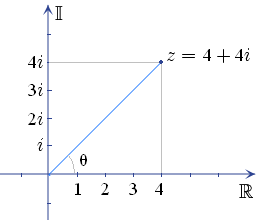
Gauss Proposes Complex Numbers as Ordered Pairs
Gauss writes a letter outlining the idea that complex numbers can be treated as ordered pairs of real numbers, anticipating later formal definitions. #complexnumbers #gauss
Gauss Proposes Complex Numbers as Ordered Pairs By IkamusumeFan - Own work, CC BY-SA 4.0, https://commons.wikimedia.org/w/index.php?curid=42024951
1812 CE
Legendre Introduces Legendre Polynomials
Adrien-Marie Legendre introduces Legendre polynomials in his work on celestial mechanics. These orthogonal polynomials become key special functions in physics and analysis. #specialfunctions #legendre
Legendre Introduces Legendre Polynomials By Geek3 - Own work, CC BY-SA 3.0, https://commons.wikimedia.org/w/index.php?curid=9552813
1821 CE
Cauchy Publishes Cours d'Analyse
Augustin-Louis Cauchy publishes 'Cours d'analyse', providing rigorous foundations for calculus and complex analysis, including early definitions of limits and continuity. #complexanalysis #cauchy
Cauchy Publishes Cours d'Analyse By Augustin Louis Cauchy - screenshot of https://archive.org/details/bub_gb_OlxT3B6EjykC/page/n5/mode/2up, CC0, https://commons.wikimedia.org/w/index.php?curid=94855343
1824 CE
Bessel Functions Introduced
Friedrich Bessel presents a systematic study of Bessel functions, solutions to Bessel's differential equation, which are crucial in wave propagation and potential theory. #specialfunctions #bessel
Bessel Functions Introduced By Sławomir Biały - This diagram was created with Mathematica by n., CC BY-SA 4.0, https://commons.wikimedia.org/w/index.php?curid=75100352
1825 CE
Cauchy's Integral Theorem
Cauchy states the integral theorem: for a holomorphic function on a simply connected domain, the contour integral over a closed path is zero. This is a fundamental result in complex analysis. #complexanalysis #cauchy
Cauchy's Integral Theorem By Geek3 - Own work, CC BY-SA 3.0, https://commons.wikimedia.org/w/index.php?curid=5156881
1827 CE
Abel Discovers Elliptic Functions
Niels Henrik Abel publishes a paper on elliptic functions, showing that these are doubly periodic meromorphic functions, laying the groundwork for the theory of elliptic curves. #complexanalysis #abel
1829 CE
Jacobi Publishes Fundamenta Nova
Carl Gustav Jacob Jacobi publishes 'Fundamenta Nova Theoriae Functionum Ellipticarum', developing the theory of theta functions and elliptic functions in depth. #complexanalysis #jacobi
1831 CE
Gauss Publishes on Complex Numbers
Gauss publishes a paper that explicitly treats complex numbers as ordered pairs, clarifying their algebraic structure and geometric interpretation. #complexnumbers #gauss
1835 CE
Hamilton Defines Complex Numbers as Ordered Pairs
William Rowan Hamilton gives a formal definition of complex numbers as ordered pairs of real numbers, establishing their rigorous algebraic foundation. #complexnumbers #hamilton
1843 CE
Laurent Series Expansion
Pierre Alphonse Laurent publishes the series expansion that bears his name, representing complex functions as power series with negative powers, crucial for studying singularities. #complexanalysis #laurent
Laurent Series Expansion By Pko - based on drawing en:Image:LaurentSeries.png, Public domain, https://commons.wikimedia.org/w/index.php?curid=742012
1843 CE
Cauchy's Integral Formula
Cauchy establishes the integral formula, showing that the values of a holomorphic function inside a contour are determined by its values on the boundary. This is a central tool in complex analysis. #complexanalysis #cauchy
1845 CE
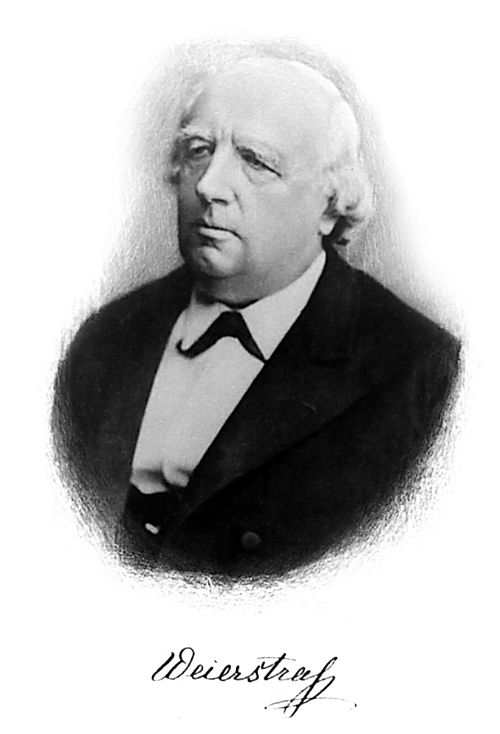
Weierstrass Begins Work on Analytic Functions
Karl Weierstrass starts his research on complex functions, developing power series methods and later founding the theory of analytic functions. #complexanalysis #weierstrass
Weierstrass Begins Work on Analytic Functions By Unknown author, Public domain, https://commons.wikimedia.org/w/index.php?curid=324146
1851 CE
Riemann's Dissertation on Complex Analysis
Bernhard Riemann publishes his doctoral dissertation, introducing Riemann surfaces, conformal mapping, and the Riemann mapping theorem, revolutionizing complex analysis. #complexanalysis #riemann
Riemann's Dissertation on Complex Analysis By Unknown author - http://www.sil.si.edu/digitalcollections/hst/scientific-identity/explore.htm according to the German Wikipedia., Public domain, https://commons.wikimedia.org/w/index.php?curid=27383
1854 CE
Riemann's Work on Hypergeometric Functions
Riemann studies hypergeometric functions using complex analysis, deriving important properties and establishing connections with differential equations. #specialfunctions #riemann
Riemann's Work on Hypergeometric Functions By WalkingRadiance - Own work, CC BY-SA 4.0, https://commons.wikimedia.org/w/index.php?curid=122403556
1857 CE
Riemann on Abelian Functions
Riemann publishes a paper on abelian functions, extending the theory of elliptic functions to higher dimensions and introducing theta functions of several variables. #complexanalysis #riemann
Riemann on Abelian Functions By Original: Jakob.scholbach Vector: Pbroks13 - Own work based on: Cyclic group.png, CC BY-SA 3.0, https://commons.wikimedia.org/w/index.php?curid=4370108
1859 CE
Riemann Hypothesis on the Zeta Function
In a paper on the distribution of primes, Riemann formulates the Riemann hypothesis, conjecturing that all nontrivial zeros of the zeta function lie on the critical line Re(s)=1/2. #numbertheory #riemann
Riemann Hypothesis on the Zeta Function By No machine-readable author provided. Conscious assumed (based on copyright claims). - No machine-readable source provided. Own work assumed (based on copyright claims)., CC BY-SA 3.0, https://commons.wikimedia.org/w/index.php?curid=939039
1868 CE
Weierstrass Defines Analytic Functions via Power Series
Weierstrass publishes a rigorous definition of analytic functions as sums of convergent power series, establishing the analytic continuation concept. #complexanalysis #weierstrass
1870 CE
Weierstrass Proves Laurent Expansion
Weierstrass gives a rigorous proof of the Laurent series expansion for functions with isolated singularities, solidifying the theory. #complexanalysis #weierstrass
1872 CE
Weierstrass Function: Continuous but Nowhere Differentiable
Weierstrass presents an example of a function that is continuous everywhere but differentiable nowhere, based on a Fourier series. This challenges intuitive notions in analysis. #realanalysis #weierstrass
Weierstrass Function: Continuous but Nowhere Differentiable By Eeyore22 - Own work, Public domain, https://commons.wikimedia.org/w/index.php?curid=5075959
1877 CE
Fuchs on Linear Differential Equations
Immanuel Lazarus Fuchs studies linear differential equations in the complex domain, identifying regular singular points and founding the Fuchsian theory. #complexanalysis #fuchs
1884 CE
Mittag-Leffler's Theorem
Gösta Mittag-Leffler proves his theorem on the existence of meromorphic functions with prescribed poles, a counterpart to Weierstrass' product theorem. #complexanalysis #mittagleffler
Mittag-Leffler's Theorem By Brauer - Vetenskapsakademiens porträttsamling, Public domain, https://commons.wikimedia.org/w/index.php?curid=91564659
1884 CE
Poincaré Studies Automorphic Functions
Henri Poincaré publishes his work on automorphic functions, which are analytic functions invariant under a group of Möbius transformations, linking complex analysis to group theory. #complexanalysis #poincare
1887 CE
Hadamard's Factorization Theorem
Jacques Hadamard proves the factorization theorem for entire functions of finite order, expressing them as infinite products. This is key to the theory of entire functions. #complexanalysis #hadamard
1893 CE
Picard's Theorem
Charles Émile Picard proves his little theorem that a nonconstant entire function misses at most one complex value, and later the big theorem about essential singularities. #complexanalysis #picard
1896 CE
Prime Number Theorem Proven via Complex Analysis
Hadamard and de la Vallée-Poussin independently prove the prime number theorem using properties of the Riemann zeta function, demonstrating the power of complex analysis in number theory. #numbertheory #complexanalysis
1900 CE
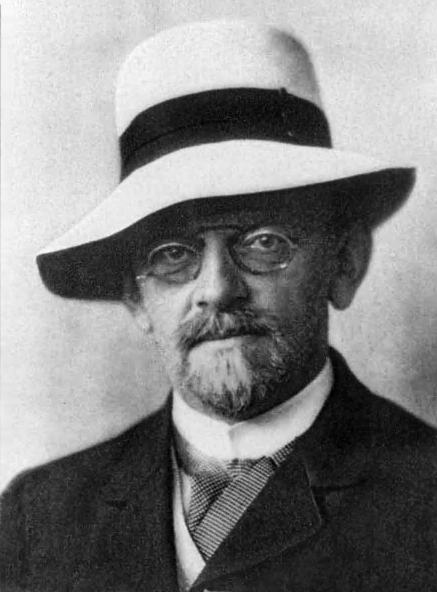
Hilbert Includes Riemann Hypothesis in His 23 Problems
David Hilbert lists the Riemann hypothesis as the eighth of his 23 unsolved problems, highlighting its central importance in mathematics. #numbertheory #riemann
Hilbert Includes Riemann Hypothesis in His 23 Problems By Unknown author - Possibly Reid, Constance (1970) Hilbert, Berlin, Heidelberg: Springer Berlin Heidelberg Imprint Springer, p. 230 ISBN: 978-3-662-27132-2., Public domain, https://commons.wikimedia.org/w/index.php?curid=36302
1907 CE
Montel Introduces Normal Families
Paul Montel introduces the concept of normal families of holomorphic functions, a key tool in function theory and complex dynamics. #complexanalysis #montel
1913 CE
Ramanujan's First Letter to Hardy
Srinivasa Ramanujan sends a letter to G. H. Hardy containing numerous formulas in complex analysis and special functions, including theta functions, stunning Hardy and initiating a famous collaboration. #specialfunctions #ramanujan
Ramanujan's First Letter to Hardy By Unknown author - https://mss-cat.trin.cam.ac.uk/manuscripts/uv/view.php?n=Add.Ms.a.94.7#?c=0&m=0&s=0&cv=6&xywh=-2849%2C-273%2C9238%2C5258, CC BY 4.0, https://commons.wikimedia.org/w/index.php?curid=153767257
1916 CE
Hardy–Ramanujan Circle Method
Hardy and Ramanujan develop the circle method to estimate the number of partitions of an integer, using complex analysis and modular forms. This method becomes influential in analytic number theory. #numbertheory #hardy
1920 CE
Nevanlinna Theory Developed
Rolf Nevanlinna creates the theory of meromorphic functions, introducing the Nevanlinna characteristic and defect relations, which generalize Picard's theorem. #complexanalysis #nevanlinna
1925 CE
Wiener's Tauberian Theorems
Norbert Wiener establishes Tauberian theorems using complex analysis and Fourier transforms, providing conditions under which certain averages converge. #complexanalysis #wiener
1930 CE
Carathéodory on Conformal Mapping
Constantin Carathéodory proves his theorem on conformal mapping of multiply connected domains to slit domains, extending Riemann's mapping theorem. #complexanalysis #caratheodory )
1934 CE
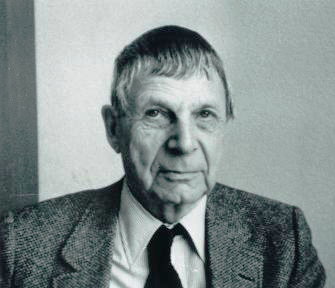
Ahlfors' Thesis on Riemann Surfaces
Lars Ahlfors publishes his doctoral thesis on Riemann surfaces, introducing the theory of covering surfaces and later winning the Fields Medal for his work. #complexanalysis #ahlfors
Ahlfors' Thesis on Riemann Surfaces By Konrad Jacobs, Erlangen - Mathematisches Institut Oberwolfach (MFO), https://opc.mfo.de/detail?photoID=20, CC BY-SA 2.0 de, https://commons.wikimedia.org/w/index.php?curid=3900645
1935 CE
Oka's Coherence Theorem
Kiyoshi Oka proves the coherence theorem for the sheaf of holomorphic functions, a fundamental result in several complex variables. #complexanalysis #oka
Oka's Coherence Theorem By Konrad Jacobs, Erlangen, Copyright is MFO - Mathematisches Forschungsinstitut Oberwolfach,https://opc.mfo.de/detail?photo_id=3147, CC BY-SA 2.0 de, https://commons.wikimedia.org/w/index.php?curid=12349202
1944 CE
Selberg's Trace Formula
Atle Selberg introduces the trace formula, a powerful tool connecting the spectral theory of Laplacians to the lengths of geodesics, with applications to Riemann surfaces and number theory. #complexanalysis #selberg