Classical Geometry & Axiomatic Deduction: From Nine Chapters to Euclid
Encyclopedia/1. The Cosmos & The Natural World/1. Mathematics & Formal Systems/01. Geometry & Spatial Systems • Curated by Admin Timeline.sg
The parallel evolution of spatial measurement and deductive proofs: Liu Hui's Pi enclosure algorithm, Gougu (Pythagorean) theorem, and Euclidean axiomatic geometry.
Chronological Storyline (37 Milestones)
1000 BCE
Zhoubi Suanjing Compiled
The Zhoubi Suanjing, an ancient Chinese astronomical and mathematical text, is compiled. It contains the earliest known proof of the Gougu theorem (Pythagorean theorem) and discusses right triangle geometry. #geometry #history
Zhoubi Suanjing Compiled By Unknown author, Public domain, https://commons.wikimedia.org/w/index.php?curid=104738
600 BCE
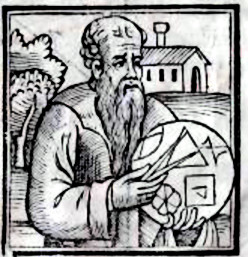
Thales Develops Early Geometry
Thales of Miletus introduces deductive reasoning to geometry, proving theorems such as that a circle is bisected by its diameter. He is considered one of the first to use logical deduction in mathematics. #geometry #philosophy
Thales Develops Early Geometry By Wilhelm Meyer - own scan, Public domain, https://commons.wikimedia.org/w/index.php?curid=11037570
530 BCE
Pythagorean School Founded
Pythagoras establishes a school in Croton, where his followers study mathematics and geometry, including the Pythagorean theorem and properties of numbers. The school contributes to the development of deductive geometry. #geometry #mathematics
Pythagorean School Founded By Unknown author - Photo by Szilas, 2013-03-04, Public domain, https://commons.wikimedia.org/w/index.php?curid=36520519
500 BCE
Indian Sulba Sutras Compose Geometry
The Sulba Sutras, part of Vedic literature, contain geometric rules for altar construction, including Pythagorean triples and approximations of square roots. They represent early Indian contributions to geometry. #geometry #history
400 BCE
Hippocrates of Chios Quadrature of Lunes
Hippocrates of Chios writes the first known geometry textbook, 'Elements', and works on the quadrature of lunes. He attempts to square the circle and contributes to the method of exhaustion. #geometry #mathematics
Hippocrates of Chios Quadrature of Lunes By No machine-readable author provided. Audriusa assumed (based on copyright claims). - No machine-readable source provided. Own work assumed (based on copyright claims)., CC BY-SA 3.0, https://commons.wikimedia.org/w/index.php?curid=478595
387 BCE
Plato's Academy Emphasizes Geometry
Plato founds the Academy in Athens, where geometry is considered essential for philosophical education. The motto 'Let no one ignorant of geometry enter' underscores its importance. #geometry #philosophy
350 BCE
Eudoxus Develops Method of Exhaustion
Eudoxus of Cnidus formalizes the method of exhaustion, a precursor to integral calculus, used to compute areas and volumes. His work influences Euclid and Archimedes. #geometry #mathematics
300 BCE
Euclid Writes 'Elements'
Euclid of Alexandria compiles 'Elements', a 13-book treatise that becomes the foundation of geometry. It introduces axiomatic method, definitions, postulates, and proofs, influencing mathematics for over two millennia. #geometry #mathematics
Euclid Writes 'Elements' By University of Pennsylvania Museum of Archaeology and Anthropology - https://openn.library.upenn.edu/Data/0016/html/e2748.html, CC BY-SA 4.0, https://commons.wikimedia.org/w/index.php?curid=169166171
250 BCE
Archimedes Computes Pi
Archimedes of Syracuse uses inscribed and circumscribed polygons to approximate pi, establishing bounds between 3.1408 and 3.1429. He also develops formulas for areas and volumes. #geometry #mathematics
Archimedes Computes Pi By Domenico Fetti - http://archimedes2.mpiwg-berlin.mpg.de/archimedes_templates/popup.htm, Public domain, https://commons.wikimedia.org/w/index.php?curid=146592
200 BCE
Apollonius Writes 'Conics'
Apollonius of Perga writes 'Conics', an eight-book work on conic sections (ellipse, parabola, hyperbola). He introduces terms like 'parabola' and 'hyperbola' and studies their properties. #geometry #mathematics
Apollonius Writes 'Conics' By Giovanni Battista Memo - File:ApolloniiPergeiOpera1537.jpg, Public domain, https://commons.wikimedia.org/w/index.php?curid=70830662
100 BCE
Liu Xin Revises Pi Value
Chinese mathematician Liu Xin calculates pi as 3.1547, one of the earliest Chinese approximations. His work contributes to the development of pi calculations in China. #geometry #history
100 CE
Heron of Alexandria Publishes 'Metrica'
Heron of Alexandria writes 'Metrica', a treatise on geometry and measurement. He derives Heron's formula for the area of a triangle and describes methods for geometric constructions. #geometry #mathematics
Heron of Alexandria Publishes 'Metrica' By Unknown author - Historia n° 767 - Novembre 2010 - page, Public domain, https://commons.wikimedia.org/w/index.php?curid=12080168
150 CE
Ptolemy Writes 'Almagest'
Claudius Ptolemy writes 'Almagest', which includes geometric models for planetary motion and a table of chords (trigonometry). His work synthesizes Greek geometric astronomy. #geometry #astronomy
Ptolemy Writes 'Almagest' By Ptolemy - http://www.univie.ac.at/hwastro/rare/1515_ptolemae.htm, Public domain, https://commons.wikimedia.org/w/index.php?curid=29985717
263 CE
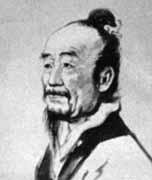
Liu Hui Comments on Nine Chapters
Liu Hui publishes a commentary on 'The Nine Chapters on the Mathematical Art', providing proofs for geometric formulas. He uses the method of exhaustion to calculate pi as 3.1416 and develops the Gougu theorem. #geometry #history
Liu Hui Comments on Nine Chapters By Unknown - "Liu Hui (220 - 280) - Biography - MacTutor History of Mathematics" https://mathshistory.st-andrews.ac.uk/Biographies/Liu_Hui/, CC BY-SA 4.0, https://commons.wikimedia.org/w/index.php?curid=130481910
300 CE
Pappus of Alexandria Writes 'Collection'
Pappus of Alexandria compiles 'Mathematical Collection', summarizing Greek geometry and including Pappus's theorem and the Pappus chain. His work preserves many lost treatises. #geometry #mathematics
Pappus of Alexandria Writes 'Collection' By Pappus Alexandrinus - https://www.christies.com/en/lot/lot-6069499, Public domain, https://commons.wikimedia.org/w/index.php?curid=132586197
400 CE
Theon of Alexandria Edits Euclid
Theon of Alexandria produces an edition of Euclid's 'Elements', which becomes the basis for many later translations. His daughter Hypatia also contributes to mathematical commentary. #geometry #history
500 CE
Aryabhata Computes Pi
Indian mathematician Aryabhata calculates pi as 3.1416 in his work 'Aryabhatiya', and provides rules for area and volume calculations. He also works on trigonometry and astronomy. #geometry #mathematics
Aryabhata Computes Pi By Cpjha13 - Own work, CC BY-SA 4.0, https://commons.wikimedia.org/w/index.php?curid=49883192
628 CE
Brahmagupta Writes 'Brahmasphutasiddhanta'
Brahmagupta writes a treatise on mathematics and astronomy, including formulas for cyclic quadrilaterals and the Brahmagupta theorem. He also gives rules for zero and negative numbers. #geometry #mathematics
820 CE
Al-Khwarizmi Writes 'Algebra'
Al-Khwarizmi writes 'The Compendious Book on Calculation by Completion and Balancing', which includes geometric methods for solving quadratic equations. His work introduces algebraic reasoning to geometry. #geometry #algebra
Al-Khwarizmi Writes 'Algebra' By Zarateman - Own work, CC0, https://commons.wikimedia.org/w/index.php?curid=162213187
833 CE
Al-Ma'mun's House of Wisdom Translates Greek Works
Caliph Al-Ma'mun establishes the House of Wisdom in Baghdad, where Greek mathematical texts, including Euclid's 'Elements', are translated into Arabic. This preserves and transmits Greek geometry to the Islamic world. #geometry #history
Al-Ma'mun's House of Wisdom Translates Greek Works By Zereshk - Own work, Public domain, https://commons.wikimedia.org/w/index.php?curid=2809505
900 CE
Thabit ibn Qurra Translates and Extends Geometry
Thabit ibn Qurra translates Greek works and writes on geometry, including the generalization of the Pythagorean theorem and work on amicable numbers. He also studies parabolas and volumes. #geometry #mathematics
1020 CE
Alhazen Writes on Optics and Geometry
Alhazen (Ibn al-Haytham) writes 'Book of Optics', using geometric methods to study light and vision. He also works on spherical geometry and the problem of Alhazen's problem. #geometry #optics
Alhazen Writes on Optics and Geometry By Adolph Boÿ, engraved by Jeremias Falck. Used as the frontispiece to Johannes Hevelius, Selenographia, 1647 - https://www.loc.gov/resource/rbctos.2017rosen1321/?sp=9&r=0.059,0.617,0.327,0.182,0, Public domain, https://commons.wikimedia.org/w/index.php?curid=165125519
1070 CE
Omar Khayyam Writes on Algebra and Geometry
Omar Khayyam writes 'Treatise on Demonstration of Problems of Algebra', classifying cubic equations and solving them using geometric methods involving conic sections. He also works on the parallel postulate. #geometry #algebra
Omar Khayyam Writes on Algebra and Geometry By Alireza Javaheri - https://web.archive.org/web/20161024154356/http://www.panoramio.com/photo/85093358, CC BY 3.0, https://commons.wikimedia.org/w/index.php?curid=55909539
1100 CE
Bhaskara II Writes 'Lilavati'
Bhaskara II writes 'Lilavati', a treatise on arithmetic and geometry, including problems on volumes, areas, and the Pythagorean theorem. He also gives a proof of the Pythagorean theorem by dissection. #geometry #mathematics
Bhaskara II Writes 'Lilavati' By Unknown author - Own work, Public domain, https://commons.wikimedia.org/w/index.php?curid=150275955
1202 CE
Fibonacci Publishes 'Liber Abaci'
Leonardo Fibonacci publishes 'Liber Abaci', introducing Hindu-Arabic numerals to Europe. The book includes geometric problems and the famous Fibonacci sequence, which appears in nature. #geometry #mathematics
Fibonacci Publishes 'Liber Abaci' By Unknown author, Public domain, https://commons.wikimedia.org/w/index.php?curid=720501
1247 CE
Qin Jiushao Publishes 'Mathematical Treatise in Nine Sections'
Chinese mathematician Qin Jiushao writes a treatise that includes methods for solving polynomial equations and geometric problems. He uses the Chinese remainder theorem and works on areas and volumes. #geometry #history
Qin Jiushao Publishes 'Mathematical Treatise in Nine Sections' By Qin Jiushao 秦九韶 - 1842 printing Shu Shu Jiu Zhang, Public domain, https://commons.wikimedia.org/w/index.php?curid=3414657
1260 CE
Nasir al-Din al-Tusi Writes on the Parallel Postulate
Nasir al-Din al-Tusi writes a treatise on the parallel postulate, attempting to prove it from other postulates. His work anticipates non-Euclidean geometry and influences later mathematicians. #geometry #mathematics
Nasir al-Din al-Tusi Writes on the Parallel Postulate By Unknown author - scan of stamp 30 May 2006, Public domain, https://commons.wikimedia.org/w/index.php?curid=829461
1303 CE
Zhu Shijie Publishes 'Jade Mirror of the Four Unknowns'
Zhu Shijie publishes a mathematical work that includes polynomial equations and geometric series. He uses the method of celestial element and solves problems in plane and solid geometry. #geometry #history
Zhu Shijie Publishes 'Jade Mirror of the Four Unknowns' By Zhu Shijie - mybook 唐戈藏书, Public domain, https://commons.wikimedia.org/w/index.php?curid=19268418
1427 CE
Al-Kashi Computes Pi to 16 Decimal Places
Persian mathematician Jamshid al-Kashi calculates pi to 16 decimal places using inscribed polygons, a record for the time. He also writes 'Key of Arithmetic', covering geometry and trigonometry. #geometry #mathematics
Al-Kashi Computes Pi to 16 Decimal Places By Christies.com - https://www.christies.com/lot/lot-6162908, Public domain, https://commons.wikimedia.org/w/index.php?curid=115212624
1482 CE
First Printed Edition of Euclid's Elements
Euclid's 'Elements' is first printed in Venice, translated from Arabic by Campanus of Novara. This makes the text widely available in Europe, spurring geometric study. #geometry #history
1525 CE
Albrecht Dürer Publishes 'Four Books on Measurement'
Albrecht Dürer publishes a treatise on geometry and perspective, including methods for constructing regular polygons and curves. His work bridges art and mathematics. #geometry #art
Albrecht Dürer Publishes 'Four Books on Measurement' By Albrecht Dürer - https://www.sammlung.pinakothek.de/de/artwork/Qlx2QpQ4Xq, Public domain, https://commons.wikimedia.org/w/index.php?curid=63803877
1543 CE
Copernicus Publishes 'De Revolutionibus'
Nicolaus Copernicus publishes his heliocentric model, which relies on geometric reasoning and circular orbits. His work uses Euclidean geometry to describe planetary motion. #geometry #astronomy
Copernicus Publishes 'De Revolutionibus' By derivative work of Johannes Petreius 1543 edition of File:Nicolai_Copernici_torinensis_De_revolutionibus_orbium_coelestium.djvu - File:Nicolai_Copernici_torinensis_De_revolutionibus_orbium_coelestium.djvu, Public domain, https://commons.wikimedia.org/w/index.php?curid=5611684
1557 CE
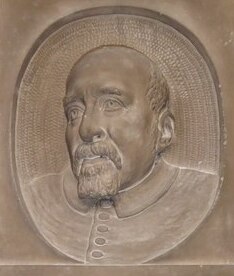
Robert Recorde Publishes 'The Whetstone of Witte'
Robert Recorde publishes an algebra book that introduces the equals sign (=) and includes geometric problems. He also writes on arithmetic and geometry in English. #geometry #mathematics
Robert Recorde Publishes 'The Whetstone of Witte' By Basher Eyre - This file was derived from: St Mary, Tenby- memorial (13) (geograph 6264760).jpg, CC BY-SA 2.0, https://commons.wikimedia.org/w/index.php?curid=124709772
1570 CE
First English Translation of Euclid's Elements
Henry Billingsley publishes the first English translation of Euclid's 'Elements', with a preface by John Dee. This makes Euclidean geometry accessible to English readers. #geometry #history
1585 CE
Simon Stevin Publishes 'The Tenth'
Simon Stevin publishes 'De Thiende' (The Tenth), introducing decimal fractions and their use in geometry and measurement. He also works on statics and hydrostatics. #geometry #mathematics
Simon Stevin Publishes 'The Tenth' By Unknown author - Digitool Leiden University Library, http://digitalcollections.universiteitleiden.nl, Public domain, https://commons.wikimedia.org/w/index.php?curid=72690
1591 CE
François Viète Publishes 'In Artem Analyticem Isagoge'
François Viète publishes his work on symbolic algebra, introducing letters for unknowns and constants. He applies algebra to geometry, solving geometric problems analytically. #geometry #algebra
François Viète Publishes 'In Artem Analyticem Isagoge' By Unknown author, Public domain, https://commons.wikimedia.org/w/index.php?curid=81021
1600 CE
Galileo Studies Motion Geometrically
Galileo Galilei uses geometric methods to study the motion of falling bodies and projectiles. His work 'Two New Sciences' lays the foundation for kinematics and mathematical physics. #geometry #physics
Galileo Studies Motion Geometrically By Justus Sustermans - http://collections.rmg.co.uk/collections/objects/14174, Public domain, https://commons.wikimedia.org/w/index.php?curid=62614082