Classical Antiquity: Athenian Democracy, Alexander's Empire & Roman Republic to Empire
Encyclopedia/3. History, Societies & Civilizations/04. European Civilizations & Empires/01. Classical Antiquity • Curated by Admin Timeline.sg
Classical Antiquity spans from the rise of Athenian democracy and the Persian Wars through Alexander the Great's conquests to the Roman Republic's expansion and the establishment of the Roman Empire, ending with the fall of the Western Roman Empire in 476 CE. This period laid the foundations for Western civilization in politics, philosophy, law, and military strategy.
Chronological Storyline (44 Milestones)
594 BCE
Solon's Reforms in Athens
Solon, an Athenian statesman, introduces groundbreaking economic and political reforms abolishing debt slavery and establishing a more equitable legal code. These measures lay the groundwork for Athenian democracy. #history #politics
Solon's Reforms in Athens By Sailko - Own work, CC BY-SA 3.0, https://commons.wikimedia.org/w/index.php?curid=30945032
509 BCE
Founding of the Roman Republic
Following the overthrow of the Roman monarchy, the Roman Republic is established with a system of checks and balances including consuls, a Senate, and popular assemblies. This constitutional framework would influence governance for centuries. #history #politics
Founding of the Roman Republic By Ifly6 - Own work, CC BY-SA 4.0, https://commons.wikimedia.org/w/index.php?curid=155519121
508 BCE
Cleisthenes' Democratic Reforms
Cleisthenes, an Athenian noble, implements radical reforms that reorganize Athenian society into demes and tribes, creating the foundations of direct democracy. The reforms include ostracism and the Council of 500. #history #politics
Cleisthenes' Democratic Reforms By Unknown author - http://www.ohiostatehouse.org/Multimedia/MediaLibrary/Media.aspx?fileId=117260, Attribution, https://commons.wikimedia.org/w/index.php?curid=6207775
Sep 12, 490 BCE
Battle of Marathon
The Athenian army, supported by Plataea, decisively defeats the first Persian invasion of Greece at Marathon. The victory preserves Greek independence and becomes a symbol of defensive courage. #history #war
Battle of Marathon By John Steeple Davis - The story of the greatest nations, from the dawn of history to the twentieth century (published in 1900), Public domain, https://commons.wikimedia.org/w/index.php?curid=75078967
Aug 1, 480 BCE
Battle of Thermopylae and Salamis
A small Greek force led by King Leonidas of Sparta holds the Persian army at Thermopylae, while the Greek navy wins a decisive victory at Salamis. These battles turn the tide of the Greco-Persian Wars. #history #war
Battle of Thermopylae and Salamis By Jacques-Louis David - photo Shonagon 2025-03-15, Public domain, https://commons.wikimedia.org/w/index.php?curid=162618408
Aug 27, 479 BCE
Battle of Plataea
The Greek alliance, led by Sparta and Athens, defeats the Persian army at Plataea, ending the second Persian invasion of Greece. This victory secures Greek independence and marks the decline of Persian power in the Aegean. #history #war
Battle of Plataea By John Steeple Davis - The story of the greatest nations, from the dawn of history to the twentieth century (published in 1900), Public domain, https://commons.wikimedia.org/w/index.php?curid=75079155
461 BCE
Pericles Comes to Power in Athens
Pericles becomes the leading statesman of Athens, ushering in the Golden Age. He promotes democracy, the arts, and the construction of the Parthenon, and strengthens Athenian imperialism. #history #politics
Pericles Comes to Power in Athens By Copy of Kresilas - Jastrow (2006), Public domain, https://commons.wikimedia.org/w/index.php?curid=1307557
431 BCE
Peloponnesian War Begins
The Peloponnesian War between Athens and Sparta erupts, eventually drawing in most of the Greek world. The conflict ends Spartan dominance and weakens Greek city-states, paving the way for Macedonian conquest. #history #war
Peloponnesian War Begins By Translator was Kenmayer - File:Pelop_krieg1.png, originally uploaded to German wikipedia by user Captain Blood, CC BY-SA 3.0, https://commons.wikimedia.org/w/index.php?curid=29073582
Apr 25, 404 BCE
Fall of Athens to Sparta
After a long siege, Athens surrenders to Sparta, ending the Peloponnesian War. The Athenian Empire is dismantled, and Sparta installs a brief oligarchic regime (the Thirty Tyrants). #history #war
399 BCE
Trial and Execution of Socrates
Socrates is tried and executed by the Athenian democracy on charges of impiety and corrupting the youth. His death becomes a pivotal event in Western philosophy, influencing Plato and later thinkers. #philosophy #history
Trial and Execution of Socrates By Copy of Lysippos (?) - Eric Gaba (User:Sting), July 2005., Public domain, https://commons.wikimedia.org/w/index.php?curid=3569936
Aug 2, 338 BCE
Battle of Chaeronea
Philip II of Macedon defeats the combined forces of Athens and Thebes, establishing Macedonian hegemony over Greece. This victory sets the stage for Alexander the Great's later conquests. #history #war )
Battle of Chaeronea By Battle_of_Chaeronea,_338_BC.gif: Kirill Lokshin derivative work: Dipa_1965 (talk) - Battle_of_Chaeronea,_338_BC.gif, Public domain, https://commons.wikimedia.org/w/index.php?curid=10623284
Jul 1, 336 BCE
Alexander the Great Becomes King
After Philip II's assassination, his son Alexander III ascends to the throne of Macedon. He quickly consolidates power and begins planning the invasion of the Persian Empire. #history
Alexander the Great Becomes King By Unknown author - This image has been extracted from another file, Public domain, https://commons.wikimedia.org/w/index.php?curid=182741814
May 1, 334 BCE
Alexander Invades Persian Empire
Alexander crosses the Hellespont into Asia Minor, beginning his campaign against the Persian Empire. He wins the Battle of Granicus, opening the way for further conquest. #history #war
Oct 1, 331 BCE
Battle of Gaugamela
Alexander decisively defeats the Persian King Darius III at Gaugamela, leading to the fall of the Achaemenid Empire. This victory solidifies Alexander's control over Persia and continues his march eastward. #history #war
Battle of Gaugamela By Pietro da Cortona - Google Arts & Culture — TAFxS-oMiYzUyA, Public domain, https://commons.wikimedia.org/w/index.php?curid=22006940
Jun 10, 323 BCE
Death of Alexander the Great
Alexander dies in Babylon at age 32, possibly from fever or poison. His death triggers the division of his empire among his generals (the Diadochi), leading to the Hellenistic period. #history
Aug 1, 322 BCE
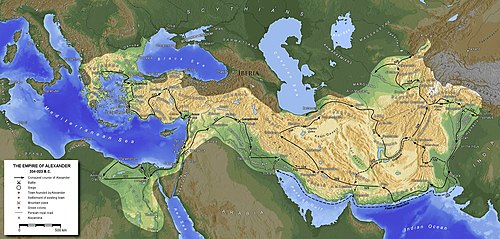
Lamian War and Greek Resistance
Greek city-states rebel against Macedonian rule after Alexander's death but are defeated by Antipater. This marks the end of Greek independence and the beginning of Hellenistic kingdoms. #history #war
Lamian War and Greek Resistance By Generic Mapping Tools - Own work, CC BY-SA 3.0, https://commons.wikimedia.org/w/index.php?curid=656066
264 BCE
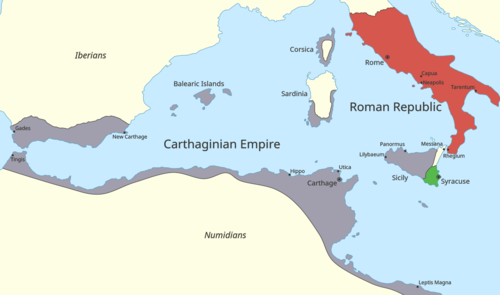
First Punic War Begins
Rome and Carthage go to war over control of Sicily. The conflict lasts over 20 years and establishes Rome as the dominant naval power in the Mediterranean. #history #war
First Punic War Begins By Harrias - This file was derived from: First Punic War 264 BC v2.png Changes: Adjusted Carthaginian territory in Corsica and Sardinia. Information from: Muir, Ramsay; Treharne R. F.; Fullard, Harold (1969). Muir's Historical Atlas. London: George Philip and Son. OCLC 1090019533 p. 11, map B., CC BY-SA 4.0, https://commons.wikimedia.org/w/index.php?curid=93911131
Mar 10, 241 BCE
First Punic War Ends
Carthage sues for peace after Rome's naval victory at the Aegates Islands. Rome gains Sicily, its first province outside Italy. #history #war
May 1, 218 BCE
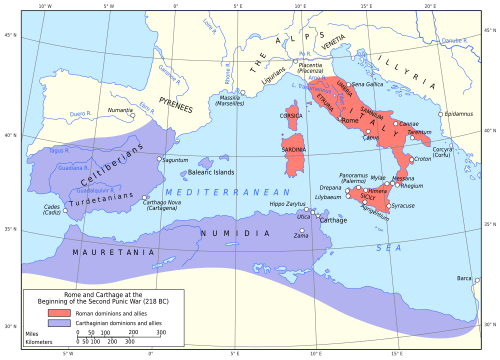
Second Punic War Begins: Hannibal Crosses Alps
Hannibal Barca leads his Carthaginian army, including war elephants, across the Alps into Italy, surprising the Romans. This begins one of the most famous military campaigns in history. #history #war
Second Punic War Begins: Hannibal Crosses Alps By William Robert Shepherd - This file was derived from: Rome carthage 218.jpg: Shepherd, William R. (1923) "Rome and Carthage at the Beginning of the Second Punic War, 218 B.C." in Historical Atlas, Category:New York: Henry Holt and Company, p. 32 OCLC: 1980660., CC BY-SA 3.0, https://commons.wikimedia.org/w/index.php?curid=19256993
Aug 2, 216 BCE
Battle of Cannae
Hannibal achieves a devastating encirclement and destroys a massive Roman army at Cannae. This tactical masterpiece remains a study in military strategy. #history #war
Battle of Cannae By John Trumbull - Yale University Art Gallery - The Death of Paulus Aemilius at the Battle of Cannae, Public domain, https://commons.wikimedia.org/w/index.php?curid=40826676
Oct 19, 202 BCE
Battle of Zama
Scipio Africanus defeats Hannibal in North Africa, ending the Second Punic War. Rome gains hegemony over the western Mediterranean and Carthage becomes a client state. #history #war
149 BCE
Third Punic War Begins
Rome declares war on Carthage under pretext of a violation, leading to a brutal siege. The war ends with the complete destruction of Carthage. #history #war
Third Punic War Begins By Harrias - Own work, loosely based on Goldsworthy, Adrian (2006). The Fall of Carthage: The Punic Wars 265–146 BC. London: Phoenix. ISBN 978-0-304-36642-2, p. 342; and Miles, Richard (2011). Carthage Must be Destroyed. London: Penguin. ISBN 978-0-141-01809-6, p. 2., CC BY-SA 4.0, https://commons.wikimedia.org/w/index.php?curid=95555913
146 BCE
Destruction of Carthage and Corinth
Rome destroys Carthage (Third Punic War) and sacks Corinth, bringing Greece under direct Roman control. This marks the end of Carthaginian independence and the Greek city-state era. #history #war
Dec 1, 133 BCE
Tiberius Gracchus Assassinated
Tiberius Gracchus, a Roman tribune, is murdered by senators after proposing land reforms to help the poor. His death marks the beginning of the Roman Republic's internal strife. #history #politics
Tiberius Gracchus Assassinated By Jean-Baptiste Claude Eugène Guillaume - https://archive.org/stream/appreciationofsc00sturuoft#page/146/mode/2up, Public domain, https://commons.wikimedia.org/w/index.php?curid=128512744
107 BCE
Marius' Reforms of the Roman Army
Gaius Marius, as consul, recruits landless citizens into the army, creating professional legions loyal to their commanders. This reform enhances military efficiency but sows seeds for later civil wars. #history #military
Marius' Reforms of the Roman Army By American Numismatic Society - http://numismatics.org/collection/1937.158.51, Public domain, https://commons.wikimedia.org/w/index.php?curid=139220239
91 BCE
Social War
Rome's Italian allies (socii) revolt over citizenship rights. The war ends with Rome granting citizenship to all Italians, unifying the Italian peninsula under Roman rule. #history #war )
Social War By Ifly6 - Own work, CC BY-SA 4.0, https://commons.wikimedia.org/w/index.php?curid=129634104
Nov 1, 82 BCE
Sulla's Dictatorship
Lucius Cornelius Sulla marches on Rome and is appointed dictator, using proscriptions to eliminate enemies. His reign sets a precedent for military strongmen seizing power. #history #politics
Sulla's Dictatorship By CNG - https://www.cngcoins.com/Coin.aspx?CoinID=310030, CC BY-SA 2.5, https://commons.wikimedia.org/w/index.php?curid=80631904
73 BCE
Spartacus Revolt Begins
A slave revolt led by Spartacus, a gladiator, grows into an army of thousands. The rebellion is crushed by Crassus, but it highlights the instability of Roman society. #history #war
Spartacus Revolt Begins By Carole Raddato from FRANKFURT, Germany - Spartacus, marble sculpture of Denis Foyatier (1830), Louvre Museum Uploaded by Marcus Cyron, CC BY-SA 2.0, https://commons.wikimedia.org/w/index.php?curid=74238062
60 BCE
First Triumvirate Formed
Julius Caesar, Pompey the Great, and Marcus Crassus form an informal political alliance to dominate Roman politics. This pact leads to Caesar's later ascent and the fall of the Republic. #history #politics
First Triumvirate Formed By Gautier Poupeau from Paris, France - César, CC BY 2.0, https://commons.wikimedia.org/w/index.php?curid=35036729
Jan 10, 49 BCE
Caesar Crosses the Rubicon
Julius Caesar leads his army across the Rubicon River into Italy, defying the Senate's order. This act sparks a civil war that ends the Roman Republic and leads to Caesar's dictatorship. #history #war
Caesar Crosses the Rubicon By Jacob Abbott - http://gutenberg.net.au/ebooks14/1400491h.html#pic5, Public domain, https://commons.wikimedia.org/w/index.php?curid=46276962
Mar 15, 44 BCE
Assassination of Julius Caesar
A group of senators led by Brutus and Cassius assassinates Julius Caesar on the Ides of March. His death triggers another civil war and the eventual rise of his adopted heir Octavian. #history #politics
Assassination of Julius Caesar By Vincenzo Camuccini - Own work, user:Rlbberlin, Public domain, https://commons.wikimedia.org/w/index.php?curid=145037989
Nov 27, 43 BCE
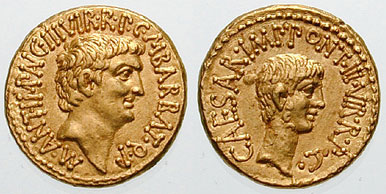
Second Triumvirate Formed
Octavian, Mark Antony, and Lepidus form a legal triumvirate to avenge Caesar and govern Rome. They institute proscriptions and defeat Caesar's assassins at Philippi. #history #politics
Second Triumvirate Formed By You may select the license of your choice. - http://www.cngcoins.com/Coin.aspx?CoinID=16529, Public domain, https://commons.wikimedia.org/w/index.php?curid=2616104
Sep 2, 31 BCE
Battle of Actium
Octavian's fleet defeats the combined forces of Mark Antony and Cleopatra of Egypt. This victory ends the civil wars and makes Octavian the undisputed master of the Roman world. #history #war
Battle of Actium By Mark Landon - Own work, CC BY 4.0, https://commons.wikimedia.org/w/index.php?curid=125313661
Jan 16, 27 BCE
Octavian Becomes Augustus
The Roman Senate grants Octavian the title 'Augustus', marking the official end of the Roman Republic and the beginning of the Roman Empire. Augustus establishes the principate and initiates the Pax Romana. #history #politics
Octavian Becomes Augustus By Justin Benttinen - Own work, CC BY-SA 4.0, https://commons.wikimedia.org/w/index.php?curid=164710011
Aug 19, 14 CE
Death of Augustus
Augustus dies, leaving a stable empire and a system of succession. He is deified, and his stepson Tiberius succeeds him, continuing the Julio-Claudian dynasty. #history
Jul 18, 64 CE
Great Fire of Rome
A massive fire devastates Rome for six days, destroying much of the city. Emperor Nero, suspected of starting the fire, blames and persecutes Christians, leading to early martyrdoms. #history #disaster
Great Fire of Rome By Hubert Robert - http://www.kunst-fuer-alle.de/index.php?mid=77&lid=1&blink=76&stext=caesar&cmstitle=Bilder,-Kunstdrucke,-Poster:-Caesar&start=80, Public domain, https://commons.wikimedia.org/w/index.php?curid=6606073
Aug 24, 79 CE
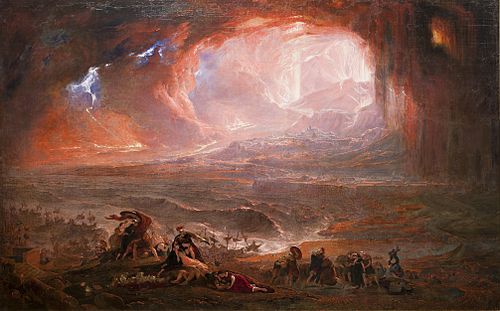
Eruption of Mount Vesuvius
Mount Vesuvius erupts, burying the cities of Pompeii and Herculaneum under ash and pumice. The disaster preserves remarkable Roman artifacts, offering insights into daily life. #history #disaster
Eruption of Mount Vesuvius By John Martin - http://greatbritishartdebate.tate.org.uk/the-reconstruction-of-pompeii-and-herculaneum/, Public domain, https://commons.wikimedia.org/w/index.php?curid=16665041
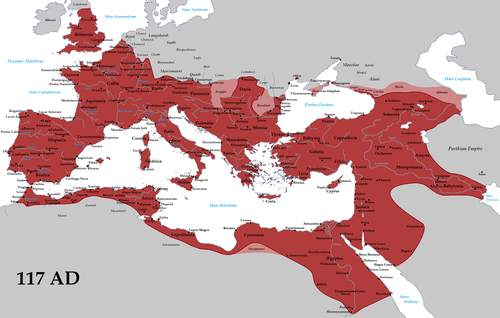
117 CE
Roman Empire at Its Greatest Extent
Under Emperor Trajan's death, the Roman Empire reaches its maximum territorial extent, spanning from Britain to Mesopotamia. This period marks the height of Roman power and influence. #history #empire
Roman Empire at Its Greatest Extent By Tataryn - Own work, CC BY-SA 3.0, https://commons.wikimedia.org/w/index.php?curid=19625326
Nov 20, 284 CE
Diocletian Becomes Emperor
Diocletian ends the Crisis of the Third Century, reorganizing the empire into the Tetrarchy and implementing economic reforms. His reign stabilizes Rome but divides it into Eastern and Western halves. #history #politics
Diocletian Becomes Emperor By Dosseman - Own work, CC BY-SA 4.0, https://commons.wikimedia.org/w/index.php?curid=187730312
Oct 28, 312 CE
Battle of Milvian Bridge
Constantine the Great defeats Maxentius at the Milvian Bridge, attributing his victory to the Christian God. This leads to the Edict of Milan (313) granting religious tolerance to Christians. #history #religion
Battle of Milvian Bridge By Giulio Romano - Vatican City, Apostolic Palace, Public domain, https://commons.wikimedia.org/w/index.php?curid=12369258
May 11, 330 CE
Constantinople Founded
Constantine dedicates the new imperial capital, Constantinople, on the site of ancient Byzantium. The city becomes the center of the Eastern Roman Empire for over a millennium. #history
Constantinople Founded By Cplakidas - Own work using: Main map source: R. Janin, Constantinople Byzantine. Developpement urbain et repertoire topographique Road network and some other details based on Dumbarton Oaks Papers 54 Data on many churches, especially unidentified ones, taken from the New York University's The Byzantine Churches of Istanbul project Other published maps and accounts of the city have been used for corroboration., CC BY-SA 3.0, https://commons.wikimedia.org/w/index.php?curid=5084599
Jan 17, 395 CE
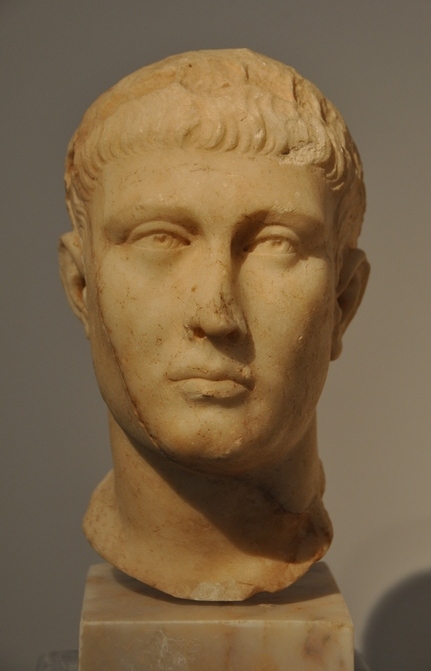
Division of the Roman Empire
Upon the death of Theodosius I, the Roman Empire is permanently divided between his sons: Arcadius (East) and Honorius (West). This division accelerates the decline of the Western Empire. #history
Division of the Roman Empire By www.livius.org - https://www.livius.org/pictures/turkey/aphrodisias/aphrodisias-museum-pieces/theodosius-i-or-ii/, CC BY-SA 4.0, https://commons.wikimedia.org/w/index.php?curid=92452046
Aug 24, 410 CE
Visigoths Sack Rome
Alaric and the Visigoths sack Rome for three days, the first time the city had fallen to a foreign enemy in over 800 years. The event shocks the Roman world and symbolizes the decline of the Western Empire. #history #war )
Visigoths Sack Rome By Joseph-Noël Sylvestre - Das Königreich der Vandalen, ed. Klaus Hattler (Mainz: Philipp von Zabern, 2009), p. 418. scan and upload: James Steakley, Public domain, https://commons.wikimedia.org/w/index.php?curid=10604542
Sep 4, 476 CE
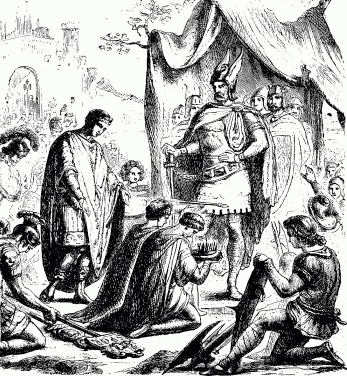
Fall of the Western Roman Empire
The Germanic chieftain Odoacer deposes the last Western Roman Emperor, Romulus Augustulus, and sends the imperial regalia to Constantinople. This event traditionally marks the end of classical antiquity. #history
Fall of the Western Roman Empire By Yonge, Charlotte Mary, (1823-1901) - Project Gutenberg's Young Folks' History of Rome, by Charlotte Mary Yonge [1], Public domain, https://commons.wikimedia.org/w/index.php?curid=1407173