Chemistry Revolution: From Chinese Alchemy to Mendeleev & Quantum Chemistry
Encyclopedia/1. The Cosmos & The Natural World/2. Physics & Chemistry/03. Chemistry & Periodic Table of Elements • Curated by Admin Timeline.sg
The history of chemistry spans from ancient Chinese alchemy to modern quantum chemistry, marked by key milestones such as Lavoisier's oxygen theory, Mendeleev's periodic table, and the development of synthetic polymers.
Chronological Storyline (49 Milestones)
500 BCE
Chinese Alchemy and Wu Xing Theory
Ancient Chinese alchemists develop the Wu Xing (Five Elements) theory to explain natural phenomena, laying the groundwork for early chemical practices. They seek elixirs of immortality and attempt transmutation of base metals into gold. #alchemy #history #chemistry
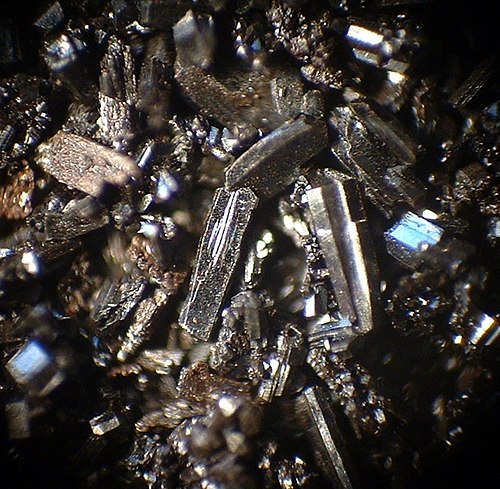
Chinese Alchemy and Wu Xing Theory By Géry Parent - collection perso., Copyrighted free use, https://commons.wikimedia.org/w/index.php?curid=2962532
400 BCE
Democritus Proposes Atomism
Greek philosopher Democritus proposes that all matter is composed of indivisible particles called atoms. This early atomic theory, though philosophical, influences later chemical thought. #atomism #philosophy #chemistry
Democritus Proposes Atomism By user:shakko - Own work, CC BY-SA 3.0, https://commons.wikimedia.org/w/index.php?curid=5535206
300 BCE
Aristotle's Four Elements
Aristotle proposes that all matter consists of four elements: earth, air, fire, and water. This theory dominates Western science for nearly two millennia, hindering chemical progress. #elements #philosophy #chemistry
Aristotle's Four Elements By After Lysippos - Jastrow (2006), Public domain, https://commons.wikimedia.org/w/index.php?curid=1359807
300 CE
Zosimos of Panopolis and Alchemy
Zosimos, a Greco-Egyptian alchemist, writes some of the earliest known alchemical texts, describing chemical apparatus and processes. His work influences both Islamic and European alchemy. #alchemy #history #chemistry
Zosimos of Panopolis and Alchemy By Rvalette - Own work, CC BY-SA 4.0, https://commons.wikimedia.org/w/index.php?curid=35562978
800 CE
Jabir ibn Hayyan (Geber) Pioneers Chemistry
Islamic alchemist Jabir ibn Hayyan develops experimental chemistry, including distillation, crystallization, and the discovery of acids like sulfuric and nitric. His works become foundational for later European chemists. #alchemy #chemistry #science
Jabir ibn Hayyan (Geber) Pioneers Chemistry By Unknown author - https://cdn.britannica.com/10/132710-050-CECF006B/illustration-manuscript-Abu-Musa-Jabir-ibn-Hayyan.jpg, Public domain, https://commons.wikimedia.org/w/index.php?curid=166835469
1250 CE
Albertus Magnus Describes Arsenic
Albertus Magnus, a German scholar, provides one of the first European descriptions of arsenic, a key element. He also writes on alchemy and mineralogy, bridging ancient and medieval knowledge. #alchemy #chemistry #elements
Albertus Magnus Describes Arsenic By Vicente Salvador Gómez - [2], Public domain, https://commons.wikimedia.org/w/index.php?curid=8528799
1520 CE
Paracelsus Rejects Alchemy for Iatrochemistry
Paracelsus pioneers iatrochemistry, using chemical remedies in medicine. He rejects traditional alchemy's focus on gold-making, emphasizing the use of minerals and chemicals for healing. #chemistry #medicine #history
Paracelsus Rejects Alchemy for Iatrochemistry By Unknown author - https://wellcomeimages.org/indexplus/obf_images/30/44/56ec07dc7139fa8474a939e67261.jpg Gallery: https://wellcomeimages.org/indexplus/image/V0004455.html Wellcome Collection gallery (2018-03-23): https://wellcomecollection.org/works/x7zn552n CC-BY-4.0, CC BY 4.0, https://commons.wikimedia.org/w/index.php?curid=36412798
1661 CE
Robert Boyle Publishes The Sceptical Chymist
Boyle defines elements as irreducible substances and argues for experimental chemistry over alchemical theory. His work lays the foundation for modern chemistry and the concept of chemical elements. #chemistry #science #history
Robert Boyle Publishes The Sceptical Chymist By Johann Kerseboom - https://digital.sciencehistory.org/works/3r074v879, Public domain, https://commons.wikimedia.org/w/index.php?curid=27091904
1669 CE
Hennig Brand Discovers Phosphorus
German alchemist Hennig Brand accidentally discovers phosphorus while trying to create the philosopher's stone. It is the first element to be discovered since antiquity, marking a milestone in chemical discovery. #chemistry #discovery #elements
Hennig Brand Discovers Phosphorus By Joseph Wright of Derby - http://www.tms.org/pubs/journals/JOM/0706/fig3.jpg http://www.culturevoyage.co.uk/wp-content/uploads/2013/03/Alchymist.jpg, Public domain, https://commons.wikimedia.org/w/index.php?curid=15154197
1735 CE
Georg Brandt Discovers Cobalt
Swedish chemist Georg Brandt isolates cobalt, the first metal discovered since prehistory. He demonstrates it is a new element, distinct from other metals, advancing the understanding of elements. #chemistry #elements #discovery
1754 CE
Joseph Black Discovers Carbon Dioxide
Scottish chemist Joseph Black identifies carbon dioxide (fixed air) as a distinct gas. His work on gases and heat leads to the concept of latent heat and advances pneumatic chemistry. #chemistry #gases #discovery
Joseph Black Discovers Carbon Dioxide By Rogers, J - http://ihm.nlm.nih.gov/images/B02979, Public domain, https://commons.wikimedia.org/w/index.php?curid=19132802
1774 CE
Joseph Priestley Discovers Oxygen
Priestley isolates oxygen gas by heating mercuric oxide. He calls it 'dephlogisticated air' and later shares his findings with Lavoisier, who correctly interprets its role in combustion. #chemistry #oxygen #discovery
Joseph Priestley Discovers Oxygen By James Sharples - https://npg.si.edu/object/npg_NPG.77.160?destination=node/63231%3Fedan_local%3D1%26edan_q%3DJoseph, Public domain, https://commons.wikimedia.org/w/index.php?curid=193629762
1777 CE
Antoine Lavoisier Publishes Reflexions sur le Phlogistique
Lavoisier disproves the phlogiston theory by showing that combustion involves oxygen. He establishes the law of conservation of mass, revolutionizing chemistry and earning the title 'Father of Modern Chemistry'. #chemistry #revolution #science
Antoine Lavoisier Publishes Reflexions sur le Phlogistique By Jacques-Louis David - Metropolitan Museum of Art: entry 436106 (accession number: 1977.10), Public domain, https://commons.wikimedia.org/w/index.php?curid=141652400
1789 CE
Lavoisier Publishes Traité Élémentaire de Chimie
Lavoisier's textbook lists 33 elements and introduces a new chemical nomenclature. It becomes the definitive chemistry text, establishing the modern system of naming chemicals. #chemistry #textbook #elements
Lavoisier Publishes Traité Élémentaire de Chimie By Lavoisier, Antoine-Laurent de - https://libserv.aip.org/ipac20/ipac.jsp?session=1C68700M5Q428.396962&profile=rev-all&source=~!horizon&view=subscriptionsummary&uri=full=3100006~!44241~!3&ri=17&aspect=power&menu=search&ipp=20&spp=20&staffonly=&term=Trait%C3%A9+%C3%A9l%C3%A9mentaire+de+Chimie&index=.GW&uindex=&aspect=power&menu=search&ri=17, Public domain, https://commons.wikimedia.org/w/index.php?curid=125621155
1800 CE
Alessandro Volta Invents the Voltaic Pile
Volta creates the first electric battery, enabling electrolysis. This invention allows chemists to decompose compounds into elements, leading to the discovery of new elements like sodium and potassium. #chemistry #electricity #invention
Alessandro Volta Invents the Voltaic Pile By Borbrav, svg version by Luigi Chiesa - Image:Voltaic pile.png, CC BY-SA 3.0, https://commons.wikimedia.org/w/index.php?curid=5091724
1803 CE
John Dalton Proposes Atomic Theory
Dalton's atomic theory states that elements consist of atoms with specific weights, and compounds form by combining atoms. This provides a quantitative framework for chemistry and explains chemical reactions. #chemistry #atomic #theory
John Dalton Proposes Atomic Theory By Thomas Phillips - National Portrait Gallery, London, Public domain, https://commons.wikimedia.org/w/index.php?curid=11727058
1807 CE
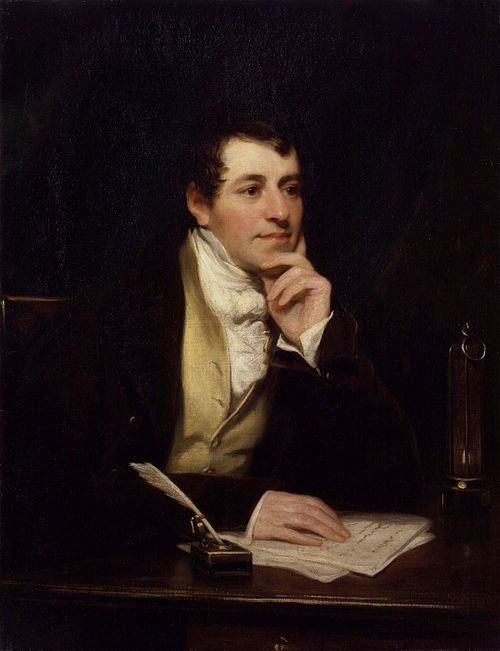
Humphry Davy Discovers Sodium and Potassium
Using electrolysis, Davy isolates sodium and potassium from their compounds. He discovers several alkali and alkaline earth metals, expanding the list of known elements and demonstrating the power of electrolysis. #chemistry #elements #discovery
Humphry Davy Discovers Sodium and Potassium By Thomas Phillips - one or more third parties have made copyright claims against Wikimedia Commons in relation to the work from which this is sourced or a purely mechanical reproduction thereof. This may be due to recognition of the "sweat of the brow" doctrine, allowing works to be eligible for protection through skill and labour, and not purely by originality as is the case in the United States (where this website is hosted). These claims may or may not be valid in all jurisdictions. As such, use of this image in the jurisdiction of the claimant or other countries may be regarded as copyright infringement. Please see Commons:When to use the PD-Art tag for more information., Public domain, https://commons.wikimedia.org/w/index.php?curid=6364758
1811 CE
Amedeo Avogadro Proposes Molecular Hypothesis
Avogadro hypothesizes that equal volumes of gases at the same temperature and pressure contain the same number of molecules. His work distinguishes atoms from molecules, but is not widely accepted until later. #chemistry #molecules #theory
Amedeo Avogadro Proposes Molecular Hypothesis By The original uploader was Anton at German Wikipedia. - Transferred from de.wikipedia to Commons by Septembermorgen using CommonsHelper., Public domain, https://commons.wikimedia.org/w/index.php?curid=8947961
1828 CE
Friedrich Wöhler Synthesizes Urea
Wöhler accidentally synthesizes urea from inorganic ammonium cyanate, disproving vitalism. This landmark event shows that organic compounds can be made from inorganic substances, founding organic chemistry. #chemistry #organic #synthesis
Friedrich Wöhler Synthesizes Urea By Rudolph Hoffmann - Eigenes Foto einer Originallithographie der ÖNB (Wien), Public domain, https://commons.wikimedia.org/w/index.php?curid=16652576
1834 CE
Michael Faraday Discovers Electrochemical Laws
Faraday formulates the laws of electrolysis, relating the amount of substance deposited to electric charge. His work establishes electrochemistry as a quantitative science and introduces terms like electrode and ion. #chemistry #electrochemistry #laws
Michael Faraday Discovers Electrochemical Laws By Unknown author - [1], Public domain, https://commons.wikimedia.org/w/index.php?curid=141504840
1856 CE
William Henry Perkin Discovers Mauveine
Perkin accidentally synthesizes the first synthetic dye, mauveine, while trying to make quinine. This discovery launches the synthetic dye industry and spurs the development of organic chemistry. #chemistry #dye #industry
William Henry Perkin Discovers Mauveine By Unknown author - English Wikipedia. - Scanned photograph from F. J. Moore's book, A History of Chemistry (1918). - Popular Science Monthly Volume 69, Public domain, https://commons.wikimedia.org/w/index.php?curid=6343060
1860 CE
Karlsruhe Congress Standardizes Atomic Weights
The first international chemistry congress resolves confusion over atomic weights and valences. Stanislao Cannizzaro presents Avogadro's hypothesis, leading to a unified system of atomic weights. #chemistry #history #standards
Karlsruhe Congress Standardizes Atomic Weights By A. Kekulé - Lehrbuch der Organischen Chemie, Public domain, https://commons.wikimedia.org/w/index.php?curid=2648205
1865 CE
August Kekulé Proposes Benzene Ring Structure
Kekulé deduces the cyclic structure of benzene after a dream of a snake biting its tail. This breakthrough explains aromatic compounds and advances structural organic chemistry. #chemistry #organic #structure
August Kekulé Proposes Benzene Ring Structure By Unknown author - https://www.gettyimages.ie/detail/news-photo/german-organic-chemist-friedrich-august-kekule-von-news-photo/72242781, Public domain, https://commons.wikimedia.org/w/index.php?curid=167877
1869 CE
Dmitri Mendeleev Publishes First Periodic Table
Mendeleev arranges elements by atomic weight and properties, leaving gaps for undiscovered elements. His table predicts the properties of gallium, scandium, and germanium, which are later found, confirming his system. #chemistry #periodictable #elements
Dmitri Mendeleev Publishes First Periodic Table By Original: Unknown authorUnknown author Upload: Germansociety2014 - Unknown source, Public domain, https://commons.wikimedia.org/w/index.php?curid=32692107
1874 CE
Jacobus Henricus van 't Hoff Proposes Tetrahedral Carbon
Van 't Hoff proposes that carbon atoms form tetrahedral bonds, explaining optical activity. This concept of stereochemistry revolutionizes organic chemistry and leads to understanding of molecular shape. #chemistry #stereochemistry #carbon
Jacobus Henricus van 't Hoff Proposes Tetrahedral Carbon By Nicola Perscheid - one or more third parties have made copyright claims against Wikimedia Commons in relation to the work from which this is sourced or a purely mechanical reproduction thereof. This may be due to recognition of the "sweat of the brow" doctrine, allowing works to be eligible for protection through skill and labour, and not purely by originality as is the case in the United States (where this website is hosted). These claims may or may not be valid in all jurisdictions. As such, use of this image in the jurisdiction of the claimant or other countries may be regarded as copyright infringement. Please see Commons:When to use the PD-Art tag for more information., Public domain, https://commons.wikimedia.org/w/index.php?curid=44101635
Arrhenius suggests that electrolytes dissociate into ions in solution, explaining conductivity. His theory, initially controversial, becomes fundamental to physical chemistry and solution chemistry. #chemistry #ions #theory
Svante Arrhenius Proposes Electrolytic Dissociation By Photogravure Meisenbach Riffarth & Co. Leipzig. - Zeitschrift für Physikalische Chemie, Band 69, 1909., Public domain, https://commons.wikimedia.org/w/index.php?curid=96273
1895 CE
Wilhelm Röntgen Discovers X-Rays
Röntgen discovers X-rays while experimenting with cathode rays. X-rays later become crucial for determining crystal structures via X-ray crystallography, a key tool in chemistry. #chemistry #xrays #discovery
Wilhelm Röntgen Discovers X-Rays By Erwin Hanfstaengl - https://global.museum-digital.org/singleimage?imagenr=2399678, Public domain, https://commons.wikimedia.org/w/index.php?curid=182243188
1896 CE
Henri Becquerel Discovers Radioactivity
Becquerel finds that uranium salts emit radiation spontaneously. This discovery of radioactivity opens new fields in nuclear chemistry and leads to the identification of radioactive elements. #chemistry #radioactivity #discovery
Henri Becquerel Discovers Radioactivity By Paul Nadar / Adam Cuerden - This file comes from Gallica Digital Library and is available under the digital ID btv1b532297273/f1, Public domain, https://commons.wikimedia.org/w/index.php?curid=120421283
1897 CE
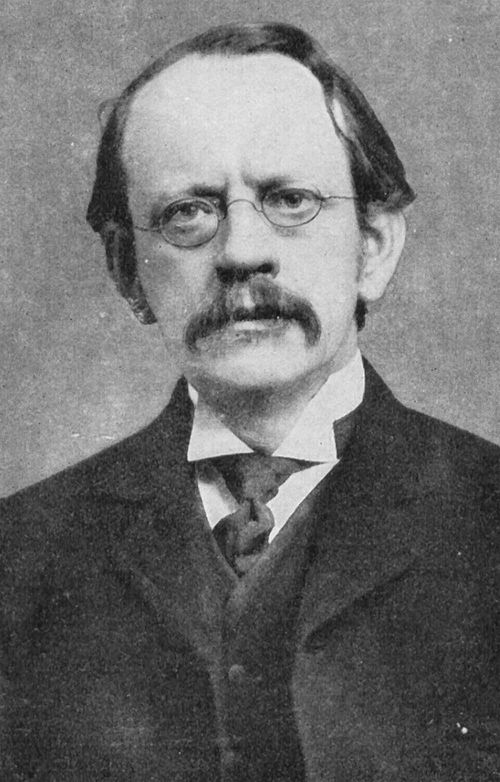
J.J. Thomson Discovers the Electron
Thomson identifies the electron as a negatively charged particle, showing atoms are divisible. This discovery revolutionizes atomic theory and leads to the development of quantum chemistry. #chemistry #electron #physics
J.J. Thomson Discovers the Electron By Not Mentioned - First World War.com, Public domain, https://commons.wikimedia.org/w/index.php?curid=2969861
1901 CE
First Nobel Prize in Chemistry Awarded
Jacobus Henricus van 't Hoff receives the first Nobel Prize in Chemistry for his work on osmotic pressure and chemical kinetics. The prize recognizes the growing importance of physical chemistry. #chemistry #Nobel #award
First Nobel Prize in Chemistry Awarded By Photograph: JonathunderMedal: Erik Lindberg (1873-1966) - Derivative of File:NobelPrize.JPG, PD-US, https://en.wikipedia.org/w/index.php?curid=58432969
1909 CE
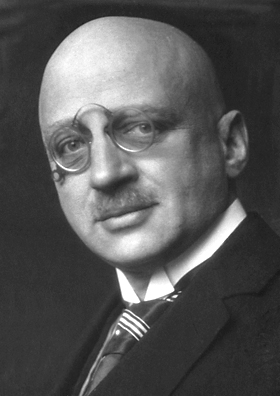
Fritz Haber Develops Ammonia Synthesis
Haber invents a process to synthesize ammonia from nitrogen and hydrogen under high pressure. The Haber-Bosch process enables large-scale fertilizer production, revolutionizing agriculture and global food supply. #chemistry #ammonia #industry
Fritz Haber Develops Ammonia Synthesis By The Nobel Foundation - http://nobelprize.org/chemistry/laureates/1918/index.html, Public domain, https://commons.wikimedia.org/w/index.php?curid=365964
1911 CE
Ernest Rutherford Discovers the Atomic Nucleus
Rutherford's gold foil experiment reveals that atoms have a small, dense nucleus. This nuclear model replaces the plum pudding model and lays the foundation for nuclear chemistry. #chemistry #nucleus #physics
Ernest Rutherford Discovers the Atomic Nucleus By Bain News Service, publisher Restored by: Bammesk - Library of Congress Catalog: https://lccn.loc.gov/2014716719 Image download: https://cdn.loc.gov/service/pnp/ggbain/36500/36570v.jpg Original url: https://www.loc.gov/pictures/item/2014716719/, Public domain, https://commons.wikimedia.org/w/index.php?curid=112190894
1913 CE
Niels Bohr Proposes Atomic Model with Electron Shells
Bohr's model describes electrons orbiting the nucleus in quantized energy levels. It explains atomic spectra and introduces quantum concepts into chemistry, leading to the understanding of chemical bonding. #chemistry #quantum #atoms
Niels Bohr Proposes Atomic Model with Electron Shells By JabberWok at English Wikipedia - Transferred from en.wikipedia to Commons., CC BY-SA 3.0, https://commons.wikimedia.org/w/index.php?curid=2639910
1916 CE
Gilbert N. Lewis Proposes Covalent Bonding
Lewis introduces the concept of the covalent bond, where atoms share electron pairs. His Lewis dot structures become a fundamental tool for representing chemical bonding and molecular structure. #chemistry #bonding #theory
1923 CE
Johannes Brønsted and Thomas Lowry Propose Acid-Base Theory
Brønsted and Lowry independently define acids as proton donors and bases as proton acceptors. This theory expands the concept of acids and bases beyond aqueous solutions and is widely used in chemistry. #chemistry #acids #bases
1925 CE
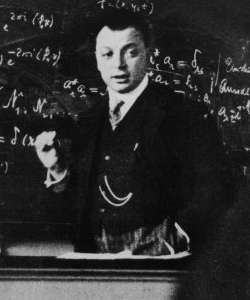
Wolfgang Pauli Formulates the Exclusion Principle
Pauli's exclusion principle states that no two electrons in an atom can have the same set of quantum numbers. This principle explains electron configuration and the structure of the periodic table. #chemistry #quantum #electrons
Wolfgang Pauli Formulates the Exclusion Principle By Unknown author, Public domain, https://commons.wikimedia.org/w/index.php?curid=333866
1927 CE
Erwin Schrödinger Develops Wave Equation
Schrödinger's wave equation describes the behavior of electrons as waves, forming the basis of quantum mechanics. It enables the calculation of atomic orbitals and chemical bonding properties. #chemistry #quantum #equation
1931 CE
Linus Pauling Publishes The Nature of the Chemical Bond
Pauling applies quantum mechanics to chemical bonding, introducing concepts like hybridization and resonance. His work revolutionizes structural chemistry and earns him the Nobel Prize in Chemistry in 1954. #chemistry #bonding #quantum
Linus Pauling Publishes The Nature of the Chemical Bond By Unknown author - Oregon State University [1], CC BY-SA 2.0, https://commons.wikimedia.org/w/index.php?curid=144490366
1932 CE
Harold Urey Discovers Deuterium
Urey isolates deuterium, a heavy isotope of hydrogen, earning the Nobel Prize in Chemistry in 1934. This discovery opens the field of isotope chemistry and has applications in nuclear science. #chemistry #isotopes #discovery
Harold Urey Discovers Deuterium By Flickr: ENERGY.GOV - Unknown photographer. Restored by Creator:Adam Cuerden - HD.3F.004, Public domain, https://commons.wikimedia.org/w/index.php?curid=178710250
1935 CE
Wallace Carothers Invents Nylon
Carothers, a chemist at DuPont, synthesizes nylon, the first synthetic polymer. Nylon's strength and elasticity revolutionize textiles and materials science, launching the age of synthetic polymers. #chemistry #polymers #invention
Wallace Carothers Invents Nylon By Unknown photographer - http://listverse.com/2007/10/07/top-10-scientists-who-committed-suicide/, Public domain, https://commons.wikimedia.org/w/index.php?curid=13295767
1937 CE
Pauling Proposes Electronegativity Scale
Linus Pauling introduces a scale of electronegativity to predict bond polarity. This concept becomes essential for understanding chemical reactivity and molecular properties. #chemistry #bonding #scale
1945 CE
Glenn T. Seaborg Discovers Plutonium and Transuranium Elements
Seaborg and his team synthesize plutonium and other transuranium elements. His work expands the periodic table and leads to the actinide concept, earning him the Nobel Prize in Chemistry in 1951. #chemistry #elements #nuclear
Glenn T. Seaborg Discovers Plutonium and Transuranium Elements By Atomic Energy Commission. (1946 - 01/19/1975) - NAIL Control Number: NWDNS-326-COM-12 NARA (enter "Glenn Seaborg" in search form under Digital Copies tab), Public domain, https://commons.wikimedia.org/w/index.php?curid=1390573
1953 CE
James Watson and Francis Crick Discover DNA Structure
Watson and Crick, using X-ray crystallography data, propose the double helix structure of DNA. This discovery, rooted in chemical principles, revolutionizes biology and biochemistry. #chemistry #DNA #biology
James Watson and Francis Crick Discover DNA Structure By Newspaper Enterprise Association - This image is available from the United States Library of Congress's Prints and Photographs division under the digital ID cph.3c37336.This tag does not indicate the copyright status of the attached work. A normal copyright tag is still required. See Commons:Licensing., Public domain, https://commons.wikimedia.org/w/index.php?curid=189390308
1962 CE
Neil Bartlett Synthesizes Noble Gas Compound
Bartlett creates xenon hexafluoroplatinate, the first compound of a noble gas. This disproves the long-held belief that noble gases are inert, opening a new area of chemistry. #chemistry #noblegas #synthesis
1970 CE
John Pople Develops Gaussian Computational Chemistry Software
Pople creates the Gaussian program, enabling quantum chemical calculations on molecules. This tool revolutionizes theoretical chemistry, allowing prediction of molecular properties and reactions. #chemistry #computational #software
John Pople Develops Gaussian Computational Chemistry Software By The White House - https://pl.wikipedia.org/wiki/Plik:Clinton%261998NobelLaureates.jpg, Public domain, https://commons.wikimedia.org/w/index.php?curid=32833562
1985 CE
Discovery of Fullerenes (Buckminsterfullerene)
Harry Kroto, Robert Curl, and Richard Smalley discover C60, a spherical carbon molecule. Fullerenes open a new branch of carbon chemistry and lead to the discovery of carbon nanotubes and graphene. #chemistry #carbon #nanotechnology
Discovery of Fullerenes (Buckminsterfullerene) By Fotograf: Jochen Gschnaller - German Wikipedia, original upload Dez 2004 by Moebius1 (selfmade), CC BY-SA 3.0, https://commons.wikimedia.org/w/index.php?curid=350278
1991 CE
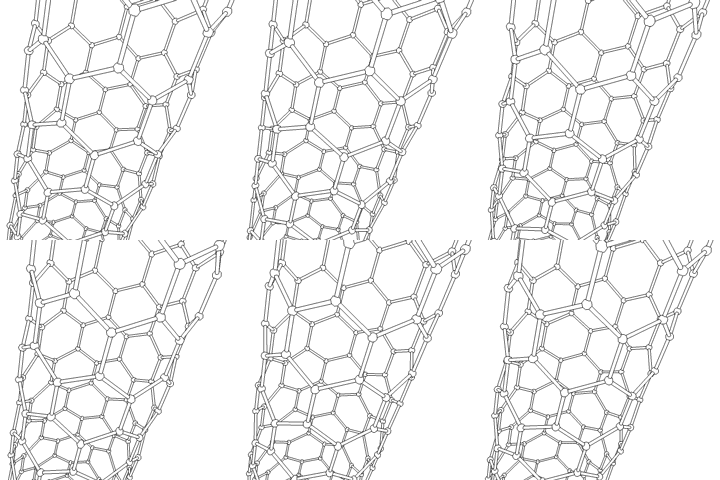
Sumio Iijima Discovers Carbon Nanotubes
Iijima observes carbon nanotubes, cylindrical fullerene structures with remarkable strength and electrical properties. This discovery spurs nanotechnology research and materials science. #chemistry #nanotubes #materials
Sumio Iijima Discovers Carbon Nanotubes By Original hochgeladen von Schwarzm am 30. Aug 2004; Selbst gemacht mit C4D/Cartoonrenderer, GNU FDL - German Wikipedia, original upload 29. Dez 2004 by APPER, CC BY-SA 3.0, https://commons.wikimedia.org/w/index.php?curid=350208
2004 CE
Andre Geim and Konstantin Novoselov Isolate Graphene
Geim and Novoselov isolate graphene, a single layer of carbon atoms, using adhesive tape. Graphene's exceptional properties lead to a Nobel Prize in Physics in 2010 and vast research in materials chemistry. #chemistry #graphene #materials
Andre Geim and Konstantin Novoselov Isolate Graphene By AlexanderAlUS - Own work, CC BY-SA 3.0, https://commons.wikimedia.org/w/index.php?curid=11294534
2016 CE
IUPAC Adds Four New Elements to Periodic Table
Elements 113, 115, 117, and 118 are officially added, completing the seventh period. Nihonium (113), Moscovium (115), Tennessine (117), and Oganesson (118) are synthesized in laboratories. #chemistry #elements #periodictable
IUPAC Adds Four New Elements to Periodic Table By Lekritz - Own work, CC BY-SA 4.0, https://commons.wikimedia.org/w/index.php?curid=185001042