Chemistry & Periodic Law: Chinese Alchemy to Lavoisier & Mendeleev
Encyclopedia/1. The Cosmos & The Natural World/2. Physics & Chemistry/03. Chemistry & Periodic Table of Elements • Curated by Admin Timeline.sg
The history of chemistry spans from ancient Chinese alchemy and the Five Elements theory to Lavoisier's oxygen theory, Dalton's atomic weights, Mendeleev's periodic table, and modern quantum chemistry. This timeline highlights key milestones in the transformation of matter understanding across global cultures.
Chronological Storyline (49 Milestones)
500 BCE
Chinese Wuxing Theory Developed
The Chinese Five Elements (Wuxing) theory—wood, fire, earth, metal, water—emerges as a philosophical framework for natural processes, influencing early alchemy and medicine. #chemistry #history )
Chinese Wuxing Theory Developed By Jim McKeeth - Own work based on old version, CC BY-SA 4.0, https://commons.wikimedia.org/w/index.php?curid=163156799
400 BCE
Democritus Proposes Atomism
Greek philosopher Democritus proposes that matter consists of indivisible particles called atoms, laying a conceptual foundation for atomic theory. #chemistry #philosophy
Democritus Proposes Atomism By user:shakko - Own work, CC BY-SA 3.0, https://commons.wikimedia.org/w/index.php?curid=5535206
350 BCE
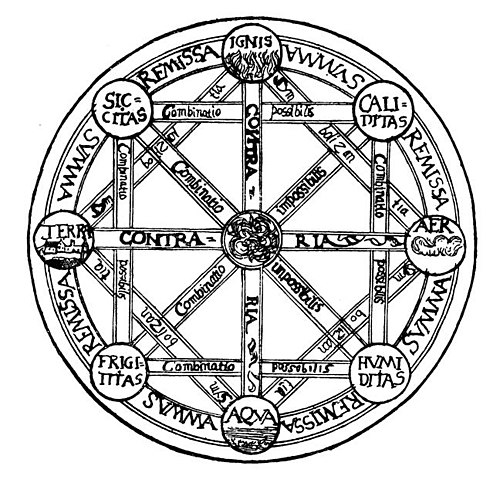
Aristotle's Four Elements
Aristotle formalizes the four-element theory (earth, water, air, fire), which dominates Western thought for nearly two millennia. #chemistry #philosophy
Aristotle's Four Elements By Gottfried Wilhelm von Leibniz - Dissertatio de Arte Combinatoria, Public domain, https://commons.wikimedia.org/w/index.php?curid=39729133
300 CE
Chinese Alchemy: Ge Hong's Baopuzi
Ge Hong writes the Baopuzi, a key alchemical text describing elixirs for immortality and the transformation of cinnabar. #chemistry #alchemy
Chinese Alchemy: Ge Hong's Baopuzi By Gan Bozong (Tang period, 618-907) - https://wellcomeimages.org/indexplus/obf_images/5f/87/4e750c334bb041db425934535c34.jpg (hi-res image) Gallery: https://wellcomeimages.org/indexplus/image/L0039323.html Wellcome Collection gallery (2018-03-28): https://wellcomecollection.org/works/f65bzfbc CC-BY-4.0, CC BY 4.0, https://commons.wikimedia.org/w/index.php?curid=33926771
800 CE
Jabir ibn Hayyan's Alchemical Works
Jabir ibn Hayyan (Geber) pioneers experimental chemistry, discovering acids like hydrochloric and nitric acid, and developing distillation and crystallization techniques. #chemistry #alchemy
Jabir ibn Hayyan's Alchemical Works By Unknown author - https://cdn.britannica.com/10/132710-050-CECF006B/illustration-manuscript-Abu-Musa-Jabir-ibn-Hayyan.jpg, Public domain, https://commons.wikimedia.org/w/index.php?curid=166835469
1000 CE
Al-Razi's Chemical Classifications
Persian physician Al-Razi (Rhazes) classifies substances into animal, vegetable, and mineral categories, and describes chemical processes like distillation. #chemistry #medicine
1250 CE
Albertus Magnus on Alchemy
Albertus Magnus writes extensively on alchemy, describing the composition of metals and the philosopher's stone, influencing European alchemy. #chemistry #alchemy
Albertus Magnus on Alchemy By Vicente Salvador Gómez - [2], Public domain, https://commons.wikimedia.org/w/index.php?curid=8528799
1597 CE
Andreas Libavius Publishes Alchemia
Libavius publishes Alchemia, one of the first chemistry textbooks, systematically describing chemical preparations and apparatus. #chemistry #history
Andreas Libavius Publishes Alchemia By Unknown author - Unknown source, Public domain, https://commons.wikimedia.org/w/index.php?curid=8949023
1661 CE
Robert Boyle's The Sceptical Chymist
Boyle defines elements as simple substances and argues for experimental chemistry, breaking from alchemical traditions. #chemistry #science
Robert Boyle's The Sceptical Chymist By Robert Boyle, 1627-1691 - Science History Institute, Public domain, https://commons.wikimedia.org/w/index.php?curid=26729105
1669 CE
Hennig Brand Discovers Phosphorus
Brand isolates phosphorus from urine, the first element discovery documented in modern chemistry. #chemistry #discovery
Hennig Brand Discovers Phosphorus By Joseph Wright of Derby - http://www.tms.org/pubs/journals/JOM/0706/fig3.jpg http://www.culturevoyage.co.uk/wp-content/uploads/2013/03/Alchymist.jpg, Public domain, https://commons.wikimedia.org/w/index.php?curid=15154197
1703 CE
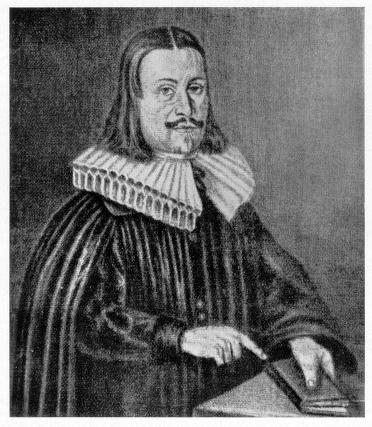
Georg Stahl's Phlogiston Theory
Stahl proposes phlogiston theory to explain combustion, a dominant paradigm until Lavoisier. #chemistry #history
Georg Stahl's Phlogiston Theory By Wolfgang Philipp Kilian - This image has been extracted from another file, Public domain, https://commons.wikimedia.org/w/index.php?curid=5722070
1735 CE
Brandt Isolates Cobalt
Swedish chemist Georg Brandt discovers and isolates cobalt, the first metal discovered since antiquity. #chemistry #discovery
1746 CE
Roebuck's Lead Chamber Process
John Roebuck invents the lead chamber process for producing sulfuric acid on an industrial scale, advancing chemical manufacturing. #chemistry #industry
1754 CE
Black Discovers Carbon Dioxide
Joseph Black identifies carbon dioxide (fixed air) through experiments on limestone, distinguishing it from air. #chemistry #discovery
Black Discovers Carbon Dioxide By Rogers, J - http://ihm.nlm.nih.gov/images/B02979, Public domain, https://commons.wikimedia.org/w/index.php?curid=19132802
1766 CE
Cavendish Discovers Hydrogen
Henry Cavendish isolates hydrogen (inflammable air) and measures its density, paving the way for understanding gases. #chemistry #discovery
Cavendish Discovers Hydrogen By George Wilson - Frontispiece of The Life of the Hon. Henry Cavendish, Public domain, https://commons.wikimedia.org/w/index.php?curid=7373371
1774 CE
Priestley Discovers Oxygen
Joseph Priestley isolates oxygen (dephlogisticated air) and notes its support of combustion and respiration. #chemistry #discovery
Priestley Discovers Oxygen By James Sharples - https://npg.si.edu/object/npg_NPG.77.160?destination=node/63231%3Fedan_local%3D1%26edan_q%3DJoseph, Public domain, https://commons.wikimedia.org/w/index.php?curid=193629762
1777 CE
Lavoisier's Oxygen Theory of Combustion
Antoine Lavoisier publishes his oxygen theory, refuting phlogiston and establishing modern chemistry with mass conservation. #chemistry #science
Lavoisier's Oxygen Theory of Combustion By Jacques-Louis David - Metropolitan Museum of Art: entry 436106 (accession number: 1977.10), Public domain, https://commons.wikimedia.org/w/index.php?curid=141652400
1789 CE
Lavoisier's Traité Élémentaire de Chimie
Lavoisier publishes the first modern chemistry textbook, listing 33 elements and defining the law of conservation of mass. #chemistry #textbook
Lavoisier's Traité Élémentaire de Chimie By Lavoisier, Antoine-Laurent de - https://libserv.aip.org/ipac20/ipac.jsp?session=1C68700M5Q428.396962&profile=rev-all&source=~!horizon&view=subscriptionsummary&uri=full=3100006~!44241~!3&ri=17&aspect=power&menu=search&ipp=20&spp=20&staffonly=&term=Trait%C3%A9+%C3%A9l%C3%A9mentaire+de+Chimie&index=.GW&uindex=&aspect=power&menu=search&ri=17, Public domain, https://commons.wikimedia.org/w/index.php?curid=125621155
1800 CE
Volta Invents the Electric Battery
Alessandro Volta creates the voltaic pile, enabling electrolysis and the discovery of new elements. #chemistry #physics
Volta Invents the Electric Battery By Borbrav, svg version by Luigi Chiesa - Image:Voltaic pile.png, CC BY-SA 3.0, https://commons.wikimedia.org/w/index.php?curid=5091724
1803 CE
Dalton's Atomic Theory
John Dalton proposes atomic theory with atomic weights, explaining chemical reactions as combinations of atoms. #chemistry #science
Dalton's Atomic Theory By Thomas Phillips - National Portrait Gallery, London, Public domain, https://commons.wikimedia.org/w/index.php?curid=11727058
1807 CE
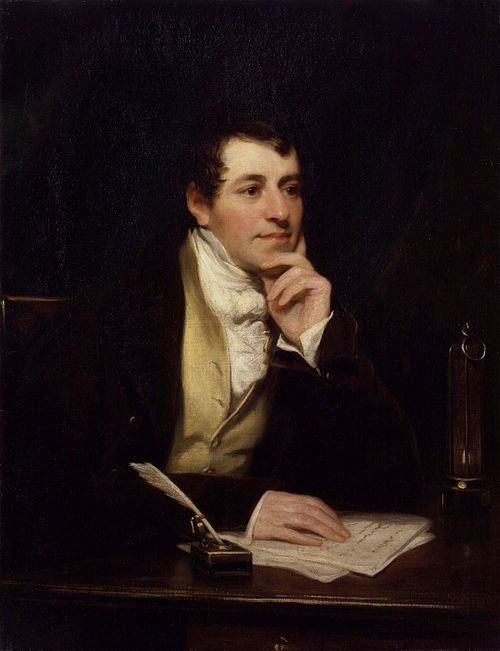
Davy Discovers Sodium and Potassium
Humphry Davy uses electrolysis to isolate sodium, potassium, and other alkali metals, expanding the element list. #chemistry #discovery
Davy Discovers Sodium and Potassium By Thomas Phillips - one or more third parties have made copyright claims against Wikimedia Commons in relation to the work from which this is sourced or a purely mechanical reproduction thereof. This may be due to recognition of the "sweat of the brow" doctrine, allowing works to be eligible for protection through skill and labour, and not purely by originality as is the case in the United States (where this website is hosted). These claims may or may not be valid in all jurisdictions. As such, use of this image in the jurisdiction of the claimant or other countries may be regarded as copyright infringement. Please see Commons:When to use the PD-Art tag for more information., Public domain, https://commons.wikimedia.org/w/index.php?curid=6364758
1811 CE
Avogadro's Molecular Hypothesis
Amedeo Avogadro proposes that equal volumes of gases contain equal numbers of molecules, distinguishing atoms from molecules. #chemistry #physics
1828 CE
Wöhler Synthesizes Urea
Friedrich Wöhler synthesizes urea from inorganic compounds, disproving vitalism and founding organic chemistry. #chemistry #organic
Wöhler Synthesizes Urea By Rudolph Hoffmann - Eigenes Foto einer Originallithographie der ÖNB (Wien), Public domain, https://commons.wikimedia.org/w/index.php?curid=16652576
1834 CE
Faraday's Laws of Electrolysis
Michael Faraday formulates laws of electrolysis, quantifying the relationship between electricity and chemical change. #chemistry #physics
Faraday's Laws of Electrolysis By Thomas Phillips - Thomas Phillips, 1842, Public domain, https://commons.wikimedia.org/w/index.php?curid=463384
1858 CE
Kekulé Proposes Carbon Tetravalence
August Kekulé establishes that carbon is tetravalent and can form chains, laying the basis for structural organic chemistry. #chemistry #organic
Kekulé Proposes Carbon Tetravalence By Unknown author - https://www.gettyimages.ie/detail/news-photo/german-organic-chemist-friedrich-august-kekule-von-news-photo/72242781, Public domain, https://commons.wikimedia.org/w/index.php?curid=167877
1865 CE
Kekulé's Benzene Structure
Kekulé proposes the cyclic structure of benzene, revolutionizing aromatic chemistry. #chemistry #organic
Kekulé's Benzene Structure By Laurent Mazouin at lb.wikipedia - Own work Transferred from lb.wikipedia, Public domain, https://commons.wikimedia.org/w/index.php?curid=1379125
1869 CE
Mendeleev's Periodic Table
Dmitri Mendeleev publishes the first periodic table, arranging elements by atomic weight and predicting undiscovered elements. #chemistry #periodictable
Mendeleev's Periodic Table By Lekritz - Own work, CC BY-SA 4.0, https://commons.wikimedia.org/w/index.php?curid=185001042
1874 CE
van't Hoff's Tetrahedral Carbon
Jacobus van't Hoff proposes the tetrahedral geometry of carbon, explaining optical isomerism and stereochemistry. #chemistry #stereochemistry
van't Hoff's Tetrahedral Carbon By Nicola Perscheid - one or more third parties have made copyright claims against Wikimedia Commons in relation to the work from which this is sourced or a purely mechanical reproduction thereof. This may be due to recognition of the "sweat of the brow" doctrine, allowing works to be eligible for protection through skill and labour, and not purely by originality as is the case in the United States (where this website is hosted). These claims may or may not be valid in all jurisdictions. As such, use of this image in the jurisdiction of the claimant or other countries may be regarded as copyright infringement. Please see Commons:When to use the PD-Art tag for more information., Public domain, https://commons.wikimedia.org/w/index.php?curid=44101635
1884 CE
Arrhenius Proposes Ionic Dissociation
Svante Arrhenius presents the theory of electrolytic dissociation, explaining conductivity of solutions. #chemistry #physical
Arrhenius Proposes Ionic Dissociation By Photogravure Meisenbach Riffarth & Co. Leipzig. - Zeitschrift für Physikalische Chemie, Band 69, 1909., Public domain, https://commons.wikimedia.org/w/index.php?curid=96273
1895 CE
Röntgen Discovers X-Rays
Wilhelm Röntgen discovers X-rays, leading to new analytical techniques in chemistry and medicine. #chemistry #physics
Röntgen Discovers X-Rays By Erwin Hanfstaengl - https://global.museum-digital.org/singleimage?imagenr=2399678, Public domain, https://commons.wikimedia.org/w/index.php?curid=182243188
1896 CE
Becquerel Discovers Radioactivity
Henri Becquerel discovers radioactivity in uranium salts, opening the field of nuclear chemistry. #chemistry #physics
Becquerel Discovers Radioactivity By Paul Nadar / Adam Cuerden - This file comes from Gallica Digital Library and is available under the digital ID btv1b532297273/f1, Public domain, https://commons.wikimedia.org/w/index.php?curid=120421283
1897 CE
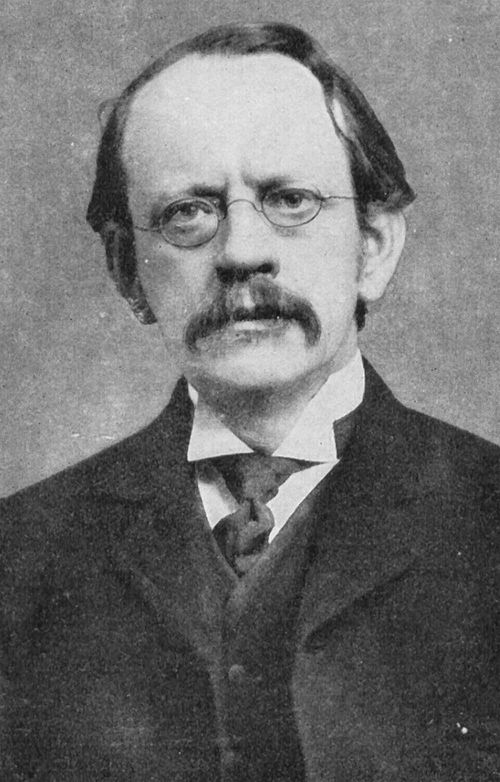
Thomson Discovers the Electron
J.J. Thomson identifies the electron, the first subatomic particle, revolutionizing atomic theory. #chemistry #physics
Thomson Discovers the Electron By Not Mentioned - First World War.com, Public domain, https://commons.wikimedia.org/w/index.php?curid=2969861
1900 CE
Planck's Quantum Hypothesis
Max Planck introduces quantum theory to explain blackbody radiation, laying the foundation for quantum chemistry. #chemistry #physics
Planck's Quantum Hypothesis By Hugo Erfurth - This file was derived from: Max Planck by Hugo Erfurth 1938cr.jpg Original source: https://www.dhm.de/lemo/bestand/objekt/max-planck, Public domain, https://commons.wikimedia.org/w/index.php?curid=153625300
1909 CE
Rutherford's Gold Foil Experiment
Ernest Rutherford discovers the atomic nucleus through alpha particle scattering, leading to the nuclear model. #chemistry #physics
1913 CE
Moseley's Atomic Number Law
Henry Moseley establishes atomic number as the basis for periodic table ordering, resolving inconsistencies. #chemistry #physics
Moseley's Atomic Number Law By AIP Emilio Segre Visual Archives, W. F. Meggers Gallery of Nobel Laureates - https://ru.wikipedia.org/wiki/%D0%A4%D0%B0%D0%B9%D0%BB:Moseley_henry.jpg, Public domain, https://commons.wikimedia.org/w/index.php?curid=39775530
1913 CE
Bohr's Atomic Model
Niels Bohr proposes a quantized electron orbit model, explaining hydrogen spectra and advancing quantum chemistry. #chemistry #physics
Bohr's Atomic Model By JabberWok at English Wikipedia - Transferred from en.wikipedia to Commons., CC BY-SA 3.0, https://commons.wikimedia.org/w/index.php?curid=2639910
1916 CE
Lewis's Covalent Bond Theory
Gilbert N. Lewis proposes the electron-pair bond and Lewis dot structures, explaining chemical bonding. #chemistry #bonding
1923 CE
Brønsted–Lowry Acid–Base Theory
Johannes Brønsted and Thomas Lowry independently define acids as proton donors and bases as proton acceptors. #chemistry #acids
1925 CE
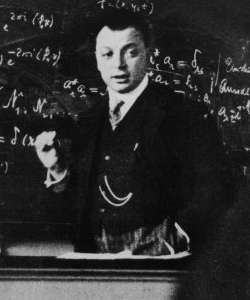
Pauli Exclusion Principle
Wolfgang Pauli formulates the exclusion principle, stating no two electrons can have identical quantum numbers. #chemistry #physics
Pauli Exclusion Principle By Unknown author, Public domain, https://commons.wikimedia.org/w/index.php?curid=333866
1926 CE
Schrödinger's Wave Equation
Erwin Schrödinger develops the wave equation for quantum mechanics, enabling calculation of electron orbitals. #chemistry #physics
1927 CE
Heisenberg's Uncertainty Principle
Werner Heisenberg states the uncertainty principle, limiting simultaneous knowledge of position and momentum. #chemistry #physics
Heisenberg's Uncertainty Principle By Unknown author - This image was provided to Wikimedia Commons by the German Federal Archive (Deutsches Bundesarchiv) as part of a cooperation project. The German Federal Archive guarantees an authentic representation only using the originals (negative and/or positive), resp. the digitalization of the originals as provided by the Digital Image Archive., CC BY-SA 3.0 de, https://commons.wikimedia.org/w/index.php?curid=5436254
1931 CE
Pauling's Resonance Theory
Linus Pauling introduces resonance theory to describe bonding in molecules like benzene, advancing quantum chemistry. #chemistry #bonding
Pauling's Resonance Theory By Unknown author - Oregon State University [1], CC BY-SA 2.0, https://commons.wikimedia.org/w/index.php?curid=144490366
1932 CE
Chadwick Discovers the Neutron
James Chadwick discovers the neutron, enabling the understanding of isotopes and nuclear reactions. #chemistry #physics
Chadwick Discovers the Neutron By Los Alamos National Laboratory, Attribution, https://commons.wikimedia.org/w/index.php?curid=36283260
1940 CE
Seaborg Synthesizes Plutonium
Glenn Seaborg and team synthesize plutonium, expanding the periodic table with transuranium elements. #chemistry #nuclear
Seaborg Synthesizes Plutonium By Atomic Energy Commission. (1946 - 01/19/1975) - NAIL Control Number: NWDNS-326-COM-12 NARA (enter "Glenn Seaborg" in search form under Digital Copies tab), Public domain, https://commons.wikimedia.org/w/index.php?curid=1390573
1953 CE
Watson and Crick Discover DNA Structure
James Watson and Francis Crick propose the double helix structure of DNA, revolutionizing biochemistry. #chemistry #biology
Watson and Crick Discover DNA Structure By Zephyris - Own work, CC BY-SA 3.0, https://commons.wikimedia.org/w/index.php?curid=15027555
1965 CE
Woodward–Hoffmann Rules
Robert Burns Woodward and Roald Hoffmann develop rules for pericyclic reactions, a milestone in theoretical organic chemistry. #chemistry #organic
Woodward–Hoffmann Rules By Ivogt - Own work, CC BY-SA 3.0, https://commons.wikimedia.org/w/index.php?curid=23034878
1985 CE
Discovery of Fullerenes
Harry Kroto, Robert Curl, and Richard Smalley discover buckminsterfullerene (C60), a new carbon allotrope. #chemistry #nanotechnology
Discovery of Fullerenes By 痛 - Own work, CC BY-SA 4.0, https://commons.wikimedia.org/w/index.php?curid=118428240
1991 CE
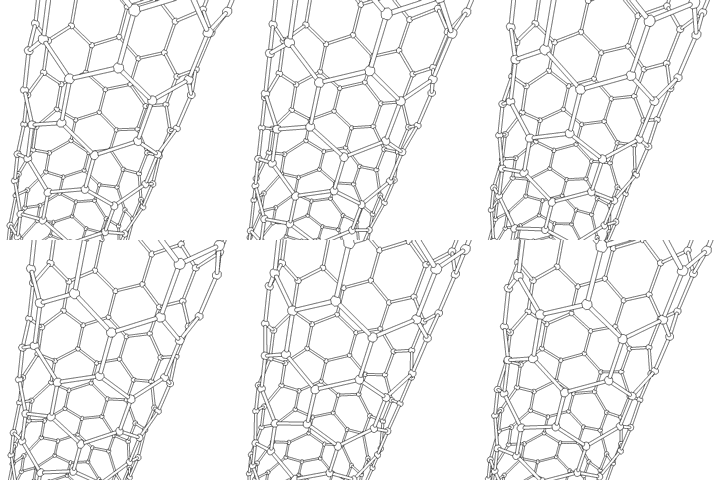
Discovery of Carbon Nanotubes
Sumio Iijima discovers carbon nanotubes, leading to advances in materials science and nanotechnology. #chemistry #nanotechnology
Discovery of Carbon Nanotubes By Original hochgeladen von Schwarzm am 30. Aug 2004; Selbst gemacht mit C4D/Cartoonrenderer, GNU FDL - German Wikipedia, original upload 29. Dez 2004 by APPER, CC BY-SA 3.0, https://commons.wikimedia.org/w/index.php?curid=350208
2016 CE
Four New Elements Named
IUPAC officially names nihonium, moscovium, tennessine, and oganesson, completing period 7 of the periodic table. #chemistry #periodictable