Carl Friedrich Gauss: Prince of Mathematicians & Field Theory Pioneer
Encyclopedia/1. The Cosmos & The Natural World/1. Mathematics & Formal Systems/14. Mathematical Biographies • Curated by Admin Timeline.sg
Timeline of Carl Friedrich Gauss, a German mathematician and physicist who made groundbreaking contributions to number theory, statistics, differential geometry, and astronomy, earning the title 'Prince of Mathematicians'.
Chronological Storyline (42 Milestones)
Apr 30, 1777 CE
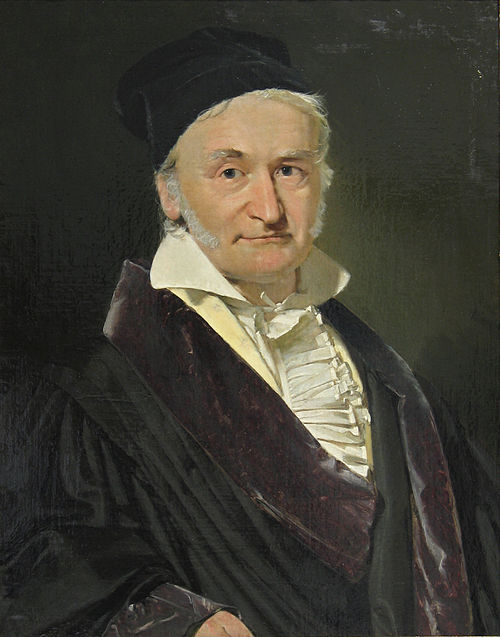
Birth of Carl Friedrich Gauss
Carl Friedrich Gauss is born in Brunswick, Duchy of Brunswick-Wolfenbüttel (now Germany). His mother, who could not read or write, does not record his birth date, but Gauss later deduces it from a church calendar. #history #mathematics
Birth of Carl Friedrich Gauss By Christian Albrecht Jensen - http://archiv.bbaw.de/archiv/archivbestaende/abteilung-sammlungen/gesamtbestand-des-kunstbesitzes/gelehrtengemaelde/gelehrtengemalde-seiten/ZIMM-0001.html, Public domain, https://commons.wikimedia.org/w/index.php?curid=6886354
1784 CE
Gauss Enters School at Age 7
Gauss enters the Katharinen-Volksschule in Brunswick. His teacher, J.G. Büttner, is amazed when Gauss quickly sums the integers from 1 to 100 using a formula. #mathematics #education
1788 CE
Gauss Attends Gymnasium with Duke's Support
Gauss transfers to the Gymnasium in Brunswick, thanks to financial support from the Duke of Brunswick, who is impressed by his abilities. He excels in languages and mathematics. #education #history
1792 CE
Gauss Enters Collegium Carolinum
Gauss enrolls at the Collegium Carolinum in Brunswick, where he studies mathematics, physics, and languages. He independently discovers the law of least squares and the prime number theorem. #mathematics #history
1795 CE
Gauss Studies at University of Göttingen
Gauss begins studies at the University of Göttingen, initially torn between mathematics and philology. He stays for three years, producing major mathematical discoveries. #education #mathematics
Gauss Studies at University of Göttingen By Unknown author - Georg August University of Göttingen, Public domain, https://commons.wikimedia.org/w/index.php?curid=15492626
Mar 30, 1796 CE
Gauss Discovers Constructibility of the 17-gon
Gauss makes his first major discovery: the regular 17-gon is constructible with compass and straightedge, a breakthrough in geometry. This is the first such construction beyond the Euclidean polygons. #mathematics #geometry
Gauss Discovers Constructibility of the 17-gon By László Németh - Own work, CC0, https://commons.wikimedia.org/w/index.php?curid=27331800
Jul 10, 1796 CE
Gauss Writes in His Diary about Prime Number Theorem
Gauss records in his mathematical diary the conjecture that the number of primes less than n is approximately n/log n, later known as the Prime Number Theorem. #mathematics #numbertheory
1798 CE
Gauss Returns to Brunswick Without a Degree
Gauss leaves Göttingen without a formal degree, having completed his first major work, the Disquisitiones Arithmeticae. He returns to Brunswick, living with his parents. #history #mathematics
1799 CE
Gauss Earns Doctorate from University of Helmstedt
Gauss receives his doctorate in absentia from the University of Helmstedt, with a dissertation on the fundamental theorem of algebra. He gives the first rigorous proof of the theorem. #mathematics #algebra
Jul 1, 1801 CE
Gauss Predicts Orbit of Ceres
Using his method of least squares, Gauss calculates the orbit of the dwarf planet Ceres, which had been discovered earlier that year and then lost. His prediction allows astronomers to relocate it. #astronomy #mathematics )
Gauss Predicts Orbit of Ceres By Justin Cowart - Ceres - RC3 - Haulani Crater, Public domain, https://commons.wikimedia.org/w/index.php?curid=49700320
Dec 7, 1801 CE
Ceres Relocated by Zach and Olbers
Based on Gauss's calculations, astronomers Franz Xaver von Zach and Heinrich Wilhelm Olbers successfully rediscover Ceres. This cements Gauss's reputation as a mathematician and astronomer. #astronomy #history )
1801 CE
Publication of Disquisitiones Arithmeticae
Gauss publishes his magnum opus, Disquisitiones Arithmeticae, a foundational text in number theory. It introduces modular arithmetic, quadratic reciprocity, and the theory of cyclotomic fields. #mathematics #numbertheory #books
Publication of Disquisitiones Arithmeticae By Unknown author, Public domain, https://commons.wikimedia.org/w/index.php?curid=641724
1802 CE
Gauss Invited to Saint Petersburg Academy
Gauss receives an invitation to become director of the astronomical observatory in Saint Petersburg. He declines, preferring to remain in Brunswick. Later, in 1807, he becomes director of the Göttingen Observatory. #astronomy #history
Oct 9, 1805 CE
Gauss Marries Johanna Osthoff
Gauss marries Johanna Osthoff, his first wife. They have three children (Joseph, Wilhelmina, and Louis). Johanna dies in 1809 after the birth of their third child. #personal #history
1807 CE
Gauss Becomes Director of Göttingen Observatory
Gauss is appointed director of the astronomical observatory at the University of Göttingen, a position he holds until his death. He also becomes a professor of astronomy. #astronomy #education
Gauss Becomes Director of Göttingen Observatory By Daniel Schwen - Own work, CC BY-SA 2.5, https://commons.wikimedia.org/w/index.php?curid=2042122
1809 CE
Publication of Theoria Motus Corporum Coelestium
Gauss publishes his major work on celestial mechanics, Theoria motus corporum coelestium in sectionibus conicis solem ambientium (Theory of the Motion of Heavenly Bodies). It contains the method of least squares. #astronomy #mathematics
1810 CE
Gauss Marries Minna Waldeck
After the death of his first wife, Gauss marries Minna Waldeck, a friend of Johanna. They have three more children (Eugen, Wilhelm, and Theresa). #personal #history
1812 CE
Gauss Proves Convergence of Hypergeometric Series
Gauss presents his work on the hypergeometric series, providing the first rigorous treatment of its convergence and its relation to many special functions. #mathematics #analysis
Gauss Proves Convergence of Hypergeometric Series By WalkingRadiance - Own work, CC BY-SA 4.0, https://commons.wikimedia.org/w/index.php?curid=122403556
1816 CE
Gauss Works on Differential Geometry
Gauss begins his work on differential geometry, leading to his 1827 publication of Disquisitiones generales circa superficies curvas (General Investigations of Curved Surfaces). #mathematics #geometry
Gauss Works on Differential Geometry By Unknown author, Public domain, https://commons.wikimedia.org/w/index.php?curid=1581561
1818 CE
Gauss Conducts Geodetic Survey of Hanover
Gauss is commissioned to survey the Kingdom of Hanover. He develops the method of least squares for surveying and invents the heliotrope for precise measurement. #geodesy #mathematics
Gauss Conducts Geodetic Survey of Hanover By U.S. Government - Extracted from PDF version of the Vol 26-4 2004 DISAM Journal (direct PDF URL [1]), Public domain, https://commons.wikimedia.org/w/index.php?curid=5020632
1821 CE
Gauss Publishes on Least Squares
Gauss publishes his definitive work on the method of least squares, which he had been using since 1795. It becomes a standard statistical tool. #statistics #mathematics
Gauss Publishes on Least Squares By Krishnavedala - File:Linear least squares2.png, CC0, https://commons.wikimedia.org/w/index.php?curid=70820642
1823 CE
Gauss Invents the Heliotrope
Gauss invents the heliotrope, a device using sunlight for long-distance land surveying. It aids his geodetic work in Hanover. #invention #geodesy )
Gauss Invents the Heliotrope By derivative work: Macchess (talk) Heliotrope2.jpg: US National Oceanic and Atmospheric Administration - Heliotrope2.jpg, Public domain, https://commons.wikimedia.org/w/index.php?curid=4281867
1824 CE
Gauss Works on Non-Euclidean Geometry
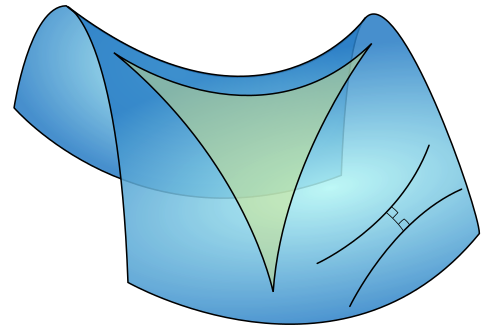
Gauss privately develops the foundations of non-Euclidean geometry but refrains from publishing due to fear of controversy. He later corresponds with János Bolyai and Nikolai Lobachevsky. #mathematics #geometry
1827 CE
Publication of Disquisitiones generales circa superficies curvas
Gauss publishes his seminal work on differential geometry, introducing Gaussian curvature and the Theorema Egregium (Remarkable Theorem). #mathematics #geometry
1829 CE
Gauss Formulates Principle of Least Constraint
Gauss publishes the principle of least constraint in mechanics, providing a variational principle for constrained motion. #physics #mechanics
Gauss Formulates Principle of Least Constraint By Gottlieb Biermann / After Christian Albrecht Jensen - Gauß-Gesellschaft Göttingen e.V. (Foto: A. Wittmann)., Public domain, https://commons.wikimedia.org/w/index.php?curid=57629
1831 CE
Gauss Begins Collaboration with Wilhelm Weber
Gauss meets physicist Wilhelm Weber at Göttingen. They collaborate on research in electromagnetism and geomagnetism for over a decade. #physics #collaboration
1832 CE
Gauss and Weber Study Earth's Magnetic Field
Gauss and Weber establish the first geomagnetic observatory in Göttingen and measure the Earth's magnetic field. They also create a magnetic map of the world. #physics #geophysics
Gauss and Weber Study Earth's Magnetic Field By Unknown author, Public domain, https://commons.wikimedia.org/w/index.php?curid=1712490
1833 CE
Gauss and Weber Invent an Electromagnetic Telegraph
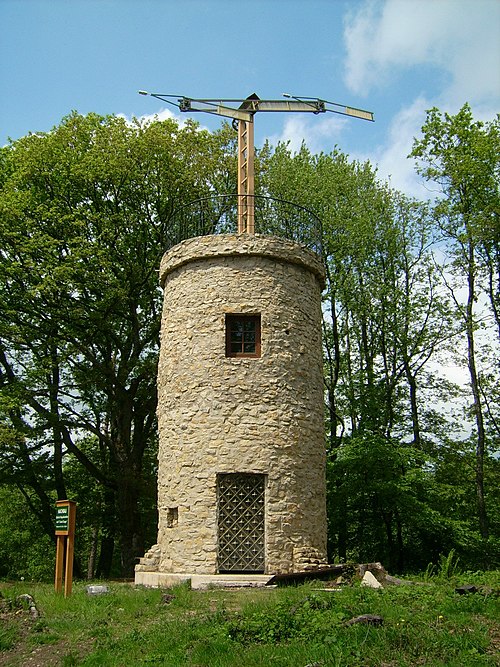
Gauss and Weber build the first practical electromagnetic telegraph, connecting the observatory and the physics institute in Göttingen. #invention #communication
Gauss and Weber Invent an Electromagnetic Telegraph By Lokilech at German Wikipedia - Own work, CC BY-SA 3.0, https://commons.wikimedia.org/w/index.php?curid=784410
1834 CE
Gauss Publishes Results on Geomagnetism
Gauss publishes Intensitas vis magneticae terrestris ad mensuram absolutam revocata, establishing absolute units for magnetic measurement. #physics #geophysics
Gauss Publishes Results on Geomagnetism By Unknown author, CC BY-SA 3.0, https://commons.wikimedia.org/w/index.php?curid=553022
1835 CE
Gauss Develops the Gaussian Error Function
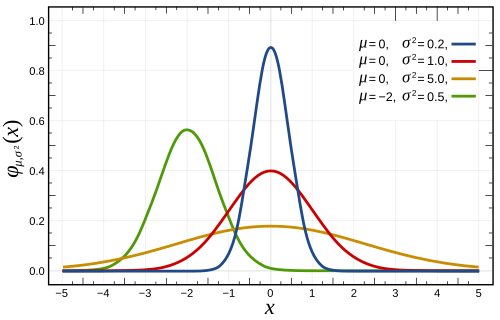
Gauss refines the normal distribution (Gaussian distribution) and introduces the error function, fundamental to statistics and probability. #statistics #mathematics
Gauss Develops the Gaussian Error Function By Inductiveload - Own work (Original text: self-made, Mathematica, Inkscape), Public domain, https://commons.wikimedia.org/w/index.php?curid=3817954
1837 CE
Gauss Criticizes Ohm's Work, Then Praises
Gauss initially criticizes Georg Ohm's work on electrical circuits, but later recognizes its importance. Ohm's law becomes fundamental. #physics #controversy
Gauss Criticizes Ohm's Work, Then Praises By Unknown author - Bayerische Akademie der Wissenschaften https://www.facebook.com/badw.muenchen/photos/a.1504466919851549/2050320341932868/, Public domain, https://commons.wikimedia.org/w/index.php?curid=154471715
1839 CE
Gauss Publishes on Potential Theory
Gauss publishes a paper on potential theory and the inverse-square law of magnetism, laying groundwork for mathematical physics. #physics #mathematics
1840 CE
Gauss Works on Dioptric Systems
Gauss publishes a work on dioptrics, analyzing lens systems and introducing the Gaussian optics approach. #optics #physics
1841 CE
Gauss Elected Foreign Member of Royal Society
Gauss is elected a Foreign Member of the Royal Society in London, one of many honors recognizing his contributions. #honor #science
1843 CE
Gauss and Weber Construct First Magnetometer
Gauss and Weber invent a portable magnetometer for measuring magnetic field intensity, crucial for geomagnetic surveys. #invention #physics
Gauss and Weber Construct First Magnetometer By NASA - http://history.nasa.gov/SP-349/ch4.htm, Public domain, https://commons.wikimedia.org/w/index.php?curid=12363893
1845 CE
Gauss Refines Least Squares for Astronomy
Gauss continues to apply least squares to astronomical problems, including the calculation of orbits of asteroids. #astronomy #mathematics
1847 CE
Gauss Writes on the Theory of Biquadratic Residues
Gauss publishes a paper on biquadratic residues, further developing number theory and introducing Gauss sums and the concept of Gaussian integers. #mathematics #numbertheory
1849 CE
Gauss Gives Jubilee Lecture on the 17-gon
For the 50th anniversary of his doctorate, Gauss gives a lecture on the heptadecagon, reflecting on his early geometric discovery. #mathematics #history
1850 CE
Gauss Works on Optics and Capillarity
Gauss continues research on optics and surface tension (capillarity), publishing a paper on the latter. #physics #mathematics
Gauss Works on Optics and Capillarity By Hankwang - Own work, CC BY-SA 3.0, https://commons.wikimedia.org/w/index.php?curid=12788416
1851 CE
Gauss Suffers Declining Health
Gauss's health begins to decline. He continues mathematical work but reduces his activities. #personal #history
1854 CE
Gauss Attends Lecture by Riemann
Gauss, in his last academic act, attends the Habilitation lecture of Bernhard Riemann, who presents Riemannian geometry. Gauss is impressed. #mathematics #history
Gauss Attends Lecture by Riemann By Unknown author - http://www.sil.si.edu/digitalcollections/hst/scientific-identity/explore.htm according to the German Wikipedia., Public domain, https://commons.wikimedia.org/w/index.php?curid=27383
Feb 23, 1855 CE
Death of Carl Friedrich Gauss
Carl Friedrich Gauss dies in Göttingen, Germany, at the age of 77. He is buried in the Albanifriedhof cemetery. His brain is preserved for study. #history #obituary