Black Hole Physics & Horizons: Modern Frontiers & Breakthrough Innovations
Encyclopedia/1. The Cosmos & The Natural World/2. Physics & Chemistry/02. Relativity & Gravitational Physics • Curated by Admin Timeline.sg
This timeline traces the evolution of black hole physics from early theoretical concepts in the 18th century to modern breakthroughs including gravitational wave detections and direct imaging. It highlights key figures, discoveries, and technologies that have shaped our understanding of these cosmic objects.
Chronological Storyline (39 Milestones)
1783 CE
John Michell Proposes Dark Stars
John Michell suggests that stars with escape velocity exceeding light speed could exist, coining the concept of 'dark stars.' This is the first theoretical precursor to black holes. #physics #history
1796 CE
Laplace's Dark Body Hypothesis
Pierre-Simon Laplace independently proposes the idea of 'invisible bodies' where gravity traps light, based on Newtonian mechanics. This idea resurfaces later in modern black hole theory. #physics
Laplace's Dark Body Hypothesis By James Posselwhite - www.britannica.com, Public domain, https://commons.wikimedia.org/w/index.php?curid=11128070
Nov 25, 1915 CE
Einstein Formulates General Relativity
Albert Einstein presents the field equations of general relativity, providing the mathematical framework for black holes as solutions to these equations. #physics #relativity
Einstein Formulates General Relativity By Simulating eXtreme Spacetimes Lensing (SXS) - https://www.ligo.caltech.edu/video/ligo20160211v3 (video link); see also http://www.black-holes.org/gw150914, CC BY-SA 4.0, https://commons.wikimedia.org/w/index.php?curid=46994894
1916 CE
Schwarzschild Solution Discovered
Karl Schwarzschild finds the first exact solution to Einstein's field equations, describing the spacetime around a non-rotating, uncharged spherical mass. This solution predicts a singularity and an event horizon. #physics #relativity
1918 CE
Reissner-Nordström Solution
Hans Reissner and Gunnar Nordström independently derive a solution for a charged, non-rotating black hole, introducing the concept of a charged black hole. #physics
1931 CE
Chandrasekhar Limit Calculated
Subrahmanyan Chandrasekhar calculates the maximum mass of a white dwarf star (Chandrasekhar limit), beyond which gravitational collapse to a neutron star or black hole is inevitable. #physics #astronomy
1939 CE
Oppenheimer Predicts Black Hole Formation
J. Robert Oppenheimer and Hartland Snyder show that a sufficiently massive star can undergo continued gravitational collapse, forming a region from which no light can escape. This is the first modern black hole model. #physics
1958 CE
Term 'Black Hole' Introduced by Wheeler
Physicist John Archibald Wheeler popularizes the term 'black hole' during a conference, though it may have been used earlier by others. The name quickly sticks. #physics #history
Term 'Black Hole' Introduced by Wheeler By AIP Emilio Segrè Visual Archives, Wheeler Collection - https://repository.aip.org/john-archibald-wheeler-lecturing-beyond-end-time-university-missouri, Attribution, https://commons.wikimedia.org/w/index.php?curid=172733880
1963 CE
Kerr Solution for Rotating Black Holes
Roy Kerr finds the exact solution for a rotating, uncharged black hole, described by the Kerr metric. This is a more realistic model for most black holes in the universe. #physics #relativity
Kerr Solution for Rotating Black Holes By Yukterez (Simon Tyran, Vienna) - Own work, CC BY-SA 4.0, https://commons.wikimedia.org/w/index.php?curid=50352912
1964 CE
Quasar Discovery Suggests Supermassive Black Holes
Maarten Schmidt identifies quasars as highly luminous objects at cosmological distances, later understood to be powered by accretion onto supermassive black holes. #astronomy
Quasar Discovery Suggests Supermassive Black Holes By ESO/M. Kornmesser - http://www.eso.org/public/images/eso1122a/, CC BY 4.0, https://commons.wikimedia.org/w/index.php?curid=15700804
1965 CE
Penrose Singularity Theorem
Roger Penrose proves that singularities must form inside black holes under general relativity, given certain energy conditions. This work later earns a Nobel Prize. #physics #relativity
1967 CE
Neutron Stars Discovered as Pulsars
Jocelyn Bell Burnell discovers pulsars, which are rapidly rotating neutron stars. This observational breakthrough confirms the existence of compact objects, strengthening the case for black holes. #astronomy #physics
Neutron Stars Discovered as Pulsars By NASA/CXC/SAO (X-Ray); NASA/JPL-Caltech (Infrared) - http://www.nasa.gov/sites/default/files/pia18848-wisefacepalm.jpg, Public domain, https://commons.wikimedia.org/w/index.php?curid=36363158
1970 CE
Hawking Proposes Black Hole Area Theorem
Stephen Hawking demonstrates that the event horizon area of a classical black hole never decreases, analogous to the second law of thermodynamics. This leads to deeper connections between gravity and thermodynamics. #physics
Hawking Proposes Black Hole Area Theorem By JRennocks - Own work, CC BY-SA 4.0, https://commons.wikimedia.org/w/index.php?curid=128242974
1971 CE
Cygnus X-1 Identified as Black Hole Candidate
Cygnus X-1, a strong X-ray source in a binary system, is identified as the first strong black hole candidate. Later studies confirm its mass exceeds the neutron star limit. #astronomy
Cygnus X-1 Identified as Black Hole Candidate By IAU and Sky & Telescope magazine (Roger Sinnott & Rick Fienberg) - [1], CC BY 4.0, https://commons.wikimedia.org/w/index.php?curid=15406373
1972 CE
Bekenstein Associates Black Holes with Entropy
Jacob Bekenstein proposes that black holes have entropy proportional to their event horizon area, laying the foundation for black hole thermodynamics. #physics
Bekenstein Associates Black Holes with Entropy By Bekenstein - Own work, Public domain, https://commons.wikimedia.org/w/index.php?curid=38674400
1974 CE
Hawking Radiation Discovered
Stephen Hawking predicts that black holes emit thermal radiation due to quantum effects near the event horizon, causing them to slowly evaporate. This unites quantum mechanics, thermodynamics, and gravity. #physics #quantum
1984 CE
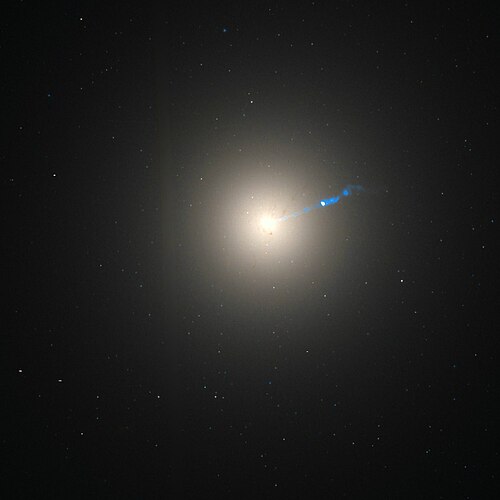
First Observation of Supermassive Black Hole in M87
Astronomers using the Hubble Space Telescope later image the jet from M87, but the existence of a supermassive black hole at its center is inferred from early observations. (Actual imaging later.) #astronomy
First Observation of Supermassive Black Hole in M87 By en:NASA, en:STScI, en:WikiSky - http://wikisky.org/snapshot?img_size=&img_res=&ra=12.5138&de=12.3896&angle=0.0293&projection=tan&rotation=0.0&survey=astrophoto&img_id=905632&width=2160&height=2160&img_borders=&interpolation=bicubic&jpeg_quality=0.8, Public domain, https://commons.wikimedia.org/w/index.php?curid=7598267
1990 CE
Hubble Space Telescope Launched
The Hubble Space Telescope begins operations, enabling high-resolution observations of galactic nuclei and providing evidence for supermassive black holes. #astronomy
Hubble Space Telescope Launched By NASA - http://spaceflight.nasa.gov/gallery/images/shuttle/sts-125/html/s125e012050.html, Public domain, https://commons.wikimedia.org/w/index.php?curid=6833760
Oct 1, 1993 CE
Nobel Prize for Hulse-Taylor Binary Pulsar
The Nobel Prize in Physics is awarded to Russell Hulse and Joseph Taylor for their discovery of a binary pulsar, providing indirect evidence of gravitational waves, relevant to black hole mergers. #physics
1998 CE
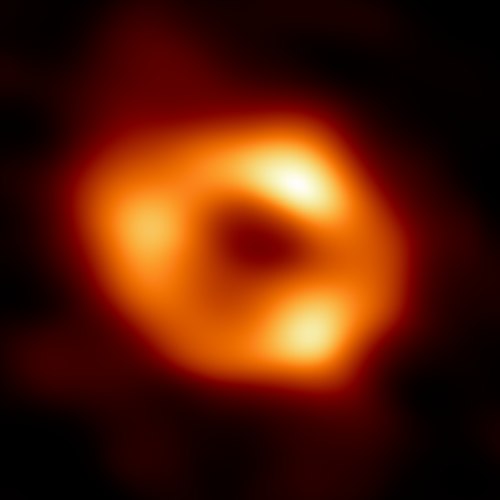
Supermassive Black Hole in Milky Way Confirmed
Observations of stellar orbits near the galactic center, led by Andrea Ghez and Reinhard Genzel, provide strong evidence for a supermassive black hole, Sagittarius A*. #astronomy
Supermassive Black Hole in Milky Way Confirmed By EHT Collaboration - https://www.eso.org/public/images/eso2208-eht-mwa/ (image link), CC BY 4.0, https://commons.wikimedia.org/w/index.php?curid=117933557
2002 CE
Chandra X-ray Observatory Reveals Black Hole Phenomena
The Chandra X-ray Observatory provides high-resolution X-ray images of black hole accretion disks and jets, deepening understanding of black hole astrophysics. #astronomy
Chandra X-ray Observatory Reveals Black Hole Phenomena By NASA/CXC/NGST - http://svs.gsfc.nasa.gov/cgi-bin/details.cgi?aid=11185 (image link), Public domain, https://commons.wikimedia.org/w/index.php?curid=38252467
2008 CE
Gravity Probe B Tests Frame-Dragging
Gravity Probe B confirms the frame-dragging effect predicted by general relativity around Earth, a phenomenon important for black hole physics. #physics
Gravity Probe B Tests Frame-Dragging By NASA/MSFC - http://www.nasa.gov/mission_pages/gpb/gpb_013.html, Public domain, https://commons.wikimedia.org/w/index.php?curid=5532645
2010 CE
First Measurement of Black Hole Spin
Astronomers using X-ray data measure the spin of the black hole in Cygnus X-1, showing it rotates at nearly the speed of light. #astronomy
2014 CE
First Black Hole Seen Exploding? (Not confirmed)
Observations of a supernova-like event initially thought to be a black hole explosion are later reinterpreted; this highlights the challenges in detecting black hole evaporation. #astronomy
First Black Hole Seen Exploding? (Not confirmed) By NASA/ESA, The Hubble Key Project Team and The High-Z Supernova Search Team - http://www.spacetelescope.org/images/opo9919i/, Public domain, https://commons.wikimedia.org/w/index.php?curid=407520
Sep 14, 2015 CE
First Gravitational Wave Detection (GW150914)
LIGO detects gravitational waves from a binary black hole merger, confirming a key prediction of general relativity and opening a new window into black hole astronomy. #physics #gravity
First Gravitational Wave Detection (GW150914) By B. P. Abbott et al. (LIGO Scientific Collaboration and Virgo Collaboration) — full list at the end of the article - http://physics.aps.org/featured-article-pdf/10.1103/PhysRevLett.116.061102 . See also the associated Jupyter notebook., CC BY 3.0, https://commons.wikimedia.org/w/index.php?curid=46987868
Feb 11, 2016 CE
LIGO Announces GW150914 Discovery
The LIGO collaboration publicly announces the first direct detection of gravitational waves, emitted by two black holes merging. This event is awarded the 2017 Nobel Prize. #physics #astronomy
Aug 17, 2017 CE
First Neutron Star Merger Observed (GW170817)
LIGO and Virgo detect gravitational waves from a neutron star merger, with electromagnetic counterparts observed across the spectrum. This provides multi-messenger insights into compact objects. #astronomy #physics
First Neutron Star Merger Observed (GW170817) By LIGO Scientific Collaboration and Virgo Collaboration - https://journals.aps.org/prl/abstract/10.1103/PhysRevLett.119.161101 This W3C-unspecified plot was created with Matplotlib., CC BY-SA 4.0, https://commons.wikimedia.org/w/index.php?curid=63455773
Oct 3, 2017 CE
Nobel Prize for Gravitational Wave Discovery
The Nobel Prize in Physics is awarded to Rainer Weiss, Barry Barish, and Kip Thorne for decisive contributions to LIGO and the detection of gravitational waves. #physics
Nobel Prize for Gravitational Wave Discovery By Design of the medal: The Nobel Foundation. Sculptor and engraver: Erik Lindberg (1902). - Source of this work Photographer: David Monniaux (2005, 2006, 2007) Edited by: hidro 21:17, 28 July 2008 (UTC) Design of the medal: The Nobel Foundation. Sculptor and engraver: Erik Lindberg (1902)., Cc-by-sa-3.0, https://en.wikipedia.org/w/index.php?curid=18622921
Apr 10, 2019 CE
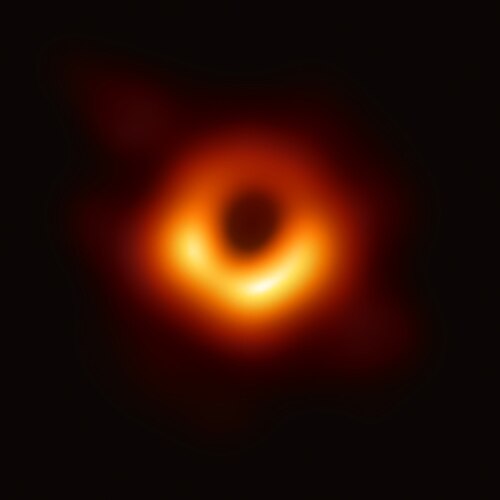
First Image of a Black Hole (M87*)
The Event Horizon Telescope (EHT) releases the first direct image of a black hole's event horizon and shadow, in the galaxy M87. This confirms theoretical predictions. #astronomy #breakthrough
First Image of a Black Hole (M87*) By D. Marrone/UofA - Event Horizon Telescope Collaboration, CC BY 4.0, https://commons.wikimedia.org/w/index.php?curid=133002860
May 1, 2020 CE
Nobel Prize for Black Hole Discoveries
Roger Penrose receives half the Nobel Prize in Physics for theoretical work on black holes, while Andrea Ghez and Reinhard Genzel share the other half for the discovery of Sagittarius A*. #physics
2021 CE
Polarized Light Image of M87 Black Hole
The EHT releases new images of the M87 black hole in polarized light, revealing magnetic field structures near the event horizon. #astronomy
May 12, 2022 CE
Image of Milky Way's Supermassive Black Hole (Sgr A*)
The Event Horizon Telescope unveils the first image of Sagittarius A*, the black hole at the center of our galaxy, confirming its presence and properties. #astronomy #breakthrough
2023 CE
Gravitational Wave Background Detected
Pulsar timing arrays, including NANOGrav, announce evidence for the gravitational wave background from merging supermassive black holes, opening a new observational window. #astronomy #physics
Gravitational Wave Background Detected By NASA / WMAP Science Team - http://map.gsfc.nasa.gov/media/121238/ilc_9yr_moll4096.png, Public domain, https://commons.wikimedia.org/w/index.php?curid=23285693
2024 CE
Black Hole Information Paradox Advances
New theoretical work using holographic principles and quantum gravity models suggests resolutions to the black hole information paradox, linking to string theory. #physics #quantum
Black Hole Information Paradox Advances By Event Horizon Telescope, uploader cropped and converted TIF to JPG - This media was produced by the European Southern Observatory (ESO), under the identifier eso1907a This tag does not indicate the copyright status of the attached work. A normal copyright tag is still required. See Commons:Licensing., CC BY 4.0, https://commons.wikimedia.org/w/index.php?curid=77925953
2025 CE
LISA Pathfinder Tests Future Space Detector
The LISA Pathfinder mission successfully tests technologies for the future Laser Interferometer Space Antenna (LISA), which will detect low-frequency gravitational waves from black hole mergers. #astronomy #physics
LISA Pathfinder Tests Future Space Detector By DLR German Aerospace Center - LISA Pathfinder, CC BY 2.0, https://commons.wikimedia.org/w/index.php?curid=32945545
2026 CE
Next-Generation Event Horizon Telescope Upgrades
The EHT undergoes significant upgrades with new telescopes and higher observational frequencies, promising sharper images of black hole shadows and dynamics. #astronomy
2027 CE
Black Hole Accretion Simulation Breakthroughs
Advanced supercomputer simulations model the magnetohydrodynamics of accretion disks around black holes with unprecedented detail, explaining jet formation and variability. #physics #astrophysics
Black Hole Accretion Simulation Breakthroughs By NASA’s Goddard Space Flight Center/Jeremy Schnittman - https://www.nasa.gov/feature/goddard/2019/nasa-visualization-shows-a-black-hole-s-warped-world, CC BY-SA 4.0, https://commons.wikimedia.org/w/index.php?curid=82619352
2028 CE
China's Einstein Probe Mission Launches
The Einstein Probe, a Chinese X-ray mission designed to monitor black hole transients and tidal disruption events, begins operations, providing new insights into black hole feeding. #astronomy
China's Einstein Probe Mission Launches By China News Service - YouTube: https://www.youtube.com/watch?v=UrgLJQairZE&t=27s – View/save archived versions on archive.org, CC BY 4.0, https://commons.wikimedia.org/w/index.php?curid=144127080
2029 CE
First Detection of a Black Hole Merger with Electromagnetic Counterpart
LIGO, Virgo, and KAGRA detect a binary black hole merger with an electromagnetic counterpart, possibly from an accretion disk around one of the black holes, enabling multi-messenger studies. #astronomy #physics
First Detection of a Black Hole Merger with Electromagnetic Counterpart By Simulating eXtreme Spacetimes Collaboration/Canadian Institute for Theoretical Astrophysics/SciNet - http://www.black-holes.org/gw150914 (see https://www.youtube.com/watch?v=c-2XIuNFgD0), CC BY-SA 4.0, https://commons.wikimedia.org/w/index.php?curid=46983496