1783 CE
John Michell Proposes 'Dark Stars'
John Michell suggests that stars with sufficient gravity could prevent light from escaping, anticipating the concept of black holes. #physics #astronomy
This timeline traces the evolution of black hole physics from early theoretical speculations in the 18th century to modern observational breakthroughs, including gravitational wave detections and direct imaging. It covers key theoretical developments, experimental validations, and paradigm shifts that have shaped our understanding of black holes and event horizons.
John Michell suggests that stars with sufficient gravity could prevent light from escaping, anticipating the concept of black holes. #physics #astronomy
Pierre-Simon Laplace independently proposes 'invisible bodies' where escape velocity exceeds light speed, reinforcing the idea of dark stars. #physics #history

Albert Einstein presents the field equations of general relativity, providing the theoretical foundation for black holes. #physics #relativity

Karl Schwarzschild derives the first exact solution to Einstein's field equations, describing a non-rotating black hole. #physics #astronomy
Subrahmanyan Chandrasekhar calculates the maximum mass of a stable white dwarf, implying that more massive stars must collapse into neutron stars or black holes. #astrophysics
J. Robert Oppenheimer and Hartland Snyder show that massive stars can undergo gravitational collapse to form what would later be called black holes. #physics #history
The discovery of quasars (quasi-stellar radio sources) suggests extremely energetic phenomena, later attributed to supermassive black holes. #astronomy

John Archibald Wheeler popularizes the term 'black hole' during a conference, replacing earlier names like 'frozen star'. #physics #history
The detection of pulsars (rapidly rotating neutron stars) confirms the existence of neutron stars and indirectly supports black hole theory. #astronomy

Roger Penrose proposes that energy can be extracted from a rotating black hole via particle decay in the ergosphere. #physics

Cygnus X-1 becomes the first widely accepted black hole candidate. #astrophysics
Cygnus X-1 is confirmed as a binary system containing a black hole and a supergiant star. #astronomy
Observations of the X-ray source Cygnus X-1 provide strong evidence for a stellar-mass black hole in a binary system. #astrophysics

Stephen Hawking proves that the event horizon area of a black hole never decreases, analogous to entropy in thermodynamics. #physics

Yakov Zeldovich and others propose that waves can be amplified by scattering off a rotating black hole. #physics
Jacob Bekenstein suggests black holes have entropy proportional to event horizon area, leading to thermodynamic laws for black holes. #physics
Stephen Hawking shows that black holes can emit thermal radiation due to quantum effects near the event horizon, leading to eventual evaporation. #physics #quantum
The no-hair theorem states that black holes are completely described by only three parameters: mass, charge, and angular momentum. #physics
Inflation models suggest that density fluctuations could produce small black holes in the early universe. #cosmology
Theory describes how mass transfer from a companion star powers black hole accretion. #astrophysics

The Hubble Space Telescope provides high-resolution images of galactic centers, helping to identify supermassive black holes. #astronomy #space

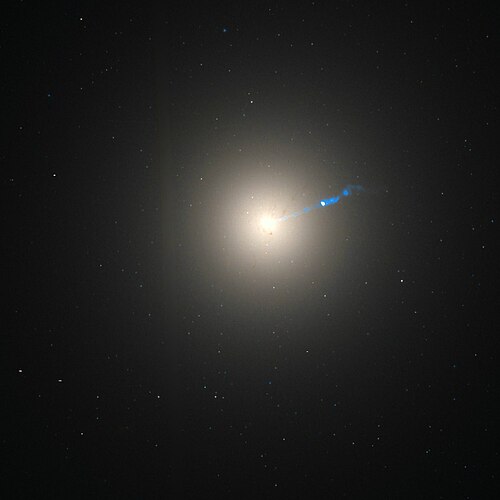
The Hubble Space Telescope images the core of galaxy M87, revealing a jet from a supermassive black hole. #astronomy
Observation of star orbits near the Galactic Center provides strong evidence for a supermassive black hole, Sagittarius A*. #astrophysics
Mathematicians and physicists prove that stationary black holes are fully characterized by mass, charge, and spin. #physics #math
NASA's Chandra X-ray Observatory enables detailed studies of black hole accretion disks and jets. #astronomy #nasa

Using stellar orbits, the mass of Sagittarius A* is determined to be about 4 million solar masses. #astrophysics
Using X-ray observations, astronomers measure the spin of the black hole in the binary system GRS 1915+105. #astrophysics

VLBI observations of Sgr A* show structure consistent with a shadow, but resolution is insufficient for direct imaging. #astronomy
Fermi detects gamma-ray emissions from black hole jets and microquasars. #astronomy #nasa

The Event Horizon Telescope (EHT) collaboration is formed to directly image black hole event horizons using very-long-baseline interferometry. #astronomy #collaboration

Stars torn apart by supermassive black holes are observed as bright flares. #astrophysics

LIGO detects gravitational waves from a binary black hole merger, confirming the existence of stellar-mass black hole pairs. #physics #astronomy

The third detection (GW170104) further validates general relativity and black hole population models. #physics

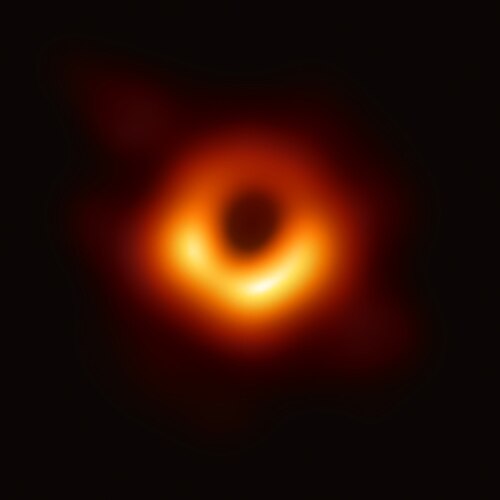
The Event Horizon Telescope releases the first direct image of a black hole's event horizon, located in galaxy M87. #astronomy #breakthrough
LIGO and Virgo detect gravitational waves from a neutron star merging with a black hole. #physics
Roger Penrose receives half the Nobel Prize for theoretical discovery of black hole formation; Andrea Ghez and Reinhard Genzel share the other half for supermassive black hole discovery. #physics #nobel
EHT reveals polarized light signatures around M87*, showing magnetic fields at the event horizon. #astronomy
The Event Horizon Telescope images the jet base of the supermassive black hole in Centaurus A. #astronomy

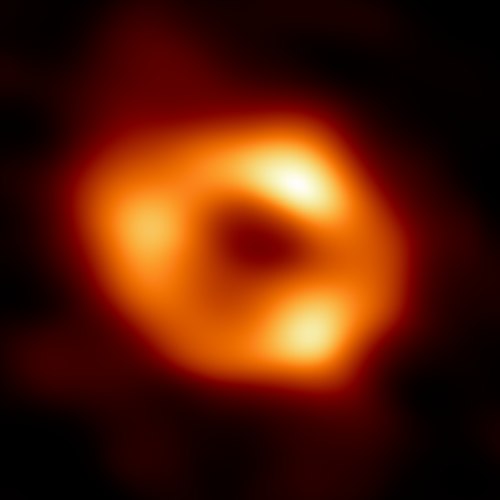
The Event Horizon Telescope images the supermassive black hole at the center of the Milky Way, Sagittarius A*. #astronomy
The James Webb Space Telescope reveals new details about black holes in the early universe. #astronomy #webb

No, but the team continues to refine techniques.
The fourth observing run includes KAGRA, detecting many black hole mergers and neutron star collisions. #physics

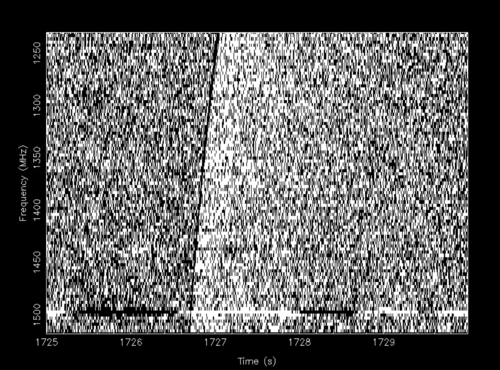
Possible link between fast radio bursts and black hole activity is proposed. #astrophysics
The Laser Interferometer Space Antenna (LISA) mission continues development to detect low-frequency gravitational waves from supermassive black hole mergers. #physics #space
Ongoing research explores whether primordial black holes could constitute dark matter.
