Black Hole Physics & Horizons: Global Cross-Cultural Perspectives
Encyclopedia/1. The Cosmos & The Natural World/2. Physics & Chemistry/02. Relativity & Gravitational Physics • Curated by Admin Timeline.sg
A global cross-cultural timeline of black hole physics and horizons, from early speculations on dark stars to modern multi-messenger astronomy, highlighting contributions across civilizations.
Chronological Storyline (33 Milestones)
1783 CE
John Michell Proposes Dark Stars
English clergyman John Michell suggests that stars could become so massive that their escape velocity exceeds the speed of light, making them invisible. This early concept of a 'dark star' anticipates black holes. #physics #history
1796 CE
Laplace Predicts Black Bodies
Pierre-Simon Laplace independently proposes the idea of 'black bodies' in his book Exposition du Système du Monde, where light cannot escape massive stars. #physics #astronomy
Laplace Predicts Black Bodies By James Posselwhite - www.britannica.com, Public domain, https://commons.wikimedia.org/w/index.php?curid=11128070
Nov 25, 1915 CE
Einstein's General Relativity
Albert Einstein presents the field equations of general relativity, revolutionizing the understanding of gravity and paving the way for black hole solutions. #physics #relativity
Einstein's General Relativity By Simulating eXtreme Spacetimes Lensing (SXS) - https://www.ligo.caltech.edu/video/ligo20160211v3 (video link); see also http://www.black-holes.org/gw150914, CC BY-SA 4.0, https://commons.wikimedia.org/w/index.php?curid=46994894
1916 CE
Schwarzschild's Solution
Karl Schwarzschild finds the first exact solution to Einstein's field equations, describing a non-rotating black hole and introducing the Schwarzschild radius. #physics #astrophysics
1931 CE
Chandrasekhar's Limit
Indian-American astrophysicist Subrahmanyan Chandrasekhar calculates the maximum mass for a white dwarf star, above which it must collapse into a neutron star or black hole. #physics #astrophysics
1939 CE
Oppenheimer-Snyder Collapse
J. Robert Oppenheimer and Hartland Snyder model the gravitational collapse of a massive star into a black hole, showing that an event horizon forms. #physics #astrophysics
1955 CE
Raychaudhuri Equation
Indian physicist Amal Kumar Raychaudhuri derives an equation describing the focusing of geodesics, a key tool in singularity theorems and black hole theory. #physics #relativity
1963 CE
Discovery of Quasars
Maarten Schmidt identifies the first quasar (3C 273), providing the first observational evidence for supermassive black holes. #astronomy #physics
Discovery of Quasars By ESO/M. Kornmesser - http://www.eso.org/public/images/eso1122a/, CC BY 4.0, https://commons.wikimedia.org/w/index.php?curid=15700804
1964 CE
Zel'dovich and Novikov Predict Observational Signatures
Soviet physicists Yakov Zel'dovich and Igor Novikov predict that black holes can be detected via accretion disks and X-ray emission. #physics #astrophysics
Zel'dovich and Novikov Predict Observational Signatures By Stamp issuing authority - MARKA Publishing & Trading Centre. Printer - Association GOZNAK of the Ministry of Finance of the Russian Federation - http://www.wnsstamps.post/en/stamps/RU055.14, Public domain, https://commons.wikimedia.org/w/index.php?curid=39238861
1965 CE
Penrose Singularity Theorem
Roger Penrose proves that gravitational collapse inevitably leads to a singularity within a black hole, winning the Nobel Prize in 2020. #physics #relativity
1967 CE
John Wheeler Coins 'Black Hole'
American physicist John Archibald Wheeler first uses the term 'black hole' at a conference, popularizing the concept. #physics #astrophysics
John Wheeler Coins 'Black Hole' By AIP Emilio Segrè Visual Archives, Wheeler Collection - https://repository.aip.org/john-archibald-wheeler-lecturing-beyond-end-time-university-missouri, Attribution, https://commons.wikimedia.org/w/index.php?curid=172733880
1970 CE
Cygnus X-1 Identified as Black Hole Candidate
The X-ray source Cygnus X-1, discovered earlier, is identified as a strong black hole candidate via orbital dynamics. #astronomy #physics
Cygnus X-1 Identified as Black Hole Candidate By IAU and Sky & Telescope magazine (Roger Sinnott & Rick Fienberg) - [1], CC BY 4.0, https://commons.wikimedia.org/w/index.php?curid=15406373
1971 CE
Hawking's Area Theorem
Stephen Hawking proves that the area of a black hole's event horizon never decreases, analogous to entropy in thermodynamics. #physics #relativity
Hawking's Area Theorem By JRennocks - Own work, CC BY-SA 4.0, https://commons.wikimedia.org/w/index.php?curid=128242974
1972 CE
No-Hair Theorem and Sunyaev-Zel'dovich Effect
Reimund Ruffini and John Wheeler formulate the no-hair theorem, stating black holes are fully described by mass, charge, and spin. Meanwhile, Soviet astronomers Rashid Sunyaev and Yakov Zel'dovich predict the Sunyaev-Zel'dovich effect for clusters. #physics #astrophysics
1974 CE
Hawking Radiation
Stephen Hawking predicts that black holes emit thermal radiation due to quantum effects, leading to eventual evaporation. #physics #quantum
1975 CE
Bekenstein-Hawking Entropy
Jacob Bekenstein proposes that black holes have entropy proportional to their event horizon area, later refined by Hawking, linking thermodynamics and gravity. #physics #thermodynamics
1981 CE
Unruh Effect
Canadian physicist William Unruh predicts that an accelerating observer perceives black-body radiation, related to Hawking radiation. #physics #quantum
1985 CE
Binary Black Hole Simulations
Numerical relativity begins to model binary black hole mergers, though full simulations take decades. #physics #computation
Binary Black Hole Simulations By Simulating eXtreme Spacetimes Collaboration/Canadian Institute for Theoretical Astrophysics/SciNet - http://www.black-holes.org/gw150914 (see https://www.youtube.com/watch?v=c-2XIuNFgD0), CC BY-SA 4.0, https://commons.wikimedia.org/w/index.php?curid=46983496
1992 CE
Kip Thorne's Black Hole Visualization
Physicist Kip Thorne works with visual effects artists to create realistic depictions of black holes for the film 'Interstellar', based on general relativistic simulations. #physics #visualization
Kip Thorne's Black Hole Visualization By Christopher Michel - Own work, CC BY-SA 4.0, https://commons.wikimedia.org/w/index.php?curid=126119947
Jul 23, 1997 CE
Chandra X-ray Observatory Launched
NASA's Chandra X-ray Observatory, with international contributions from the UK and Netherlands, begins observing high-energy phenomena including black hole accretion. #astronomy #space
Chandra X-ray Observatory Launched By NASA/CXC/NGST - http://svs.gsfc.nasa.gov/cgi-bin/details.cgi?aid=11185 (image link), Public domain, https://commons.wikimedia.org/w/index.php?curid=38252467
1998 CE
Evidence for Supermassive Black Holes in Galaxy Centers
Hubble Space Telescope observations confirm that many galaxies harbor supermassive black holes, correlating with galaxy properties. #astronomy #physics
Evidence for Supermassive Black Holes in Galaxy Centers By Event Horizon Telescope - https://www.eso.org/public/images/eso1907a/; JPG saved from full size TIFF and converted with maximum quality level 12 in Photoshop 2019., CC BY 4.0, https://commons.wikimedia.org/w/index.php?curid=77916527
Oct 1, 2002 CE
Genzel and Ghez Show Stars Orbit Sgr A*
Teams led by Reinhard Genzel and Andrea Ghez demonstrate that stars at the Galactic Center orbit a supermassive black hole, leading to their Nobel Prize in 2020. #astronomy #physics
Genzel and Ghez Show Stars Orbit Sgr A* By EHT Collaboration - https://www.eso.org/public/images/eso2208-eht-mwa/ (image link), CC BY 4.0, https://commons.wikimedia.org/w/index.php?curid=117933557
Jul 21, 2004 CE
Hawking Concedes Black Hole Information Paradox
Stephen Hawking announces that black holes do not destroy information, reversing his earlier stance, a key moment in quantum gravity research. #physics #quantum
Hawking Concedes Black Hole Information Paradox By Event Horizon Telescope, uploader cropped and converted TIF to JPG - This media was produced by the European Southern Observatory (ESO), under the identifier eso1907a This tag does not indicate the copyright status of the attached work. A normal copyright tag is still required. See Commons:Licensing., CC BY 4.0, https://commons.wikimedia.org/w/index.php?curid=77925953
2008 CE
GRAVITY Instrument on VLT
The European Southern Observatory's GRAVITY instrument begins operations, enabling astrometric observations of stars at the Galactic Center and testing general relativity. #astronomy #technology )
2011 CE
NuSTAR Launched
NASA's Nuclear Spectroscopic Telescope Array (NuSTAR) opens a new window on black hole physics by observing high-energy X-rays. #astronomy #space
NuSTAR Launched By NASA/JPL-Caltech - http://www.nustar.caltech.edu/news/48/71/NuSTAR/d,gallery-detail-template (direct link), Public domain, https://commons.wikimedia.org/w/index.php?curid=19679153
Sep 14, 2015 CE
LIGO Detects Gravitational Waves from BBH
The Laser Interferometer Gravitational-Wave Observatory (LIGO) makes the first direct detection of gravitational waves from a binary black hole merger, confirming a key prediction of general relativity. #physics #astrophysics
LIGO Detects Gravitational Waves from BBH By B. P. Abbott et al. (LIGO Scientific Collaboration and Virgo Collaboration) — full list at the end of the article - http://physics.aps.org/featured-article-pdf/10.1103/PhysRevLett.116.061102 . See also the associated Jupyter notebook., CC BY 3.0, https://commons.wikimedia.org/w/index.php?curid=46987868
Aug 17, 2017 CE
GW170817: Neutron Star Merger
LIGO and Virgo detect gravitational waves from a neutron star merger, providing insights into formation of black holes and kilonovae. #astronomy #physics
GW170817: Neutron Star Merger By LIGO Scientific Collaboration and Virgo Collaboration - https://journals.aps.org/prl/abstract/10.1103/PhysRevLett.119.161101 This W3C-unspecified plot was created with Matplotlib., CC BY-SA 4.0, https://commons.wikimedia.org/w/index.php?curid=63455773
Apr 10, 2019 CE
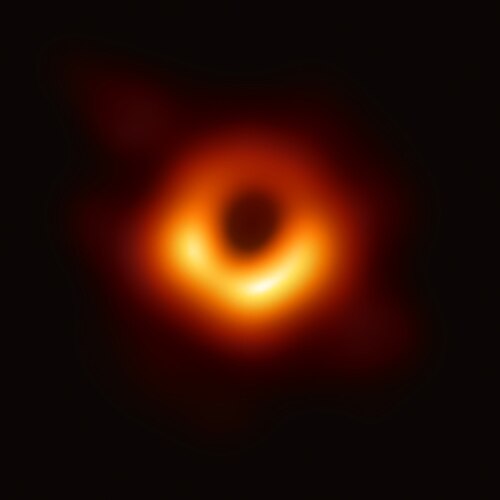
First Image of a Black Hole: M87*
The Event Horizon Telescope (EHT) collaboration releases the first direct image of a black hole's shadow at the center of galaxy M87, with global participation including China, Japan, and others. #astronomy #physics
First Image of a Black Hole: M87* By D. Marrone/UofA - Event Horizon Telescope Collaboration, CC BY 4.0, https://commons.wikimedia.org/w/index.php?curid=133002860
Oct 6, 2020 CE
Nobel Prize in Physics for Penrose, Genzel, Ghez
Roger Penrose receives half the Nobel for theoretical black hole work; Reinhard Genzel and Andrea Ghez share the other half for discovering the supermassive black hole Sgr A*. #physics #awards
2021 CE
Chinese FAST Telescope Studies Black Holes
China's Five-hundred-meter Aperture Spherical Telescope (FAST) contributes to black hole research by discovering pulsars and studying accretion processes. #astronomy #China
Chinese FAST Telescope Studies Black Holes By SCJiang - Own work, CC BY-SA 4.0, https://commons.wikimedia.org/w/index.php?curid=172271062
May 12, 2022 CE
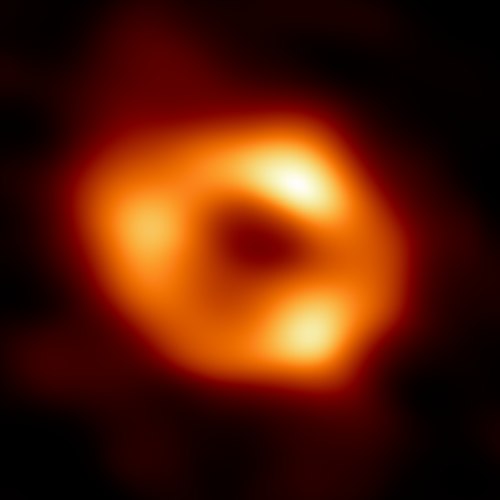
EHT Images Sgr A*
The Event Horizon Telescope reveals the first image of the supermassive black hole at the center of the Milky Way, confirming its existence and testing general relativity. #astronomy #physics
2023 CE
JWST Observations of Early Black Holes
The James Webb Space Telescope detects quasars and black holes from the early universe, probing growth of supermassive black holes in the first billion years. #astronomy #space
JWST Observations of Early Black Holes By NASA - https://www.jwst.nasa.gov/content/webbLaunch/whereIsWebb.html, Public domain, https://commons.wikimedia.org/w/index.php?curid=114125719
2024 CE
LISA Pathfinder Technology Prepares for Space-Based GW Detection
The LISA Pathfinder mission demonstrates technology for the future space-based gravitational wave observatory, enabling detection of massive black hole mergers. #physics #space
LISA Pathfinder Technology Prepares for Space-Based GW Detection By DLR German Aerospace Center - LISA Pathfinder, CC BY 2.0, https://commons.wikimedia.org/w/index.php?curid=32945545