Biochemistry & Enzymatic Catalysis: Modern Frontiers & Breakthrough Innovations
Encyclopedia/1. The Cosmos & The Natural World/2. Physics & Chemistry/03. Chemistry & Periodic Table of Elements • Curated by Admin Timeline.sg
This timeline traces the evolution of biochemistry and enzymatic catalysis from ancient fermentation practices to modern breakthroughs in directed evolution, CRISPR, and AI-driven protein design, highlighting key discoveries and global contributions.
Chronological Storyline (41 Milestones)
2500 BCE
Ancient Egyptians Use Yeast for Bread and Beer
Ancient Egyptians harness fermentation by yeast to leaven bread and brew beer, marking one of the earliest practical applications of biochemistry. This process relies on enzymes from microorganisms, unknowingly utilizing biocatalysis. #biochemistry #history
Ancient Egyptians Use Yeast for Bread and Beer By Hanay - Own work, CC BY-SA 3.0, https://commons.wikimedia.org/w/index.php?curid=19472476
1773 CE
Spallanzani Experiments on Gastric Digestion
Lazzaro Spallanzani showed that gastric juice digests meat through chemical action, not mechanical force, providing early evidence for enzymatic digestion. His work laid groundwork for enzyme research. #biochemistry #enzymes
Spallanzani Experiments on Gastric Digestion By Rijksmuseum - http://hdl.handle.net/10934/RM0001.COLLECT.164733, CC0, https://commons.wikimedia.org/w/index.php?curid=183998186
1833 CE
Payen and Persoz Isolate Diastase
Anselme Payen and Jean-François Persoz isolated diastase from malt, the first enzyme to be discovered and named. This marked the beginning of enzymology. #enzymes #biochemistry
1850 CE
Pasteur Studies Fermentation
Louis Pasteur demonstrated that fermentation is caused by living cells (yeast) and linked to specific microorganisms, advancing the understanding of biochemical processes. #microbiology #biochemistry
Pasteur Studies Fermentation By Paul Nadar - File:Louis Pasteur, foto av Paul Nadar.jpg, Public domain, https://commons.wikimedia.org/w/index.php?curid=28039885
1878 CE
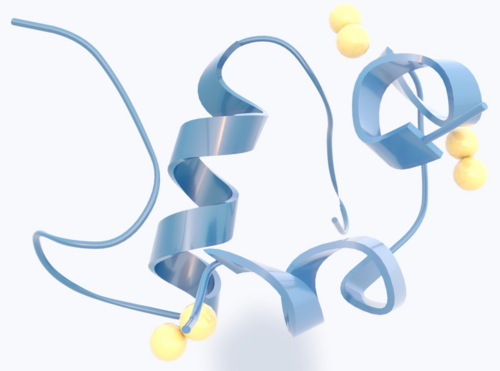
Kühne Coins the Term 'Enzyme'
Wilhelm Kühne introduced the word 'enzyme' (from Greek 'in leaven') to describe biological catalysts, distinguishing them from organized ferments. This term became fundamental in biochemistry. #enzymes #terminology
Kühne Coins the Term 'Enzyme' By Thomas Shafee - Own work, CC BY 4.0, https://commons.wikimedia.org/w/index.php?curid=38738689
1897 CE
Buchner Demonstrates Cell-Free Fermentation
Eduard Buchner showed that yeast extract can ferment sugar without living cells, proving that enzymes are chemical catalysts. His work revolutionized biochemistry and earned a Nobel Prize. #biochemistry #enzymes
Buchner Demonstrates Cell-Free Fermentation By Unknown author - http://www.nobelprize.org/nobel_prizes/chemistry/laureates/1907/buchner.html, Public domain, https://commons.wikimedia.org/w/index.php?curid=18253176
1908 CE
Takamine Isolates Adrenaline
Jokichi Takamine isolated and crystallized adrenaline (epinephrine), the first hormone to be purified, marking a milestone in biochemical isolation and pharmacology. #biochemistry #hormones
Takamine Isolates Adrenaline By AnonymousUnknown author - Science history Institute [1], Public domain, https://commons.wikimedia.org/w/index.php?curid=8462606
1909 CE
Sörensen Introduces pH Scale
Søren Peder Lauritz Sørensen introduced the pH scale as a measure of hydrogen ion concentration, essential for studying enzyme activity and biochemical reactions. #chemistry #biochemistry
Sörensen Introduces pH Scale By Alvy16 - Own work, CC BY 4.0, https://commons.wikimedia.org/w/index.php?curid=84933482
1913 CE
Michaelis-Menten Kinetics Proposed
Leonor Michaelis and Maud Menten published their theory of enzyme kinetics, describing the relationship between substrate concentration and reaction rate. This model remains a cornerstone of enzymology. #enzymes #kinetics
Michaelis-Menten Kinetics Proposed By Athel cb - Own work, CC BY-SA 4.0, https://commons.wikimedia.org/w/index.php?curid=130422583
1926 CE
Sumner Crystallizes Urease
James B. Sumner crystallized urease, proving that enzymes are proteins and can be purified. This breakthrough earned a Nobel Prize and opened the field of enzymology. #enzymes #biochemistry
Sumner Crystallizes Urease By Unknown author - http://www.nobelprize.org/nobel_prizes/chemistry/laureates/1946/sumner.html, Public domain, https://commons.wikimedia.org/w/index.php?curid=18260359
1929 CE
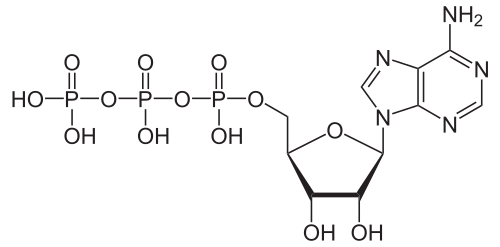
Lohmann Discovers ATP
Karl Lohmann discovered adenosine triphosphate (ATP) in muscle tissue, which later became recognized as the universal energy currency of cells. #biochemistry #energy
Lohmann Discovers ATP By NEUROtiker - Own work, Public domain, https://commons.wikimedia.org/w/index.php?curid=2194476
1937 CE
Krebs Cycle Elucidated
Hans Krebs elucidated the citric acid cycle (Krebs cycle), a central metabolic pathway for aerobic respiration. This discovery integrated enzyme reactions into cellular metabolism. #metabolism #biochemistry
Krebs Cycle Elucidated By Narayanese, WikiUserPedia, YassineMrabet, TotoBaggins - http://biocyc.org/META/NEW-IMAGE?type=PATHWAY&object=TCA. Image adapted from Image:Citric acid cycle noi.svg, CC BY-SA 3.0, https://commons.wikimedia.org/w/index.php?curid=6217701
1944 CE
Avery Identifies DNA as Genetic Material
Oswald Avery, Colin MacLeod, and Maclyn McCarty demonstrated that DNA carries genetic information, using enzymatic treatments to rule out proteins. This paved the way for molecular biology. #genetics #biochemistry
Avery Identifies DNA as Genetic Material By Bbkkk - self-made in the Naturkunste Museum in Berlin, CC BY-SA 4.0, https://commons.wikimedia.org/w/index.php?curid=3679283
1951 CE
Pauling Proposes Alpha-Helix
Linus Pauling used model building and X-ray data to propose the alpha-helix and beta-sheet as protein secondary structures, revolutionizing structural biochemistry. #proteins #structure
Pauling Proposes Alpha-Helix By Theislikerice - Own work, CC BY-SA 4.0, https://commons.wikimedia.org/w/index.php?curid=81729199
1953 CE
Watson and Crick Discover DNA Double Helix
James Watson and Francis Crick, using X-ray data from Rosalind Franklin, proposed the double helix structure of DNA, explaining its replication and function. This landmark in biochemistry and genetics. #DNA #biochemistry
Watson and Crick Discover DNA Double Helix By Unknown author, Public domain, https://commons.wikimedia.org/w/index.php?curid=510095
1955 CE
Sanger Sequences Insulin
Frederick Sanger determined the amino acid sequence of insulin, the first protein to be sequenced. This showed proteins have defined sequences and opened proteomics. #proteins #sequencing
Sanger Sequences Insulin By User:AtikaAtikawa - Own work, CC BY-SA 4.0, https://commons.wikimedia.org/w/index.php?curid=107840330
Matthew Meselson and Franklin Stahl used density gradient centrifugation and enzymatic manipulation to confirm that DNA replication is semiconservative, a key enzymatic process. #DNA #replication
1959 CE
Kornberg Discovers DNA Polymerase
Arthur Kornberg isolated DNA polymerase I from E. coli, the first enzyme for DNA synthesis. This enabled in vitro DNA replication and molecular cloning. #enzymes #molecularbiology
Kornberg Discovers DNA Polymerase By Yikrazuul - Own work, CC BY-SA 3.0, https://commons.wikimedia.org/w/index.php?curid=427810
1961 CE
Monod and Jacob Propose Operon Model
François Jacob and Jacques Monod introduced the operon model for gene regulation, based on studies of enzyme induction in bacteria. This linked enzyme synthesis to genetic control. #genetics #regulation
1961 CE
Nirenberg Cracks the Genetic Code
Marshall Nirenberg and Heinrich Matthaei deciphered the first codon (UUU) using cell-free protein synthesis, showing how nucleic acid sequence directs amino acid assembly. #genetics #biochemistry
Nirenberg Cracks the Genetic Code By The original uploader was Sverdrup at English Wikipedia. Vectorized by: User:VectorVoyager - Vectorization of https://commons.wikimedia.org/wiki/File:RNA-codon.png, Public domain, https://commons.wikimedia.org/w/index.php?curid=124414787
1965 CE
Chinese Scientists Synthesize Insulin
A team led by Wang Yinglai at the Shanghai Institute of Biochemistry successfully synthesized bovine insulin, the first artificial protein. This feat demonstrated full chemical synthesis of a bioactive enzyme. #biochemistry #china
1970 CE
Discovery of Reverse Transcriptase
Howard Temin and David Baltimore independently discovered reverse transcriptase in retroviruses, an enzyme that synthesizes DNA from RNA. This revolutionized molecular biology and biotechnology. #enzymes #virology
Discovery of Reverse Transcriptase By Thomas Splettstoesser (www.scistyle.com) - Own work, CC BY-SA 3.0, https://commons.wikimedia.org/w/index.php?curid=33598425
1972 CE
First Recombinant DNA Created
Paul Berg and colleagues created the first recombinant DNA molecule by ligating DNA from different organisms using restriction enzymes and ligase. This launched genetic engineering. #biotechnology #genetics
First Recombinant DNA Created By Minestrone Soup at English Wikipedia - Transferred from en.wikipedia to Commons., CC BY-SA 3.0, https://commons.wikimedia.org/w/index.php?curid=46890662
1977 CE
Sanger Develops DNA Sequencing
Frederick Sanger introduced the chain-termination method for DNA sequencing, enabling rapid determination of nucleotide sequences. This tool became essential for genomics. #sequencing #genomics
Sanger Develops DNA Sequencing By Estevezj - Own work, CC BY-SA 3.0, https://commons.wikimedia.org/w/index.php?curid=23264166
1983 CE
PCR Invented by Mullis
Kary Mullis invented the polymerase chain reaction (PCR), using a heat-stable DNA polymerase from Thermus aquaticus to amplify DNA exponentially. PCR revolutionized molecular biology. #molecularbiology #biotechnology
PCR Invented by Mullis By Madprime - Own work, CC0, https://commons.wikimedia.org/w/index.php?curid=2104468
1985 CE
Smith-Waterman Algorithm for Sequence Alignment
Temple Smith and Michael Waterman developed an algorithm for local sequence alignment, crucial for comparing protein and DNA sequences in biochemistry and bioinformatics. #bioinformatics #algorithms
Smith-Waterman Algorithm for Sequence Alignment By Yz cs5160 - Own work, CC BY-SA 4.0, https://commons.wikimedia.org/w/index.php?curid=54416043
1989 CE
Cech and Altman Discover Ribozymes
Thomas Cech and Sidney Altman independently discovered RNA molecules with catalytic activity (ribozymes), expanding the concept of biocatalysis beyond proteins. #RNA #enzymes
Cech and Altman Discover Ribozymes By William G. Scott - Own work, CC BY-SA 3.0, https://commons.wikimedia.org/w/index.php?curid=2257831
1990 CE
Human Genome Project Launched
An international consortium began the Human Genome Project to sequence the entire human genome. This endeavor applied enzymatic methods like PCR and sequencing. #genomics #biochemistry
Human Genome Project Launched By U.S. Department of Energy, Human Genome Project - http://www.ornl.gov/hgmis, Public domain, https://commons.wikimedia.org/w/index.php?curid=2485616
1993 CE
Directed Evolution of Enzymes Developed
Frances Arnold pioneered directed evolution of enzymes by applying random mutagenesis and selection to create novel biocatalysts. This approach earned a Nobel Prize. #biocatalysis #evolution
Directed Evolution of Enzymes Developed By Thomas Shafee - Thomas, Shafee, (2014). "Evolvability of a viral protease: experimental evolution of catalysis, robustness and specificity". PhD Thesis. University of Cambridge., CC BY 4.0, https://commons.wikimedia.org/w/index.php?curid=37193303
2000 CE
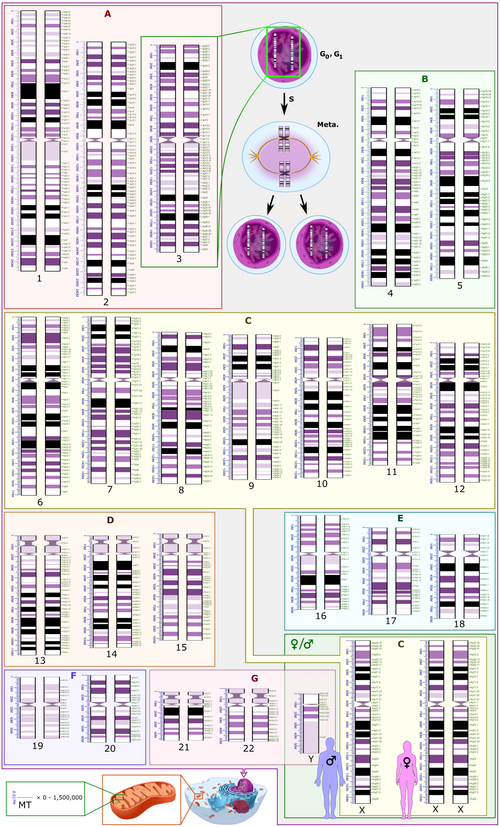
Draft of Human Genome Completed
The Human Genome Project and Celera Genomics jointly announced a draft sequence of the human genome, enabling large-scale biochemical and enzymatic studies. #genomics #bioinformatics
Draft of Human Genome Completed By Mikael Häggström, M.D. Author info - Reusing images- Conflicts of interest: None Mikael Häggström, M.D.- The work integrates Public Domain source images by Was A Bee, Kelvin Ma and Michał Komorniczak- Also, a special acknowledgement to everyone involved in the Human Genome Project for generating the source data.edit - editOwn work, integrating the following Public Domain pictures: Chromosomes, with annotated bands and sub-bands, by User:Was a bee, in turn using data from the Human Genome Project, as displayed in the Ensembl genome database: Ensembl - Homo sapiens: Animal Cell.svg by Kelvin Ma (for mitochondrial localization) Animal cell cycle-en.svg by Kelvin Ma (for cell cycle changes at top) Female shadow (for the female silhouette), by Mikael Häggström Autodominant en.svg by Michał Komorniczak (for the male silhouette) The purple hue for the chromosomes and cell nuclei was digitally sampled from the following image: Human Chromosomes (crop), before conversion to grayscale, by SANCHITA20. Creative Commons Attribution 4.0 International license., CC0, https://commons.wikimedia.org/w/index.php?curid=125968286
2002 CE
Synthetic Biology Advances with Artificially Expanded Genetic Systems
Researchers introduced artificial nucleotides and enzymes to create semi-synthetic organisms, expanding the genetic alphabet and enabling novel biochemical functions. #syntheticbiology #biochemistry
Synthetic Biology Advances with Artificially Expanded Genetic Systems By Alexander van Dijk from San Francisco, United States - Synthetic Biology Research at NASA Ames, CC BY 2.0, https://commons.wikimedia.org/w/index.php?curid=26376516
2005 CE
Metagenomics Uncovers New Enzymes
Metagenomics allowed direct extraction of DNA from environmental samples, leading to discovery of novel enzymes from unculturable microbes, expanding biocatalytic diversity. #metagenomics #enzymes
Metagenomics Uncovers New Enzymes By Original: Darekk2, SVG: Palosirkka - File:Hybridogenesis in water frogs gametes.gif, CC BY-SA 4.0, https://commons.wikimedia.org/w/index.php?curid=67142604
2009 CE
Ribosome Structure Solved at Atomic Resolution
Venkatraman Ramakrishnan, Thomas Steitz, and Ada Yonath solved the structure of the ribosome using X-ray crystallography, revealing the enzymatic mechanism of peptide bond formation. #ribosome #structure
Ribosome Structure Solved at Atomic Resolution By Vossman - Own work, CC BY-SA 3.0, https://commons.wikimedia.org/w/index.php?curid=6865434
2012 CE
CRISPR-Cas9 Gene Editing Developed
Jennifer Doudna, Emmanuelle Charpentier, and others harnessed the bacterial CRISPR-Cas9 nuclease for genome editing. This RNA-guided enzyme system revolutionized genetic engineering. #geneediting #enzymes
CRISPR-Cas9 Gene Editing Developed By Boghog - Own work, CC BY-SA 4.0, https://commons.wikimedia.org/w/index.php?curid=68597347
David Baker and colleagues used computational protein design (Rosetta) to create novel enzymes catalyzing reactions not found in nature, showcasing de novo biocatalyst design. #computationaldesign #enzymes
2016 CE
Cryo-EM Revolutionizes Structural Biochemistry
Advances in cryo-electron microscopy (cryo-EM) allowed near-atomic resolution structures of large enzymatic complexes, transforming structural biology. Jacques Dubochet, Joachim Frank, and Richard Henderson shared the Nobel Prize. #structuralbiology #cryoem
Cryo-EM Revolutionizes Structural Biochemistry By Hiramano92 - Own work, CC BY-SA 4.0, https://commons.wikimedia.org/w/index.php?curid=121225443
2018 CE
First Synthetic Minimal Cell Created
J. Craig Venter Institute synthesized a minimal bacterial genome and inserted it into a cell, using essential enzymes for replication and metabolism. This advanced synthetic biology. #syntheticbiology #genomics
First Synthetic Minimal Cell Created By Thomas Shafee - Own work, CC BY 4.0, https://commons.wikimedia.org/w/index.php?curid=48343444
2020 CE
AlphaFold Predicts Protein Structures
DeepMind's AlphaFold used deep learning to predict protein 3D structures with high accuracy, a breakthrough for understanding enzymatic functions and drug design. #ai #proteins
AlphaFold Predicts Protein Structures By Kathryn Tunyasuvunakool, Jonas Adler, Zachary Wu, Tim Green, Michal Zielinski, Augustin Žídek, Alex Bridgland, Andrew Cowie, Clemens Meyer, Agata Laydon, Sameer Velanka *, Gerard J Kleywegt *, Alex Bateman *, Richard Evans, Alexander Pritzel, Michael Figurnov, Olaf Ronneberger, Russ Bates, Simon A. A. Kohl, Anna Potapenko, Andrew J Ballard, Bernardino Romera-Paredes, Stanislav Nikolov, Rishub Jain, Ellen Clancy, David Reiman, Stig Petersen, Andrew Senior, Koray Kavukcuoglu, Ewan Birney *, Pushmeet Kohli, John Jumper, Demis Hassabis - https://deepmind.google/blog/enabling-high-accuracy-protein-structure-prediction-at-the-proteome-scale/, CC BY 4.0, https://commons.wikimedia.org/w/index.php?curid=188769148
2021 CE
Nobel Prize in Chemistry for Directed Evolution
Frances Arnold received the Nobel Prize in Chemistry for her pioneering work on directed evolution of enzymes, alongside George Smith and Gregory Winter for phage display. #Nobel #biocatalysis
2022 CE
Enzyme Cascades for Sustainable Drug Synthesis
Researchers developed multi-enzyme cascades to produce pharmaceuticals with high efficiency and minimal waste, advancing green chemistry and biocatalysis. #biocatalysis #greenchenistry
2023 CE
AI-Designed Enzymes Achieve Novel Reactions
Machine learning models, including protein language models, guided the design of enzymes with functions absent in nature, expanding the toolkit for synthetic biology. #AI #enzymedesign