Encyclopedia/1. The Cosmos & The Natural World/2. Physics & Chemistry/03. Chemistry & Periodic Table of Elements • Curated by Admin Timeline.sg
This timeline traces the foundational epochs and evolutionary milestones in biochemistry and enzymatic catalysis, from early observations of fermentation to modern enzyme engineering and CRISPR-Cas9 gene editing. It highlights global contributions including Islamic alchemy and Chinese medicine, along with key discoveries by pioneers such as Buchner, Sumner, and Anfinsen.
Chronological Storyline (46 Milestones)
8000 BCE
Fermentation used by early civilizations
Early humans in the Fertile Crescent, China, and the Americas independently discovered fermentation to produce bread, beer, and wine, laying the groundwork for enzymatic catalysis. These processes were later understood as mediated by microbial enzymes. #biochemistry #history
Fermentation used by early civilizations By Tjhackmann - Own work, CC BY-SA 4.0, https://commons.wikimedia.org/w/index.php?curid=152132653
300 CE
Zosimos of Panopolis describes fermentation
Greek-Egyptian alchemist Zosimos writes about the transformation of substances, including early concepts of catalytic processes in alchemical texts. His work influences later Islamic and European alchemy. #alchemy #biochemistry
Zosimos of Panopolis describes fermentation By Rvalette - Own work, CC BY-SA 4.0, https://commons.wikimedia.org/w/index.php?curid=35562978
800 CE
Jabir ibn Hayyan develops alchemical processes
Islamic alchemist Jabir ibn Hayyan (Geber) describes distillation, crystallization, and the preparation of acids, indirectly contributing to early biochemistry. His works emphasize systematic experimentati. #islamic_golden_age #chemistry
Jabir ibn Hayyan develops alchemical processes By Unknown author - https://cdn.britannica.com/10/132710-050-CECF006B/illustration-manuscript-Abu-Musa-Jabir-ibn-Hayyan.jpg, Public domain, https://commons.wikimedia.org/w/index.php?curid=166835469
1652 CE
Van Helmont coins 'gas' and studies fermentation
Jan Baptist van Helmont, a Flemish chemist, conducts experiments on fermentation, identifying carbon dioxide (gas sylvestre) and distinguishing it from air. He contributes to the concept of chemical reactions in living systems. #biochemistry #history
Van Helmont coins 'gas' and studies fermentation By Mary Beale, Public domain, https://commons.wikimedia.org/w/index.php?curid=59197
1785 CE
Lavoisier studies respiration and combustion
Antoine Lavoisier identifies oxygen's role in respiration and combustion, establishing that living organisms consume oxygen and produce carbon dioxide. This marks the birth of quantitative biochemistry. #biochemistry #chemistry
Lavoisier studies respiration and combustion By Jacques-Louis David - Metropolitan Museum of Art: entry 436106 (accession number: 1977.10), Public domain, https://commons.wikimedia.org/w/index.php?curid=141652400
1833 CE
Payen and Persoz discover diastase
French chemists Anselme Payen and Jean-François Persoz isolate diastase (amylase) from malt, the first enzyme to be discovered. They show it breaks down starch into sugar, establishing the concept of enzymatic catalysis. #enzymes #biochemistry
1835 CE
Berzelius coins 'catalysis'
Swedish chemist Jöns Jacob Berzelius introduces the term 'catalysis' to describe the acceleration of chemical reactions by substances that remain unchanged. He includes fermentation and other biological processes. #catalysis #chemistry
Berzelius coins 'catalysis' By John Way [1] - https://www.meisterdrucke.com/fine-art-prints/Unknown-artist/1000178/Portrait-of-the-Swedish-Chemist-Jons-Jacob-Berzelius.html, Public domain, https://commons.wikimedia.org/w/index.php?curid=162866730
1857 CE
Pasteur demonstrates fermentation is caused by microorganisms
Louis Pasteur shows that fermentation is a biological process driven by living yeast cells, contradicting the prevailing chemical theory. This work founds the field of microbiology and connects biochemistry to living systems. #microbiology #biochemistry
Pasteur demonstrates fermentation is caused by microorganisms By Paul Nadar - File:Louis Pasteur, foto av Paul Nadar.jpg, Public domain, https://commons.wikimedia.org/w/index.php?curid=28039885
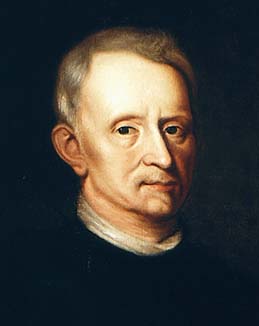
1876 CE
Kühne coins the term 'enzyme'
German physiologist Wilhelm Kühne proposes the word 'enzyme' (from Greek 'in yeast') to describe the unorganized ferments in cells, distinguishing them from organized ferments like bacteria. This terminology becomes standard. #enzymes #biochemistry
Kühne coins the term 'enzyme' By Carl Lange Heidelberg - HeidICON via Prometheus, CC BY-SA 4.0, https://commons.wikimedia.org/w/index.php?curid=64103923
1890 CE
Fischer proposes lock-and-key model
Emil Fischer, based on studies of sugar and enzyme specificity, proposes the 'lock-and-key' hypothesis for enzyme-substrate interaction. This model becomes a cornerstone of enzymology. #enzymes #biochemistry
Fischer proposes lock-and-key model By Trougnouf - Own work, CC BY 4.0, https://commons.wikimedia.org/w/index.php?curid=65582711
1897 CE
Buchner discovers cell-free fermentation
Eduard Buchner extracts a cell-free preparation from yeast that can ferment sugar, showing that fermentation is catalyzed by enzymes (zymase) rather than living cells. This wins him the Nobel Prize in Chemistry (1907) and launches modern biochemistry. #biochemistry #enzymes
Buchner discovers cell-free fermentation By Unknown author - http://www.nobelprize.org/nobel_prizes/chemistry/laureates/1907/buchner.html, Public domain, https://commons.wikimedia.org/w/index.php?curid=18253176
1913 CE
Michaelis-Menten equation derived
Leonor Michaelis and Maud Menten publish their mathematical model for enzyme kinetics, relating reaction rate to substrate concentration. The Michaelis constant (Km) remains fundamental in biochemistry. #enzymology #biochemistry
Michaelis-Menten equation derived By Athel cb - Own work, CC BY-SA 4.0, https://commons.wikimedia.org/w/index.php?curid=130422583
1922 CE
Banting and Best isolate insulin
Frederick Banting, Charles Best, and colleagues extract insulin from dog pancreas, demonstrating its role in blood sugar regulation. This milestone in biochemistry leads to treatment for diabetes. #biochemistry #medicine
Banting and Best isolate insulin By User:AtikaAtikawa - Own work, CC BY-SA 4.0, https://commons.wikimedia.org/w/index.php?curid=107840330
1926 CE
Sumner crystallizes urease
James B. Sumner crystallizes the enzyme urease from jack beans, proving that enzymes are proteins. Initially met with skepticism, his work earns the 1946 Nobel Prize in Chemistry. #enzymes #biochemistry
Sumner crystallizes urease By Unknown author - http://www.nobelprize.org/nobel_prizes/chemistry/laureates/1946/sumner.html, Public domain, https://commons.wikimedia.org/w/index.php?curid=18260359
1928 CE
Fleming discovers lysozyme
Alexander Fleming identifies lysozyme, an enzyme in tears and saliva that breaks down bacterial cell walls. This discovery of antibacterial enzymes opens new avenues in biochemistry. #enzymes #biochemistry
Fleming discovers lysozyme By Yikrazuul - Own work, CC BY-SA 3.0, https://commons.wikimedia.org/w/index.php?curid=204021
1932 CE
Krebs and Henseleit discover urea cycle
Hans Krebs and Kurt Henseleit elucidate the urea cycle, the first metabolic cycle discovered. This work establishes the concept of metabolic pathways in biochemistry. #metabolism #biochemistry
1937 CE
Krebs cycle (citric acid cycle) elucidated
Hans Krebs discovers the tricarboxylic acid cycle (Krebs cycle), the central metabolic pathway for cellular respiration. This breakthrough integrates carbohydrate, fat, and protein metabolism. #biochemistry #metabolism
Krebs cycle (citric acid cycle) elucidated By Narayanese, WikiUserPedia, YassineMrabet, TotoBaggins - http://biocyc.org/META/NEW-IMAGE?type=PATHWAY&object=TCA. Image adapted from Image:Citric acid cycle noi.svg, CC BY-SA 3.0, https://commons.wikimedia.org/w/index.php?curid=6217701
1940 CE
Lipmann discovers coenzyme A
Fritz Lipmann isolates coenzyme A (CoA), a key cofactor in cellular metabolism. He later describes the role of ATP in energy transfer, earning the 1953 Nobel Prize. #biochemistry #coenzyme
Lipmann discovers coenzyme A By NEUROtiker - Own work, Public domain, https://commons.wikimedia.org/w/index.php?curid=1555660
1948 CE
Pauling proposes protein secondary structure
Linus Pauling, using X-ray diffraction and model building, discovers the alpha-helix and beta-sheet as fundamental protein secondary structures. His work revolutionizes structural biochemistry. #proteins #biochemistry
Pauling proposes protein secondary structure By Theislikerice - Own work, CC BY-SA 4.0, https://commons.wikimedia.org/w/index.php?curid=81729199
1951 CE
Anfinsen's paradox and protein folding
Christian Anfinsen demonstrates that the amino acid sequence of ribonuclease determines its folded structure, winning the 1972 Nobel Prize. His work introduces the concept of thermodynamic control of protein folding. #proteins #biochemistry
Anfinsen's paradox and protein folding By Hubbard, Edward A.; National Institutes of Health - http://profiles.nlm.nih.gov/KK/B/B/B/G/, Public domain, https://commons.wikimedia.org/w/index.php?curid=2949195
1955 CE
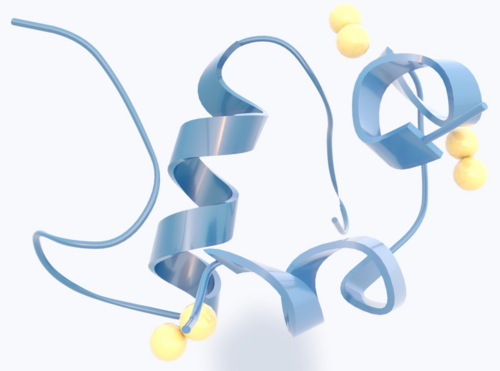
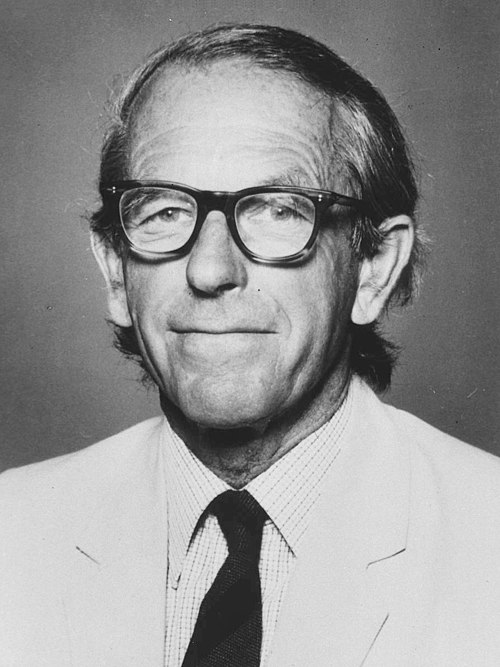
Sanger sequences insulin
Frederick Sanger determines the complete amino acid sequence of insulin, the first protein to be sequenced. This demonstrates that proteins have a defined primary structure and wins him the 1958 Nobel Prize in Chemistry. #proteins #biochemistry
Sanger sequences insulin By Unknown author, Public domain, https://commons.wikimedia.org/w/index.php?curid=1249932
1956 CE
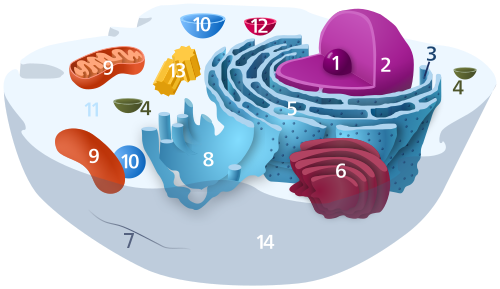
DeDuve discovers lysosomes
Christian de Duve identifies lysosomes as cellular organelles containing hydrolytic enzymes. This discovery advances understanding of intracellular digestion and enzyme compartmentalization. #cell_biology #enzymes
DeDuve discovers lysosomes By Kelvinsong - Own work, CC0, https://commons.wikimedia.org/w/index.php?curid=22952603
1958 CE
Kornberg synthesizes DNA in vitro
Arthur Kornberg discovers DNA polymerase I and achieves the first cell-free synthesis of DNA, showing how enzymes replicate genetic material. He shares the 1959 Nobel Prize in Medicine. #DNA #biochemistry
Kornberg synthesizes DNA in vitro By NIH History Office, https://www.flickr.com/people/124413887@N04 Restored by: Bammesk - https://www.flickr.com/photos/historyatnih/30828410210/, Public domain, https://commons.wikimedia.org/w/index.php?curid=90604243
1961 CE
Monod and Jacob propose operon model
Jacques Monod and François Jacob introduce the operon model of gene regulation in bacteria, revealing how enzymes are controlled at the genetic level. This work wins the 1965 Nobel Prize. #genetics #biochemistry
1962 CE
Perutz solves hemoglobin structure
Max Perutz determines the three-dimensional structure of hemoglobin using X-ray crystallography, revealing the mechanism of cooperative oxygen binding. This milestone in structural biology earns him the 1962 Nobel Prize. #structuralbiology #biochemistry
Perutz solves hemoglobin structure By Zephyris at English Wikipedia - Transferred from en.wikipedia to Commons., CC BY-SA 3.0, https://commons.wikimedia.org/w/index.php?curid=2300973
1965 CE
Phillips solves lysozyme structure
David Phillips and colleagues determine the first high-resolution enzyme structure (lysozyme) by X-ray crystallography, showing the active site and catalytic mechanism. This ushers in the era of enzyme structural biology. #enzymes #structuralbiology
1967 CE
Boyer and Walker describe ATP synthase
Paul D. Boyer and John E. Walker elucidate the binding-change mechanism of ATP synthase, the enzyme that generates ATP. Their work explains the molecular basis of oxidative phosphorylation. #biochemistry #energy
Boyer and Walker describe ATP synthase By Alex.X - enWiki (PDB.org for coordinate), CC BY-SA 3.0, https://commons.wikimedia.org/w/index.php?curid=1618502
1969 CE
Merrifield develops solid-phase peptide synthesis
Bruce Merrifield invents solid-phase peptide synthesis, enabling automated production of peptides and proteins. This method becomes essential for enzyme engineering and drug development. #biochemistry #synthesis
Merrifield develops solid-phase peptide synthesis By Dann Kristoff - Own work, CC BY-SA 4.0, https://commons.wikimedia.org/w/index.php?curid=48220584
1970 CE
Smith discovers restriction enzymes
Hamilton Smith isolates the first restriction enzyme, HindII, showing that bacteria produce enzymes that cut DNA at specific sequences. This discovery enables recombinant DNA technology. #molecularbiology #enzymes
1972 CE
Fersht establishes enzyme kinetics on stable isotopes
Alan Fersht develops methods using stable isotopes to study enzyme mechanisms, providing detailed insight into transition states and catalytic strategies. His work greatly advances physical enzymology. #enzymes #kinetics
Fersht establishes enzyme kinetics on stable isotopes By Athel cb - Own work, CC BY-SA 4.0, https://commons.wikimedia.org/w/index.php?curid=119076344
1975 CE
Sanger develops dideoxy sequencing method
Frederick Sanger invents the dideoxy chain-termination method for DNA sequencing, which becomes the standard for decades. This technique relies on DNA polymerase and dideoxynucleotides. #DNA #sequencing
Sanger develops dideoxy sequencing method By Estevezj - Own work, CC BY-SA 3.0, https://commons.wikimedia.org/w/index.php?curid=23264166
1981 CE
Cech discovers ribozymes
Thomas Cech finds that the self-splicing intron of Tetrahymena rRNA is catalytic RNA, proving RNA can act as an enzyme. This discovery of ribozymes wins the 1989 Nobel Prize and reshapes views on early life. #ribozyme #biochemistry
Cech discovers ribozymes By William G. Scott - Own work, CC BY-SA 3.0, https://commons.wikimedia.org/w/index.php?curid=2257831
1983 CE
Mullis invents PCR
Kary Mullis develops the polymerase chain reaction (PCR), using a thermostable DNA polymerase (Taq) to amplify DNA millions of fold. PCR revolutionizes molecular biology and diagnostics. #biotechnology #enzymes
Mullis invents PCR By Madprime - Own work, CC0, https://commons.wikimedia.org/w/index.php?curid=2104468
1985 CE
Smith and Temple use site-directed mutagenesis
Michael Smith and colleagues develop site-directed mutagenesis to introduce specific mutations in genes, allowing functional study of enzyme residues. Smith shares the 1993 Nobel Prize in Chemistry. #geneticengineering #enzymes
1990 CE
Arnold pioneers directed evolution
Frances Arnold introduces directed evolution of enzymes, using iterative mutagenesis and selection to create proteins with novel functions. This method earns her the 2018 Nobel Prize in Chemistry. #enzymeengineering #biochemistry
Arnold pioneers directed evolution By Thomas Shafee - Thomas, Shafee, (2014). "Evolvability of a viral protease: experimental evolution of catalysis, robustness and specificity". PhD Thesis. University of Cambridge., CC BY 4.0, https://commons.wikimedia.org/w/index.php?curid=37193303
1993 CE
Smith and Winter develop phage display
George P. Smith and Gregory Winter develop phage display technology, enabling the evolution of antibodies and enzymes on phage surfaces. This wins the 2018 Nobel Prize in Chemistry. #biotechnology #enzymes
Smith and Winter develop phage display By Thomas Shafee - Own work, CC BY 4.0, https://commons.wikimedia.org/w/index.php?curid=79128254
1998 CE
Kohn and Dill develop protein folding models
David Kohn and Ken Dill advance computational models for protein folding, including lattice models and hydrophobicity scales, improving prediction of enzyme structure. #proteins #computationalbiochemistry
Kohn and Dill develop protein folding models By Holger87 - Own work, CC BY-SA 3.0, https://commons.wikimedia.org/w/index.php?curid=20899169
2000 CE
Human Genome Project draft published
The International Human Genome Sequencing Consortium publishes a working draft of the human genome, enabling genome-wide studies of enzymes and metabolic pathways. This milestone accelerates systems biochemistry. #genomics #biochemistry
Human Genome Project draft published By U.S. Department of Energy, Human Genome Project - http://www.ornl.gov/hgmis, Public domain, https://commons.wikimedia.org/w/index.php?curid=2485616
2005 CE
Shendure and Church develop next-generation sequencing
Jay Shendure and George Church pioneer massively parallel sequencing, drastically increasing throughput for DNA sequencing. This technology enables large-scale enzyme discovery and metagenomics. #sequencing #biotechnology
2009 CE
Zhang develops optogenetic tools
Edward Boyden and Feng Zhang engineer light-sensitive proteins (channelrhodopsins) to control neuronal activity, opening new avenues for enzyme-based optogenetics. #optogenetics #enzymes
2010 CE
Gibson assembles synthetic genome
J. Craig Venter and colleagues create the first synthetic bacterial cell (Mycoplasma mycoides) with a synthetic genome, demonstrating large-scale DNA synthesis and enzyme-mediated assembly. #syntheticbiology #biochemistry
Gibson assembles synthetic genome By Alexander van Dijk from San Francisco, United States - Synthetic Biology Research at NASA Ames, CC BY 2.0, https://commons.wikimedia.org/w/index.php?curid=26376516
2012 CE
Doudna and Charpentier develop CRISPR-Cas9
Jennifer Doudna and Emmanuelle Charpentier demonstrate that the Cas9 endonuclease can be reprogrammed with guide RNA to cut specific DNA sequences. This RNA-guided enzyme revolutionizes gene editing, winning the 2020 Nobel Prize in Chemistry. #geneediting #enzymes
Doudna and Charpentier develop CRISPR-Cas9 By Deposition authors: Nishimasu, H., Ishitani, R., Nureki, O.; Visualization author: Synpath - Atom coordinates: https://www.rcsb.org/structure/4OO8; Visualization: Own work, CC0, https://commons.wikimedia.org/w/index.php?curid=133423568
2014 CE
Ban et al. solve ribosome structure
Nenad Ban, Peter Moore, and Thomas Steitz determine the atomic structure of the ribosome using X-ray crystallography, revealing the enzyme's active site (peptidyl transferase). This wins the 2009 Nobel Prize. #ribosome #structuralbiology
Ban et al. solve ribosome structure By Vossman - Own work, CC BY-SA 3.0, https://commons.wikimedia.org/w/index.php?curid=6865434
2015 CE
Frank wins Nobel for cryo-EM advances
Joachim Frank, Jacques Dubochet, and Richard Henderson develop cryo-electron microscopy for high-resolution structure determination of enzymes. This technique enables visualization of dynamic enzyme complexes. #structuralbiology #cryoem
Frank wins Nobel for cryo-EM advances By Hiramano92 - Own work, CC BY-SA 4.0, https://commons.wikimedia.org/w/index.php?curid=121225443
2018 CE
Arnold wins Nobel Prize for directed evolution
Frances Arnold is awarded the Nobel Prize in Chemistry for her pioneering work on directed evolution of enzymes, enabling the creation of new biocatalysts for industrial and medical applications. #directedevolution #enzymes
Arnold wins Nobel Prize for directed evolution By Christopher Michel - Own work, CC BY-SA 4.0, https://commons.wikimedia.org/w/index.php?curid=114693578
2020 CE
Doudna and Charpentier win Nobel for CRISPR-Cas9
Emmanuelle Charpentier and Jennifer Doudna receive the Nobel Prize in Chemistry for developing the CRISPR-Cas9 gene editing tool, an RNA-guided enzyme system that has transformed genetic research and therapy. #geneediting #nobelprize
Doudna and Charpentier win Nobel for CRISPR-Cas9 By Boghog - Own work, CC BY-SA 4.0, https://commons.wikimedia.org/w/index.php?curid=68597347