WW2/Battles of WW2/Hour-by-Hour • Curated by Admin Timeline.sg
Minute-by-minute development of the Battle of Midway (3–7 June 1942), the carrier engagement that broke Japanese naval superiority in the Pacific. All times are local Midway time (GMT-12). A Date-Time timeline: events carry a 24h hh:mm timestamp.
Chronological Storyline (31 Milestones)
Jun 3, 1942 CE
B-17s attack the invasion convoy
Nine Midway-based B-17 Flying Fortresses bomb the Japanese transport group from high altitude. They claim hits but achieve none — the first of many strikes the convoy shrugs off.
B-17 - Chino Airshow 2014 By Airwolfhound - commons file, CC BY-SA 2.0, https://commons.wikimedia.org/w/index.php?curid=70277974
Jun 3, 1942 CE
PBY sights the Japanese invasion force
Ensign Jack Reid, piloting a PBY Catalina from Midway, spots the Japanese transport group about 580 miles west of the atoll and radios "Sighted main body" — in fact the invasion convoy, not Nagumo’s carriers.
USS Yorktown (CV-5) is hit on the port side, amidships, by a Japanese Type 91 aerial torpedo during the mid-afternoon attack by planes from the carrier Hiryu, in the Battle of Midway, on 4 June, 1942. Yorktown is heeling to port and is seen at a different aspect than in other views taken by USS Pensacola (CA-24), indicating that this is the second of the two torpedo hits she received. Note very heavy anti-aircraft fire. By USN, photographed from USS Pensacola (CA-24) - Official U.S. Navy Photograph 80-G-414423, U.S. National Archives., Public domain, https://commons.wikimedia.org/w/index.php?curid=522315
Jun 4, 1942 CE
Torpedo Squadron 8 attacks alone
Hornet’s VT-8 under Lieutenant Commander John Waldron finds the Japanese carriers and attacks without fighter cover. All 15 TBD Devastators are shot down; Ensign George Gay is the sole survivor.
Pilots of the U.S. Navy Torpedo Squadron 8 (VT-8) aboard the aircraft carrier USS Hornet (CV-8) in May 1942, shortly before battle of Midway. Standing (L-R): Lieutenant James C. Owens, Ensign Eddy L. Fayle (transferred), Lieutenant Commander John C. Waldron (Squadron Commanding Officer), Lieutenant Raymond A. Moore, Ensign Ulvert M. Moore, Ensign William R. Evans, Ensign Grant W. Teats, Lieutenant (Junior Grade) George M. Campbell. Kneeling (L-R): Ensign Harold J. Ellison, Ensign Henry R. Kenyon, Ensign John P. Gray, Ensign George H. Gay (rescued), Lieutenant (Junior Grade) Jeff D. Woodson, Ensign William W. Creamer, Aviation Pilot First Class Robert B. Miles. By Credited on page 17 as a U.S. Navy photo - Self scan of Life, August 31, 1942, pp. 70–71 Individuals are identified via NH 93595 Torpedo Squadron Eight (VT-8) Pilots, Public domain, https://commons.wikimedia.org/w/index.php?curid=179477602
Jun 4, 1942 CE
Nagumo reverses: rearm with torpedoes
Nagumo suspends the Midway rearming and orders aircraft rearmed again with torpedoes for a naval strike. Bombs, torpedoes and fuel lines now litter the carriers’ hangar decks.
Title: "Vice Admiral Chuichi Nagumo". Imperial Japanese Navy Portrait photograph, taken circa 1941-42, when he was commander of the First Air Fleet. Original photograph was in the files of Rear Admiral Samuel Eliot Morison, USNR. U.S. Naval History and Heritage Command Photograph. By Unknown author - Naval History and Heritage Command - Photo NH 63423 - http://www.history.navy.mil/our-collections/photography/numerical-list-of-images/nhhc-series/nh-series/NH-63000/NH-63423.html, Public domain, https://commons.wikimedia.org/w/index.php?curid=43777
Jun 4, 1942 CE
VMF-221 intercepts — and is shredded
Marine fighter squadron VMF-221, flying obsolete F2A Buffaloes and a few F4F Wildcats, intercepts the raid. Of 25 fighters, 13 are shot down and 4 more badly damaged by the escorting Zeros.
VMF-221 intercepts — and is shredded By Unknown author - http://patchmart.com/Merchant2/merchant.mvc?Screen=CTGY&Store_Code=P&Category_Code=USMCAviationPatches, Public domain, https://commons.wikimedia.org/w/index.php?curid=14926434
Jun 4, 1942 CE
Kidō Butai turns to fight the US fleet
Having recovered the Midway strike, Nagumo turns his carriers northeast to close with and destroy the American task forces once his rearmed strike is ready. He never gets the chance to launch it.
Title: "Vice Admiral Chuichi Nagumo". Imperial Japanese Navy Portrait photograph, taken circa 1941-42, when he was commander of the First Air Fleet. Original photograph was in the files of Rear Admiral Samuel Eliot Morison, USNR. U.S. Naval History and Heritage Command Photograph. By Unknown author - Naval History and Heritage Command - Photo NH 63423 - http://www.history.navy.mil/our-collections/photography/numerical-list-of-images/nhhc-series/nh-series/NH-63000/NH-63423.html, Public domain, https://commons.wikimedia.org/w/index.php?curid=43777
Jun 4, 1942 CE
Two torpedoes stop Yorktown
Hiryū’s second strike, led by Tomonaga (flying with a one-way fuel load), puts two torpedoes into Yorktown. Listing hard and without power, she is ordered abandoned shortly before 15:00.
The U.S. Navy aircraft carrier USS Yorktown (CV-5) underway, on 21 July 1937. By U.S. Navy photo 19-N-17424 - This tag does not indicate the copyright status of the attached work. A normal copyright tag is still required. See Commons:Licensing., Public domain, https://commons.wikimedia.org/w/index.php?curid=6411792
Jun 4, 1942 CE
Midway radar detects the incoming raid
Radar on Midway picks up the Japanese strike 93 miles out. Every flyable aircraft on the atoll scrambles — fighters to intercept, bombers to get out from under the attack and hit the carriers.
USS Yorktown (CV-5) is hit on the port side, amidships, by a Japanese Type 91 aerial torpedo during the mid-afternoon attack by planes from the carrier Hiryu, in the Battle of Midway, on 4 June, 1942. Yorktown is heeling to port and is seen at a different aspect than in other views taken by USS Pensacola (CA-24), indicating that this is the second of the two torpedo hits she received. Note very heavy anti-aircraft fire. By USN, photographed from USS Pensacola (CA-24) - Official U.S. Navy Photograph 80-G-414423, U.S. National Archives., Public domain, https://commons.wikimedia.org/w/index.php?curid=522315
Jun 4, 1942 CE
Nagumo launches the Midway strike
Vice Admiral Chūichi Nagumo’s four carriers — Akagi, Kaga, Hiryū and Sōryū — begin launching 108 aircraft against Midway Atoll, holding a second wave in reserve armed for ships.
Title: "Vice Admiral Chuichi Nagumo". Imperial Japanese Navy Portrait photograph, taken circa 1941-42, when he was commander of the First Air Fleet. Original photograph was in the files of Rear Admiral Samuel Eliot Morison, USNR. U.S. Naval History and Heritage Command Photograph. By Unknown author - Naval History and Heritage Command - Photo NH 63423 - http://www.history.navy.mil/our-collections/photography/numerical-list-of-images/nhhc-series/nh-series/NH-63000/NH-63423.html, Public domain, https://commons.wikimedia.org/w/index.php?curid=43777
Jun 4, 1942 CE
Hiryū strikes back
The untouched Hiryū launches 18 dive bombers and 6 fighters under Lieutenant Michio Kobayashi, following the retiring American aircraft home toward Yorktown.
A photo of the construction after the completion Japanese Navy aircraft carrier "Hiryu" in Yokosuka naval port. By Unknown - Photo from the Archives of the Kure Maritime Museum., Public domain, https://commons.wikimedia.org/w/index.php?curid=3569186
Jun 4, 1942 CE
Kaga sinks
Kaga, gutted by fires that killed some 800 of her crew, is scuttled by torpedoes from destroyer Hagikaze and slips under twelve minutes after Sōryū.
Imperial Japanese Navy Carrier Kaga: photo taken after her massive refitting. Its smokestack is directed downwards to extinguish the smoke with seawater. By Mr Fukami - Photo is taken from the original exhibit at the Yamato Museum.[1], Public domain, https://commons.wikimedia.org/w/index.php?curid=3563232
Jun 4, 1942 CE
Hiryū caught and crippled
Twenty-four Enterprise dive bombers — including orphaned Yorktown aircraft — catch Hiryū as her exhausted crews prepare a dusk strike, and hit her with four bombs. The last of Nagumo’s four carriers is ablaze.
A photo of the construction after the completion Japanese Navy aircraft carrier "Hiryu" in Yokosuka naval port. By Unknown - Photo from the Archives of the Kure Maritime Museum., Public domain, https://commons.wikimedia.org/w/index.php?curid=3569186
Jun 4, 1942 CE
Yorktown takes three bombs
Kobayashi’s dive bombers fight through Wildcats and flak to hit Yorktown three times, knocking out her boilers. Damage control has her steaming again within the hour — so effective the next Japanese strike thinks she is a different, undamaged carrier.
The U.S. Navy aircraft carrier USS Yorktown (CV-5) underway, on 21 July 1937. By U.S. Navy photo 19-N-17424 - This tag does not indicate the copyright status of the attached work. A normal copyright tag is still required. See Commons:Licensing., Public domain, https://commons.wikimedia.org/w/index.php?curid=6411792
Jun 4, 1942 CE
The fatal five minutes: Kaga and Akagi hit
Enterprise dive bombers under Lieutenant Commander Wade McClusky, arriving high and unopposed, plant bombs into Kaga and Akagi. Fueled and armed aircraft on their decks turn both carriers into infernos within minutes.
Captain Clarence Wade McClusky, Jr., USN. Photo #: NH 93189 By US Navy - Downloaded from http://www.history.navy.mil/photos/pers-us/uspers-m/c-mcclsk.htm., Public domain, https://commons.wikimedia.org/w/index.php?curid=2729434
Jun 4, 1942 CE
VT-6 presses the attack
Enterprise’s Torpedo Squadron 6 attacks next, losing 10 of 14 Devastators. Like VT-8 it scores no hits — but the low-level torpedo attacks drag the Japanese fighter cover down to sea level.
VT-6 Shooters insignia. By e2a2j - US Navy, Public domain, https://commons.wikimedia.org/w/index.php?curid=4351089
Jun 4, 1942 CE
Sōryū goes down
Torpedoed by her own escorting destroyers after burning for nine hours, Sōryū sinks with 711 of her crew, including Captain Ryūsaku Yanagimoto, who chose to go down with his ship.
日本海軍航空母艦「蒼龍」。千葉県館山沖にて公試中の写真。Imperial Japanese Navy aircraft carrier Soryu rushed on trials, Tateyama, Chiba Prefecture. By 不明。Unknown - 広島県呉市海事歴史科学館所蔵品。Photo from the Archives of the Kure Maritime Museum., Public domain, https://commons.wikimedia.org/w/index.php?curid=3569158
Jun 4, 1942 CE
"Enemy carriers" — the sighting report
A patrolling PBY radios the electrifying contact report "enemy carriers", followed by "many planes heading Midway". The US carriers finally know roughly where Nagumo is.
PBY Catalina in flight By Filipe Sousa - RIHB 2022 | PBY Catalina, Public domain, https://commons.wikimedia.org/w/index.php?curid=139498802
Jun 4, 1942 CE
The raid hits Midway
Japanese bombs wreck the seaplane hangar, oil tanks and barracks on Midway, but the runways remain usable and the island’s anti-aircraft guns keep firing — Midway is hurt, not neutralized.
USS Yorktown (CV-5) is hit on the port side, amidships, by a Japanese Type 91 aerial torpedo during the mid-afternoon attack by planes from the carrier Hiryu, in the Battle of Midway, on 4 June, 1942. Yorktown is heeling to port and is seen at a different aspect than in other views taken by USS Pensacola (CA-24), indicating that this is the second of the two torpedo hits she received. Note very heavy anti-aircraft fire. By USN, photographed from USS Pensacola (CA-24) - Official U.S. Navy Photograph 80-G-414423, U.S. National Archives., Public domain, https://commons.wikimedia.org/w/index.php?curid=522315
Jun 4, 1942 CE
Midway’s bombers strike back
Torpedo-armed B-26 Marauders and TBF Avengers from Midway attack the Japanese carriers without fighter escort. Most are shot down; no torpedo finds a target — but the attacks keep Nagumo off balance.
A U.S. Army Air Forces Martin B-26B-55-MA Marauder (s/n 42-96142). The aircraft was assigned to the 596th Bombardment Squadron, 397th Bombardment Group, 98th Bombardment Wing, 9th Bomber Command, 9th Air Force in Europe. "X2-A" was named "Dee-Feater" and carries numerous mission markers, and D-Day invasion stripes. The 397th BG was stationed starting 15 April 1944 at Rivenhall, Essex (UK), and moved to Hurn, Hampshire, on 4 August 1944. On 30th August 1944 the Group was relocated to France. By Photo by: Charles E. Brown. The original uploader was Bzuk at English Wikipedia., 2007-02-14 (original upload date) - USAAF; Originally from en.wikipedia; description page is/was here, source WW2 in Color., Public domain, https://commons.wikimedia.org/w/index.php?curid=2053969
Jun 4, 1942 CE
Nagumo orders bombers rearmed for Midway
Convinced no US ships are near, Nagumo orders his reserve aircraft — armed with torpedoes for ships — struck below and rearmed with land bombs for a second Midway strike. The fateful shuffle begins.
Title: "Vice Admiral Chuichi Nagumo". Imperial Japanese Navy Portrait photograph, taken circa 1941-42, when he was commander of the First Air Fleet. Original photograph was in the files of Rear Admiral Samuel Eliot Morison, USNR. U.S. Naval History and Heritage Command Photograph. By Unknown author - Naval History and Heritage Command - Photo NH 63423 - http://www.history.navy.mil/our-collections/photography/numerical-list-of-images/nhhc-series/nh-series/NH-63000/NH-63423.html, Public domain, https://commons.wikimedia.org/w/index.php?curid=43777
Jun 4, 1942 CE
"There is need for a second attack"
Strike leader Lieutenant Jōichi Tomonaga radios Nagumo that another strike on Midway is needed. At the same hour, Admiral Spruance’s Task Force 16 begins launching everything it has at the Japanese carriers.
Jun 4, 1942 CE
Tone’s floatplane: "10 enemy surface ships"
The late-launched No. 4 scout plane from cruiser Tone reports ten enemy surface ships northeast of Midway — the first hint that the US fleet is at sea. Its vague report omits the one thing that matters: carriers.
Jun 4, 1942 CE
"Appears to be accompanied by a carrier"
Tone’s scout amends its report: the American force appears to include a carrier. The news lands on Nagumo’s bridge like a bomb — his own decks are in no state to launch an immediate strike.
Jun 4, 1942 CE
VT-3 draws down the last of the Zeros
Yorktown’s VT-3 begins its run, suffering the same slaughter. With the entire Japanese combat air patrol pulled down chasing torpedo planes, the sky above the carriers is left undefended.
Jun 4, 1942 CE
Sōryū set ablaze
Almost simultaneously, Yorktown’s VB-3 under Lieutenant Commander Max Leslie hits Sōryū with three bombs. In five minutes three of Japan’s six fleet carriers are burning and out of the war.
Jun 5, 1942 CE
Akagi scuttled at dawn
Nagumo’s burned-out flagship Akagi is scuttled by destroyer torpedoes on Yamamoto’s reluctant order — the first Japanese warship ever deliberately sunk by her own navy’s torpedoes.
Japanese aircraft carrier Akagi in April, 1942 during the Indian Ocean Raid as seen from an aircraft that has just taken off from her deck. The aircraft on the flight deck preparing for takeoff are Aichi D3A Type 99 dive bombers. By Japanese Navy - Kure Maritime Museum, (edited by Kazushige Todaka), Japanese Naval Warship Photo Album: Aircraft carrier and Seaplane carrier, p. 24, Public domain, https://commons.wikimedia.org/w/index.php?curid=1127487
Jun 5, 1942 CE
Hiryū sinks
Hiryū, scuttled before dawn but stubbornly afloat for hours, finally goes down. Rear Admiral Tamon Yamaguchi — considered Yamamoto’s likeliest successor — remains aboard by choice and is lost with her.
Jun 5, 1942 CE
Yamamoto cancels the operation
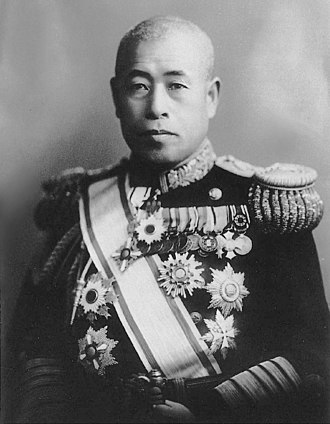
With his carrier striking force destroyed and the Americans refusing a night surface action, Admiral Isoroku Yamamoto orders the invasion of Midway abandoned and a general retirement west.
Portrait of Yamamoto Isoroku (1884 – 1943) during his time as Commander-in-Chief of the Combined Fleet of the Imperial Japanese Navy. By Unknown author - This image is available from the website of the National Diet Library, Public domain, https://commons.wikimedia.org/w/index.php?curid=33544815
Jun 6, 1942 CE
Cruiser Mikuma pounded under
Dive bombers from Enterprise and Hornet leave the heavy cruiser Mikuma a burning wreck — she sinks that evening, the price of a collision during the fleet’s withdrawal. Her sister Mogami, mangled, limps home.
Jun 6, 1942 CE
I-168 torpedoes Yorktown and Hammann
Japanese submarine I-168 slips through the destroyer screen and fires four torpedoes at the salvage-underway Yorktown. Two hit the carrier; a third breaks the destroyer USS Hammann in half, sinking her in minutes.
Jun 7, 1942 CE
Yorktown sinks — the battle ends
At dawn USS Yorktown rolls over and sinks in 5,500 metres of water. The Battle of Midway is over: four Japanese fleet carriers sunk for one American, and the Pacific war’s momentum reversed in a single morning.
The U.S. Navy aircraft carrier USS Yorktown (CV-5) underway, on 21 July 1937. By U.S. Navy photo 19-N-17424 - This tag does not indicate the copyright status of the attached work. A normal copyright tag is still required. See Commons:Licensing., Public domain, https://commons.wikimedia.org/w/index.php?curid=6411792