WW2/Battles of WW2/Date-by-Date/European Theatre – West • Curated by Admin Timeline.sg
The six-week German invasion that broke through the Ardennes, encircled the Allied armies, forced the Dunkirk evacuation, and knocked France out of the war. (10 May – 25 June 1940)
Chronological Storyline (26 Milestones)
May 10, 1940 CE
Germany invades the Low Countries
German forces launched Fall Gelb, invading the Netherlands, Belgium, and Luxembourg, drawing Allied armies northward as planned, while the main Panzer thrust waited in the Ardennes. · Wikipedia: https://en.wikipedia.org/wiki/Battle_of_France
For documentary purposes the German Federal Archive often retained the original image captions, which may be erroneous, biased, obsolete or politically extreme. Kriegsbeute By Unknown - This image was provided to Wikimedia Commons by the German Federal Archive (Deutsches Bundesarchiv) as part of a cooperation project. The German Federal Archive guarantees an authentic representation only using the originals (negative and/or positive), resp. the digitalization of the originals as provided by the Digital Image Archive., CC BY-SA 3.0 de, https://commons.wikimedia.org/w/index.php?curid=5416426The Battle of France 1940 (WW2 Documentary)
May 12, 1940 CE
Guderian crosses the Meuse at Sedan
Heinz Guderian's XIX Panzer Corps reached the Meuse River at Sedan, the critical crossing point through the Ardennes that the French had believed was impassable to armor. · Wikipedia: https://en.wikipedia.org/wiki/Battle_of_Sedan_(1940)
"M108/9 14 May 1940 1st Panzer Regiment crosses pontoon bridge over the Meuse at Floing, near Sedan [Army film office, Spandau-Ruhleben]" By Unknown author - This image was provided to Wikimedia Commons by the German Federal Archive (Deutsches Bundesarchiv) as part of a cooperation project. The German Federal Archive guarantees an authentic representation only using the originals (negative and/or positive), resp. the digitalization of the originals as provided by the Digital Image Archive., CC BY-SA 3.0 de, https://commons.wikimedia.org/w/index.php?curid=5482960
May 13, 1940 CE
German bridgeheads established at Sedan
German infantry and engineers crossed the Meuse under intense Luftwaffe air support, establishing bridgeheads at Sedan that shattered the French Ninth Army's defensive line. · Wikipedia: https://en.wikipedia.org/wiki/Battle_of_Sedan_(1940)
"M108/9 14 May 1940 1st Panzer Regiment crosses pontoon bridge over the Meuse at Floing, near Sedan [Army film office, Spandau-Ruhleben]" By Unknown author - This image was provided to Wikimedia Commons by the German Federal Archive (Deutsches Bundesarchiv) as part of a cooperation project. The German Federal Archive guarantees an authentic representation only using the originals (negative and/or positive), resp. the digitalization of the originals as provided by the Digital Image Archive., CC BY-SA 3.0 de, https://commons.wikimedia.org/w/index.php?curid=5482960
May 14, 1940 CE
French counterattack at Sedan fails
French armored counterattacks by the 3rd Armored Division against the Sedan bridgeheads were repulsed by German anti-tank defenses and Stuka dive-bombers, collapsing organized resistance. · Wikipedia: https://en.wikipedia.org/wiki/Battle_of_Sedan_(1940)
"M108/9 14 May 1940 1st Panzer Regiment crosses pontoon bridge over the Meuse at Floing, near Sedan [Army film office, Spandau-Ruhleben]" By Unknown author - This image was provided to Wikimedia Commons by the German Federal Archive (Deutsches Bundesarchiv) as part of a cooperation project. The German Federal Archive guarantees an authentic representation only using the originals (negative and/or positive), resp. the digitalization of the originals as provided by the Digital Image Archive., CC BY-SA 3.0 de, https://commons.wikimedia.org/w/index.php?curid=5482960
May 15, 1940 CE
Dutch army surrenders
The Dutch army surrendered after the devastating bombing of Rotterdam, though Queen Wilhelmina and the government had already fled to London to continue the fight. ) · Wikipedia: https://en.wikipedia.org/wiki/Battle_of_the_Netherlands
"The German ultimatum ordering the Dutch commander of Rotterdam to cease fire was delivered to him at 10:30h on 14 May 1940. At 13:22h, German bombers set the whole inner city of Rotterdam ablaze, killing 814 of its inhabitants." The photo was taken after the removal of all debris. By Unknown author - https://www.archives.gov/research_room/arc/ ARC Identifier: 535916; U.S. Defense Visual Information Center photo HD-SN-99-02993 [1], Public domain, https://commons.wikimedia.org/w/index.php?curid=196261
May 16, 1940 CE
Panzer breakout from the Meuse
Guderian's panzers broke out westward from the Meuse bridgeheads, driving deep into France and beginning the race to the Channel coast, exploiting the gap between Allied armies. · Wikipedia: https://en.wikipedia.org/wiki/Manstein_Plan
Evolution of the Plan Gelb By Unknown author - https://web.archive.org/web/20030710041330/http://www.dean.usma.edu/history/web03/atlases/ww2%20europe/ww2%20europe%20pages/ww2%20europe%20map%2009.htm, Public domain, https://commons.wikimedia.org/w/index.php?curid=4182860
May 19, 1940 CE
Weygand replaces Gamelin as French commander
General Maxime Weygand replaced Maurice Gamelin as French commander-in-chief, inheriting a deteriorating situation as German panzers raced toward the Channel. ) · Wikipedia: https://en.wikipedia.org/wiki/Maxime_Weygand
Portrait en pied du général Maxime Weygand. By Unknown author - This file comes from Gallica Digital Library and is available under the digital ID btv1b103368405/f26, Public domain, https://commons.wikimedia.org/w/index.php?curid=94564449
May 20, 1940 CE
Panzers reach the English Channel
Guderian's 2nd Panzer Division reached Abbeville on the English Channel, completing the encirclement of the Allied armies in Belgium and severing their supply lines to the south. · Wikipedia: https://en.wikipedia.org/wiki/Battle_of_Abbeville
Situation on June 4, 1940 and actions since May 21 By The History Department of the United States Military Academy. - http://www.dean.usma.edu/history/web03/atlases/ww2%20europe/EuropeanTheaterGIF/WWIIEurope13.gif, Public domain, https://commons.wikimedia.org/w/index.php?curid=9764981
May 21, 1940 CE
Allied counterattack at Arras
British and French forces launched a counterattack at Arras, with British Matilda tanks briefly panicking German forces before being repulsed, confirming the encirclement was unbroken. · Wikipedia: https://en.wikipedia.org/wiki/Battle_of_Arras_(1940)
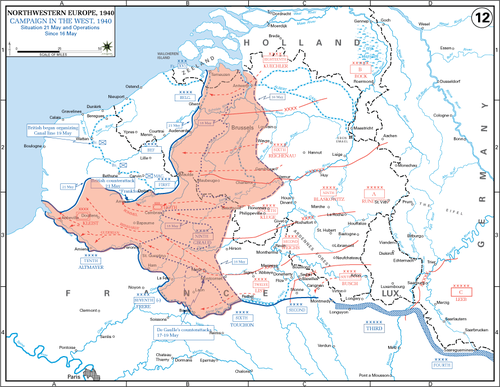
The German advance to the English Channel between 16 May and 21 May of 1940. By The History Department of the United States Military Academy - (Original text: http://www.dean.usma.edu/history/web03/atlases/ww2%20europe/EuropeanTheaterGIF/WWIIEurope12.gif) Archive link to original website used for the map and the archive link to the map source page. Current link to map, and link to map source page., Public domain, https://commons.wikimedia.org/w/index.php?curid=9764998
May 23, 1940 CE
Gort orders retreat to Dunkirk
British General Lord Gort, seeing the encirclement closing, ordered the BEF to retreat toward Dunkirk, the only remaining port for evacuation, without informing the French. ) · Wikipedia: https://en.wikipedia.org/wiki/John_Vereker%2C_6th_Viscount_Gort
General the Viscount Gort Vc, Gcb, Cbe, Dso, Mvo, Mc image: A head and shoulders portrait of Gort wearing uniform. By Reginald Grenville Eves - http://media.iwm.org.uk/iwm/mediaLib//142/media-142232/large.jpg This photograph Art.IWM ART LD 730 comes from the collections of the Imperial War Museums., Public domain, https://commons.wikimedia.org/w/index.php?curid=25313247
May 24, 1940 CE
Hitler halts the panzers at Dunkirk
Hitler ordered the panzers to halt outside Dunkirk, allowing the Luftwaffe to finish the encircled Allied armies, a decision that gave the Allies a critical window to organize evacuation. · Wikipedia: https://en.wikipedia.org/wiki/Halt_Order
May 26, 1940 CE
Operation Dynamo begins at Dunkirk
The Royal Navy launched Operation Dynamo to evacuate the BEF and French troops from Dunkirk, using destroyers and hundreds of civilian vessels to ferry soldiers across the Channel. ) · Wikipedia: https://en.wikipedia.org/wiki/Operation_Dynamo
Dunkirk 26-29 May 1940 British troops line up on the beach at Dunkirk to await evacuation. By Unknown author - http://media.iwm.org.uk/iwm/mediaLib//37/media-37332/large.jpg This photograph NYP 68075 comes from the collections of the Imperial War Museums., Public domain, https://commons.wikimedia.org/w/index.php?curid=25312782
May 28, 1940 CE
Belgian army surrenders
King Leopold III surrendered the Belgian army, removing the northern flank of the Allied position and accelerating the BEF's encirclement at Dunkirk. ) · Wikipedia: https://en.wikipedia.org/wiki/Belgium_in_World_War_II
For documentary purposes the German Federal Archive often retained the original image captions, which may be erroneous, biased, obsolete or politically extreme. Vor dem königlichen Schloß in Brüssel. Parade vor dem Führer einer Armee. Pro.Kp. 612 By Pincornelly - This image was provided to Wikimedia Commons by the German Federal Archive (Deutsches Bundesarchiv) as part of a cooperation project. The German Federal Archive guarantees an authentic representation only using the originals (negative and/or positive), resp. the digitalization of the originals as provided by the Digital Image Archive., CC BY-SA 3.0 de, https://commons.wikimedia.org/w/index.php?curid=5482860
May 29, 1940 CE
French Weygand Line established
General Weygand established a defensive line along the Somme and Aisne rivers, attempting to create a continuous front to halt the German advance southward after Dunkirk. · Wikipedia: https://en.wikipedia.org/wiki/Weygand_Line
Portrait en pied du général Maxime Weygand. By Unknown author - This file comes from Gallica Digital Library and is available under the digital ID btv1b103368405/f26, Public domain, https://commons.wikimedia.org/w/index.php?curid=94564449
Jun 1, 1940 CE
Dunkirk evacuation enters final phase
The evacuation at Dunkirk entered its final phase as German forces closed in, with over 200,000 troops already evacuated and the perimeter shrinking under artillery and air attack. · Wikipedia: https://en.wikipedia.org/wiki/Operation_Dynamo
Dunkirk 26-29 May 1940 British troops line up on the beach at Dunkirk to await evacuation. By Unknown author - http://media.iwm.org.uk/iwm/mediaLib//37/media-37332/large.jpg This photograph NYP 68075 comes from the collections of the Imperial War Museums., Public domain, https://commons.wikimedia.org/w/index.php?curid=25312782
Jun 4, 1940 CE
Dunkirk evacuation concludes
Operation Dynamo ended with 338,000 British and French troops evacuated, but the BEF abandoned nearly all its equipment, tanks, and heavy weapons on the beaches. ) · Wikipedia: https://en.wikipedia.org/wiki/Operation_Dynamo
Dunkirk 26-29 May 1940 British troops line up on the beach at Dunkirk to await evacuation. By Unknown author - http://media.iwm.org.uk/iwm/mediaLib//37/media-37332/large.jpg This photograph NYP 68075 comes from the collections of the Imperial War Museums., Public domain, https://commons.wikimedia.org/w/index.php?curid=25312782
Jun 5, 1940 CE
Fall Rot: German offensive south begins
Germany launched Fall Rot, the second phase of the offensive, attacking the Weygand Line along the Somme and Aisne with over 140 divisions against a weakened French army. · Wikipedia: https://en.wikipedia.org/wiki/Fall_Rot
Title: Paris, Parade auf der Champs Elysée For documentary purposes the German Federal Archive often retained the original image captions, which may be erroneous, biased, obsolete or politically extreme. Factual corrections and alternative descriptions are encouraged separately from the original description. Additionally errors can be reported at this page to inform the Bundesarchiv. Alemannisch | العربية | Boarisch | беларуская | беларуская (тарашкевіца) | català | čeština | Deutsch | English | Esperanto | español | suomi | français | हिन्दी | hrvatski | magyar | italiano | 한국어 | македонски | Plattdüütsch | polski | português | română | русский | sicilianu | slovenčina | slovenščina | svenska | українська | 中文 | 中文(简体) | 中文(繁體) | +/− Original historic description: Paris, Champs Elysée: Die Wache zieht auf. By Unknown - Deutsches Bundesarchiv (German Federal Archive), Bild 146-1994-036-09A, CC BY-SA 3.0 de, https://commons.wikimedia.org/w/index.php?curid=5483600
Jun 9, 1940 CE
Weygand Line collapses
The Weygand Line collapsed as German forces broke through on the Somme and Aisne, and the French government began evacuating Paris, declaring it an open city. · Wikipedia: https://en.wikipedia.org/wiki/Weygand_Line
Portrait en pied du général Maxime Weygand. By Unknown author - This file comes from Gallica Digital Library and is available under the digital ID btv1b103368405/f26, Public domain, https://commons.wikimedia.org/w/index.php?curid=94564449
Jun 10, 1940 CE
Italy declares war on France
Mussolini's Italy declared war on France and Britain, opening an Alpine front that further stretched French forces, though Italian gains were minimal before the armistice. ) · Wikipedia: https://en.wikipedia.org/wiki/Italian_invasion_of_France
The Alpini Battalion "Val Dora" of the 3rd Alpini Regiment in action in the Col de Pelouse during the Italian invasion of France in June 1940. By AnonymousUnknown author - L'illustrazione italiana 19 July 1942, Public domain, https://commons.wikimedia.org/w/index.php?curid=107166949
Jun 11, 1940 CE
Paris declared an open city
The French government declared Paris an open city to prevent its destruction, as General Weygand ordered a general retreat south of the Seine to avoid encirclement. · Wikipedia: https://en.wikipedia.org/wiki/Paris_in_World_War_II
Jun 14, 1940 CE
German forces enter Paris
German troops entered Paris unopposed, with the Wehrmacht marching down the Champs-Élysées and the swastika raised over the Eiffel Tower, marking the fall of the French capital. · Wikipedia: https://en.wikipedia.org/wiki/Paris_in_World_War_II
Jun 16, 1940 CE
Reynaud resigns, Pétain takes power
French Prime Minister Paul Reynaud resigned and was replaced by Marshal Philippe Pétain, who immediately sought an armistice, signaling France's intent to surrender. ) · Wikipedia: https://en.wikipedia.org/wiki/Philippe_P%C3%A9tain
Philippe Pétain. Photographie officielle couleur titrée sur papier, imprimerie Draeger, 1941. By Imprimerie Draeger à Montrouge en région parisienne) - Bibliothèque nationale de France, Public domain, https://commons.wikimedia.org/w/index.php?curid=165488246
Jun 17, 1940 CE
Pétain announces France will seek armistice
Marshal Pétain publicly announced France would seek an armistice with Germany, prompting thousands of refugees to flee south and the British to offer a union of nations, which France declined. · Wikipedia: https://en.wikipedia.org/wiki/Armistice_of_22_June_1940
Hitler (hand on side) and German high-ranked nazis and officers staring at WWI French marshall Maréchal Foch's memorial statue before entering the railway carriage in order to start the negotiations for the 1940 armistice at Rethondes in the Compiègne forest, France. The armistice will only be signed the next day (June 22), Hitler being absent, by General Keitel on the German side and by General Huntziger on the French side. Screenshot taken from the 1943 United States Army propaganda film Divide and Conquer (Why We Fight #3) directed by Frank Capra and partially based on news archives, animations, restaged scenes and captured propaganda material from both sides. By Frank Capra (film) - Divide and Conquer (Why We Fight #3) Public Domain (U.S. War Department): https://archive.org/details/DivideAndConquer, Public domain, https://commons.wikimedia.org/w/index.php?curid=1392555
Jun 20, 1940 CE
French government seeks armistice terms
The French government sent envoys to negotiate armistice terms with Germany, as German forces continued advancing south and the Maginot Line garrisons were being surrounded. · Wikipedia: https://en.wikipedia.org/wiki/Armistice_of_22_June_1940
Hitler (hand on side) and German high-ranked nazis and officers staring at WWI French marshall Maréchal Foch's memorial statue before entering the railway carriage in order to start the negotiations for the 1940 armistice at Rethondes in the Compiègne forest, France. The armistice will only be signed the next day (June 22), Hitler being absent, by General Keitel on the German side and by General Huntziger on the French side. Screenshot taken from the 1943 United States Army propaganda film Divide and Conquer (Why We Fight #3) directed by Frank Capra and partially based on news archives, animations, restaged scenes and captured propaganda material from both sides. By Frank Capra (film) - Divide and Conquer (Why We Fight #3) Public Domain (U.S. War Department): https://archive.org/details/DivideAndConquer, Public domain, https://commons.wikimedia.org/w/index.php?curid=1392555
Jun 22, 1940 CE
Armistice signed at Compiègne
France signed the armistice with Germany in the same railway carriage at Compiègne where the 1918 armistice was signed, dividing France into occupied and unoccupied zones. ) · Wikipedia: https://en.wikipedia.org/wiki/Armistice_of_22_June_1940
Hitler (hand on side) and German high-ranked nazis and officers staring at WWI French marshall Maréchal Foch's memorial statue before entering the railway carriage in order to start the negotiations for the 1940 armistice at Rethondes in the Compiègne forest, France. The armistice will only be signed the next day (June 22), Hitler being absent, by General Keitel on the German side and by General Huntziger on the French side. Screenshot taken from the 1943 United States Army propaganda film Divide and Conquer (Why We Fight #3) directed by Frank Capra and partially based on news archives, animations, restaged scenes and captured propaganda material from both sides. By Frank Capra (film) - Divide and Conquer (Why We Fight #3) Public Domain (U.S. War Department): https://archive.org/details/DivideAndConquer, Public domain, https://commons.wikimedia.org/w/index.php?curid=1392555
Jun 25, 1940 CE
Armistice takes effect, battle ends
The armistice took effect at 01:35, ending the Battle of France after six weeks of fighting, with Germany occupying northern and western France and Pétain leading a collaborationist regime from Vichy. · Wikipedia: https://en.wikipedia.org/wiki/Armistice_of_22_June_1940
Hitler (hand on side) and German high-ranked nazis and officers staring at WWI French marshall Maréchal Foch's memorial statue before entering the railway carriage in order to start the negotiations for the 1940 armistice at Rethondes in the Compiègne forest, France. The armistice will only be signed the next day (June 22), Hitler being absent, by General Keitel on the German side and by General Huntziger on the French side. Screenshot taken from the 1943 United States Army propaganda film Divide and Conquer (Why We Fight #3) directed by Frank Capra and partially based on news archives, animations, restaged scenes and captured propaganda material from both sides. By Frank Capra (film) - Divide and Conquer (Why We Fight #3) Public Domain (U.S. War Department): https://archive.org/details/DivideAndConquer, Public domain, https://commons.wikimedia.org/w/index.php?curid=1392555

!["M108/9 14 May 1940 1st Panzer Regiment crosses pontoon bridge over the Meuse at Floing, near Sedan [Army film office, Spandau-Ruhleben]"](https://upload.wikimedia.org/wikipedia/commons/thumb/9/96/Bundesarchiv_Bild_146-1978-062-24%2C_Floing%2C_Pontonbr%C3%BCcke_%C3%BCber_die_Maas.jpg/500px-Bundesarchiv_Bild_146-1978-062-24%2C_Floing%2C_Pontonbr%C3%BCcke_%C3%BCber_die_Maas.jpg)