WW2/Battles of WW2/Date-by-Date/European Theatre – West • Curated by Admin Timeline.sg
The air campaign in which RAF Fighter Command denied the Luftwaffe air superiority over southern England, forcing Hitler to postpone the invasion of Britain. (10 July – 31 October 1940)
Chronological Storyline (23 Milestones)
Jul 10, 1940 CE
Kanalkampf begins over English Channel
The Luftwaffe launched attacks on British coastal shipping convoys in the English Channel, initiating the Kanalkampf phase and testing RAF Fighter Command's response capabilities. · Wikipedia: https://en.wikipedia.org/wiki/Battle_of_Britain
Battle of Britain - Empty Skies | FULL DOCUMENTARYA Royal Air Force Supermarine Spitfire trails smoke after attacking a German Heinkel He 111H/P bomber during the Battle of Britain. By Australian armed forces - This tag does not indicate the copyright status of the attached work. A normal copyright tag is still required. See Commons:Licensing for more information., Public domain, https://commons.wikimedia.org/w/index.php?curid=19114172
Jul 25, 1940 CE
RAF attacks French ports, Luftwaffe hits Dover
The RAF bombed German-occupied channel ports while the Luftwaffe attacked a convoy near Dover, intensifying the struggle for control of the Channel and its shipping routes. · Wikipedia: https://en.wikipedia.org/wiki/Battle_of_Britain
A Royal Air Force Supermarine Spitfire trails smoke after attacking a German Heinkel He 111H/P bomber during the Battle of Britain. By Australian armed forces - This tag does not indicate the copyright status of the attached work. A normal copyright tag is still required. See Commons:Licensing for more information., Public domain, https://commons.wikimedia.org/w/index.php?curid=19114172
Aug 1, 1940 CE
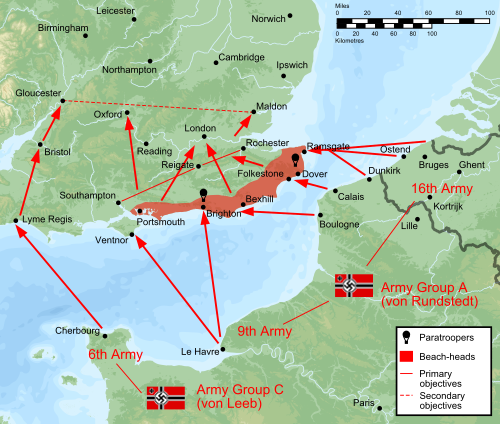
Hitler issues directive for air war on England
Hitler issued Directive No. 17, ordering the Luftwaffe to overpower the Royal Air Force to prepare for Operation Sea Lion, the invasion of Britain. · Wikipedia: https://en.wikipedia.org/wiki/Operation_Sea_Lion
Plan of battle of Operation Sealion, the cancelled German plan to invade England in 1940. Vector version of Image:Operazione-leone-marino.PNG, created by Resigua of the Italian Wikipedia. Ordnance Survey projection, covering from XJ170777 in the south-west to TJ447250 in the north-east, at 100m per pixel. Relief has been created from SRTM, bathymetry from ETOPO1, both from NASA. Coastlines are from the GSHHS, and the borders and rivers from the WDB data bundled with it. By User:Wereon - Own work, Public domain, https://commons.wikimedia.org/w/index.php?curid=6396911
Aug 8, 1940 CE
Convoy Peewit attacked in Channel
Luftwaffe aircraft heavily attacked Convoy Peewit in the English Channel, causing significant shipping losses and drawing RAF fighters into large-scale combat. · Wikipedia: https://en.wikipedia.org/wiki/Battle_of_Britain
A Royal Air Force Supermarine Spitfire trails smoke after attacking a German Heinkel He 111H/P bomber during the Battle of Britain. By Australian armed forces - This tag does not indicate the copyright status of the attached work. A normal copyright tag is still required. See Commons:Licensing for more information., Public domain, https://commons.wikimedia.org/w/index.php?curid=19114172
Aug 11, 1940 CE
RAF intercepts Luftwaffe over Portland
Fighter Command intercepted large Luftwaffe formations targeting the Portland naval base, inflicting notable losses on German bomber and fighter aircraft. · Wikipedia: https://en.wikipedia.org/wiki/Battle_of_Britain
A Royal Air Force Supermarine Spitfire trails smoke after attacking a German Heinkel He 111H/P bomber during the Battle of Britain. By Australian armed forces - This tag does not indicate the copyright status of the attached work. A normal copyright tag is still required. See Commons:Licensing for more information., Public domain, https://commons.wikimedia.org/w/index.php?curid=19114172
Aug 12, 1940 CE
Luftwaffe targets Chain Home radar stations
The Luftwaffe attacked southern Chain Home radar stations, damaging several sites but failing to destroy the network, which remained operational and crucial to British defense. · Wikipedia: https://en.wikipedia.org/wiki/Chain_Home
Chain Home radar installation at Poling, Sussex, 1945. Chain Home: AMES Type 1 CH East Coast radar installation at Poling, Sussex. On the left are three (originally four) in-line 360ft steel transmitter towers, between which the transmitter aerials were slung, with the heavily protected transmitter building in front. On the right are four 240ft wooden receiver towers placed in rhombic formation, with the receiver building in the middle. By Royal Air Force official photographer - http://media.iwm.org.uk/iwm/mediaLib//36/media-36281/large.jpg This photograph CH 15173 comes from the collections of the Imperial War Museums., Public domain, https://commons.wikimedia.org/w/index.php?curid=24473222
Aug 13, 1940 CE
Adlertag: Eagle Day launches major assault
Göring launched Adlertag, a massive assault on RAF airfields and radar stations, but poor coordination and weather reduced its effectiveness despite heavy fighting. · Wikipedia: https://en.wikipedia.org/wiki/Adlertag
IWM caption : THE BATTLE OF BRITAIN 1940. Pattern of condensation trails left by British and German aircraft after a dogfight. By Puttnam (Mr), War Office official photographer - This photograph H 4219 comes from the collections of the Imperial War Museums(collection no. 4700-37), Public domain, https://commons.wikimedia.org/w/index.php?curid=2867178
Aug 15, 1940 CE
Black Thursday: Luftwaffe suffers heavy losses
The Luftwaffe mounted its largest attack yet, but sustained severe losses across all sectors, particularly when unescorted Ju 88s were decimated by RAF fighters in the north. · Wikipedia: https://en.wikipedia.org/wiki/Battle_of_Britain
A Royal Air Force Supermarine Spitfire trails smoke after attacking a German Heinkel He 111H/P bomber during the Battle of Britain. By Australian armed forces - This tag does not indicate the copyright status of the attached work. A normal copyright tag is still required. See Commons:Licensing for more information., Public domain, https://commons.wikimedia.org/w/index.php?curid=19114172
Aug 18, 1940 CE
The Hardest Day: intense airfield battles
Both sides suffered their highest losses of the campaign as the Luftwaffe targeted RAF fighter stations, with RAF Biggin Hill and Kenley heavily bombed but remaining operational. · Wikipedia: https://en.wikipedia.org/wiki/The_Hardest_Day
This is a picture taken over 70 years ago, by a British serviceman, of a Dornier Do 17 bomber of 9 staffel (Squadron) Kampfgeschwader 76, brought down on 18 August 1940 near RAF Biggin Hill. By Unknown civilian or military - Photo of the aircraft appears in several different media. The Imperial War Museum published several pictures of it from different angles on line. The aircraft appears in Francis K. Mason's 1969 work The Battle over Britain on page 275. He credits the picture to the Imperial War Museum., PD, https://en.wikipedia.org/w/index.php?curid=30969536
Aug 20, 1940 CE
Churchill honors 'The Few' in speech
Winston Churchill delivered his famous speech praising RAF pilots, declaring, 'Never in the field of human conflict was so much owed by so many to so few.' · Wikipedia: https://en.wikipedia.org/wiki/Never_was_so_much_owed_by_so_many_to_so_few
A poster quoting Churchill's words on the pilots of the Battle of Britain By H.M. Stationery Office - This World War II poster was taken from the uploader's own collection. A lower resolution version of the same poster is available at https://www.mplib.org/wpdb/index.asp?exact=MPW00376 where the publisher information is provided as follows "Printed for H.M. Stationery Office by Lowe & Brydon Printers, Ltd". This implies that the copyright holder is HMSO or, in other words, it is Crown Copyright. As this poster is more than 50 years old, it is now in the public domain. This photograph PST 14972 comes from the collections of the Imperial War Museums. This photograph PST 3738 comes from the collections of the Imperial War Museums. This photograph PST 8774 comes from the collections of the Imperial War Museums., Public domain, https://commons.wikimedia.org/w/index.php?curid=35330825
Aug 24, 1940 CE
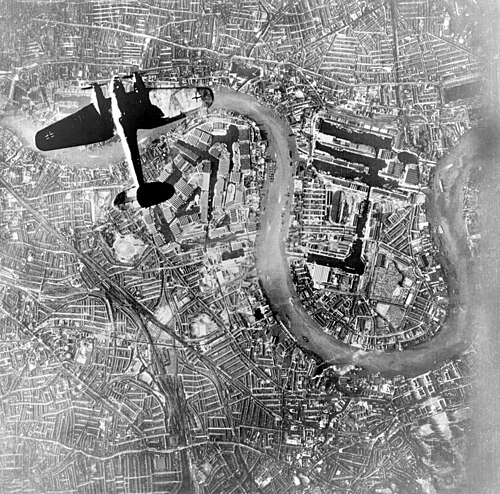
Luftwaffe bombs London by accident
German bombers accidentally dropped bombs on central London, prompting Churchill to order a retaliatory raid on Berlin, which enraged Hitler and shifted the campaign's focus. · Wikipedia: https://en.wikipedia.org/wiki/The_Blitz
Operations: A German Luftwaffe Heinkel He 111 bomber flying over Wapping, London at the start of the Luftwaffe's evening raids of 7 September 1940. Copy negative of part of an aerial photograph taken from a German aircraft at 1848 hrs German time. By German Air Force photographer - This tag does not indicate the copyright status of the attached work. A normal copyright tag is still required. See Commons:Licensing for more information., Public domain, https://commons.wikimedia.org/w/index.php?curid=15593029
Aug 25, 1940 CE
RAF raids Berlin in retaliation
In response to the bombing of London, the RAF launched a bombing raid on Berlin, the first of several such attacks that would psychologically impact the German leadership. · Wikipedia: https://en.wikipedia.org/wiki/Bombing_of_Berlin_in_World_War_II
The Kaiser Wilhelm Memorial Church in Berlin-Charlottenburg By Null8fuffzehn - Own work, Public domain, https://commons.wikimedia.org/w/index.php?curid=219546
Aug 30, 1940 CE
Biggin Hill heavily bombed
RAF Biggin Hill was subjected to devastating bombing raids that destroyed buildings and killed personnel, but the sector station continued to direct fighter operations. · Wikipedia: https://en.wikipedia.org/wiki/RAF_Biggin_Hill
Aerial view of the London Biggin Hill Airport By Foma - Own work, CC BY-SA 4.0, https://commons.wikimedia.org/w/index.php?curid=15419310
Sep 3, 1940 CE
Göring shifts strategy to bomb London
Enraged by the Berlin raids, Hitler and Göring decided to shift the Luftwaffe's focus from RAF airfields to bombing London, giving Fighter Command a critical reprieve. · Wikipedia: https://en.wikipedia.org/wiki/The_Blitz
Operations: A German Luftwaffe Heinkel He 111 bomber flying over Wapping, London at the start of the Luftwaffe's evening raids of 7 September 1940. Copy negative of part of an aerial photograph taken from a German aircraft at 1848 hrs German time. By German Air Force photographer - This tag does not indicate the copyright status of the attached work. A normal copyright tag is still required. See Commons:Licensing for more information., Public domain, https://commons.wikimedia.org/w/index.php?curid=15593029
Sep 5, 1940 CE
RAF Fighter Command regroups
With the Luftwaffe's focus moving to London, RAF fighter stations were able to repair and regroup, restoring operational effectiveness that had been severely strained. · Wikipedia: https://en.wikipedia.org/wiki/Battle_of_Britain
A Royal Air Force Supermarine Spitfire trails smoke after attacking a German Heinkel He 111H/P bomber during the Battle of Britain. By Australian armed forces - This tag does not indicate the copyright status of the attached work. A normal copyright tag is still required. See Commons:Licensing for more information., Public domain, https://commons.wikimedia.org/w/index.php?curid=19114172
Sep 7, 1940 CE
The Blitz begins on London
The Luftwaffe launched a massive daylight raid on London, marking the start of the Blitz and shifting the battle from airfields to civilian and industrial targets. · Wikipedia: https://en.wikipedia.org/wiki/The_Blitz
Operations: A German Luftwaffe Heinkel He 111 bomber flying over Wapping, London at the start of the Luftwaffe's evening raids of 7 September 1940. Copy negative of part of an aerial photograph taken from a German aircraft at 1848 hrs German time. By German Air Force photographer - This tag does not indicate the copyright status of the attached work. A normal copyright tag is still required. See Commons:Licensing for more information., Public domain, https://commons.wikimedia.org/w/index.php?curid=15593029
Sep 9, 1940 CE
Bomber Command raids German invasion ports
RAF Bomber Command attacked German barges assembled in Channel ports for Operation Sea Lion, disrupting invasion preparations and causing significant material damage. · Wikipedia: https://en.wikipedia.org/wiki/RAF_Bomber_Command
Sep 15, 1940 CE
Battle of Britain Day: decisive RAF victory
RAF Fighter Command repelled two massive Luftwaffe attacks on London, shooting down many aircraft and convincing Hitler to postpone Operation Sea Lion indefinitely. · Wikipedia: https://en.wikipedia.org/wiki/Battle_of_Britain_Day
Robert Zehbe's Dornier Do 17 bomber of bomber group Kampfgeschwader 76, brought down on Sunday 15 September 1940. It crashed onto London Victoria Station. This image was taken by an anonymous civilian. By Unknown likely ROC. The original uploader was Dapi89 at English Wikipedia.. Later version(s) were uploaded by Hohum at en.wikipedia. - Transferred from en.wikipedia to Commons. (Original text : http://bbm.org.uk/airmen/HolmesRT.htm), Public domain, https://commons.wikimedia.org/w/index.php?curid=175095007
Sep 17, 1940 CE
Hitler postpones Operation Sea Lion
Following the failure to gain air superiority, Hitler postponed Operation Sea Lion indefinitely, acknowledging the Luftwaffe had not defeated the RAF. · Wikipedia: https://en.wikipedia.org/wiki/Operation_Sea_Lion
Plan of battle of Operation Sealion, the cancelled German plan to invade England in 1940. Vector version of Image:Operazione-leone-marino.PNG, created by Resigua of the Italian Wikipedia. Ordnance Survey projection, covering from XJ170777 in the south-west to TJ447250 in the north-east, at 100m per pixel. Relief has been created from SRTM, bathymetry from ETOPO1, both from NASA. Coastlines are from the GSHHS, and the borders and rivers from the WDB data bundled with it. By User:Wereon - Own work, Public domain, https://commons.wikimedia.org/w/index.php?curid=6396911
Sep 27, 1940 CE
Luftwaffe loses heavily in London raid
A large Luftwaffe formation attacking London was intercepted by RAF fighters and anti-aircraft fire, resulting in heavy German losses that further eroded the bomber force. · Wikipedia: https://en.wikipedia.org/wiki/Battle_of_Britain
A Royal Air Force Supermarine Spitfire trails smoke after attacking a German Heinkel He 111H/P bomber during the Battle of Britain. By Australian armed forces - This tag does not indicate the copyright status of the attached work. A normal copyright tag is still required. See Commons:Licensing for more information., Public domain, https://commons.wikimedia.org/w/index.php?curid=19114172
Oct 7, 1940 CE
Luftwaffe shifts to night bombing
Recognizing unsustainable daylight losses, the Luftwaffe increasingly shifted to night bombing raids, marking the transition to the sustained Blitz on British cities. · Wikipedia: https://en.wikipedia.org/wiki/The_Blitz
Operations: A German Luftwaffe Heinkel He 111 bomber flying over Wapping, London at the start of the Luftwaffe's evening raids of 7 September 1940. Copy negative of part of an aerial photograph taken from a German aircraft at 1848 hrs German time. By German Air Force photographer - This tag does not indicate the copyright status of the attached work. A normal copyright tag is still required. See Commons:Licensing for more information., Public domain, https://commons.wikimedia.org/w/index.php?curid=15593029
Oct 15, 1940 CE
RAF downs bombers over London
Fighter Command continued to intercept Luftwaffe raids, shooting down multiple bombers in daylight attacks that demonstrated the RAF's enduring control of British airspace. · Wikipedia: https://en.wikipedia.org/wiki/Battle_of_Britain
A Royal Air Force Supermarine Spitfire trails smoke after attacking a German Heinkel He 111H/P bomber during the Battle of Britain. By Australian armed forces - This tag does not indicate the copyright status of the attached work. A normal copyright tag is still required. See Commons:Licensing for more information., Public domain, https://commons.wikimedia.org/w/index.php?curid=19114172
Oct 31, 1940 CE
Battle of Britain officially concludes
The battle ended with RAF Fighter Command having denied the Luftwaffe air superiority, ensuring Britain remained a base for future operations and ending the threat of invasion. · Wikipedia: https://en.wikipedia.org/wiki/Battle_of_Britain
A Royal Air Force Supermarine Spitfire trails smoke after attacking a German Heinkel He 111H/P bomber during the Battle of Britain. By Australian armed forces - This tag does not indicate the copyright status of the attached work. A normal copyright tag is still required. See Commons:Licensing for more information., Public domain, https://commons.wikimedia.org/w/index.php?curid=19114172