WW2/Battles of WW2/Hour-by-Hour • Curated by Admin Timeline.sg
Hour-by-hour account of the Royal Navy's pioneering night carrier strike that crippled the Italian battle fleet at anchor in Taranto harbour. (11–12 November 1940)
Chronological Storyline (15 Milestones)
Nov 11, 1940 CE
Second wave launches from Illustrious
Nine additional Swordfish, led by Lieutenant Commander J. W. Hale, departed HMS Illustrious to reinforce the attack, though two aircraft turned back early due to technical problems, leaving seven to press on to Taranto. · Wikipedia: https://en.wikipedia.org/wiki/Battle_of_Taranto
The Italian battleship CONTE DI CAVOUR after the Taranto attack. Only her funnels and super-structure remain above the water By Photographer not identified. "Official photograph". - https://www.iwm.org.uk/collections/item/object/205225994, Public domain, https://commons.wikimedia.org/w/index.php?curid=180173598
Nov 11, 1940 CE
First wave sights Taranto
The first wave of Swordfish aircraft approached the Italian naval base, encountering intense anti-aircraft fire and barrage balloons as they prepared to strike the battleships anchored in the Mar Grande and Mar Piccolo harbours. · Wikipedia: https://en.wikipedia.org/wiki/Battle_of_Taranto
The Italian battleship CONTE DI CAVOUR after the Taranto attack. Only her funnels and super-structure remain above the water By Photographer not identified. "Official photograph". - https://www.iwm.org.uk/collections/item/object/205225994, Public domain, https://commons.wikimedia.org/w/index.php?curid=180173598
Nov 11, 1940 CE
Flares illuminate Taranto harbour
Lieutenant N. Kemp and Lieutenant M. Spreckley dropped flares to illuminate the harbour, revealing Italian battleships including the Littorio, Cavour, and Duilio as targets for the torpedo bombers following behind. · Wikipedia: https://en.wikipedia.org/wiki/Battle_of_Taranto
The Italian battleship CONTE DI CAVOUR after the Taranto attack. Only her funnels and super-structure remain above the water By Photographer not identified. "Official photograph". - https://www.iwm.org.uk/collections/item/object/205225994, Public domain, https://commons.wikimedia.org/w/index.php?curid=180173598
Nov 11, 1940 CE
Torpedo strikes Littorio
Lieutenant Commander Williamson's aircraft and others launched torpedoes at the battleship Littorio, which sustained multiple hits that tore open its hull and caused severe flooding, though Williamson's own aircraft was downed by anti-aircraft fire. · Wikipedia: https://en.wikipedia.org/wiki/Italian_battleship_Littorio
For documentary purposes the German Federal Archive often retained the original image captions, which may be erroneous, biased, obsolete or politically extreme. Italien, Schlachtschiff "Littorio" Die erste Probefahrt des 1937 vom Stapel gelaufenen italienischen 35.000 t Schlachtschiffes "Littorio" im November 1939. Scherl: "Littorio" Italiens neuestes 35.000 Tonnen Schlachtschiff in Dienst gestellt Nach einer Rekordbauzeit von 1 1/2 Jahren wurde mit einer militärischen Feier in Genua das 35.000 Tonnen Schlachtschiff "Littorio" den Marinebehörden übergeben und in den aktiven Verband der italienischen Kriegsflotte eingereiht. Dieses neue Schiff bildet mit drei Schwesterschiffen gleicher Grösse die stärksten Einheiten der italienischen Kriegsflotte, die das Kräfteverhältnis der Mittelmeer-Seemächte erheblich zu Gunsten Italiens verschieben. Die Bestückung des Schiffes besteht aus neun 38,1 cm-Geschützen, zwölf 15,2 cm-Geschützen, einer starken Flak-Abwehr aus zwölf 9 cm-Geschützen und 40 Fla-MGs, zwei Katapult-Einrichtungen und drei Bordflugzeugen. U.B. zeigt das neue italienische Schlachtschiff "Littorio". Scherl Bilderdienst, Berlin 7.5.40 By Unknown - This image was provided to Wikimedia Commons by the German Federal Archive (Deutsches Bundesarchiv) as part of a cooperation project. The German Federal Archive guarantees an authentic representation only using the originals (negative and/or positive), resp. the digitalization of the originals as provided by the Digital Image Archive., CC BY-SA 3.0 de, https://commons.wikimedia.org/w/index.php?curid=5369410
Nov 11, 1940 CE
Cavour hit and doomed
A torpedo struck the battleship Conte di Cavour, causing catastrophic flooding that eventually sank the vessel in shallow water, permanently removing it from Italian fleet service for the remainder of the war. · Wikipedia: https://en.wikipedia.org/wiki/Italian_battleship_Conte_di_Cavour
RN Conte di Cavour - original structure By Unknown author - http://www.marina.difesa.it/storiacultura/storia/almanacco/PublishingImages/corazzate%20navi%20battaglia/cavour04.jpg, Public domain, https://commons.wikimedia.org/w/index.php?curid=2936504
Nov 11, 1940 CE
First wave withdraws under fire
Surviving aircraft of the first wave departed Taranto under heavy anti-aircraft barrages, having inflicted severe damage on three Italian battleships, though two Swordfish had been lost with their crews captured. · Wikipedia: https://en.wikipedia.org/wiki/Battle_of_Taranto
The Italian battleship CONTE DI CAVOUR after the Taranto attack. Only her funnels and super-structure remain above the water By Photographer not identified. "Official photograph". - https://www.iwm.org.uk/collections/item/object/205225994, Public domain, https://commons.wikimedia.org/w/index.php?curid=180173598
Nov 11, 1940 CE
Illustrious launches first wave
Twelve Swordfish torpedo bombers, led by Lieutenant Commander Kenneth Williamson, departed HMS Illustrious positioned about 170 miles southwest of Taranto, initiating the first carrier-launched torpedo attack on a major fleet at anchor. · Wikipedia: https://en.wikipedia.org/wiki/Battle_of_Taranto
The Italian battleship CONTE DI CAVOUR after the Taranto attack. Only her funnels and super-structure remain above the water By Photographer not identified. "Official photograph". - https://www.iwm.org.uk/collections/item/object/205225994, Public domain, https://commons.wikimedia.org/w/index.php?curid=180173598Battle of Taranto 1940 - Pearl Harbor of the Mediterranean DOCUMENTARY
Nov 12, 1940 CE
Italian fleet assesses damage
Admiral Inigo Campioni, commander of the Italian battle fleet, surveyed the devastation at dawn: three battleships incapacitated, with Littorio and Duilio beached and Cavour sunk, fundamentally altering the Mediterranean naval balance. · Wikipedia: https://en.wikipedia.org/wiki/Inigo_Campioni
Vice admiral Inigo Campioni (1878-1944) By Unknown author - Photographs available at www.audiovis.nac.gov.pl are public domain or the owner of the copyrights is the State Treasury of Poland, represented by the National Digital Archive and which grant free of charge licence for free use of the materials on all known exploitation fields., Public domain, https://commons.wikimedia.org/w/index.php?curid=72889612
Nov 12, 1940 CE
Surviving aircraft return to Illustrious
The surviving Swordfish from both waves landed back on HMS Illustrious, completing a remarkable operation that had crippled half the Italian battle fleet for the loss of only two aircraft and two crewmen captured. · Wikipedia: https://en.wikipedia.org/wiki/Battle_of_Taranto
The Italian battleship CONTE DI CAVOUR after the Taranto attack. Only her funnels and super-structure remain above the water By Photographer not identified. "Official photograph". - https://www.iwm.org.uk/collections/item/object/205225994, Public domain, https://commons.wikimedia.org/w/index.php?curid=180173598
Nov 12, 1940 CE
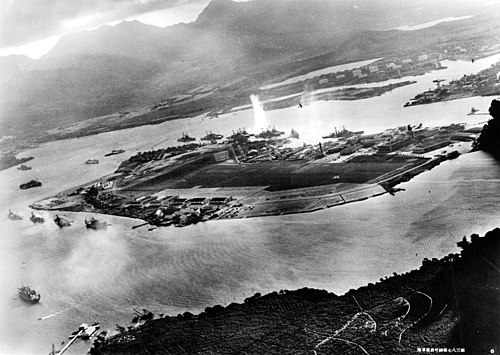
Raid's legacy and Japanese study
The stunning success of obsolete biplane torpedo bombers attacking a fleet at anchor attracted worldwide attention, and Japanese naval officers including Minoru Genda later studied the Taranto operation intensively when planning the attack on Pearl Harbor. · Wikipedia: https://en.wikipedia.org/wiki/Attack_on_Pearl_Harbor
Photograph taken from a Japanese plane during the torpedo attack on ships moored on both sides of Ford Island shortly after the beginning of the Pearl Harbor attack. View looks about east, with the supply depot, submarine base and fuel tank farm in the right center distance. A torpedo has just hit USS West Virginia on the far side of Ford Island (center). Other battleships moored nearby are (from left): Nevada, Arizona, Tennessee (inboard of West Virginia), Oklahoma (torpedoed and listing) alongside Maryland, and California. On the near side of Ford Island, to the left, are light cruisers Detroit and Raleigh, target and training ship Utah and seaplane tender Tangier. Raleigh and Utah have been torpedoed, and Utah is listing sharply to port. Japanese planes are visible in the right center (over Ford Island) and over the Navy Yard at right. U.S. Navy planes on the seaplane ramp are on fire. By Imperial Japanese Navy - Official U.S. Navy photograph NH 50930., Public domain, https://commons.wikimedia.org/w/index.php?curid=223876
Nov 12, 1940 CE
Cunningham seizes strategic initiative
Admiral Andrew Cunningham, commander of the Mediterranean Fleet, recognised that the neutralisation of three Italian battleships at Taranto gave the Royal Navy decisive superiority, enabling greater freedom of operations across the Mediterranean. · Wikipedia: https://en.wikipedia.org/wiki/Andrew_Cunningham%2C_1st_Viscount_Cunningham_of_Hyndhope
Andrew Cunningham This photograph is strikingly similar to one taken by Yousuf Karsh ("Karsh of Ottawa") which appears facing page 50 in his book of portraits of wartime leaders "Faces of Destiny" published 1947 London, etc., Chicago and New York. Admiral Cunningham adopts an identical pose (only facing slightly to his right in the "Faces of Destiny" portrait). Other details, including the background, are identical suggesting that this photograph was taken by Yousuf Karsh on the same occasion. His description on page 50 of the circumstances very strongly supports that suggestion, explaining that the photographic session at The Admiralty in London was necessarily a short one as Admiral Cunningham was at the time en route to Buckingham Palace for his formal appointment as First Sea Lord by King George VI. By Yousuf Karsh - [1] Dutch National Archives, The Hague, Fotocollectie Algemeen Nederlands Persbureau (ANEFO), 1945-1989 bekijk toegang 2.24.01.04 Bestanddeelnummer 902-2069, CC BY-SA 3.0 nl, https://commons.wikimedia.org/w/index.php?curid=37131099
Nov 12, 1940 CE
Littorio takes additional hits
The already-damaged battleship Littorio sustained further torpedo hits from the second wave, compounding the severe flooding and damage inflicted during the first wave's attack earlier in the night. · Wikipedia: https://en.wikipedia.org/wiki/Italian_battleship_Littorio
For documentary purposes the German Federal Archive often retained the original image captions, which may be erroneous, biased, obsolete or politically extreme. Italien, Schlachtschiff "Littorio" Die erste Probefahrt des 1937 vom Stapel gelaufenen italienischen 35.000 t Schlachtschiffes "Littorio" im November 1939. Scherl: "Littorio" Italiens neuestes 35.000 Tonnen Schlachtschiff in Dienst gestellt Nach einer Rekordbauzeit von 1 1/2 Jahren wurde mit einer militärischen Feier in Genua das 35.000 Tonnen Schlachtschiff "Littorio" den Marinebehörden übergeben und in den aktiven Verband der italienischen Kriegsflotte eingereiht. Dieses neue Schiff bildet mit drei Schwesterschiffen gleicher Grösse die stärksten Einheiten der italienischen Kriegsflotte, die das Kräfteverhältnis der Mittelmeer-Seemächte erheblich zu Gunsten Italiens verschieben. Die Bestückung des Schiffes besteht aus neun 38,1 cm-Geschützen, zwölf 15,2 cm-Geschützen, einer starken Flak-Abwehr aus zwölf 9 cm-Geschützen und 40 Fla-MGs, zwei Katapult-Einrichtungen und drei Bordflugzeugen. U.B. zeigt das neue italienische Schlachtschiff "Littorio". Scherl Bilderdienst, Berlin 7.5.40 By Unknown - This image was provided to Wikimedia Commons by the German Federal Archive (Deutsches Bundesarchiv) as part of a cooperation project. The German Federal Archive guarantees an authentic representation only using the originals (negative and/or positive), resp. the digitalization of the originals as provided by the Digital Image Archive., CC BY-SA 3.0 de, https://commons.wikimedia.org/w/index.php?curid=5369410
Nov 12, 1940 CE
Duilio struck by torpedo
A torpedo from the second wave hit the battleship Giulio Cesare's sister ship Caio Duilio, forcing it to be beached to prevent sinking and requiring months of repairs before it could rejoin the fleet. · Wikipedia: https://en.wikipedia.org/wiki/Italian_battleship_Caio_Duilio
Italian battleship Duilio in Naples in 1948. By Unknown author - http://www.naviearmatori.net/albums/userpics/12829/Caio_Duilio_at_Naples__13_September_1948..JPG, Public domain, https://commons.wikimedia.org/w/index.php?curid=90670491
Nov 12, 1940 CE
Second wave completes attack
The remaining Swordfish of the second wave completed their torpedo and bombing runs against Taranto, with one aircraft lost during the attack, before turning back toward HMS Illustrious in the darkness. · Wikipedia: https://en.wikipedia.org/wiki/Battle_of_Taranto
The Italian battleship CONTE DI CAVOUR after the Taranto attack. Only her funnels and super-structure remain above the water By Photographer not identified. "Official photograph". - https://www.iwm.org.uk/collections/item/object/205225994, Public domain, https://commons.wikimedia.org/w/index.php?curid=180173598
Nov 12, 1940 CE
Second wave arrives over Taranto
The second wave reached Taranto harbour and encountered renewed anti-aircraft fire, with Italian defenders now fully alerted and prepared, making the approach significantly more hazardous than the first wave had faced. · Wikipedia: https://en.wikipedia.org/wiki/Battle_of_Taranto
The Italian battleship CONTE DI CAVOUR after the Taranto attack. Only her funnels and super-structure remain above the water By Photographer not identified. "Official photograph". - https://www.iwm.org.uk/collections/item/object/205225994, Public domain, https://commons.wikimedia.org/w/index.php?curid=180173598