WW2/Battles of WW2/Hour-by-Hour • Curated by Admin Timeline.sg
Hour-by-hour account of the surprise Japanese carrier strike on the US Pacific Fleet at Pearl Harbor. (7 December 1941)
Chronological Storyline (17 Milestones)
Dec 7, 1941 CE
USS Nevada Beached to Avoid Sinking
Having sustained heavy damage while attempting to sortie, the USS Nevada was deliberately beached at Waipio Point to avoid sinking in the harbor channel. This action prevented the ship from blocking the main navigable entrance to Pearl Harbor. · Wikipedia: https://en.wikipedia.org/wiki/USS_Nevada_(BB-36)
USS Nevada (BB-36) underway off of the U.S. Atlantic coast on 17 September 1944. Photographed from a blimp of squadron ZP-12. Official U.S. Navy Photograph, now in the collections of the National Archives. By US Navy - Photo #: 80-G-282709, Public domain, https://commons.wikimedia.org/w/index.php?curid=169994
Dec 7, 1941 CE
Japanese Pilots Consider Third Wave
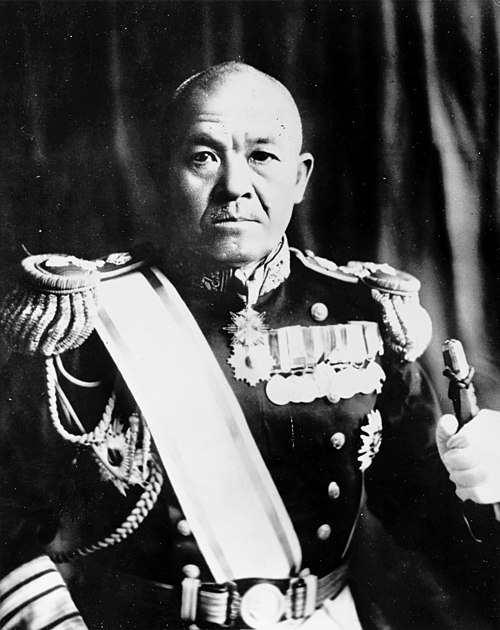
Mitsuo Fuchida remained over Pearl Harbor to assess damage and relayed information to Admiral Chuichi Nagumo regarding the possibility of a third strike. Nagumo ultimately decided against launching a third wave, fearing increasing American resistance and risk to his carriers. · Wikipedia: https://en.wikipedia.org/wiki/Chuichi_Nagumo
Title: "Vice Admiral Chuichi Nagumo". Imperial Japanese Navy Portrait photograph, taken circa 1941-42, when he was commander of the First Air Fleet. Original photograph was in the files of Rear Admiral Samuel Eliot Morison, USNR. U.S. Naval History and Heritage Command Photograph. By Unknown author - Naval History and Heritage Command - Photo NH 63423 - http://www.history.navy.mil/our-collections/photography/numerical-list-of-images/nhhc-series/nh-series/NH-63000/NH-63423.html, Public domain, https://commons.wikimedia.org/w/index.php?curid=43777
Dec 7, 1941 CE
First Wave Strikes Ford Island and Airfields
Mitsuo Fuchida's first wave arrived over Oahu, deploying torpedo bombers against Battleship Row and dive bombers against Ford Island and Wheeler Field. The Japanese achieved complete tactical surprise, crippling American air power on the ground within minutes. · Wikipedia: https://en.wikipedia.org/wiki/First_wave_of_the_attack_on_Pearl_Harbor
Dec 7, 1941 CE
Casualty Reports and Damage Assessment Begin
American forces began assessing the catastrophic damage to the Pacific Fleet, confirming over 2,400 military and civilian deaths. The devastating surprise attack galvanized American public opinion, leading directly to the United States declaring war on Japan the following day. · Wikipedia: https://en.wikipedia.org/wiki/Attack_on_Pearl_Harbor
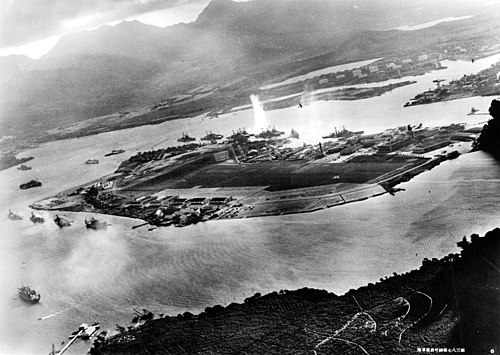
Photograph taken from a Japanese plane during the torpedo attack on ships moored on both sides of Ford Island shortly after the beginning of the Pearl Harbor attack. View looks about east, with the supply depot, submarine base and fuel tank farm in the right center distance. A torpedo has just hit USS West Virginia on the far side of Ford Island (center). Other battleships moored nearby are (from left): Nevada, Arizona, Tennessee (inboard of West Virginia), Oklahoma (torpedoed and listing) alongside Maryland, and California. On the near side of Ford Island, to the left, are light cruisers Detroit and Raleigh, target and training ship Utah and seaplane tender Tangier. Raleigh and Utah have been torpedoed, and Utah is listing sharply to port. Japanese planes are visible in the right center (over Ford Island) and over the Navy Yard at right. U.S. Navy planes on the seaplane ramp are on fire. By Imperial Japanese Navy - Official U.S. Navy photograph NH 50930., Public domain, https://commons.wikimedia.org/w/index.php?curid=223876
Dec 7, 1941 CE
Torpedo Bombers Hit Battleship Row
Nakajima B5N torpedo bombers launched their weapons against the moored battleships of the Pacific Fleet along the southeast shore of Ford Island. The USS Oklahoma and USS West Virginia sustained multiple torpedo hits, causing severe flooding and massive casualties. · Wikipedia: https://en.wikipedia.org/wiki/Battleship_Row
Torpedo Bombers Hit Battleship Row By Unknown author, CC BY-SA 3.0, https://commons.wikimedia.org/w/index.php?curid=209891
Dec 7, 1941 CE
USS Oklahoma Capsizes After Multiple Torpedo Hits
The USS Oklahoma, struck by at least three torpedoes, rapidly capsized in the shallow water of Battleship Row, trapping hundreds of sailors inside. The sudden capsizing killed 429 crew members, making it one of the deadliest incidents of the morning. · Wikipedia: https://en.wikipedia.org/wiki/USS_Oklahoma_(BB-37)
Removed caption read: Photo # NH 44401 USS Oklahoma wearing experimental camouflage, circa 1917 By Unknown USN photographer - https://www.history.navy.mil/content/history/nhhc/our-collections/photography/us-navy-ships/battleships/oklahoma-bb-37/NH-44401.html, Public domain, https://commons.wikimedia.org/w/index.php?curid=1168806
Dec 7, 1941 CE
USS Nevada Gets Underway Under Fire
The USS Nevada, the only battleship to get underway during the attack, attempted to sortie from Battleship Row. Despite heavy damage from bombs and torpedoes, the crew navigated the ship toward the harbor entrance, drawing intense Japanese fire. · Wikipedia: https://en.wikipedia.org/wiki/USS_Nevada_(BB-36)
USS Nevada (BB-36) underway off of the U.S. Atlantic coast on 17 September 1944. Photographed from a blimp of squadron ZP-12. Official U.S. Navy Photograph, now in the collections of the National Archives. By US Navy - Photo #: 80-G-282709, Public domain, https://commons.wikimedia.org/w/index.php?curid=169994
Dec 7, 1941 CE
First Wave Attack Concludes
The first wave of Japanese aircraft withdrew after inflicting heavy damage on the Pacific Fleet and Oahu's airfields. The strike left Battleship Row ablaze and American air defenses severely degraded, setting the stage for the second wave. · Wikipedia: https://en.wikipedia.org/wiki/First_wave_of_the_attack_on_Pearl_Harbor
Dec 7, 1941 CE
Second Wave Targets Hickam and Kaneohe Fields
Japanese dive bombers struck Hickam Field and Kaneohe Naval Air Station, destroying parked aircraft and hangars. By this time, American anti-aircraft fire had intensified, inflicting greater losses on the second wave than the first. · Wikipedia: https://en.wikipedia.org/wiki/Hickam_Field
The historic base operations building (DV1) at Hickam Air Field dressed for VIP arrival. By 399scout - Own work, CC BY-SA 4.0, https://commons.wikimedia.org/w/index.php?curid=112932683
Dec 7, 1941 CE
First Wave Launches from Japanese Carriers
Approximately 183 aircraft of the first attack wave began launching from six Japanese carriers operating 230 miles north of Oahu, commanded by Mitsuo Fuchida. This force was divided into strike groups targeting Battleship Row and Oahu's airfields. · Wikipedia: https://en.wikipedia.org/wiki/Attack_on_Pearl_Harbor
Attack on Pearl Harbor - Pacific War #1 DOCUMENTARYPhotograph taken from a Japanese plane during the torpedo attack on ships moored on both sides of Ford Island shortly after the beginning of the Pearl Harbor attack. View looks about east, with the supply depot, submarine base and fuel tank farm in the right center distance. A torpedo has just hit USS West Virginia on the far side of Ford Island (center). Other battleships moored nearby are (from left): Nevada, Arizona, Tennessee (inboard of West Virginia), Oklahoma (torpedoed and listing) alongside Maryland, and California. On the near side of Ford Island, to the left, are light cruisers Detroit and Raleigh, target and training ship Utah and seaplane tender Tangier. Raleigh and Utah have been torpedoed, and Utah is listing sharply to port. Japanese planes are visible in the right center (over Ford Island) and over the Navy Yard at right. U.S. Navy planes on the seaplane ramp are on fire. By Imperial Japanese Navy - Official U.S. Navy photograph NH 50930., Public domain, https://commons.wikimedia.org/w/index.php?curid=223876
Dec 7, 1941 CE
Second Wave Withdraws, Attack Concludes
The second wave of Japanese aircraft withdrew northward, marking the end of the active assault on Pearl Harbor. The Japanese strike force had sunk or severely damaged eight battleships and destroyed nearly 200 American aircraft. · Wikipedia: https://en.wikipedia.org/wiki/Attack_on_Pearl_Harbor
Photograph taken from a Japanese plane during the torpedo attack on ships moored on both sides of Ford Island shortly after the beginning of the Pearl Harbor attack. View looks about east, with the supply depot, submarine base and fuel tank farm in the right center distance. A torpedo has just hit USS West Virginia on the far side of Ford Island (center). Other battleships moored nearby are (from left): Nevada, Arizona, Tennessee (inboard of West Virginia), Oklahoma (torpedoed and listing) alongside Maryland, and California. On the near side of Ford Island, to the left, are light cruisers Detroit and Raleigh, target and training ship Utah and seaplane tender Tangier. Raleigh and Utah have been torpedoed, and Utah is listing sharply to port. Japanese planes are visible in the right center (over Ford Island) and over the Navy Yard at right. U.S. Navy planes on the seaplane ramp are on fire. By Imperial Japanese Navy - Official U.S. Navy photograph NH 50930., Public domain, https://commons.wikimedia.org/w/index.php?curid=223876
Dec 7, 1941 CE
USS Shaw Destroyed in Floating Dry Dock
The destroyer USS Shaw, in floating dry dock YFD-2, was hit by multiple bombs, causing her forward magazine to explode and severing the bow. The dramatic explosion was captured in one of the attack's most iconic photographs. · Wikipedia: https://en.wikipedia.org/wiki/USS_Shaw_(DD-373)
The U.S. Navy destroyer USS Shaw (DD-373) entering Rio de Janeiro harbor, Brazil, 1 September 1938. By Taken by a USS Enterprise (CV-6) photographer. Official U.S. Navy Photograph, from the collections of the Naval Historical Center. - Official U.S. Navy photo NH 97420 from the U.S. Navy Naval History and Heritage Command, Public domain, https://commons.wikimedia.org/w/index.php?curid=3147574
Dec 7, 1941 CE
Second Wave Arrives Over Oahu
Approximately 167 aircraft of the second attack wave, led by Lieutenant Commander Shigekazu Shimazaki, arrived over Oahu. The strike force focused on secondary targets including the navy yard, remaining ships, and airfields. · Wikipedia: https://en.wikipedia.org/wiki/Second_wave_of_the_attack_on_Pearl_Harbor
Dec 7, 1941 CE
Message Sent: Air Raid on Pearl Harbor
Commander in Chief of the Pacific Fleet Husband Kimmel sent a dispatch to the Navy Department stating that Pearl Harbor was under air raid. This message alerted Washington to the surprise attack that was actively devastating the Pacific Fleet. · Wikipedia: https://en.wikipedia.org/wiki/Husband_E._Kimmel
Admiral Husband E. Kimmel, USNCommander in Chief, U.S. Fleet (CINCUS) and Pacific Fleet (CINCPACFLT) in 1941. By USS ArizonaPearl Harbor National Memorial - https://twitter.com/USSArizonaCropped and color corrected from https://twitter.com/USSArizona/status/1197732021709074438/photo/1, Public domain, https://commons.wikimedia.org/w/index.php?curid=114029914
Dec 7, 1941 CE
USS Arizona Magazine Explodes
A Japanese armor-piercing bomb detonated the forward magazine of the USS Arizona, causing a catastrophic explosion that killed 1,177 crewmen. The battleship was destroyed in minutes, representing the single greatest loss of life in the attack. · Wikipedia: https://en.wikipedia.org/wiki/USS_Arizona_(BB-39)
Arizona (BB39) port bow, before being modernized at Norfolk Naval Shipyard between May 1929 and January 1930 By Photographer: Unknown Retouched by: Mmxx - This tag does not indicate the copyright status of the attached work. A normal copyright tag is still required. See Commons:Licensing., Public domain, https://commons.wikimedia.org/w/index.php?curid=15678237
Dec 7, 1941 CE
USS Ward Sinks a Japanese Midget Submarine
The destroyer USS Ward, on patrol outside the harbor entrance, attacked and sank an unidentified midget submarine near the entrance to Pearl Harbor. This was the first American engagement of the Pacific War, occurring over an hour before the air raid began. · Wikipedia: https://en.wikipedia.org/wiki/USS_Ward_(DD-139)
USS Ward Sinks a Japanese Midget Submarine By Unknown author, Public domain, https://commons.wikimedia.org/w/index.php?curid=25955
Dec 7, 1941 CE
Opana Mobile Radar Station Detects Japanese Planes
Private Joseph Lockard and George Elliott, operating an SCR-270 radar at Opana Point, detected a large flight of aircraft approaching Oahu from the north. The information was dismissed by the duty officer at Fort Shafter, who assumed the blip represented a scheduled flight of B-17 bombers. · Wikipedia: https://en.wikipedia.org/wiki/Opana_Mobile_Radar_Station