Encyclopedia/4. Arts & Literature/3. Music, Theatre & Performance/02. Traditional Asian Instrumental Music • Curated by Admin Timeline.sg
This timeline traces the history of Asian instrumental music, with a focus on the guqin, a classical Chinese zither with over 3,000 years of tradition. It highlights key developments across East, South, and Southeast Asia, from ancient ritual instruments to modern revival movements.
Chronological Storyline (39 Milestones)
3000 BCE
Earliest Chinese Bone Flutes
The oldest known Chinese musical instruments, bone flutes from the Neolithic period, are found in Jiahu. These flutes demonstrate advanced pentatonic scales and mark the beginning of Chinese instrumental music. #music #archaeology
1100 BCE
Guqin Mentioned in Early Chinese Texts
The guqin (or qin) is first mentioned in Chinese classics like the Book of Songs and the Shangshu. This seven-stringed zither becomes central to Chinese literati culture. #guqin #history
Guqin Mentioned in Early Chinese Texts By The original uploader was CharlieHuang at English Wikipedia. - Transferred from en.wikipedia to Commons by Shizhao using CommonsHelper., CC BY-SA 3.0, https://commons.wikimedia.org/w/index.php?curid=5146121
770 BCE
Confucius and the Guqin
Confucius (551–479 BCE) is a master of the guqin and considered a key figure in its tradition. He uses music for moral cultivation, influencing later literati. #confucianism #guqin
Confucius and the Guqin By Wu Daozi, 685-758, Tang Dynasty. - https://i.pinimg.com/originals/77/95/19/7795198cc338e4642d2ce7ac965458b2.jpg, Public domain, https://commons.wikimedia.org/w/index.php?curid=857482
0 CE
Earliest Known Guqin Manuscript
The earliest surviving guqin manuscript, 'Youlan' (Solitary Orchid), is composed. It is later preserved in the Japanese imperial repository. #guqin #music
100 CE
Indian Veena Depicted in Sculpture
The veena, a plucked string instrument, is depicted in Buddhist art at Bharhut. It becomes a key instrument in Indian classical music. #indianmusic #veena
Indian Veena Depicted in Sculpture By Veena.svg: Sreejithk2000 derivative work: Gringer (talk) - Veena.svg, CC BY 3.0, https://commons.wikimedia.org/w/index.php?curid=11886656
300 CE
Ji Kang Writes on Guqin Aesthetics
Ji Kang, a Chinese poet and philosopher, writes 'Qin Fu' (Rhapsody on the Qin), an influential treatise on guqin music and philosophy. #guqin #literature
500 CE
Introduction of the Pipa to China
The pipa, a pear-shaped lute from Central Asia, becomes popular in China during the Northern Wei dynasty. It influences later East Asian music. #pipa #music
Introduction of the Pipa to China By Unknown author - This file was donated to Wikimedia Commons as part of a project by the Metropolitan Museum of Art. See the Image and Data Resources Open Access Policy, CC0, https://commons.wikimedia.org/w/index.php?curid=57858544
600 CE
Korean Gayageum Created
The gayageum, a Korean zither, is invented by King Gasil of Gaya. It becomes a central instrument in Korean court and folk music. #koreanmusic #gayageum
Korean Gayageum Created By 국립중앙박물관 e뮤지엄 - 풍류가야금 https://www.emuseum.go.kr/detail?cateClass=&cateListFlag=&keyword=%EA%B0%80%EC%95%BC%EA%B8%88&pageNum=5&rows=9&reltRows=10&sort=&highQualityYn=&isImgExistOp=&mckoglsvOp=&isIntrstMuseumOp=&filedOp=&detailFlag=&dq=&ps01Lv1=&ps01Lv2=&ps01Lv3=&mcSeqNo=&author=&ps06Lv1=&ps06Lv2=&ps08Lv1=&ps08Lv2=&ps09Lv1=&ps09Lv2=&ps09Lv3=&ps09Lv4=&gl05Lv1=&gl05Lv2=&ps12Lv1=&ps15Lv1=&culturalHerNo=&publicType=&detailedDes=&thema=&storySeq=&categoryLv=&categoryCode=&mobileFacetIng=&location=&facet1Lv1=&facet1Lv2=&facet2Lv1=&facet3Lv1=&facet3Lv2=&facet4Lv1=&facet4Lv2=&facet5Lv1=&facet5Lv2=&facet5Lv3=&facet5Lv4=&facet6Lv1=&facet6Lv2=&facet7Lv1Selected=&facet7Lv1=&facet8Lv1=&gl27Lv1=&gl27Lv2=&gl27Lv3=&gl27Lv4=&gl28Lv1=&gl28Lv2=&gl28Lv3=&gl29Lv1=&gl30Lv1=&mcgpyear1=&mcgpyear2=&mcginves=&mcgchalj=&mcgchams=&facetGL27Lv1=&facetGL27Lv2=&facetGL27Lv3=&facetGL27Lv4=&facetGL28Lv1=&facetGL28Lv2=&facetGL29Lv1=&facetGL30Lv1=&mcgwonpn=&keywordHistory=&showSearchOption=&intrstMuseumCode=&returnUrl=%2FheaderSearch&selectMakerGroup=0&radioSearchCheck=unifiedSearch&headerPs01Lv1=&headerPs01Lv2=&headerPs01Lv3=, KOGL Type 1, https://commons.wikimedia.org/w/index.php?curid=148944599
701 CE
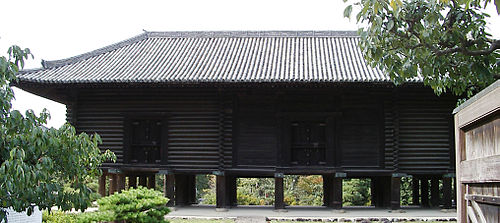
Japanese Shōsōin Instrument Collection
The Shōsōin repository in Nara, Japan, preserves ancient instruments including biwa, shō, and a Tang-dynasty guqin. This collection is a vital source for Asian music history. #japan #music
Japanese Shōsōin Instrument Collection By Unknown author, CC BY-SA 3.0, https://commons.wikimedia.org/w/index.php?curid=407922
900 CE
Development of Gagaku Ensemble
Gagaku, the imperial court music of Japan, evolves with instruments like the hichiriki, ryūteki, and biwa. It is one of the oldest surviving orchestral traditions. #gagaku #japan
Development of Gagaku Ensemble By Josep Panadero - Own work, CC BY-SA 4.0, https://commons.wikimedia.org/w/index.php?curid=84160383
1000 CE
Guqin Tablature 'Jieshi Diao Youlan'
The earliest surviving guqin score, 'Jieshi Diao Youlan', is copied. It preserves ancient finger techniques and tunings. #guqin #tradition
Guqin Tablature 'Jieshi Diao Youlan' By Unknown author - https://emuseum.nich.go.jp/detail?langId=zh&webView=&content_base_id=100229&content_part_id=0&content_pict_id=0, Public domain, https://commons.wikimedia.org/w/index.php?curid=5146159
1100 CE
Zhu Xi Promotes Guqin in Neo-Confucianism
Neo-Confucian scholar Zhu Xi emphasizes the guqin as a tool for self-cultivation, reinforcing its literati status. #neo-confucianism #guqin
Zhu Xi Promotes Guqin in Neo-Confucianism By Unknown author - scan from 《社会历史博物馆》 ISBN 7-5347-1397-8, Public domain, https://commons.wikimedia.org/w/index.php?curid=93319
1200 CE
Japanese Biwa Hōshi Tradition
Blind monks (biwa hōshi) reciting The Tale of the Heike to biwa accompaniment popularize the instrument. This tradition influences Japanese narrative music. #biwa #japan
The janggu, an hourglass-shaped drum, becomes a staple of Korean folk and court music. It is used in genres like pungmul and samul nori. #koreanmusic #drum
Korean Janggu Drum Developed By Visviva - Own work, Public domain, https://commons.wikimedia.org/w/index.php?curid=2256180
1400 CE
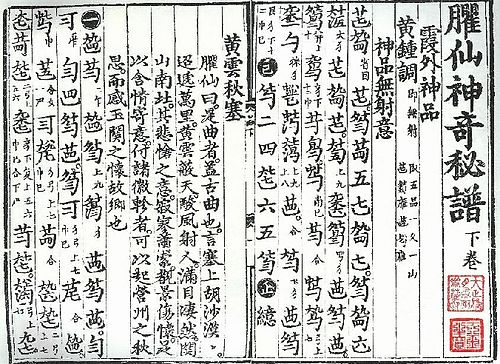
Shennagaku and Ming Dynasty Guqin Anthologies
The Ming dynasty sees the compilation of major guqin anthologies like 'Shennagaku' (Divine Music), preserving over 600 pieces. #guqin #history
1500 CE
Ryukyuan Music and the Sanshin
The sanshin, a three-stringed instrument from the Ryukyu Kingdom (modern Okinawa), develops. It later influences the Japanese shamisen. #sanshin #okinawa
1587 CE
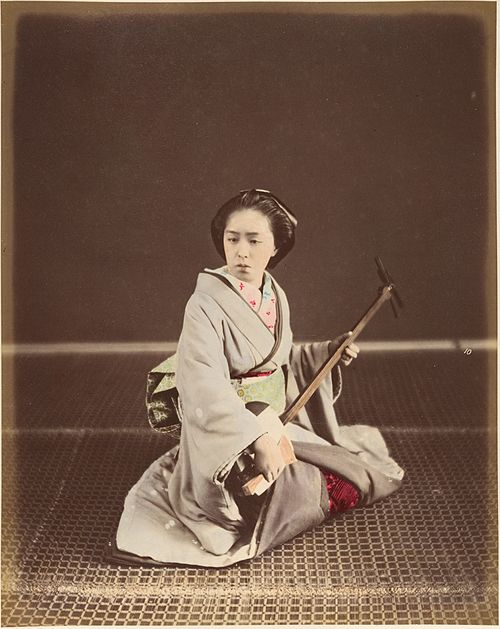
Shamisen Introduced to Japan
The shamisen, derived from the Chinese sanxian, arrives in Japan via the Ryukyu Islands. It becomes central to Kabuki and Bunraku theater. #shamisen #japan
Shamisen Introduced to Japan By Unknown Artist, Unknown School - The Metropolitan Museum of Art, Public domain, https://commons.wikimedia.org/w/index.php?curid=10706498
1600 CE
Indian Dhrupad Tradition and the Rudra Veena
Dhrupad, the oldest surviving style of Hindustani classical music, features the rudra veena. It is performed at Mughal courts. #indianmusic #dhrupad
1684 CE
Zhu Quan's Guqin Treatise 'Shenmi Pu'
Ming prince Zhu Quan compiles 'Shenmi Pu' (Mysterious and Secret Scores), a major guqin notation collection. #guqin #musicology
Zhu Quan's Guqin Treatise 'Shenmi Pu' By Unknown author, Public domain, https://commons.wikimedia.org/w/index.php?curid=1521072
1700 CE
Korean Court Music 'Daechwita'
Daechwita, a Korean court march for wind and percussion, is formalized. It is still performed today as a traditional military music. #koreanmusic #court
Korean Court Music 'Daechwita' By by ddol-mang - https://www.flickr.com/photos/ysjjhfox/2044960655/, CC BY-SA 2.0, https://commons.wikimedia.org/w/index.php?curid=3166682
1800 CE
Sitar Develops in India
The sitar, a plucked string instrument, evolves from the setar and becomes prominent in Hindustani classical music. Ravi Shankar later popularizes it globally. #sitar #indianmusic
Sitar Develops in India By unknown, MET museum - https://www.metmuseum.org/art/collection/search/502150, CC0, https://commons.wikimedia.org/w/index.php?curid=124998973
1895 CE
Guqin Virtuoso Zha Fuxi Born
Zha Fuxi, a leading 20th-century guqin master and scholar, is born. He later compiles the 'Qin Qubao' (Collection of Qin Music). #guqin #master
Guqin Virtuoso Zha Fuxi Born By Unknown author - http://www.tongdengzhongyao.com/gq/wshm/1930.htm, Public domain, https://commons.wikimedia.org/w/index.php?curid=37609267
1900 CE
Indian Ghatam Classical Percussion
The ghatam, a clay pot percussion instrument, becomes standardized in Carnatic music concerts. #indianmusic #percussion
Indian Ghatam Classical Percussion By Sven.petersen - Own work, Public domain, https://commons.wikimedia.org/w/index.php?curid=3971790
1910 CE
Japanese Shakuhachi Revival
The shakuhachi, a bamboo flute used by Zen monks, sees a revival in Japan as concert music. #shakuhachi #japan
Japanese Shakuhachi Revival By Tarourashima - Own work, Public domain, https://commons.wikimedia.org/w/index.php?curid=3836936
1920 CE
Chinese Erhu Modernization
The erhu, a two-stringed fiddle, is redesigned by artists like Liu Tianhua, who composes new pieces and elevates its status to a solo instrument. #erhu #china
Chinese Erhu Modernization By Unknown author - Metropolitan Museum of Art, CC0, https://commons.wikimedia.org/w/index.php?curid=192017131
1930 CE
Korean Gayageum Sanjo Established
Kim Chang-jo formally structures gayageum sanjo, a solo form with improvisation, influencing modern Korean traditional music. #gayageum #korea )
Korean Gayageum Sanjo Established By 국립중앙박물관 e뮤지엄 - https://www.emuseum.go.kr/detail?cateClass=&cateListFlag=&keyword=%EC%82%B0%EC%A1%B0&pageNum=1&rows=9&reltRows=10&sort=&highQualityYn=&isImgExistOp=&mckoglsvOp=&isIntrstMuseumOp=&filedOp=&detailFlag=&dq=&ps01Lv1=&ps01Lv2=&ps01Lv3=&mcSeqNo=&author=&ps06Lv1=&ps06Lv2=&ps08Lv1=&ps08Lv2=&ps09Lv1=&ps09Lv2=&ps09Lv3=&ps09Lv4=&gl05Lv1=&gl05Lv2=&ps12Lv1=&ps15Lv1=&culturalHerNo=&publicType=&detailedDes=&thema=&storySeq=&categoryLv=&categoryCode=&mobileFacetIng=&location=&facet1Lv1=&facet1Lv2=&facet2Lv1=&facet3Lv1=&facet3Lv2=&facet4Lv1=&facet4Lv2=&facet5Lv1=&facet5Lv2=&facet5Lv3=&facet5Lv4=&facet6Lv1=&facet6Lv2=&facet7Lv1Selected=&facet7Lv1=&facet8Lv1=&gl27Lv1=&gl27Lv2=&gl27Lv3=&gl27Lv4=&gl28Lv1=&gl28Lv2=&gl28Lv3=&gl29Lv1=&gl30Lv1=&mcgpyear1=&mcgpyear2=&mcginves=&mcgchalj=&mcgchams=&facetGL27Lv1=&facetGL27Lv2=&facetGL27Lv3=&facetGL27Lv4=&facetGL28Lv1=&facetGL28Lv2=&facetGL29Lv1=&facetGL30Lv1=&mcgwonpn=&keywordHistory=&showSearchOption=&intrstMuseumCode=&returnUrl=%2FheaderSearch&selectMakerGroup=0&radioSearchCheck=unifiedSearch&headerPs01Lv1=&headerPs01Lv2=&headerPs01Lv3=, KOGL Type 1, https://commons.wikimedia.org/w/index.php?curid=148945610
1945 CE
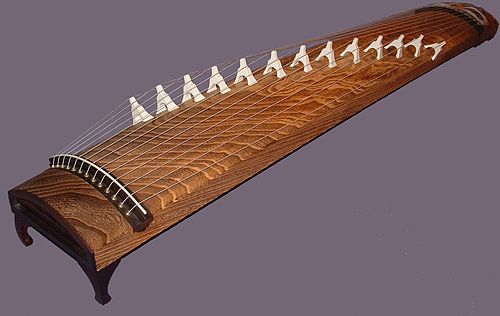
Post-War Japanese Koto Revival
The koto, a zither instrument, experiences a revival in Japan through composers like Miyagi Michio, who blend traditional and Western styles. #koto #japan )
Post-War Japanese Koto Revival By Original uploader and author was Smgregory at en.wikipedia - Originally from en.wikipedia; description page is/was here., CC BY-SA 3.0, https://commons.wikimedia.org/w/index.php?curid=2539413
1950 CE
Indian Bansuri Concert Tradition
Pandit Pannalal Ghosh pioneers the bansuri (bamboo flute) as a full-fledged Hindustani classical instrument, expanding its range. #bansuri #indianmusic
Indian Bansuri Concert Tradition By Abhiptr - Own work, CC BY-SA 4.0, https://commons.wikimedia.org/w/index.php?curid=75408784
1956 CE
Chinese Guqin Preservation Efforts
Thousands of guqin pieces are transcribed into modern notation, and the government establishes research institutes to preserve the tradition. #guqin #preservation
1961 CE
Kabuki Music and the Nagauta Ensemble
Nagauta, the vocal and instrumental music for Kabuki, is standardized. It features shamisen, flutes, and drums. #kabuki #music
Kabuki Music and the Nagauta Ensemble By Kyoden Santo - http://www.wdl.org/en/item/4350/, Public domain, https://commons.wikimedia.org/w/index.php?curid=27223373
1970 CE
Southeast Asian Gamelan Goes Global
Gamelan, the Indonesian percussion orchestra, gains international recognition through performances abroad and academic study. #gamelan #indonesia
Southeast Asian Gamelan Goes Global By Gunawan Kartapranata - Own work, CC BY-SA 3.0, https://commons.wikimedia.org/w/index.php?curid=18455562
1977 CE
Voyager Golden Record Includes Guqin
The guqin piece 'Flowing Water' is included on the Voyager Golden Record, representing Chinese music to extraterrestrials. #guqin #space )
1985 CE
Modernization of the Japanese Koto
Composers like Sawada Kumi introduce contemporary techniques to the koto, integrating it with electronic music. #koto #modern )
1990 CE
Korean Samul Nori Formation
Samul nori, a contemporary percussion genre using traditional instruments (kkwaenggwari, jing, janggu, buk), is created and gains global popularity. #samulnori #korea
Korean Samul Nori Formation By No machine-readable author provided. Cablekyung assumed (based on copyright claims). - No machine-readable source provided. Own work assumed (based on copyright claims)., Public domain, https://commons.wikimedia.org/w/index.php?curid=1035529
2000 CE
Indian Santoor Concert Stage Rise
Shivkumar Sharma elevates the santoor (hammered dulcimer) to a leading solo instrument in Hindustani classical music. #santoor #indianmusic
Indian Santoor Concert Stage Rise By Suyash Dwivedi - Own work, CC BY-SA 4.0, https://commons.wikimedia.org/w/index.php?curid=50226399
2003 CE
Guqin Inscribed as UNESCO Intangible Heritage
UNESCO declares the guqin a Masterpiece of the Oral and Intangible Heritage of Humanity, boosting conservation. #guqin #unesco
2010 CE
Zhongguo Jie (Chinese Instruments) Orchestra Boom
Chinese orchestras combining erhu, pipa, dizi, and other instruments experience a renaissance, with new compositions and world tours. #chinesemusic #orchestra
Zhongguo Jie (Chinese Instruments) Orchestra Boom By Unknown author - This image has been extracted from another file, Public domain, https://commons.wikimedia.org/w/index.php?curid=83033156
2015 CE
Indian Mohan Veena Modernized
Vishwa Mohan Bhatt modifies the guitar to create the mohan veena, a slide instrument playing Indian ragas, winning Grammy recognition. #mohanveena #fusion
Indian Mohan Veena Modernized By adil113 - Mohan Veena, CC BY 2.0, https://commons.wikimedia.org/w/index.php?curid=54271858
2020 CE
COVID-19 Impact on Asian Music Ensembles
Traditional music groups across Asia shift to online performances, leading to innovative digital collaborations and new audiences. #covid19 #music
COVID-19 Impact on Asian Music Ensembles By Gustavo Basso - https://www.flickr.com/photos/gustavocb/49913440386, CC BY-SA 4.0, https://commons.wikimedia.org/w/index.php?curid=112916636