Encyclopedia/3. History, Societies & Civilizations/02. South & Southeast Asian Civilizations • Curated by Admin Timeline.sg
Ancient Mesopotamia, the cradle of civilization, saw the rise of the first cities, writing, and empires such as Sumer, Akkad, Babylon, and Assyria, whose laws, literature, and innovations shaped subsequent history. This timeline traces key milestones from the Ubaid period to the fall of Babylon and modern rediscovery.
Chronological Storyline (38 Milestones)
6500 BCE
First agricultural settlements in Mesopotamia
Early farming communities emerge in the Fertile Crescent, cultivating wheat and barley and domesticating animals, laying the foundation for urban civilization. #history #mesopotamia
First agricultural settlements in Mesopotamia By Goran tek-en - Own work based on: Karte Mesopotamien.png and N-Mesopotamia and Syria.svg, CC BY-SA 4.0, https://commons.wikimedia.org/w/index.php?curid=30851043
5900 BCE
Ubaid period begins
The Ubaid period marks the development of the first large settlements, temple architecture, and trade networks across southern Mesopotamia. #history #ubaid
Ubaid period begins By Unknown author - This file was donated to Wikimedia Commons as part of a project by the Metropolitan Museum of Art. See the Image and Data Resources Open Access Policy, CC0, https://commons.wikimedia.org/w/index.php?curid=78060306
4000 BCE
Uruk period and rise of cities
The city of Uruk becomes the largest urban center, with monumental temples, administrative systems, and early cylinder seals indicating complex society. #history #uruk
Uruk period and rise of cities By Middle_East_topographic_map-blank.svg: Sémhur (talk) derivative work: Zunkir - This file was derived from: Middle East topographic map-blank.svg:, CC BY-SA 3.0, https://commons.wikimedia.org/w/index.php?curid=25540654
3300 BCE
Invention of cuneiform writing
Sumerians develop pictographic script on clay tablets, evolving into cuneiform, the world's first writing system, used for record-keeping and literature. #history #writing
Invention of cuneiform writing By Bjørn Christian Tørrissen - Own work by uploader, http://bjornfree.com/galleries.html, CC BY-SA 3.0, https://commons.wikimedia.org/w/index.php?curid=8296178
3000 BCE
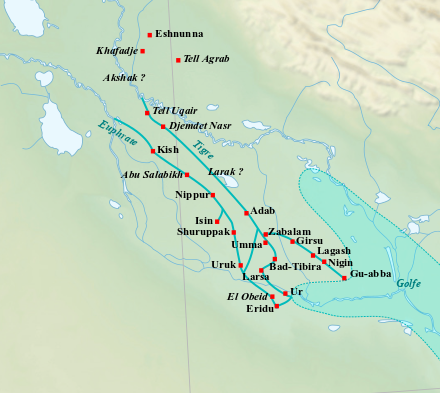
Sumerian city-states flourish
Independent city-states like Ur, Lagash, and Kish compete for power, each ruled by a king (lugal), with ziggurats as religious centers. #history #sumer
Sumerian city-states flourish By NASA Overlay: पाटलिपुत्र (talk) - This image has been extracted from another file, Public domain, https://commons.wikimedia.org/w/index.php?curid=98779414
2900 BCE
Early Dynastic period of Sumer
Sumer enters the Early Dynastic period, marked by dynastic kingship, warfare, and the development of the Standard of Ur and Royal Tombs of Ur. #history #sumer )
Early Dynastic period of Sumer By Near_East_topographic_map-blank.svg: Sémhur derivative work: Zunkir (talk) - Near_East_topographic_map-blank.svg, CC BY-SA 3.0, https://commons.wikimedia.org/w/index.php?curid=11620508
2334 BCE
Sargon of Akkad conquers Sumer
Sargon establishes the Akkadian Empire, unifying Mesopotamia under a centralized rule, with Akkad as capital, and trading as far as the Indus Valley. #history #akkadian
Sargon of Akkad conquers Sumer By ALFGRN - This image has been extracted from another file, CC BY-SA 2.0, https://commons.wikimedia.org/w/index.php?curid=90062589
2285 BCE
Enheduanna becomes first known author
Enheduanna, daughter of Sargon, serves as high priestess and writes hymns to Inanna, making her the first named author in history. #history #literature
Enheduanna becomes first known author By Mefman00 - This image has been extracted from another file, CC0, https://commons.wikimedia.org/w/index.php?curid=77518127
2112 BCE
Ur III dynasty founded by Ur-Nammu
Ur-Nammu established the Neo-Sumerian Ur III dynasty, issuing the earliest known law code and building the Great Ziggurat of Ur. #history #sumer
Ur III dynasty founded by Ur-Nammu By Steve Harris, source - This image has been extracted from another file, CC BY-SA 2.0, https://commons.wikimedia.org/w/index.php?curid=77615392
2100 BCE
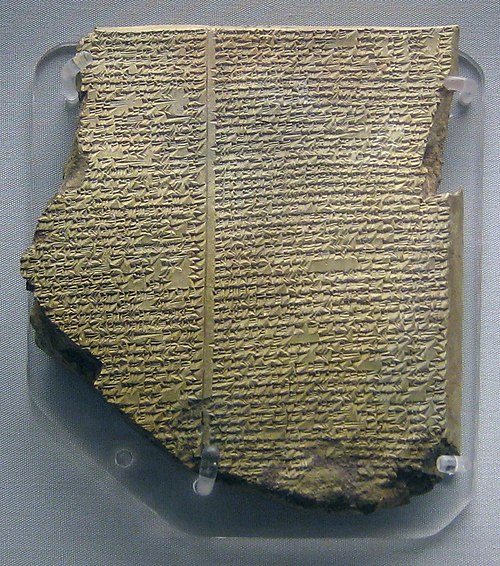
Composition of the Epic of Gilgamesh
Sumerian tales of Gilgamesh are compiled into the epic poem, exploring themes of mortality, friendship, and the quest for immortality. #history #literature
Composition of the Epic of Gilgamesh By Unknown author - BabelStone (Own work), CC0, https://commons.wikimedia.org/w/index.php?curid=10755114
2025 BCE
Old Assyrian period begins
Assyrian city-state of Ashur emerges as a trading hub, establishing merchant colonies in Anatolia and using the earliest known writing on lead. #history #assyria
1792 BCE
Hammurabi becomes king of Babylon
Hammurabi ascends to the throne and later expands Babylon into a major empire, known for his code of laws inscribed on a stele. #history #babylon
Hammurabi becomes king of Babylon By Mbzt - Own work, CC BY 3.0, https://commons.wikimedia.org/w/index.php?curid=59794940
1754 BCE
Code of Hammurabi inscribed
Hammurabi's law code, one of the oldest deciphered codes, is carved on a stone stele, covering trade, family, and criminal law with the principle of lex talionis. #history #law
Code of Hammurabi inscribed By Mbzt - Own work, CC BY 3.0, https://commons.wikimedia.org/w/index.php?curid=16931676
1595 BCE
Hittites sack Babylon, end of Old Babylonian period
Hittite king Mursili I attacks Babylon, ending the First Babylonian dynasty and ushering in Kassite rule. #history #babylon
1365 BCE
Middle Assyrian Empire begins
Ashur-uballit I liberates Assyria from Mitanni control and expands territory, marking the start of the Middle Assyrian period. #history #assyria
Middle Assyrian Empire begins By Near_East_topographic_map-blank.svg: Sémhur derivative work: Zunkir (talk) - Near_East_topographic_map-blank.svg, CC BY-SA 3.0, https://commons.wikimedia.org/w/index.php?curid=11552918
1243 BCE
Tukulti-Ninurta I conquers Babylon
Assyrian king Tukulti-Ninurta I defeats Kassite Babylon and rules as the first Assyrian to claim kingship over both lands. #history #assyria
Tukulti-Ninurta I conquers Babylon By Osama Shukir Muhammed Amin FRCP(Glasg) - Own work, CC BY-SA 4.0, https://commons.wikimedia.org/w/index.php?curid=92055991
911 BCE
Neo-Assyrian Empire begins
Adad-nirari II initiates the Neo-Assyrian Empire, which becomes the largest empire in history up to that time. #history #assyria
Neo-Assyrian Empire begins By Ningyou - Own work data from Based on a map in 'Atlas of the Bible Lands', C S Hammond & Co (1959), ISBN 9780843709414., Public domain, https://commons.wikimedia.org/w/index.php?curid=600659
745 BCE
Tiglath-Pileser III reforms Assyria
Tiglath-Pileser III centralizes power, reorganizes the army, and expands Assyrian territory through systematic conquest. #history #assyria
Tiglath-Pileser III reforms Assyria By Unknown artist - See below, Public domain, https://commons.wikimedia.org/w/index.php?curid=15378403
722 BCE
Assyria destroys Israel
Assyrian forces under Sargon II capture Samaria and deport the Israelites, leading to the loss of the Ten Lost Tribes. #history #assyria
Assyria destroys Israel By Osama Shukir Muhammed Amin FRCP(Glasg) - Own work, CC BY-SA 4.0, https://commons.wikimedia.org/w/index.php?curid=78780705
701 BCE
Sennacherib’s siege of Jerusalem
Assyrian king Sennacherib besieges Jerusalem but fails to capture it; the event is recorded in the Bible and Assyrian annals. #history #assyria
Sennacherib’s siege of Jerusalem By Timo Roller - Own work, CC BY 3.0, https://commons.wikimedia.org/w/index.php?curid=39985581
650 BCE
Library of Ashurbanipal
Ashurbanipal collects thousands of cuneiform tablets in Nineveh, including the Epic of Gilgamesh, creating the first systematic library. #history #literature
Library of Ashurbanipal By Gary Todd - https://www.flickr.com/photos/101561334@N08/36562516345/, CC0, https://commons.wikimedia.org/w/index.php?curid=91138912
626 BCE
Neo-Babylonian Empire established
Nabopolassar rebels against Assyria and founds the Neo-Babylonian (Chaldean) Empire, with Babylon as its capital. #history #babylon
612 BCE
Fall of Nineveh
A coalition of Babylonians, Medes, and others sacks Nineveh, ending the Assyrian Empire. #history #assyria
Fall of Nineveh By (Mu-tamajo) むーたんじょ - Own work, CC BY-SA 4.0, https://commons.wikimedia.org/w/index.php?curid=48411583
605 BCE
Nebuchadnezzar II becomes king
Nebuchadnezzar II ascends the throne and leads Babylon to its zenith, conquering Jerusalem and beginning the Babylonian captivity of the Jews. #history #babylon
Nebuchadnezzar II becomes king By Unknown author, Public domain, https://commons.wikimedia.org/w/index.php?curid=87505819
600 BCE
Hanging Gardens of Babylon
According to tradition, Nebuchadnezzar builds the Hanging Gardens, one of the Seven Wonders of the Ancient World, though archaeological evidence remains elusive. #history #babylon
Hanging Gardens of Babylon By Unknown author - http://www.plinia.net/wonders/gardens/hgpix1.html, Public domain, https://commons.wikimedia.org/w/index.php?curid=65909
539 BCE
Cyrus the Great conquers Babylon
Persian king Cyrus captures Babylon without a battle, ending the Neo-Babylonian Empire and issuing the Cyrus Cylinder, a charter of human rights. #history #babylon
Cyrus the Great conquers Babylon By Unknown author - https://wellcomeimages.org/indexplus/obf_images/fc/fc/32d4c8b927dea8bfbf69f55cbd10.jpg Gallery: https://wellcomeimages.org/indexplus/image/V0034440.html Wellcome Collection gallery (2018-04-03): https://wellcomecollection.org/works/pc9e75j3 CC-BY-4.0, CC BY 4.0, https://commons.wikimedia.org/w/index.php?curid=36614814
331 BCE
Alexander the Great conquers Mesopotamia
Alexander defeats the Persians at Gaugamela and takes Babylon, later dying in the city, leading to Hellenistic influence. #history #mesopotamia
Alexander the Great conquers Mesopotamia By Pietro da Cortona - Google Arts & Culture — TAFxS-oMiYzUyA, Public domain, https://commons.wikimedia.org/w/index.php?curid=22006940
305 BCE
Seleucid Empire controls Mesopotamia
Seleucus I establishes the Seleucid Empire with capitals in Seleucia and later Antioch, blending Greek and Mesopotamian cultures. #history #seleucid
Seleucid Empire controls Mesopotamia By Hartmann Linge - Own work, CC BY-SA 4.0, https://commons.wikimedia.org/w/index.php?curid=21343017
150 BCE
Parthians take Mesopotamia
The Parthian Empire (Arsacid) conquers Mesopotamia from the Seleucids, reviving Iranian rule and promoting trade along the Silk Road. #history #parthian
Parthians take Mesopotamia By Original file by Ro4444, edited by me - Own work using: Sources I listed at en:w:Talk:Parthian_Empire/Archive_1#Boundaries_on_the_map, too lazy to write them down here at the moment. The Iranian Expanse by Canepa Olbrycht, Marek Jan 2009. "Mithridates VI Eupator and Iran, pp. 164–166, 170–171 Olbrycht, Marek Jan (2010). "The early reign of Mithradates II the Great in Parthia". pp. 151–153 Shayegan, M. Rahim (2011). Arsacids and Sasanians: Political Ideology in Post-Hellenistic and Late Antique Persia. pp. 116–118, 168 Kia, Mehrdad (2016). The Persian Empire: A Historical Encyclopedia [2 volumes]: A Historical Encyclopedia. pp. 55, 186 (need to find a better source to replace this in the future though)., CC BY-SA 4.0, https://commons.wikimedia.org/w/index.php?curid=94664729
224 CE
Sasanian Empire replaces Parthian rule
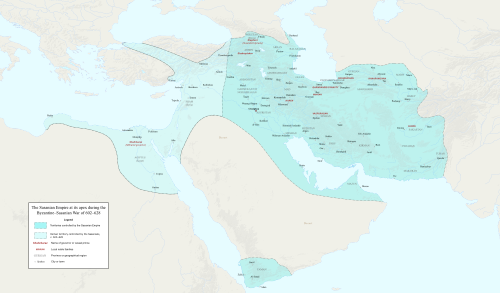
Ardashir I founds the Sasanian Empire, restoring Zoroastrianism and centralizing power in Ctesiphon, in Mesopotamia. #history #sasanian
Sasanian Empire replaces Parthian rule By Original file by Ro4444, edited by me - Based on several sources, including the Middle Persian geographical text Šahrestānīhā ī Ērānšahr, CC BY 4.0, https://commons.wikimedia.org/w/index.php?curid=94837349
637 CE
Muslim conquest of Mesopotamia
Arab Muslims under Sa'd ibn Abi Waqqas defeat the Sasanians at the Battle of al-Qadisiyyah, bringing Mesopotamia under Islamic rule. #history #islam
Muslim conquest of Mesopotamia By Unknown artist - http://dglnotes.com/notes/qadisiyyah.htm#image4, Public domain, https://commons.wikimedia.org/w/index.php?curid=24725846
1843 CE
Botta discovers Assyrian palace at Khorsabad
French consul Paul Émile Botta excavates the palace of Sargon II, revealing Neo-Assyrian art and architecture to the Western world. #history #archaeology
Botta discovers Assyrian palace at Khorsabad By Charles-Émile-Callande de Champmartin - Réunion des Musées Nationaux, Inventarnummer RF37, Public domain, https://commons.wikimedia.org/w/index.php?curid=10252565
1845 CE
Layard excavates Nineveh
Austen Henry Layard begins excavations at Nineveh, uncovering the Library of Ashurbanipal and colossal lamassu statues. #history #archaeology
Layard excavates Nineveh By British School - Art UK, Public domain, https://commons.wikimedia.org/w/index.php?curid=3941257
1851 CE
Rawlinson deciphers Behistun inscription
Henry Rawlinson successfully deciphers the trilingual Behistun inscription, enabling the reading of cuneiform scripts. #history #archaeology
Rawlinson deciphers Behistun inscription By Korosh.091 - Own work, CC BY-SA 4.0, https://commons.wikimedia.org/w/index.php?curid=73454100
1853 CE
Discovery of Gilgamesh tablets
Hormuzd Rassam discovers clay tablets from the Library of Ashurbanipal containing the Epic of Gilgamesh. #history #literature
1922 CE
Leonard Woolley excavates Ur
Sir Leonard Woolley leads excavations at Ur, uncovering the Royal Tombs, the Standard of Ur, and the ziggurat. #history #archaeology
Leonard Woolley excavates Ur By Hulton-Deutsch Collection - https://www.gettyimages.com/detail/news-photo/the-archaeologist-and-writer-charles-woolley-he-led-news-photo/613511248?adppopup=true, CC0, https://commons.wikimedia.org/w/index.php?curid=112258971
1932 CE
Standard of Ur discovered
Woolley's team uncovers the Standard of Ur, a Sumerian artifact depicting scenes of war and peace. #history #archaeology
Standard of Ur discovered By Denis Bourez from France - British Museum, London Uploaded by SunOfErat, CC BY 2.0, https://commons.wikimedia.org/w/index.php?curid=30317206
2003 CE
Iraq War damages Mesopotamian sites
The US-led invasion of Iraq leads to looting of the Iraq Museum and damage to archaeological sites like Babylon and Ur. #history #archaeology