Encyclopedia/3. History, Societies & Civilizations/11. Pre-Modern & Modern History • Curated by Admin Timeline.sg
This timeline covers the major milestones of Ancient Egyptian civilization from the Predynastic Period through the Old Kingdom, including the unification of Egypt, the construction of the great pyramids, and the development of writing and monumental architecture.
Chronological Storyline (47 Milestones)
5500 BCE
Predynastic Period Begins
The Predynastic Period in Egypt sees the development of agriculture, permanent settlements, and early trade networks along the Nile. This era lays the foundation for the later unification of Upper and Lower Egypt. #AncientEgypt #History
Predynastic Period Begins By Collage of:Image:Diorite Vase Neqada II Predynastic Ancient Egypt Field Museum.jpg by User:Madman2001, Image:Egypte louvre 322.jpg and Image:Egypte louvre 314.jpg by User:Borislav, Image:Egypte louvre 316.jpg by [[fr:Utilisateur:Aoineko]] (Guillaume Blanchard), Image:PredynasticFemaleFigurine BrooklynMuseum.png by User:Captmondo, and Image:Louvre-antiquites-egyptiennes-p1020364.jpg by User:Rama - This image has been extracted from another file, CC BY-SA 3.0, https://commons.wikimedia.org/w/index.php?curid=88147140
4000 BCE
Naqada Culture Emerges
The Naqada culture in Upper Egypt becomes dominant, characterized by advanced pottery, trade with Nubia and the Levant, and the emergence of social hierarchies. This period sees the rise of early proto-kingdoms. #AncientEgypt #Archaeology
Naqada Culture Emerges By H.Seldon - The map was made from file Ancient_Egypt_map.svg. This file was made by Jeff Dahl. For NaqadaI.svg was used information from book: Ian Shaw: Dějiny starověkého Egypta, ISBN 80-7257-975-4., CC BY-SA 3.0, https://commons.wikimedia.org/w/index.php?curid=3948509
3500 BCE
Hieroglyphic Writing Develops
Early hieroglyphic symbols appear in Egypt, used for record-keeping and religious inscriptions. This marks one of the earliest known writing systems, evolving from pictographic representations. #Writing #AncientEgypt
Hieroglyphic Writing Develops By unknown Egyptian scribe - The British Museum (http://www.egyptarchive.co.uk/html/british_museum_29.html (Jon Bodsworth) - https://www.egyptarchive.co.uk/), Copyrighted free use, https://commons.wikimedia.org/w/index.php?curid=3210751
3100 BCE
First Dynasty Established
The First Dynasty of Egypt begins with the reign of Narmer/Menes, marking the start of the Early Dynastic Period. Memphis is founded as the capital, and centralized administration develops. #Dynasty #AncientEgypt
First Dynasty Established By anonymous - This image has been extracted from another file, Public domain, https://commons.wikimedia.org/w/index.php?curid=91163917
3100 BCE
Unification of Egypt by Narmer
King Narmer (often identified with Menes) unifies Upper and Lower Egypt, establishing the First Dynasty. The Narmer Palette commemorates this event, depicting the king wearing both crowns. #Unification #AncientEgypt
Unification of Egypt by Narmer By Unknown author - This image has been extracted from another file, Public domain, https://commons.wikimedia.org/w/index.php?curid=181920722
3000 BCE
Early Dynastic Period Flourishes
The Early Dynastic Period (Dynasties I-II) sees the consolidation of royal power, development of bureaucracy, and construction of mudbrick tombs at Abydos and Saqqara. Trade expands with Mesopotamia. #AncientEgypt #History
Early Dynastic Period Flourishes By पाटलिपुत्र - Own work, CC BY-SA 4.0, https://commons.wikimedia.org/w/index.php?curid=174855970
2686 BCE
Old Kingdom Begins with Third Dynasty
The Third Dynasty marks the start of the Old Kingdom, a period of strong central government and pyramid building. Pharaoh Djoser commissions the Step Pyramid at Saqqara, the first colossal stone monument. #OldKingdom #Pyramids
Old Kingdom Begins with Third Dynasty By Vyacheslav Argenberg - Own work, CC BY 4.0, https://commons.wikimedia.org/w/index.php?curid=121352034
2670 BCE
Step Pyramid of Djoser Built
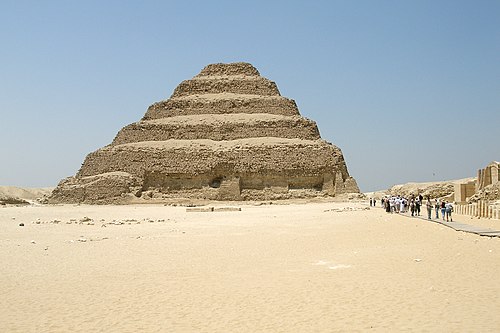
Architect Imhotep designs the Step Pyramid for Pharaoh Djoser at Saqqara, the earliest known large-scale cut stone construction. This six-tiered pyramid becomes the prototype for later pyramids. #Architecture #Pyramids
Step Pyramid of Djoser Built By Olaf Tausch - Own work, CC BY 3.0, https://commons.wikimedia.org/w/index.php?curid=6871914
2613 BCE
Fourth Dynasty Begins
The Fourth Dynasty ushers in the age of the great pyramid builders, including Pharaohs Sneferu, Khufu, Khafre, and Menkaure. This dynasty achieves unprecedented architectural and organizational feats. #Dynasty #Pyramids
Fourth Dynasty Begins By Nina - Own work, CC BY 2.5, https://commons.wikimedia.org/w/index.php?curid=282496
2610 BCE
Sneferu Builds the Bent Pyramid
Pharaoh Sneferu constructs the Bent Pyramid at Dahshur, a transitional design with a change in slope angle. This experiment leads to the development of the true smooth-sided pyramid. #Architecture #Pyramids
Sneferu Builds the Bent Pyramid By lienyuan lee - https://web.archive.org/web/20161022073024/http://www.panoramio.com/photo/68023631, CC BY 3.0, https://commons.wikimedia.org/w/index.php?curid=54566893
2600 BCE
Red Pyramid Completed
Sneferu completes the Red Pyramid at Dahshur, the first successful true pyramid with smooth sides. Its name comes from the reddish limestone used, and it marks a milestone in pyramid construction. #Architecture #Pyramids
Red Pyramid Completed By Olaf Tausch - Own work, CC BY 3.0, https://commons.wikimedia.org/w/index.php?curid=36358297
2580 BCE
Great Pyramid of Giza Built
Pharaoh Khufu (Cheops) commissions the Great Pyramid of Giza, the largest of the Egyptian pyramids. Standing 146.6 meters tall, it remains the only surviving Wonder of the Ancient World. #Wonders #Pyramids
Great Pyramid of Giza Built By Douwe C. van der Zee - Own work, CC BY-SA 4.0, https://commons.wikimedia.org/w/index.php?curid=138278511
2570 BCE
Pyramid of Khafre Constructed
Pharaoh Khafre builds the second pyramid at Giza, slightly smaller than Khufu's but appearing taller due to its elevated location. The Great Sphinx is also associated with his pyramid complex. #Architecture #Sphinx
Pyramid of Khafre Constructed By M1chu - Shot from my hotel, CC BY-SA 3.0, https://commons.wikimedia.org/w/index.php?curid=41245735
2550 BCE
Great Sphinx of Giza Carved
The Great Sphinx, a limestone statue with a lion's body and human head, is carved during the reign of Khafre. It guards the Giza plateau and symbolizes royal power and wisdom. #Sphinx #Monument
Great Sphinx of Giza Carved By Hesham Ebaid - Own work, CC0, https://commons.wikimedia.org/w/index.php?curid=62791941
2530 BCE
Pyramid of Menkaure Built
Pharaoh Menkaure constructs the third and smallest pyramid at Giza, standing 65 meters tall. Its complex includes three subsidiary pyramids and a mortuary temple. #Architecture #Pyramids
Pyramid of Menkaure Built By Unknown author, CC BY-SA 2.5, https://commons.wikimedia.org/w/index.php?curid=303308
2500 BCE
Old Kingdom Peak Under Fifth Dynasty
The Fifth Dynasty continues pyramid building but on a smaller scale, with sun temples dedicated to Ra. The Palermo Stone records royal annals, and the cult of the sun god becomes prominent. #OldKingdom #Religion
Old Kingdom Peak Under Fifth Dynasty By Olaf Tausch - Own work, CC BY 3.0, https://commons.wikimedia.org/w/index.php?curid=36515177
2490 BCE
Pyramid Texts Appear
The Pyramid Texts, the oldest known religious writings, are inscribed in the pyramids of Unas and later kings. These spells and rituals ensure the pharaoh's afterlife and reveal early Egyptian theology. #Religion #Writing
Pyramid Texts Appear By Chipdawes - en Wiki, Public domain, https://commons.wikimedia.org/w/index.php?curid=1193630
2465 BCE
Userkaf Builds Sun Temple
Pharaoh Userkaf, founder of the Fifth Dynasty, builds a sun temple at Abusir dedicated to Ra. These temples feature a large obelisk on a platform, emphasizing the solar cult. #Religion #Architecture
Userkaf Builds Sun Temple By Ovedc - Own work, CC BY-SA 4.0, https://commons.wikimedia.org/w/index.php?curid=65686832
2450 BCE
Sahure's Pyramid Complex at Abusir
Pharaoh Sahure constructs his pyramid complex at Abusir, known for its well-preserved reliefs depicting naval expeditions and trade. The complex includes a valley temple, causeway, and mortuary temple. #Architecture #Trade
Sahure's Pyramid Complex at Abusir By No machine-readable author provided. Neithsabes assumed (based on copyright claims). - No machine-readable source provided. Own work assumed (based on copyright claims)., Public domain, https://commons.wikimedia.org/w/index.php?curid=882929
2400 BCE
Neferirkare Kakai's Pyramid
Pharaoh Neferirkare Kakai builds the largest pyramid at Abusir, though it is unfinished. His reign sees administrative reforms and the expansion of the bureaucracy. #Architecture #Administration
Neferirkare Kakai's Pyramid By Kurohito - Own work, CC BY-SA 3.0, https://commons.wikimedia.org/w/index.php?curid=12115370
2375 BCE
Unas Pyramid and Pyramid Texts
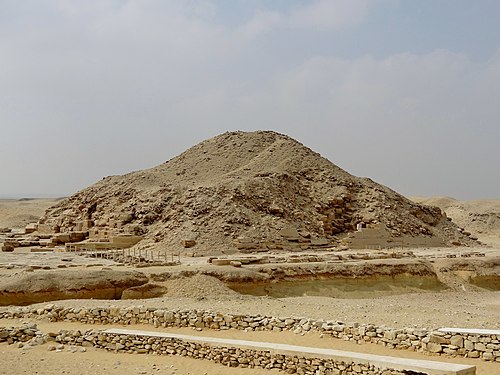
Pharaoh Unas, last ruler of the Fifth Dynasty, builds a small pyramid at Saqqara inscribed with the Pyramid Texts. These texts are the earliest known corpus of Egyptian funerary literature. #Religion #Writing
Unas Pyramid and Pyramid Texts By Olaf Tausch - Own work, CC BY 3.0, https://commons.wikimedia.org/w/index.php?curid=36514180
2345 BCE
Sixth Dynasty Begins
The Sixth Dynasty continues the Old Kingdom, with pharaohs like Teti, Pepi I, and Pepi II. Pyramid building continues at Saqqara, and the power of regional officials begins to grow. #Dynasty #OldKingdom
Sixth Dynasty Begins By Keith Schengili-Roberts - Own work (photo), CC BY-SA 2.5, https://commons.wikimedia.org/w/index.php?curid=1625218
2330 BCE
Teti's Pyramid at Saqqara
Pharaoh Teti, founder of the Sixth Dynasty, builds his pyramid at Saqqara near the Step Pyramid. His pyramid contains Pyramid Texts and is surrounded by mastabas of nobles. #Architecture #Saqqara
Teti's Pyramid at Saqqara By Wknight94 talk - Own work, CC BY-SA 3.0, https://commons.wikimedia.org/w/index.php?curid=9824052
2320 BCE
Pepi I's Reign and Pyramid
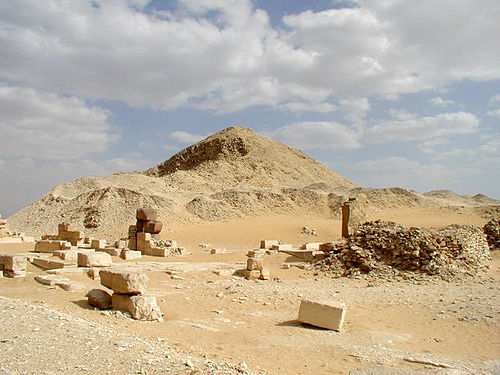
Pharaoh Pepi I rules for several decades and builds a pyramid at Saqqara. His reign is marked by extensive trade and military campaigns, as well as the growing influence of nomarchs. #Reign #Pyramids
Pepi I's Reign and Pyramid By Charles Edwin Wilbour Fund - Brooklyn Museum, No restrictions, https://commons.wikimedia.org/w/index.php?curid=168242149
2280 BCE
Merenre Nemtyemsaf I Succeeds
Pharaoh Merenre I, son of Pepi I, rules briefly and continues his father's policies. His pyramid is unfinished, reflecting the declining resources of the Old Kingdom. #Dynasty #Decline
Merenre Nemtyemsaf I Succeeds By Rudolf Anthes (1896 - 1985) - Sethe, Kurt, ed. (1928) Die Felseninschriften von Hatnub / nach den Aufnahmen Georg Möllers; herasugegeben und bearbeitet von Rudolf Anthes, 9, Leipzig: J. C. Hinrichs OCLC: 241525038. see Tafel 5, Inschrift 6 (p. 235 in online reader), Public domain, https://commons.wikimedia.org/w/index.php?curid=185422324
2278 BCE
Pepi II's Long Reign Begins
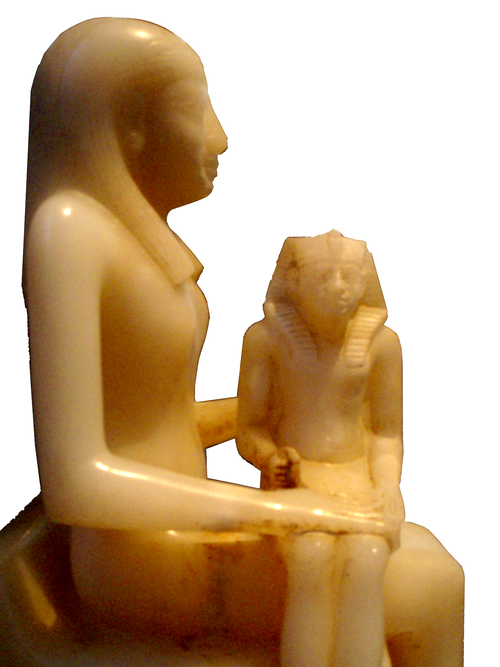
Pharaoh Pepi II ascends the throne as a child and rules for over 90 years, the longest reign in ancient Egyptian history. His reign sees the gradual decentralization of power and economic decline. #Reign #OldKingdom
Pepi II's Long Reign Begins By Metropolitan Museum of Art, New York - This file was donated to Wikimedia Commons as part of a project by the Metropolitan Museum of Art. See the Image and Data Resources Open Access Policy, CC0, https://commons.wikimedia.org/w/index.php?curid=56210720
2250 BCE
Pepi II's Pyramid Complex
Pepi II builds his pyramid at Saqqara, smaller than earlier pyramids, with a complex of temples and subsidiary pyramids. The Pyramid Texts are inscribed inside, but the structure is poorly preserved. #Architecture #Saqqara
Pepi II's Pyramid Complex By Jon Bodsworth - http://www.egyptarchive.co.uk/html/saqqara_pyramids_08.html, Copyrighted free use, https://commons.wikimedia.org/w/index.php?curid=1363766
2200 BCE
Old Kingdom Collapses
The Old Kingdom ends around 2200 BCE due to political fragmentation, economic troubles, and possibly climate change. Egypt enters the First Intermediate Period, a time of civil war and weak central rule. #Collapse #History
Old Kingdom Collapses By Cattette - Own work This PNG graphic was created with Adobe Illustrator., CC BY 4.0, https://commons.wikimedia.org/w/index.php?curid=110087569
2181 BCE
Seventh and Eighth Dynasties
The Seventh and Eighth Dynasties are poorly documented, with many ephemeral rulers. Memphis remains the nominal capital, but effective control is lost to regional nomarchs. #Dynasty #FirstIntermediate
2160 BCE
Heracleopolis Magna Rises
The Ninth and Tenth Dynasties based at Heracleopolis Magna attempt to reunify Egypt but face competition from Thebes. This period sees the composition of the 'Teaching for King Merikare'. #Dynasty #Literature
Heracleopolis Magna Rises By Flinders Petrie (1853-1942) - Scarabs and cylinders with names (1917), available copyright-free here, pl. X, n. 9.2., Public domain, https://commons.wikimedia.org/w/index.php?curid=30739702
2134 BCE
Eleventh Dynasty Founded at Thebes
The Eleventh Dynasty emerges in Thebes under Intef I, challenging Heracleopolitan rule. The Theban rulers gradually expand their territory, setting the stage for reunification. #Dynasty #Thebes
Eleventh Dynasty Founded at Thebes By Prof. Mortel - https://www.flickr.com/photos/43714545@N06/52087071973/, CC BY 2.0, https://commons.wikimedia.org/w/index.php?curid=118201367
2120 BCE
Intef II Expands Theban Control
Pharaoh Intef II of the Eleventh Dynasty conquers key territories, including the nome of Abydos. His reign marks the intensification of the conflict between Thebes and Heracleopolis. #Warfare #Unification
Intef II Expands Theban Control By Unknown author - This file was donated to Wikimedia Commons as part of a project by the Metropolitan Museum of Art. See the Image and Data Resources Open Access Policy, CC0, https://commons.wikimedia.org/w/index.php?curid=60934803
2070 BCE
Mentuhotep II Begins Reign
Mentuhotep II ascends the Theban throne and launches a campaign to reunify Egypt. He defeats the Heracleopolitan kingdom and establishes the Middle Kingdom. #Reunification #MiddleKingdom
2055 BCE
Mentuhotep II Reunifies Egypt
Mentuhotep II conquers Heracleopolis and reunites Egypt, ending the First Intermediate Period. He adopts the title 'Uniter of the Two Lands' and builds a mortuary temple at Deir el-Bahri. #Unification #MiddleKingdom
2040 BCE
Middle Kingdom Begins
The reunification under Mentuhotep II marks the start of the Middle Kingdom, a period of stability, artistic renaissance, and expansion. Thebes becomes the capital, and the god Amun rises in prominence. #MiddleKingdom #History
Middle Kingdom Begins By Gert7 - Own work, CC BY-SA 4.0, https://commons.wikimedia.org/w/index.php?curid=143556656
2000 BCE
Mentuhotep III's Building Projects
Pharaoh Mentuhotep III continues construction at Deir el-Bahri and leads expeditions to the Red Sea and Punt. His reign sees the development of the Karnak temple complex. #Architecture #Trade
Mentuhotep III's Building Projects By Keith Schengili-Roberts - Own work (photo), CC BY-SA 2.5, https://commons.wikimedia.org/w/index.php?curid=1853384
1991 BCE
Twelfth Dynasty Founded by Amenemhat I
Amenemhat I, a vizier under Mentuhotep IV, seizes power and founds the Twelfth Dynasty. He moves the capital to Itjtawy near Memphis and strengthens central authority. #Dynasty #Capital
Twelfth Dynasty Founded by Amenemhat I By Unknown author - This file was donated to Wikimedia Commons as part of a project by the Metropolitan Museum of Art. See the Image and Data Resources Open Access Policy, CC0, https://commons.wikimedia.org/w/index.php?curid=168789895
1970 BCE
Senusret I's Co-regency and Campaigns
Senusret I rules as co-regent with his father Amenemhat I and later independently. He leads military campaigns into Nubia and Libya, and builds the White Chapel at Karnak. #Warfare #Architecture
Senusret I's Co-regency and Campaigns By W. M. Flinders Petrie (1853-1942) - Petrie (ed) in Ancient Egypt, 1914, MacMillian and Co. & British School fo Archaeology in Egypt, University College, London., Public domain, https://commons.wikimedia.org/w/index.php?curid=177095405
1920 BCE
Senusret II's Irrigation Projects
Pharaoh Senusret II undertakes major irrigation works in the Faiyum region, including the construction of a canal to regulate the Bahr Yussef. This boosts agricultural productivity. #Agriculture #Engineering
Senusret II's Irrigation Projects By ArchaiOptix - Own work, CC BY-SA 4.0, https://commons.wikimedia.org/w/index.php?curid=177791076
1890 BCE
Senusret III's Nubian Fortresses
Senusret III launches aggressive campaigns into Nubia, building a series of fortresses along the Nile to secure Egyptian control. He also reforms the administration and curbs the power of nomarchs. #Warfare #Fortifications
Senusret III's Nubian Fortresses By ArchaiOptix - Own work, CC BY-SA 4.0, https://commons.wikimedia.org/w/index.php?curid=177791287
1878 BCE
Amenemhat III's Reign and Building
Amenemhat III, son of Senusret III, oversees a period of prosperity. He builds the 'Black Pyramid' at Dahshur and the 'Labyrinth' at Hawara, a massive mortuary complex admired by later Greeks. #Architecture #Prosperity
Amenemhat III's Reign and Building By sailko - Own work, CC BY-SA 3.0, https://commons.wikimedia.org/w/index.php?curid=177941954
1850 BCE
Twelfth Dynasty Decline Begins
After Amenemhat III, the Twelfth Dynasty weakens under Amenemhat IV and Sobekneferu, the first confirmed female pharaoh. The dynasty ends around 1800 BCE, leading to the Thirteenth Dynasty. #Decline #Dynasty
1800 BCE
Thirteenth Dynasty and Second Intermediate Period
The Thirteenth Dynasty rules from Itjtawy but faces internal strife and the gradual infiltration of Hyksos into the Delta. This period marks the beginning of the Second Intermediate Period. #SecondIntermediate #Hyksos
Thirteenth Dynasty and Second Intermediate Period By anonymous - https://libis-kul.primo.exlibrisgroup.com/permalink/32KUL_KUL/1fst9n3/alma9992120394001488, Public domain, https://commons.wikimedia.org/w/index.php?curid=173106750
1720 BCE
Hyksos Take Control of Avaris
The Hyksos, a Semitic people, establish a stronghold at Avaris in the Nile Delta. They introduce new military technology, including horse-drawn chariots and composite bows. #Hyksos #Warfare
Hyksos Take Control of Avaris By Macquarie University - Benihassan Project Photograph of a 2-Dimentional object which is in the Public Domain, hence PD-Art applies, Public domain, https://commons.wikimedia.org/w/index.php?curid=91632148
1650 BCE
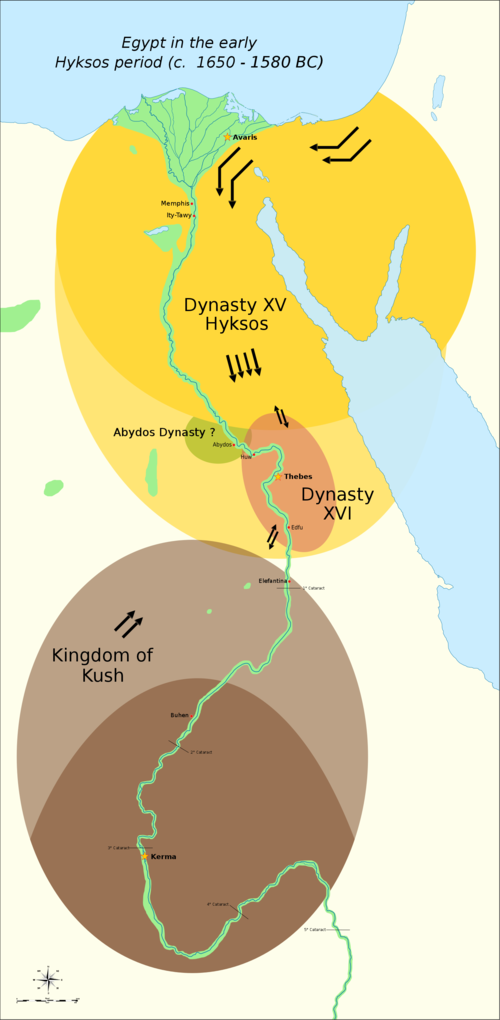
Hyksos Rule as Fifteenth Dynasty
The Hyksos formally establish the Fifteenth Dynasty, ruling much of Lower Egypt from Avaris. They adopt Egyptian titles and customs while maintaining their own cultural identity. #Hyksos #Dynasty
Hyksos Rule as Fifteenth Dynasty By Iry-Hor - Own work, CC BY-SA 4.0, https://commons.wikimedia.org/w/index.php?curid=34922151
1600 BCE
Theban Seventeenth Dynasty Resists
The Seventeenth Dynasty in Thebes begins a campaign of resistance against the Hyksos. Pharaohs like Seqenenre Tao and Kamose lead military efforts to expel the invaders. #Resistance #Warfare
Theban Seventeenth Dynasty Resists By Unknown artist - Mbzt (2013), CC BY-SA 3.0, https://commons.wikimedia.org/w/index.php?curid=30235411
1550 BCE
Ahmose I Expels Hyksos and Begins New Kingdom
Ahmose I captures Avaris and drives the Hyksos out of Egypt, reuniting the country and founding the Eighteenth Dynasty. This marks the start of the New Kingdom, Egypt's most powerful era. #NewKingdom #Unification
Ahmose I Expels Hyksos and Begins New Kingdom By anonymous - This file was donated to Wikimedia Commons as part of a project by the Metropolitan Museum of Art. See the Image and Data Resources Open Access Policy, CC0, https://commons.wikimedia.org/w/index.php?curid=60903043