Ancient Egypt: Pyramids, Hieroglyphs & Pharaonic Dynasties
Encyclopedia/3. History, Societies & Civilizations/04. European Civilizations & Empires/01. Classical Antiquity • Curated by Admin Timeline.sg
Ancient Egypt, one of the world's oldest civilizations, flourished along the Nile for over three millennia, marked by monumental pyramids, hieroglyphic writing, and powerful pharaohs. This timeline covers key events from the unification under Narmer to the end of the Ptolemaic period.
Chronological Storyline (38 Milestones)
3100 BCE
Narmer Unifies Upper and Lower Egypt
King Narmer (Menes) unifies Upper and Lower Egypt, establishing the First Dynasty and the capital at Memphis. The Narmer Palette commemorates this unification. #history #ancientegypt
Narmer Unifies Upper and Lower Egypt By Unknown author - This image has been extracted from another file, Public domain, https://commons.wikimedia.org/w/index.php?curid=181920722
2686 BCE
Start of the Old Kingdom
The Third Dynasty begins under Djoser, marking the start of the Old Kingdom, a period of pyramid building and strong central government. #history #ancientegypt
Start of the Old Kingdom By Cattette - Own work This PNG graphic was created with Adobe Illustrator., CC BY 4.0, https://commons.wikimedia.org/w/index.php?curid=110087569
2630 BCE
Djoser's Step Pyramid Built
Imhotep designs the Step Pyramid for Pharaoh Djoser at Saqqara, the earliest colossal stone building in Egypt. #architecture #history
Djoser's Step Pyramid Built By Olaf Tausch - Own work, CC BY 3.0, https://commons.wikimedia.org/w/index.php?curid=6871914
2589 BCE
Khufu Begins Reign
Pharaoh Khufu (Cheops) ascends the throne and commissions the Great Pyramid of Giza, the largest of the pyramids. #history #ancientegypt
Khufu Begins Reign By UserPpPp - This image has been extracted from another file, CC BY-SA 4.0, https://commons.wikimedia.org/w/index.php?curid=175970893
2560 BCE
Great Pyramid of Giza Completed
The Great Pyramid of Giza, built for Pharaoh Khufu, is completed. It stands 146.6 meters tall and remains the only surviving Wonder of the Ancient World. #architecture #history
Great Pyramid of Giza Completed By Douwe C. van der Zee - Own work, CC BY-SA 4.0, https://commons.wikimedia.org/w/index.php?curid=138278511
2532 BCE
Khafre's Pyramid and Sphinx Built
Pharaoh Khafre builds the second pyramid at Giza and the Great Sphinx, a limestone statue with a lion's body and human head. #architecture #history
Khafre's Pyramid and Sphinx Built By Hesham Ebaid - Own work, CC0, https://commons.wikimedia.org/w/index.php?curid=62791941
2490 BCE
Menkaure's Pyramid Completed
The third and smallest pyramid at Giza is built for Pharaoh Menkaure. #architecture #history
Menkaure's Pyramid Completed By Unknown author, CC BY-SA 2.5, https://commons.wikimedia.org/w/index.php?curid=303308
2181 BCE
Old Kingdom Collapses; First Intermediate Period Begins
Central authority weakens, leading to the First Intermediate Period, a time of civil war and decentralized rule. #history #ancientegypt
Old Kingdom Collapses; First Intermediate Period Begins By Jeff Dahl - Own work using: Shaw, Ian, ed. (2003) The Oxford History of Ancient Egypt, Oxford University Press ISBN: 0-19-280293-3. Dr. Peter Der Manuelian, ed. (1998) Egypt: The World of the Pharaohs, Bonner Straße, Köln (Deutschland): Könemann Verlagsgesellschaft mbH ISBN: 3-89508-913-3. Digital Egypt - maps. Retrieved on 2007-11-25. NASA PIA04957. Retrieved on 2007-11-25. NASA PIA02647. Retrieved on 2007-11-25. NASA PIA04965. Retrieved on 2007-11-25. Coordinates: Sais 30°57′53″N, 30°46′6″E Buto 31°11′47″N, 30°44′41″E Alexandria 31°11′53″N 29°55′09″E Naukratis 30°54' N 30°35'E coordinates here Tanis 30°58′37″N, 31°52′48″E Avaris 30°47′N, 31°50′E Busiris 30°54′40″N, 31°14′40″E Image renamed from File:Ancient Egypt map.svg (see #Original upload log)., CC BY-SA 4.0, https://commons.wikimedia.org/w/index.php?curid=5818406
2055 BCE
Mentuhotep II Reunifies Egypt; Middle Kingdom Begins
Mentuhotep II of Thebes reunites Egypt, starting the Middle Kingdom, a period of stability and cultural revival. #history #ancientegypt
Mentuhotep II Reunifies Egypt; Middle Kingdom Begins By Prof. Mortel - https://www.flickr.com/photos/43714545@N06/52087071973/, CC BY 2.0, https://commons.wikimedia.org/w/index.php?curid=118201367
1963 BCE
Senusret I Builds the White Chapel
Pharaoh Senusret I constructs the White Chapel at Karnak, a masterpiece of Middle Kingdom architecture. #architecture #history
Senusret I Builds the White Chapel By Markh at English Wikipedia - Transferred from en.wikipedia to Commons by Leoboudv using CommonsHelper., CC BY-SA 3.0, https://commons.wikimedia.org/w/index.php?curid=20206703
1850 BCE
The Tale of Sinuhe Composed
The classic Egyptian story 'The Tale of Sinuhe' is written, reflecting Middle Kingdom literary sophistication. #literature #history
1795 BCE
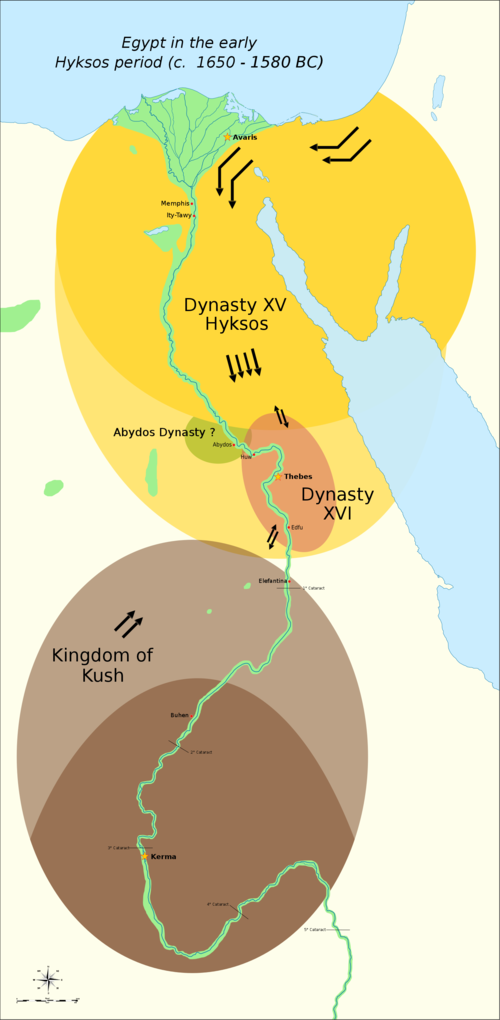
Middle Kingdom Ends; Second Intermediate Period Begins
The Middle Kingdom declines, leading to the Second Intermediate Period, with Hyksos rule in the north. #history #ancientegypt
Middle Kingdom Ends; Second Intermediate Period Begins By Iry-Hor - Own work, CC BY-SA 4.0, https://commons.wikimedia.org/w/index.php?curid=34922151
1550 BCE
Ahmose I Expels Hyksos; New Kingdom Begins
Ahmose I drives out the Hyksos and reunites Egypt, founding the Eighteenth Dynasty and the New Kingdom. #history #ancientegypt
Ahmose I Expels Hyksos; New Kingdom Begins By anonymous - This file was donated to Wikimedia Commons as part of a project by the Metropolitan Museum of Art. See the Image and Data Resources Open Access Policy, CC0, https://commons.wikimedia.org/w/index.php?curid=60903043
1479 BCE
Hatshepsut Becomes Pharaoh
Hatshepsut, one of the few female pharaohs, takes the throne and launches a prosperous reign, building the Mortuary Temple at Deir el-Bahri. #history #women
Hatshepsut Becomes Pharaoh By Unknown author - This file was donated to Wikimedia Commons as part of a project by the Metropolitan Museum of Art. See the Image and Data Resources Open Access Policy, CC0, https://commons.wikimedia.org/w/index.php?curid=57859093
1458 BCE
Thutmose III's Military Campaigns
Thutmose III, often called the Napoleon of Egypt, conducts numerous military campaigns, expanding Egypt's empire to its greatest extent. #history #warfare
Thutmose III's Military Campaigns By TuthmosisIII.JPG: en:User:Chipdawes derivative work: Oltau (talk) - TuthmosisIII.JPG, Public domain, https://commons.wikimedia.org/w/index.php?curid=177840257
1353 BCE
Akhenaten's Religious Revolution
Pharaoh Akhenaten introduces monotheistic worship of Aten, moving the capital to Akhetaten (Amarna). #religion #history
Akhenaten's Religious Revolution By Unknown author, CC BY-SA 2.5, https://commons.wikimedia.org/w/index.php?curid=505800
1336 BCE
Tutankhamun Restores Traditional Religion
Tutankhamun reverses Akhenaten's reforms, restoring the worship of Amun and moving the capital back to Thebes. #history #ancientegypt
Tutankhamun Restores Traditional Religion By Roland Unger - Own work, Public domain, https://commons.wikimedia.org/w/index.php?curid=48168958
1323 BCE
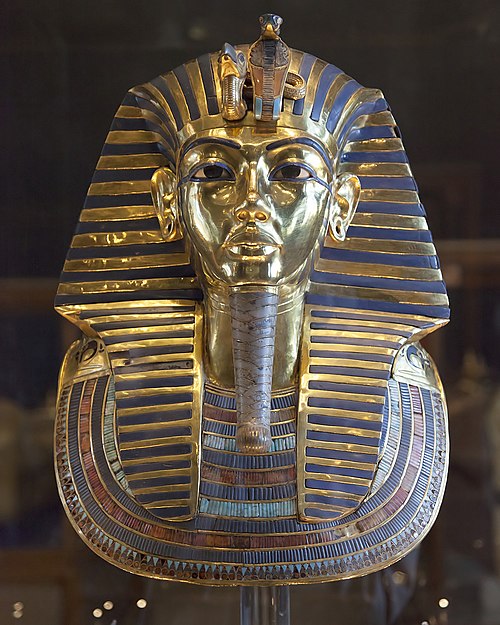
Tutankhamun Dies; Tomb Sealed
Tutankhamun dies at about age 18 and is buried in the Valley of the Kings. His tomb remains largely intact until its discovery in 1922. #history #archaeology
1279 BCE
Ramesses II Ascends Throne
Ramesses II, also known as Ramesses the Great, begins his 66-year reign, marked by extensive building projects and military campaigns. #history #ancientegypt
Ramesses II Ascends Throne By Pbuergler - Own work, CC BY-SA 3.0, https://commons.wikimedia.org/w/index.php?curid=11798746
1274 BCE
Battle of Kadesh
Ramesses II fights the Hittites at the Battle of Kadesh, one of the largest chariot battles in history, ending in a stalemate and later a peace treaty. #warfare #history
Battle of Kadesh By Unknown author, CC BY-SA 3.0, https://commons.wikimedia.org/w/index.php?curid=581507
1250 BCE
Abu Simbel Temples Built
Ramesses II orders the construction of the Great Temple at Abu Simbel, dedicated to Ra-Horakhty and himself, with colossal statues at the entrance. #architecture #history
Abu Simbel Temples Built By youssef_alam - https://web.archive.org/web/20161013233830/http://www.panoramio.com/photo/27079522, CC BY 3.0, https://commons.wikimedia.org/w/index.php?curid=53765899
1213 BCE
Ramesses II Dies
Ramesses II dies at age 90 and is buried in the Valley of the Kings. His mummy is one of the best-preserved ever found. #history #ancientegypt
1186 BCE
Ramesses III Defends Against Sea Peoples
Ramesses III repels invasions by the Sea Peoples and Libyans, recording his victories at Medinet Habu. #warfare #history
Ramesses III Defends Against Sea Peoples By Asavaa - Own work, CC BY-SA 3.0, https://commons.wikimedia.org/w/index.php?curid=10233973
1070 BCE
New Kingdom Collapses; Third Intermediate Period Begins
The New Kingdom ends with the death of Ramesses XI, leading to the Third Intermediate Period, with divided rule. #history #ancientegypt
New Kingdom Collapses; Third Intermediate Period Begins By Jeff Dahl - Own work, CC BY-SA 4.0, https://commons.wikimedia.org/w/index.php?curid=3333667
950 BCE
Shoshenq I Founds the Twenty-Second Dynasty
Shoshenq I, a Libyan chieftain, becomes pharaoh and reunites Egypt, campaigning in the Levant. #history #ancientegypt
Shoshenq I Founds the Twenty-Second Dynasty By Ippolito Rosellini (1800-1843) - I monumenti dell'Egitto e della Nubia disegnati dalla spedizione scientifico-letteraria toscana in Egitto (1832), Public domain, https://commons.wikimedia.org/w/index.php?curid=129119311
728 BCE
Kushite Conquest; Twenty-Fifth Dynasty Begins
Piye, king of Kush (Nubia), conquers Egypt, founding the Twenty-Fifth Dynasty and ushering in a period of Nubian rule. #history #africa
Kushite Conquest; Twenty-Fifth Dynasty Begins By Auguste Mariette (1821-1881) - Monuments divers recueillis en Egypte et en Nubie (1872) This image has an extracted file: Stele Piye submission Mariette.jpg., Public domain, https://commons.wikimedia.org/w/index.php?curid=69267254
671 BCE
Assyrian Invasion of Egypt
Esarhaddon of Assyria invades Egypt, sacking Memphis and ending Kushite rule. #warfare #history
Assyrian Invasion of Egypt By Osama Shukir Muhammed Amin FRCP(Glasg) - Own work, CC BY-SA 4.0, https://commons.wikimedia.org/w/index.php?curid=90734401
664 BCE
Psamtik I Unites Egypt; Saite Period Begins
Psamtik I expels the Assyrians and reunites Egypt, starting the Twenty-Sixth Dynasty and the Saite period, a renaissance of art and culture. #history #ancientegypt
Psamtik I Unites Egypt; Saite Period Begins By Unknown author - This file was donated to Wikimedia Commons as part of a project by the Metropolitan Museum of Art. See the Image and Data Resources Open Access Policy, CC0, https://commons.wikimedia.org/w/index.php?curid=60906554
525 BCE
Persian Conquest of Egypt
Cambyses II of Persia defeats Pharaoh Psamtik III at the Battle of Pelusium, making Egypt a Persian satrapy. #warfare #history )
Persian Conquest of Egypt By Henry Charles Seppings Wright - Public domainː https://www.meisterdrucke.uk/kunstdrucke/Henry-Charles-Seppings-Wright/280719/Der-Seeschlacht-bei-Pelusium%2C-Illustration-aus-Hutchinsons-Geschichte-der-Nationen%2C-um-1910.html, Public domain, https://commons.wikimedia.org/w/index.php?curid=138493992
404 BCE
Egypt Regains Independence from Persia
Amyrtaeus of Sais leads a successful revolt, restoring native Egyptian rule for the Twenty-Eighth Dynasty. #history #ancientegypt
Egypt Regains Independence from Persia By Eduard Sachau (1845 - 1930) - Ein altaramareischer Papyrus aus der Zeit der aegyptischen Koenigs Amyrtaeus, in Florilegium: ou, Recueil de travaux d'érudition dédiés à monsieur le marquis Melchior de Vogüé à l'occasion du quatre-vingtième anniversaire de sa naissance, 18 octobre 1909, pp. 529-538, Public domain, https://commons.wikimedia.org/w/index.php?curid=56694657
343 BCE
Second Persian Conquest
Artaxerxes III reconquers Egypt, ending the last native dynasty (Thirtieth Dynasty). #warfare #history
Second Persian Conquest By AR VLD - Own work, CC BY-SA 4.0, https://commons.wikimedia.org/w/index.php?curid=136535586
332 BCE
Alexander the Great Conquers Egypt
Alexander the Great takes Egypt without resistance, founding the city of Alexandria and beginning the Ptolemaic period. #history #alexanderthegreat
Alexander the Great Conquers Egypt By Unknown author - This image has been extracted from another file, Public domain, https://commons.wikimedia.org/w/index.php?curid=182741814
305 BCE
Ptolemy I Soter Founds Ptolemaic Dynasty
Ptolemy I, a general of Alexander, declares himself pharaoh, establishing the Greek Ptolemaic dynasty that rules Egypt for 300 years. #history #ancientegypt
Ptolemy I Soter Founds Ptolemaic Dynasty By Marie-Lan Nguyen - This file was derived from: Ptolemy I Soter Louvre Ma849.jpg, Public domain, https://commons.wikimedia.org/w/index.php?curid=178958429
283 BCE
Library of Alexandria Flourishes
Under Ptolemy II Philadelphus, the Library of Alexandria becomes the greatest center of learning in the ancient world. #culture #history
Library of Alexandria Flourishes By O. Von Corven - Tolzmann, Don Heinrich; Alfred Hessel and Reuben Peiss. The Memory of Mankind. New Castle, DE: Oak Knoll Press, 2001, Public domain, https://commons.wikimedia.org/w/index.php?curid=2307486
196 BCE
Rosetta Stone Inscribed
The Rosetta Stone is carved with a decree in hieroglyphic, demotic, and Greek scripts, later key to deciphering Egyptian hieroglyphs. #archaeology #history
Rosetta Stone Inscribed By Hans Hillewaert - Own work, CC BY-SA 4.0, https://commons.wikimedia.org/w/index.php?curid=3153928
51 BCE
Cleopatra VII Becomes Pharaoh
Cleopatra VII ascends the throne as the last active pharaoh of Ptolemaic Egypt, known for her political alliances with Julius Caesar and Mark Antony. #history #women
Cleopatra VII Becomes Pharaoh By Louis le Grand - own work / Altes Museum Berlin (Berliner Museumsinsel), Public domain, https://commons.wikimedia.org/w/index.php?curid=2597825
31 BCE
Battle of Actium
Octavian defeats the combined forces of Mark Antony and Cleopatra at the Battle of Actium, leading to the end of Ptolemaic rule. #warfare #history
Battle of Actium By Mark Landon - Own work, CC BY 4.0, https://commons.wikimedia.org/w/index.php?curid=125313661
30 BCE
Cleopatra Dies; Egypt Becomes Roman Province
Cleopatra dies by suicide, and Egypt is annexed by the Roman Empire, ending the pharaonic era. #history #ancientegypt