Encyclopedia/3. History, Societies & Civilizations/10. World Civilizations & Modern History • Curated by Admin Timeline.sg
Mesopotamia · Egypt · the Indus Valley · China · Mesoamerica · the Andes · Africa (Nubia/Kush/Aksum/Great Zimbabwe) · Europe (Minoan/Mycenaean/Etruscan)
Chronological Storyline (34 Milestones)
3500 BCE
Uruk period and early Sumerian cities
The Sumerian city of Uruk in Mesopotamia grew into one of the world's first major urban centers, developing early cuneiform writing and monumental temple architecture. · Wikipedia: https://en.wikipedia.org/wiki/Uruk_period
Map of the Middle East during the last centuries of the 4th millennium BC: archaeological sites of the "urukean expansion". By Middle_East_topographic_map-blank.svg: Sémhur (talk) derivative work: Zunkir - This file was derived from: Middle East topographic map-blank.svg:, CC BY-SA 3.0, https://commons.wikimedia.org/w/index.php?curid=25540654
3100 BCE
Unification of Upper and Lower Egypt
King Narmer unified Upper and Lower Egypt, founding the First Dynasty and initiating the long civilization of pharaonic Egypt. · Wikipedia: https://en.wikipedia.org/wiki/Narmer_Palette
The Narmer Palette By anonymous - http://www.studyblue.com/notes/note/n/art-midterm/deck/1189362, Public domain, https://commons.wikimedia.org/w/index.php?curid=27338888
3000 BCE
Rise of Norte Chico civilization
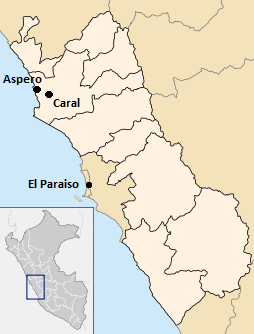
The Norte Chico civilization emerged along the Peruvian coast, featuring monumental pyramid complexes at sites like Caral, making it one of the earliest civilizations in the Americas. Source — Wikipedia:
Archaeological Site locations within Peru, including El Paraiso, Caral, and Aspero By Ontrvet - Own work, CC BY-SA 3.0, https://commons.wikimedia.org/w/index.php?curid=18736804
2600 BCE
Great Pyramid of Giza constructed
Pharaoh Khufu commissioned the Great Pyramid of Giza, the largest of the three pyramids at Giza and one of the most monumental building projects in history. · Wikipedia: https://en.wikipedia.org/wiki/Great_Pyramid_of_Giza
Pyramid of Khufu - May 2023 By Douwe C. van der Zee - Own work, CC BY-SA 4.0, https://commons.wikimedia.org/w/index.php?curid=138278511Decoding the Great Pyramid | Full Documentary | NOVA | PBS
2600 BCE
Mature Harappan urban centers
The Indus Valley Civilization reached its mature urban phase with major cities at Harappa and Mohenjo-daro, featuring advanced municipal planning and drainage systems. Source — Wikipedia:
Sources: McIntosh, Jane (2008). The Ancient Indus Valley: New Perspectives. ISBN 978-1-57607-907-2. Background from http://www2.demis.nl/mapserver/mapper.asp By Avantiputra7 - Own work, CC BY-SA 3.0, https://commons.wikimedia.org/w/index.php?curid=33202416
2500 BCE
Minoan palace at Knossos
The Minoan civilization on Crete built the great palace complex at Knossos, a multi-story architectural marvel that served as a ceremonial and administrative center. Source — Wikipedia:
Integrated map of Crete island, Greece By Eric Gaba (Sting) - Own work, based on Image:Crete_topographic_map-fr.svg (modified and translated) created by myself ;Compass rose : Image:Brújula.svg (modified) created by Serg!o under GFDL, CC BY-SA 4.0, https://commons.wikimedia.org/w/index.php?curid=3180935
2334 BCE
Sargon founds Akkadian Empire
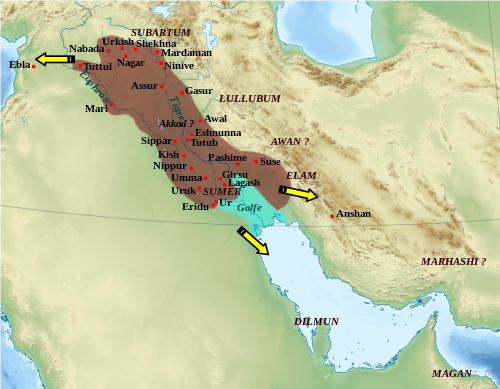
Sargon of Akkad created the Akkadian Empire, widely considered the world's first multinational empire, uniting Sumerian and Akkadian city-states under one rule. Source — Wikipedia:
Mapa que mostra l'extensió aproximada de l'imperi Accadi durant el regnat de Narâm-Sîn (2254-2218 a.C. en la cronologia breu). By Middle_East_topographic_map-blank.svg: Sémhur (talk) derivative work: Zunkir (talk) - Middle_East_topographic_map-blank.svg, CC BY-SA 3.0, https://commons.wikimedia.org/w/index.php?curid=11966732
2070 BCE
Xia Dynasty in China
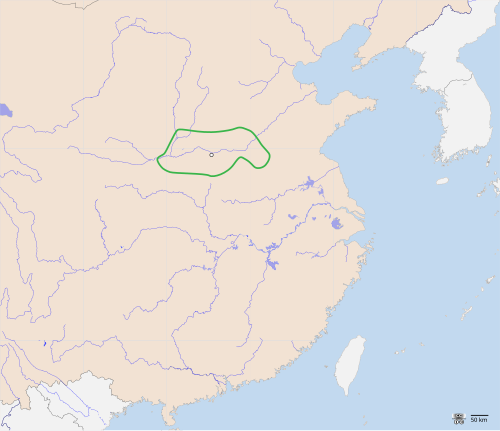
According to Chinese tradition, the Xia Dynasty was founded by Yu the Great, marking the beginning of dynastic rule in China, though archaeological evidence remains debated. Source — Wikipedia:
Xia Dynasty By w:en:User:Gurdjieff (Lamassu Design) - w:en:File:Xia dynasty.svg, CC BY-SA 3.0, https://commons.wikimedia.org/w/index.php?curid=15641604
2000 BCE
Mycenaean civilization emerges
The Mycenaean civilization arose on mainland Greece, characterized by fortified palace centers and the earliest written form of the Greek language, Linear B. Source — Wikipedia:
Map of Mycenaean Greece 1400-1200 BC: Palaces, main cities and other settlements. By User:Alexikoua, User:Panthera tigris tigris, TL User:Reedside - Ιστορία του Ελληνικού Έθνους, Εκδοτική Αθηνών, τ. Α' χάρτες σε σελ. 263-265, σελ. 290, 292-293 (επίσης [1], CC BY-SA 3.0, https://commons.wikimedia.org/w/index.php?curid=61505445
1900 BCE
Kingdom of Kush established
The Kingdom of Kush emerged in Nubia, south of Egypt, developing as a major power that would eventually rival and even rule Egypt during the 25th Dynasty. · Wikipedia: https://en.wikipedia.org/wiki/Kingdom_of_Kush
Kushite heartland and Kushite Empire of the 25th dynasty circa 700 BCE By Original map: Lommes Addition of Kushite heartland पाटलिपुत्र (talk) Source: National Geographic 2019 - Derived from, CC BY-SA 4.0, https://commons.wikimedia.org/w/index.php?curid=93708787
1600 BCE
Shang Dynasty oracle bones
The Shang Dynasty in China produced the earliest known Chinese writing on oracle bones used in divination, providing crucial records of early Chinese society. · Wikipedia: https://en.wikipedia.org/wiki/Oracle_bone
Oracle bone with Old Chinese inscription, attributed to the Lì (歷) diviner group 2 in oracle bone period II (kings Zu Geng and Zu Jia). By Unknown author - User Herr Klugbeisser on de.wikipedia Geschossen von im Shanghai-Museum, Januar 2004 Created and published under the GFDL by User Herr Klugbeisser Originally from de.wikipedia; description page is (was) here 18:41, 2. Mai 2004 Herr Klugbeisser 800 x 800 (91585 Byte) (Orakelknochen), CC BY-SA 3.0, https://commons.wikimedia.org/w/index.php?curid=38023
1200 BCE
Olmec colossal heads carved
The Olmec civilization in Mesoamerica carved massive stone heads at San Lorenzo, distinctive monuments that reflect the artistic and political sophistication of Mesoamerica's earliest major civilization. Source — Wikipedia:
Colossal Head 4 from San Lorenzo Tenochtitlán, Veracruz, Mexico. Photographed at at a temporary exhibition in the De Young Museum, San Francisco in 2006. The head is on permanent display at the Museo de Antropología de Xalapa in Veracruz, Mexico By Marshall Astor (Life on the Edge), CC BY-SA 2.0, https://commons.wikimedia.org/w/index.php?curid=19349056
1000 BCE
Chavín culture flourishes in Andes
The Chavín culture spread across the Andean highlands, centered on the religious site of Chavín de Huántar, establishing shared artistic and religious traditions. · Wikipedia: https://en.wikipedia.org/wiki/Chav%C3%ADn_culture
Map of the area of control and influence of the Chavin By QQuantum - Own work, CC BY-SA 4.0, https://commons.wikimedia.org/w/index.php?curid=67354421
900 BCE
Etruscan civilization begins
The Etruscan civilization emerged in central Italy, developing distinctive art, religion, and urban centers that would deeply influence early Roman culture. · Wikipedia: https://en.wikipedia.org/wiki/Etruscan_civilization
A map showing the extent of Etruria and the Etruscan civilization. The map includes the 12 cities of the Etruscan League and notable cities founded by the Etruscans. The dates on the map are an approximation. By NormanEinstein - Based on a map from The National Geographic Magazine Vol.173 No.6 June 1988., CC BY-SA 3.0, https://commons.wikimedia.org/w/index.php?curid=241378
771 BCE
Zhou Dynasty's Spring and Autumn period
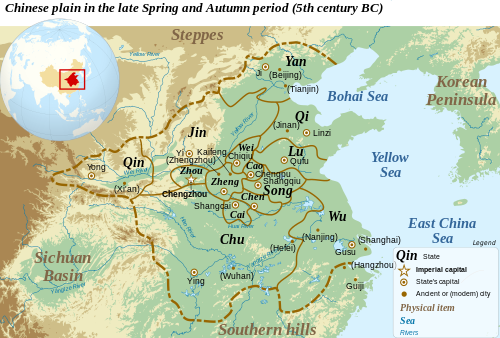
The Zhou Dynasty's authority weakened, beginning the Spring and Autumn period, an era of cultural flourishing that produced Confucius and Laozi. Source — Wikipedia:
Map of the Chinese plain at the end of the Spring & Autumn period & the beginning of the War Kingdoms period (5th century B.C.E. / H.E.95th century) By Yug - Own work, *Background data: ETOPO1 + QGIS > then vectorized using Inkscape*Semantic data: some from Le Monde Chinois, Gernet, p58.or (en:) Gernet (1996) A History of Chinese Civilisation, Cambridge university press, p. 59, CC BY-SA 3.0, https://commons.wikimedia.org/w/index.php?curid=15585702
760 BCE
Kushite pharaohs rule Egypt
Kushite kings of the 25th Dynasty ruled Egypt as pharaohs, unifying the Nile Valley from Nubia to the Mediterranean and promoting a cultural renaissance. Source — Wikipedia:
Rulers of Kush, Kerma Museum By Matthias Gehricke - This image has been extracted from another file, Public domain, https://commons.wikimedia.org/w/index.php?curid=91192226
600 BCE
Nebuchadnezzar II builds Hanging Gardens
Nebuchadnezzar II ruled the Neo-Babylonian Empire, constructing the Hanging Gardens of Babylon and rebuilding the city as a wonder of the ancient world. · Wikipedia: https://en.wikipedia.org/wiki/Hanging_Gardens_of_Babylon
'Hanging Gardens of Babylon' probably 19th century after the first excavations in the Assyrian capitals. ::The Hanging Gardens of Babylon This hand-coloured engraving probably made in 19th century after the first excavations in the Assyrian capitals, depicts the fabled Hanging Gardens of Babylon, one of the Seven Wonders of the World. According to the tradition, the gardens did not hang, but grew on the roofs and terraces of the royal palace in Babylon. Nebuchadnezzar II, the Chaldean king, is supposed to have had the gardens built in about 600 BC as a consolation to his Median wife, who missed the natural surroundings of her homeland. By Unknown author - http://www.plinia.net/wonders/gardens/hgpix1.html, Public domain, https://commons.wikimedia.org/w/index.php?curid=65909The Hanging Gardens of Babylon: The Ancient World's Missing Wonder
550 BCE
Achaemenid Persia rises
Cyrus the Great founded the Achaemenid Empire, which became the largest empire in history up to that point, stretching from the Balkans to the Indus Valley. · Wikipedia: https://en.wikipedia.org/wiki/Achaemenid_Empire
Achaemenid Empire 500 BCE By Cattette - This image has been extracted from another file, CC BY 4.0, https://commons.wikimedia.org/w/index.php?curid=113179532
500 BCE
Teotihuacan founded in Mesoamerica
The city of Teotihuacan was established in the Valley of Mexico, eventually growing into one of the largest cities of the ancient world with the Pyramid of the Sun at its center. · Wikipedia: https://en.wikipedia.org/wiki/Teotihuacan
This is a photo of a monument in Mexico, identified by ID By Ricardo David Sánchez - Own work, CC BY-SA 3.0, https://commons.wikimedia.org/w/index.php?curid=28728086
400 BCE
Maya Preclassic urbanism
Maya civilization developed monumental cities and writing systems during the Preclassic period, with sites like El Mirador featuring massive pyramids. Source — Wikipedia:
300 BCE
Moche civilization on north Peru coast
The Moche civilization flourished on Peru's north coast, building massive adobe pyramids like the Huaca del Sol and producing sophisticated pottery and metalwork. Source — Wikipedia:
Moche civilization on north Peru coast By Unknown author, CC BY-SA 3.0, https://commons.wikimedia.org/w/index.php?curid=392038
256 BCE
Qin unifies China
Qin Shi Huang unified China under the Qin Dynasty, standardizing writing, weights, and measures, and beginning construction of the Great Wall. · Wikipedia: https://en.wikipedia.org/wiki/Qin_dynasty
Commandaries and population centers of the Qin dynasty (221–206 BC) By Ian Remsen - Modern natural borders from Natural Earth Albers used for the map projection, via svgis λ 0 = 110 {\displaystyle \lambda _{0}=110} φ 0 = 30 {\displaystyle \varphi _{0}=30} φ 1 = 25 {\displaystyle \varphi _{1}=25} φ 2 = 37 {\displaystyle \varphi _{2}=37} Political borders, location of the Great Wall, and adjustments to reflect ancient borders from Li, Feng (2013) Early China: A Social and Cultural History, New Approaches to Asian History, 12, Cambridge University Press, p. 246 DOI: 10.1017/CBO9781139034395. ISBN: 978-0-521-89552-1. Square represents the Qin capital at Xianyang Dotted open circles represent population centers whose precise locations are unclear, CC0, https://commons.wikimedia.org/w/index.php?curid=158113722
100 BCE
Kingdom of Aksum rises
The Kingdom of Aksum emerged in what is now Ethiopia and Eritrea, becoming a major trading power that controlled Red Sea commerce and later adopted Christianity. · Wikipedia: https://en.wikipedia.org/wiki/Kingdom_of_Aksum
King Endybis Ethiopia 227-235 A.D By PHGCOM - self-made, photographed at the British Museum, CC BY-SA 3.0, https://commons.wikimedia.org/w/index.php?curid=2350285
250 CE
Classic Maya civilization at peak
Maya civilization reached its Classic period zenith with cities like Tikal and Calakmul, developing advanced astronomy, mathematics, and hieroglyphic writing. · Wikipedia: https://en.wikipedia.org/wiki/Classic_Maya_collapse
300 CE
Aksum adopts Christianity
King Ezana of Aksum converted to Christianity, making Aksum one of the first states in the world to adopt the religion as its official faith. Source — Wikipedia:
King Endybis Ethiopia 227-235 A.D By PHGCOM - self-made, photographed at the British Museum, CC BY-SA 3.0, https://commons.wikimedia.org/w/index.php?curid=2350285
550 CE
Great Zimbabwe construction begins
Construction began on the stone city of Great Zimbabwe in southern Africa, which became the capital of a wealthy trading kingdom linked to the Indian Ocean trade network. · Wikipedia: https://en.wikipedia.org/wiki/Great_Zimbabwe
Great Zimbabwe By Andrew Moore from Johannesburg, South Africa - Conical Tower - Great Enclosure III, CC BY-SA 2.0, https://commons.wikimedia.org/w/index.php?curid=82748017
800 CE
Charlemagne crowned Holy Roman Emperor
Charlemagne was crowned Emperor by Pope Leo III, marking a revival of imperial authority in Western Europe and the foundation of European Christendom. · Wikipedia: https://en.wikipedia.org/wiki/Charlemagne
Appartient à l’ensemble documentaire : MonnFrCar By Charlemagne. Autorité émettrice de monnaie indéterminé. Atelier monétaire. Émetteur - Bibliothèque nationale de France, Public domain, https://commons.wikimedia.org/w/index.php?curid=136608827
900 CE
Maya Classic collapse
Maya cities in the southern lowlands experienced a dramatic collapse, with monumental construction ceasing and populations declining over the 9th and 10th centuries. Source — Wikipedia:
1100 CE
Great Zimbabwe at its height
Great Zimbabwe reached its peak as the center of a powerful Shona kingdom, with its Great Enclosure representing the largest ancient structure in sub-Saharan Africa. · Wikipedia: https://en.wikipedia.org/wiki/Great_Zimbabwe
Great Zimbabwe By Andrew Moore from Johannesburg, South Africa - Conical Tower - Great Enclosure III, CC BY-SA 2.0, https://commons.wikimedia.org/w/index.php?curid=82748017
1200 CE
Inca civilization begins
The Inca civilization began its rise in the Cuzco Valley, eventually building the largest empire in pre-Columbian America, connected by an extensive road network. Source — Wikipedia:
Suntur Paucar, according to the description of the chronicles of Bernabé Cobo By Adapted from Huhsunqu, made by Pachakutec - Own work based on: Banner of the Inca Empire.svg, CC BY-SA 2.5, https://commons.wikimedia.org/w/index.php?curid=92212633
1438 CE
Pachacuti expands Inca Empire
Pachacuti Inca Yupanqui began the dramatic expansion of the Inca Empire, transforming it from a small Cuzco kingdom into Tawantinsuyu, the largest empire in pre-Columbian America. · Wikipedia: https://en.wikipedia.org/wiki/Pachacuti
Pachacuti expands Inca Empire By Unknown author - Online Collection of Brooklyn Museum; Photo: Brooklyn Museum, 1995.29.10_PS6.jpg, Public domain, https://commons.wikimedia.org/w/index.php?curid=148459836
1450 CE
Machu Picchu constructed
The Inca royal estate of Machu Picchu was built during the reign of Pachacuti, perched high in the Andes as a masterpiece of dry-stone architecture. · Wikipedia: https://en.wikipedia.org/wiki/Machu_Picchu
Machu Picchu By Draceane - Own work, CC BY-SA 4.0, https://commons.wikimedia.org/w/index.php?curid=159377526Machu Picchu 101 | National Geographic
1521 CE
Fall of the Aztec Empire
Spanish conquistadors led by Hernán Cortés captured Tenochtitlan, ending the Aztec Empire and marking a decisive turning point in Mesoamerican history. Source — Wikipedia:
From the Conquest of México series. Depicts the 1521 Fall of Tenochtitlan by Spanish Conquistador Hernán Cortés, in the Spanish conquest of the Aztec Empire. By Unknown author - https://s.libertaddigital.com/2021/08/09/conquista-de-mexico.jpg, Public domain, https://commons.wikimedia.org/w/index.php?curid=110660051BBC Conquistadors 1of4 The Fall of the Aztecs Full Documentary Films
1533 CE
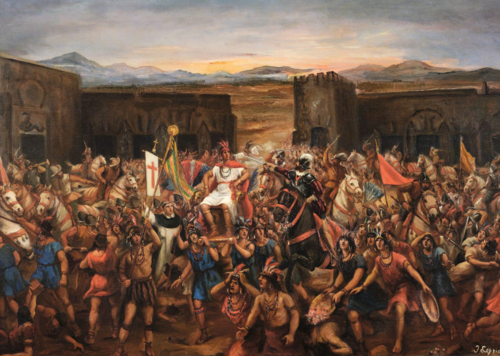
Fall of the Inca Empire
Spanish forces under Francisco Pizarro captured and executed the Inca emperor Atahualpa, effectively ending the Inca Empire and ancient Andean civilization. Source — Wikipedia:
Oil painting depicts The Capture of Atahualpa in Cajamarca (Battle of Cajamarca) and the Spanish conquest of the Inca Empire in 1532. The artwork was made between 1920-1927 by Juan Lepiani. By Juan Lepiani - https://img.haarets.co.il/img/1.4276143/4073906597.jpg, Public domain, https://commons.wikimedia.org/w/index.php?curid=120590094The Fall of the Inca Empire: Conquest by Pizarro