Ancient Chinese Civil Engineering: Dujiangyan, Great Wall & Grand Canal
Encyclopedia/2. Technology & The Built World/3. Civil, Architectural & Structural Engineering/01. Infrastructure & Architecture • Curated by Admin Timeline.sg
Ancient Chinese civil engineering produced monumental infrastructure feats such as Li Bing's Dujiangyan irrigation system (256 BCE), the Great Wall fortifications, the Zhaozhou Anji stone arch bridge (605 CE), and the Grand Canal system. These projects demonstrate advanced hydraulics, structural engineering, and large-scale organization, profoundly impacting Chinese civilization and influencing global engineering.
Chronological Storyline (43 Milestones)
500 BCE
Earliest Great Wall Sections Built by Chu
The state of Chu constructs the earliest known sections of what would later become the Great Wall, using rammed earth for defense against northern nomads. These early walls mark the beginning of a millennia-long fortification tradition. #GreatWall #ancientChina #engineering
Earliest Great Wall Sections Built by Chu By Severin.stalder - Own work, CC BY-SA 3.0, https://commons.wikimedia.org/w/index.php?curid=39661035
486 BCE
First Grand Canal Section: Han Gou
King Fuchai of Wu orders the construction of the Han Gou canal, linking the Yangtze and Huai Rivers for military transport. This is the earliest segment of what will become the Grand Canal. #GrandCanal #canal #ancientChina
First Grand Canal Section: Han Gou By EditQ - Own work, CC BY-SA 4.0, https://commons.wikimedia.org/w/index.php?curid=136061119
361 BCE
Wei State Canal System by Ximen Bao
Ximen Bao, a minister of Wei, oversees the construction of a canal system on the Zhang River to irrigate the Ye region. This project demonstrates early hydraulic engineering and water management. #irrigation #hydraulicEngineering #ancientChina
256 BCE
Li Bing Builds Dujiangyan Irrigation System
Li Bing, governor of Shu, completes the Dujiangyan irrigation system on the Min River. Using a non-dam design with a fishmouth levee and spillway, it diverts water for irrigation and flood control, still in use today. #Dujiangyan #irrigation #hydraulicEngineering
Li Bing Builds Dujiangyan Irrigation System By 星 - Own work, CC BY-SA 4.0, https://commons.wikimedia.org/w/index.php?curid=2132521
221 BCE
Qin Shi Huang Unifies and Extends Great Wall
Emperor Qin Shi Huang orders the connection and extension of existing northern walls into a unified Great Wall, using rammed earth and forced labor. This project symbolizes imperial power and defense. #GreatWall #QinDynasty #fortification
214 BCE
Lingqu Canal Connects Yangtze and Pearl Rivers
The Lingqu Canal, built under Qin Shi Huang, links the Xiang and Li Rivers, enabling transport between the Yangtze and Pearl River systems. It is one of the world's oldest contour canals. #canal #QinDynasty #transport
Lingqu Canal Connects Yangtze and Pearl Rivers By Farm - Own work, CC BY 3.0, https://commons.wikimedia.org/w/index.php?curid=6907371
200 BCE
Han Dynasty Expands Great Wall Westward
Emperor Wu of Han extends the Great Wall westward to protect the Silk Road trade routes. Watchtowers and beacon towers are added, improving communication and defense. #GreatWall #HanDynasty #SilkRoad
141 BCE
Han Dynasty Canal and Irrigation Projects
Emperor Wu of Han initiates large-scale canal and irrigation projects, including the Zhengguo Canal and the expansion of the Dujiangyan system. These boost agricultural productivity and economic growth. #irrigation #HanDynasty #agriculture
Han Dynasty Canal and Irrigation Projects By DannamEmpire - Own work using: Based on: Map, p. 63, Mapping History: World History (London: Cartographica, 2007), by Dr. Ian Barnes. ISBN 978-1-84573-323-0, CC BY 4.0, https://commons.wikimedia.org/w/index.php?curid=162847450
120 BCE
Zhang Qian's Western Regions Expeditions
Zhang Qian's travels open the Silk Road, prompting the Han to build defensive walls and beacon towers along the Hexi Corridor. These structures protect trade routes and facilitate cultural exchange. #SilkRoad #HanDynasty #exploration
Zhang Qian's Western Regions Expeditions By PHG - copied from en wp, Public domain, https://commons.wikimedia.org/w/index.php?curid=721599
111 BCE
Han Conquest of Nanyue and Canal Construction
The Han dynasty conquers Nanyue (modern Vietnam) and builds canals to improve transport and control in the region. These canals integrate the south into the empire. #canal #HanDynasty #expansion
34 CE
Han Dynasty Repairs and Extends Great Wall
Emperor Guangwu of Han orders repairs and extensions of the Great Wall to defend against Xiongnu raids. The wall is reinforced with stone and brick in some sections. #GreatWall #HanDynasty #defense
204 CE
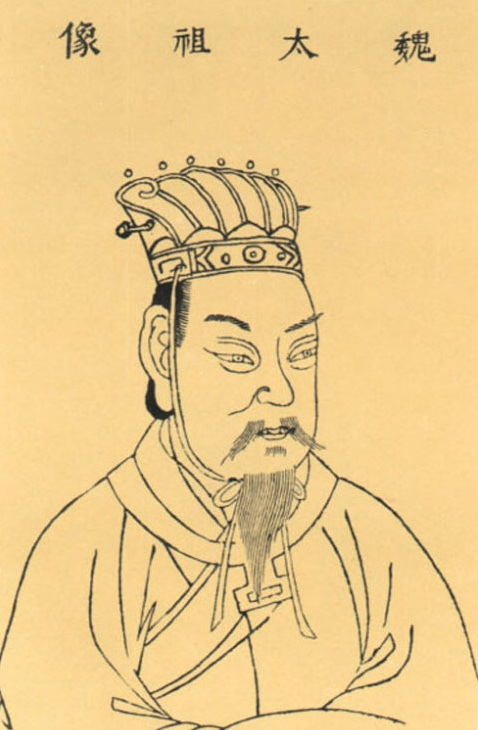
Cao Cao Builds Canal System for Grain Transport
Warlord Cao Cao constructs a series of canals in northern China to transport grain for his armies. These canals improve logistics and later become part of the Grand Canal system. #canal #ThreeKingdoms #logistics
Cao Cao Builds Canal System for Grain Transport By Wang Qi - A copy of w:Sancai Tuhui, Public domain, https://commons.wikimedia.org/w/index.php?curid=10217506
310 CE
Northern Wei Builds Great Wall Sections
The Northern Wei dynasty constructs new sections of the Great Wall using rammed earth and stone. These walls protect against Rouran raids and define the northern frontier. #GreatWall #NorthernWei #fortification
Northern Wei Builds Great Wall Sections By Ktrinko - This image has been extracted from another file, CC BY-SA 4.0, https://commons.wikimedia.org/w/index.php?curid=128482219
514 CE
Liang Dynasty Constructs Dikes on Yangtze
The Liang dynasty builds extensive dikes along the Yangtze River to control flooding and protect farmland. These dikes are among the earliest large-scale flood control works in China. #floodControl #dike #ancientChina
Liang Dynasty Constructs Dikes on Yangtze By S - This image has been extracted from another file, CC BY-SA 4.0, https://commons.wikimedia.org/w/index.php?curid=126392218
581 CE
Sui Dynasty Unifies and Plans Grand Canal
Emperor Wen of Sui begins planning a unified canal system to link the Yellow and Yangtze Rivers. This project aims to transport grain from the south to the capital in the north. #GrandCanal #SuiDynasty #transport
Sui Dynasty Unifies and Plans Grand Canal By Ian Kiu - Own work, CC BY 3.0, https://commons.wikimedia.org/w/index.php?curid=3082893
604 CE
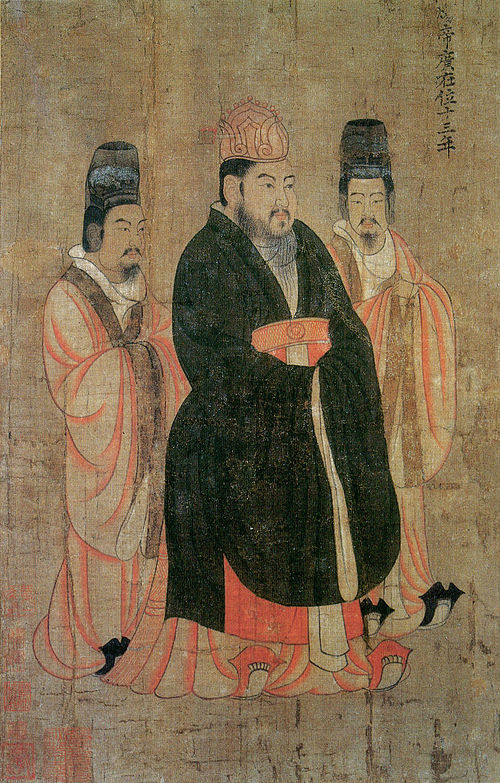
Emperor Yang of Sui Orders Grand Canal Construction
Emperor Yang of Sui orders the massive expansion of the Grand Canal, connecting the Yellow and Yangtze Rivers. Millions of laborers are conscripted, and the canal becomes a vital economic artery. #GrandCanal #SuiDynasty #megaproject
Emperor Yang of Sui Orders Grand Canal Construction By Yan Liben - Taken from http://www.sxlbl.com/web/idccc/minghua/200810159105.html, Public domain, https://commons.wikimedia.org/w/index.php?curid=1971182
605 CE
Zhaozhou Bridge (Anji Bridge) Completed
The Zhaozhou Bridge, designed by Li Chun, is completed in Hebei Province. It is the world's oldest open-spandrel segmental stone arch bridge, with a span of 37 meters, influencing bridge design worldwide. #bridge #engineering #TangDynasty
Zhaozhou Bridge (Anji Bridge) Completed By English Wikipedia user Zhao 1974 - Imported from English Wikipedia, Photo taken by Zhao 1974, Public domain, https://commons.wikimedia.org/w/index.php?curid=1813644
608 CE
Grand Canal Reaches Zhuojun (Beijing)
The Grand Canal is extended to Zhuojun (modern Beijing), linking the north to the Yangtze River. This completion enables efficient grain transport and political control over the north. #GrandCanal #SuiDynasty #Beijing
618 CE
Tang Dynasty Maintains and Improves Grand Canal
The Tang dynasty undertakes regular maintenance and improvements of the Grand Canal, including dredging and lock construction. The canal supports the Tang economy and facilitates trade. #GrandCanal #TangDynasty #trade
Tang Dynasty Maintains and Improves Grand Canal By Kanguole - Own work Boundaries from Twitchett, Denis and Wechsler, Howard J. (1979), "Kao-tsung (reign 649–83) and the Empress Wu: The Inheritor and the Usurper", in Denis Twitchett and John Fairbank (eds.), The Cambridge History of China, Volume 3: Sui and T'ang China, 589–906, Part I, Cambridge University Press, ISBN 978-0-521-21446-9, (Map 8 p.281) and map 9 (p. 283). Blunden, Caroline and Elvin, Mark (1983), Cultural Atlas of China, Oxford: Phaidon Press, ISBN 0-7148-2309-0, pp. 26, 92–93. Shin, Michael D., ed. (2014) Korean History in Maps, Cambridge University Press, pp. 39, 47 ISBN: 978-1-107-09846-6. (pre-conquest extent of Baekje, approximating the extent of the Ungjin Commandery) Coastline and lakes from Natural Earth 1:50m Physical Vectors Conversion to SVG using svgis, CC BY-SA 4.0, https://commons.wikimedia.org/w/index.php?curid=131635251
630 CE
Tang Dynasty Repairs Great Wall
Emperor Taizong of Tang orders repairs to sections of the Great Wall to defend against Turkic incursions. The wall is reinforced with watchtowers and garrisons. #GreatWall #TangDynasty #defense
Tang Dynasty Repairs Great Wall By Unknown artist - Digitized by NPM; image is directly from Shuge, Public domain, https://commons.wikimedia.org/w/index.php?curid=2176477
700 CE
Tang Dynasty Builds Extensive Canal Network
The Tang dynasty expands the canal network beyond the Grand Canal, building smaller canals for irrigation and local transport. These canals boost agricultural output and regional economies. #canal #TangDynasty #irrigation
742 CE
Tang Dynasty Flood Control Works on Yellow River
The Tang government constructs dikes and levees along the Yellow River to prevent flooding. These works are part of a long-term effort to manage the river's unpredictable course. #floodControl #YellowRiver #TangDynasty
Tang Dynasty Flood Control Works on Yellow River By fading - https://web.archive.org/web/20161026113822/http://www.panoramio.com/photo/75987059, CC BY-SA 3.0, https://commons.wikimedia.org/w/index.php?curid=54896538
907 CE
Five Dynasties Period: Canal Neglect and Decline
During the Five Dynasties period, the Grand Canal falls into disrepair due to political fragmentation. Siltation and lack of maintenance reduce its navigability. #GrandCanal #decline #FiveDynasties
Five Dynasties Period: Canal Neglect and Decline By Ian Kiu - Own work, CC BY 3.0, https://commons.wikimedia.org/w/index.php?curid=3048730
960 CE
Song Dynasty Revives Grand Canal
The Song dynasty undertakes major repairs and upgrades to the Grand Canal, including the construction of new locks and dredging. The canal becomes crucial for transporting grain to the capital Kaifeng. #GrandCanal #SongDynasty #revival
Song Dynasty Revives Grand Canal By China - Song Dynasty - cs.svg: User:Mozzan derivative work: Kanguole - China 11a.jpg: User:LiDaobing based on Tan Qixiang (ed.), Zhongguo lishi ditu (中国历史地图集; 1982) China - Song Dynasty - cs.svg: User:Mozzan, CC BY-SA 3.0, https://commons.wikimedia.org/w/index.php?curid=39938105
984 CE
First Recorded Use of Pound Lock on Grand Canal
The Song engineer Qiao Weiyue invents the pound lock (double slipway) on the Grand Canal, allowing boats to pass through changes in water level. This innovation greatly improves canal efficiency. #canal #lock #SongDynasty
First Recorded Use of Pound Lock on Grand Canal By George Mahoney - From geograph.org.uk, CC BY-SA 2.0, https://commons.wikimedia.org/w/index.php?curid=9269744
1000 CE
Song Dynasty Builds Extensive Sea Walls
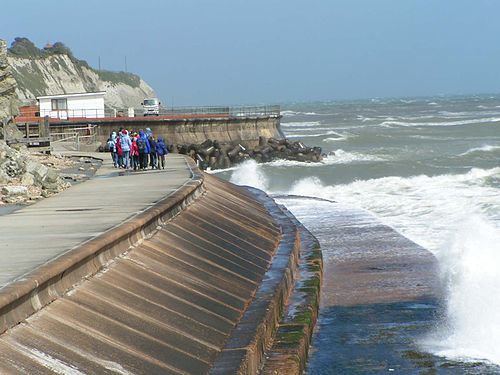
The Song dynasty constructs sea walls along the coast of Zhejiang to protect farmland from saltwater intrusion and tidal flooding. These walls are built with stone and rammed earth. #seaWall #SongDynasty #floodControl
Song Dynasty Builds Extensive Sea Walls By Oikos-team at English Wikipedia - Transferred from en.wikipedia to Commons., Public domain, https://commons.wikimedia.org/w/index.php?curid=2746549
1032 CE
Song Dynasty Repairs and Extends Great Wall
The Song dynasty, though not controlling the northern frontier, repairs sections of the Great Wall in the northwest to defend against Western Xia. The wall is reinforced with brick and stone. #GreatWall #SongDynasty #defense
1048 CE
Yellow River Flood and Course Change
The Yellow River floods and changes its course, causing widespread devastation. The Song government mobilizes massive resources to build new dikes and levees to control the river. #flood #YellowRiver #SongDynasty
1060 CE
Song Dynasty Builds Longest Stone Arch Bridge: Baodai Bridge
The Baodai Bridge (Precious Belt Bridge) is completed in Suzhou, spanning 317 meters with 53 arches. It is the longest stone arch bridge in ancient China, showcasing advanced masonry. #bridge #SongDynasty #engineering
Song Dynasty Builds Longest Stone Arch Bridge: Baodai Bridge By Rolf Müller (User:Rolfmueller) - Own work, CC BY-SA 3.0, https://commons.wikimedia.org/w/index.php?curid=1596347
1075 CE
Song Dynasty Canal Lock System Matures
The Song dynasty perfects the use of pound locks on the Grand Canal, with multiple locks allowing efficient navigation over varied terrain. This system becomes a model for later canals. #canal #lock #SongDynasty
1100 CE
Song Dynasty Builds Flood Control Reservoirs
The Song dynasty constructs reservoirs and detention basins to mitigate flooding from the Yellow and Huai Rivers. These works are among the earliest examples of integrated flood management. #floodControl #reservoir #SongDynasty
Song Dynasty Builds Flood Control Reservoirs By Risker (talk) - Own work (Original text: I created this work entirely by myself.), CC BY-SA 3.0, https://commons.wikimedia.org/w/index.php?curid=7296974
1127 CE
Jin Dynasty Takes Northern China, Maintains Grand Canal
The Jurchen Jin dynasty captures northern China and continues to maintain the Grand Canal for grain transport. The canal remains vital for the Jin economy. #GrandCanal #JinDynasty #transport
Jin Dynasty Takes Northern China, Maintains Grand Canal By Ian Kiu - Own work using: File:Sung Dynasty 1141.png, itself based on a map in Albert Herrmann (1935). History and Commercial Atlas of China. Harvard University Press., CC BY 3.0, https://commons.wikimedia.org/w/index.php?curid=83725994
1194 CE
Yellow River Course Change Devastates Grand Canal
The Yellow River shifts its course southward, flowing into the Huai River and disrupting the Grand Canal. The Jin dynasty struggles to maintain canal operations amid siltation. #YellowRiver #GrandCanal #flood
1211 CE
Mongol Invasion Disrupts Infrastructure
Mongol invasions under Genghis Khan damage canals, bridges, and walls across northern China. Many infrastructure projects are abandoned or destroyed during the conflict. #war #infrastructure #Mongol
Mongol Invasion Disrupts Infrastructure By SY - Sverdrup, Carl (2017) The Mongol Conquests: The Military Campaigns of Genghis Khan and Sübe'etei, Warwick: Helion & Company ISBN: 978-1913336059. Jackson, Peter (2017) The Mongols and the Islamic World: From Conquest to Conversion, New Haven: Yale University Press Waterson, James (2013) Defending Heaven: China's Mongol Wars, 1209–1370, Barnsley: Frontline Books ISBN: 978-1-7834-6943-7., CC BY-SA 4.0, https://commons.wikimedia.org/w/index.php?curid=61416607
Kublai Khan founds the Yuan dynasty and orders the restoration and extension of the Grand Canal to supply his new capital, Dadu (Beijing). The canal is widened and deepened. #GrandCanal #YuanDynasty #KublaiKhan
Kublai Khan Establishes Yuan Dynasty, Plans Canal Revival By Araniko - This image has been extracted from another file, Public domain, https://commons.wikimedia.org/w/index.php?curid=4126240
1283 CE
Yuan Dynasty Builds New Grand Canal Route
The Yuan dynasty constructs a new, more direct route for the Grand Canal, shortening the distance from Hangzhou to Beijing. This route uses locks and aqueducts to cross the Yellow River. #GrandCanal #YuanDynasty #engineering
1293 CE
Grand Canal Reaches Dadu (Beijing) Under Yuan
The Grand Canal is completed to Dadu (Beijing), enabling direct water transport from the south. This boosts trade and supplies the capital with grain and goods. #GrandCanal #Beijing #YuanDynasty
1300 CE
Yuan Dynasty Builds Stone Bridges and Roads
The Yuan dynasty invests in infrastructure, building stone arch bridges and paved roads to improve transport. These projects facilitate trade across the vast empire. #bridge #road #YuanDynasty
Yuan Dynasty Builds Stone Bridges and Roads By Cattette - Own work, CC BY 4.0, https://commons.wikimedia.org/w/index.php?curid=145249990
1344 CE
Yellow River Floods and Breaches Grand Canal
A major Yellow River flood breaches the Grand Canal, causing severe siltation and disrupting navigation. The Yuan government struggles to fund repairs, leading to economic decline. #flood #GrandCanal #YuanDynasty
1351 CE
Red Turban Rebellion Damages Infrastructure
The Red Turban Rebellion against Yuan rule leads to widespread destruction of canals, bridges, and walls. Many infrastructure projects are abandoned as the dynasty collapses. #rebellion #infrastructure #YuanDynasty
Red Turban Rebellion Damages Infrastructure By SY - Own work, CC BY-SA 4.0, https://commons.wikimedia.org/w/index.php?curid=64876992
1368 CE
Ming Dynasty Founded, Begins Great Wall Reconstruction
The Ming dynasty is established and immediately begins rebuilding and extending the Great Wall using brick and stone. This massive project aims to defend against Mongol raids. #GreatWall #MingDynasty #fortification
Ming Dynasty Founded, Begins Great Wall Reconstruction By Albert Herrmann Creator:Q1509115 & Georg Westermann - Historical and Commercial Atlas of China, Public domain, https://commons.wikimedia.org/w/index.php?curid=158240988
1370 CE
Ming Dynasty Restores Grand Canal
The Ming dynasty undertakes major repairs to the Grand Canal, dredging silt and rebuilding locks. The canal is restored as the primary transport route for grain to the new capital, Nanjing. #GrandCanal #MingDynasty #restoration
1400 CE
Ming Dynasty Builds Extensive Flood Control Works
The Ming dynasty constructs dikes, levees, and canals to control the Yellow and Huai Rivers. These works include the construction of the Gaoyou Lake detention basin. #floodControl #MingDynasty #YellowRiver