Oct 1, 1900 CE
First elected to Parliament
Churchill entered the House of Commons as the Conservative MP for Oldham, beginning a parliamentary career that would span over six decades.

Wikimedia Commons
Churchill entered the House of Commons as the Conservative MP for Oldham, beginning a parliamentary career that would span over six decades.
Tasked with modernizing the Royal Navy, Churchill championed the switch from coal to oil and the naval arms race against Germany before the Great War.
Holding Cabinet office during the failed Gallipoli campaign, Churchill resigned to serve on the Western Front with the Royal Scots Fusiliers.
Rejoining the Conservatives after years as a Liberal, Churchill oversaw Britain's finances and controversially returned the pound to the gold standard in 1925.
Out of office and increasingly isolated from his party's leadership, Churchill spent the decade warning against the rising threat of Nazi Germany and appeasement policies.
In a landmark Commons speech, Churchill called the Munich pact a defeat without a war, cementing his reputation as a leading anti-appeasement voice.
Upon Britain's declaration of war against Germany, Prime Minister Neville Chamberlain recalled Churchill to his former post at the head of the Royal Navy.
Following Chamberlain's resignation amid the Norway debate, King George VI appointed Churchill as Prime Minister to lead a national coalition government.
In his first speech to the Commons as premier, Churchill rallied the nation by declaring he had nothing to offer but blood, toil, tears, and sweat to secure victory.
Following the Dunkirk evacuation, Churchill delivered a defiant speech vowing that Britain would never surrender, bolstering public morale during the fall of France.
During the Battle of Britain, Churchill immortalized the Royal Air Force pilots, declaring that never in the field of human conflict was so much owed by so many to so few.
Meeting aboard naval vessels off Newfoundland, Churchill and President Roosevelt drafted a joint declaration of postwar goals that became known as the Atlantic Charter.
Days after the US entered the war, Churchill traveled to Washington to address a joint session of Congress, strengthening the Anglo-American alliance against the Axis powers.
Allied forces under Churchill's strategic direction landed in North Africa, marking the first major joint Anglo-American offensive operation of the war.
With Roosevelt at Casablanca, Churchill agreed on the policy of demanding the unconditional surrender of the Axis powers and planned the invasion of Sicily.
At the first Big Three summit in Tehran, Churchill, Roosevelt, and Stalin coordinated the final strategy for defeating Nazi Germany, including the Normandy invasion.
Under the supreme command of Eisenhower and Churchill's political oversight, Allied forces stormed the beaches of Normandy, opening the long-awaited second front in Europe.
Meeting in the Crimea, Churchill, Roosevelt, and Stalin negotiated the postwar reorganization of Germany and Europe, sowing seeds of Cold War tensions.
From the balcony of the Ministry of Health, Churchill broadcast to the nation that the war in Europe was over and praised the British people for their steadfastness.
In a shock result, British voters rejected Churchill and the Conservatives in favor of Clement Attlee's Labour Party, which promised sweeping social reforms and a welfare state.
Speaking at Westminster College in Fulton, Missouri, Churchill warned that an iron curtain had descended across Europe, defining the ideological divide of the Cold War.
After six years in opposition, Churchill led the Conservatives back to power and formed a government focused on domestic recovery and Cold War diplomacy.
Churchill served as Prime Minister during the coronation, symbolizing a bridge between Britain's imperial past and its postwar future under the new monarch.
Churchill received the Nobel Prize for his mastery of historical and biographical description and brilliant oratory in defending human values.
Citing declining health and age, Churchill resigned from office, handing the premiership to his long-time protégé Anthony Eden and ending his political leadership.
Roosevelt defeated incumbent Herbert Hoover in a landslide, promising a New Deal for the American people amid the Great Depression.

Taking office amid a banking crisis, FDR told Americans the only thing to fear was fear itself, launching the New Deal's first 100 days.

Roosevelt refused to cooperate on international currency stabilization, prioritizing domestic recovery over global economic coordination.

FDR signed the Social Security Act, creating a federal safety net for elderly and unemployed Americans as a cornerstone of the Second New Deal.
Congress passed legislation imposing an arms embargo on all belligerents, reflecting strict isolationist sentiment that FDR reluctantly accepted.
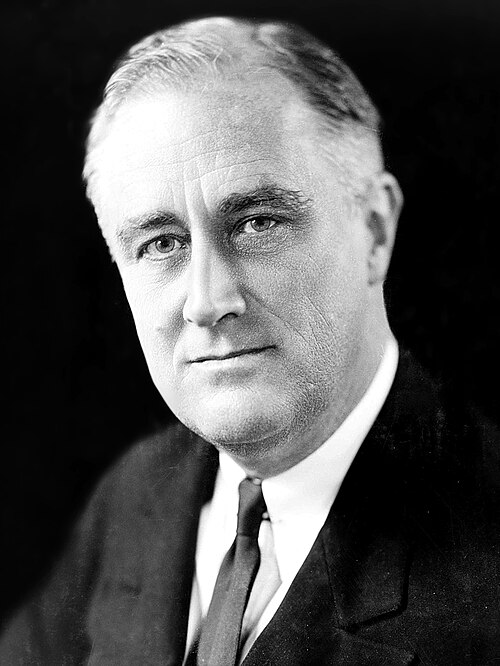
Roosevelt won re-election carrying 46 of 48 states, validating the New Deal and giving him a mandate to continue domestic reform.

FDR called for an international quarantine of aggressor nations, his first significant public step away from strict neutrality and isolationism.

Republicans gained seats in Congress, reflecting growing conservative opposition to FDR's domestic agenda and complicating his legislative majority.

Roosevelt warned Congress that the survival of democracy was at stake from fascist aggression, while still navigating isolationist resistance to rearmament.
Following Germany's invasion of Poland, FDR declared a limited national emergency, beginning the gradual expansion of US military readiness.
Roosevelt transferred 50 WWI-era destroyers to Britain in exchange for military base leases, a bold circumvention of isolationist neutrality laws.

FDR urged Americans to support the Allied powers with materiel, declaring the US must become the great arsenal of democracy.
In his State of the Union, Roosevelt articulated four essential human freedoms: speech, worship, want, and fear, as a framework for the postwar world.
FDR signed legislation authorizing the president to provide war supplies to any country whose defense was deemed vital to US security, effectively ending neutrality.
Roosevelt and Churchill issued a joint declaration of postwar aims including self-determination and disarmament, laying the ideological foundation for the United Nations.
A surprise Japanese attack on the US naval base at Pearl Harbor killed over 2,400 Americans and decisively ended the isolationist era.
FDR addressed a joint session of Congress, declaring December 7 a date which will live in infamy, and requested a declaration of war against Japan.
Roosevelt coined the term United Nations as 26 Allied nations pledged to fight the Axis powers and not make separate peace.
FDR authorized the forced relocation and internment of over 120,000 Japanese Americans, one of the most controversial domestic actions of the war.
Roosevelt and Churchill met in Morocco, demanding unconditional Axis surrender and planning the Allied invasion of Europe.
FDR met with Churchill and Chiang Kai-shek in Cairo, then with Stalin in Tehran, coordinating D-Day plans and postwar territorial arrangements.
On the evening of the Normandy landings, FDR led the nation in a radio prayer for the success of the invasion and the safety of American forces.
Roosevelt's administration championed an international monetary conference establishing the IMF and World Bank to stabilize the postwar global economy.
Despite declining health, FDR won a fourth presidential term, defeating Thomas Dewey with Harry Truman as his running mate.
The Big Three met in Crimea to plan the occupation of Germany, Soviet entry into the Pacific war, and the structure of the future United Nations.
Roosevelt defended the Yalta agreements before Congress, arguing they provided the best framework for lasting peace and international cooperation.
Roosevelt died of a cerebral hemorrhage at his retreat in Georgia, ending a 12-year presidency weeks before the Allied victory in Europe.
Stalin was appointed General Secretary of the Communist Party, using the position to build a loyal patronage network.

Following Lenin's death, Stalin outmaneuvered rivals like Trotsky to become the undisputed leader of the Soviet Union.
Stalin launched the First Five-Year Plan, initiating rapid industrialization and forced collectivization of agriculture.
The murder of Sergei Kirov triggered the Great Purge, eliminating perceived opposition through mass arrests and executions.
Stalin signed a cynical non-aggression pact with Nazi Germany, secretly dividing Eastern Europe into spheres of influence.
The Red Army invaded eastern Poland, annexing territory as agreed in the secret protocols of the Nazi-Soviet pact.
Stalin concluded the Winter War with Finland, gaining territorial concessions but exposing severe Red Army weaknesses.
Nazi Germany launched a massive surprise invasion of the USSR, completely blindsiding Stalin and pushing Soviet forces to the brink.
Stalin rallied the Soviet populace in a radio address, urging a scorched earth policy and total resistance against the invaders.
The Red Army launched a counter-offensive, repelling German forces from Moscow and shattering the myth of Nazi invincibility.
Stalin ordered the defense of Stalingrad at all costs, leading to a brutal battle that became the war's turning point.
The surrender of German forces at Stalingrad marked a decisive victory, shifting the strategic initiative to the Red Army.
Stalin met with Roosevelt and Churchill in Tehran, coordinating the final strategy for defeating Nazi Germany.
A massive Soviet summer offensive destroyed German Army Group Centre, pushing the Red Army toward the pre-war Polish border.
Stalin negotiated post-war spheres of influence in Europe with Allied leaders, shaping the continent's future division.
Stalin ordered the final assault on Berlin, resulting in the city's capture and the effective end of the war in Europe.
Stalin met with new Allied leaders Truman and Attlee to finalize post-war borders and the administration of defeated Germany.
Stalin delivered a speech emphasizing the inevitability of conflict between capitalism and communism, shaping Cold War ideology.
Stalin cut off land access to West Berlin, provoking the Western Allied airlift and solidifying the Cold War division of Europe.
The USSR successfully tested its first atomic weapon, ending the American nuclear monopoly and escalating the arms race.
Stalin consolidated his final political grip at the last Party Congress of his life, renaming the Politburo the Presidium.
Stalin died after a stroke, ending his three-decade rule and triggering a power struggle among Soviet leadership.
Chiang (蒋介石, Jiǎng Jièshí) traveled to Tokyo to study at the Shimbu Gakko, a military preparatory school for Chinese students, where he met Chen Qimei (陈其美, Chén Qíměi). (蒋介石, Jiǎng Jièshí)_Kai-shek

Chiang (蒋介石, Jiǎng Jièshí) returned to China to support the Xinhai Revolution, serving under Chen Qimei (陈其美, Chén Qíměi) in the capture of Hangzhou during the Wuchang Uprising. (蒋介石, Jiǎng Jièshí)_Kai-shek
Sun Yat-sen (孙中山, Sūn Zhōngshān) sent Chiang (蒋介石, Jiǎng Jièshí) to Moscow to study Soviet military and political institutions for the Kuomintang's reorganization. (蒋介石, Jiǎng Jièshí)_Kai-shek
Chiang (蒋介石, Jiǎng Jièshí) became the first commandant of the Whampoa Military Academy, training officers for the National Revolutionary Army.
Chiang (蒋介石, Jiǎng Jièshí) launched the Northern Expedition from Guangzhou, a military campaign to unify China under Kuomintang rule.
Chiang (蒋介石, Jiǎng Jièshí) ordered the purge of communists in Shanghai, ending the First United Front and sparking the Chinese Civil War.
Zhang Xueliang (张学良, Zhāng Xuéliáng) pledged allegiance to the Nationalist government in Nanjing, completing the nominal unification of China.
Japan invaded Manchuria following a staged railway sabotage, challenging Chiang's (蒋介石, Jiǎng Jièshí) government and establishing a puppet state.

Chinese communists began the Long March to evade Chiang's (蒋介石, Jiǎng Jièshí) encirclement campaigns, retreating to Yan'an in Shaanxi.
Zhang Xueliang (张学良, Zhāng Xuéliáng) kidnapped Chiang (蒋介石, Jiǎng Jièshí) in Xi'an, forcing him to agree to a Second United Front with the communists against Japan.
A clash between Japanese and Chinese troops near Beijing marked the start of the Second Sino-Japanese War.
Japanese forces captured Nanjing, leading to the Nanjing Massacre; Chiang's (蒋介石, Jiǎng Jièshí) government relocated to Wuhan and later Chongqing.
Chiang (蒋介石, Jiǎng Jièshí) ordered the breaching of Yellow River dikes to slow the Japanese advance, causing massive civilian casualties and displacement.
Following Pearl Harbor, China officially declared war on Japan, Germany, and Italy, aligning with the Allied powers.
Chiang (蒋介石, Jiǎng Jièshí) met with Roosevelt and Churchill in Cairo to discuss the Allied strategy against Japan and postwar Asia.
Chiang's (蒋介石, Jiǎng Jièshí) government signed a treaty with the USSR recognizing Mongolian independence in exchange for Soviet support in Manchuria.
Japan announced its surrender, ending World War II; Chiang (蒋介石, Jiǎng Jièshí) was recognized as one of the Big Four Allied leaders.
Chiang (蒋介石, Jiǎng Jièshí) and Mao Zedong (毛泽东, Máo Zédōng) signed an agreement in Chongqing for a coalition government, which ultimately failed to prevent civil war.
Chiang's (蒋介石, Jiǎng Jièshí) Nationalist government returned to Nanjing from Chongqing as the Chinese Civil War resumed.
An anti-government uprising in Taiwan was violently suppressed by Nationalist forces, causing lasting resentment among Taiwanese.
Chiang (蒋介石, Jiǎng Jièshí) was inaugurated as the first President of the Republic of China under the newly adopted Constitution. (蒋介石, Jiǎng Jièshí)_Kai-shek
Facing military defeats, Chiang (蒋介石, Jiǎng Jièshí) resigned as president and retreated to his hometown of Xikou, leaving Li Zongren (李宗仁, Lǐ Zōngrén) in charge. (蒋介石, Jiǎng Jièshí)_Kai-shek
Communist forces captured the Nationalist capital of Nanjing, effectively ending Chiang's (蒋介石, Jiǎng Jièshí) rule on the Chinese mainland.
Chiang (蒋介石, Jiǎng Jièshí) fled from Chengdu to Taipei, establishing the Republic of China government in Taiwan after losing the mainland.