← Open Interactive Timeline Board

Algebraic Thought: From Chinese Counting Rods to Symbolic Equations

Encyclopedia/1. The Cosmos & The Natural World/1. Mathematics & Formal Systems/02. Algebra & Symbolic Systems  •  Curated by Admin Timeline.sg

This timeline traces the global development of algebraic thought from ancient Chinese matrix methods to European symbolic notation, highlighting key contributions from East Asia, the Islamic world, and Europe.

Chronological Storyline (27 Milestones)

200 BCE

Chinese Counting Rods Used for Fangcheng

Chinese mathematicians use counting rods to solve systems of linear equations, a method known as Fangcheng, which is an early form of matrix elimination. #mathematics #history )

100 BCE

Nine Chapters on the Mathematical Art

The Chinese text 'Nine Chapters on the Mathematical Art' is compiled, containing methods for solving systems of linear equations using rod calculus and negative numbers. #mathematics #history

Nine Chapters on the Mathematical Art
By 中國書店海王邨公司 - https://pmgs.kongfz.com/detail/1_158470/, Public domain, https://commons.wikimedia.org/w/index.php?curid=22913440
250 CE

Diophantus Writes Arithmetica

Greek mathematician Diophantus writes 'Arithmetica', a seminal work on solving algebraic equations, introducing syncopated notation. #mathematics #history

499 CE

Aryabhata's Aryabhatiya

Indian mathematician Aryabhata writes 'Aryabhatiya', which includes methods for solving quadratic equations and linear indeterminate equations. #mathematics #history

Aryabhata's Aryabhatiya
By Krishnachandranvn - Verses in Devanagari saved as image. Previously published: Publishing for the first time., CC BY-SA 3.0, https://commons.wikimedia.org/w/index.php?curid=47811589
628 CE

Brahmagupta's Brahmasphutasiddhanta

Indian mathematician Brahmagupta writes 'Brahmasphutasiddhanta', providing rules for solving quadratic equations and using zero. #mathematics #history

820 CE

Al-Khwarizmi's The Compendious Book on Calculation by Completion and Balancing

Persian mathematician Al-Khwarizmi writes 'Al-Kitab al-Mukhtasar fi Hisab al-Jabr wal-Muqabala', introducing systematic algebraic methods and the term 'algebra'. #mathematics #history
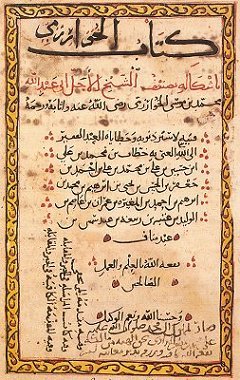
Al-Khwarizmi's The Compendious Book on Calculation by Completion and Balancing
By Muḥammad ibn Musa al-Khwarizmi - Esposito, John L., ed. (1999) The Oxford History of Islam, Oxford University Press ISBN: 0195107993. ; April 2006 (upload date) by Spm, Public domain, https://commons.wikimedia.org/w/index.php?curid=716423
850 CE

Al-Khwarizmi's Arithmetic Introduces Hindu-Arabic Numerals

Al-Khwarizmi's work on arithmetic popularizes Hindu-Arabic numerals in the Islamic world, facilitating algebraic computation. #mathematics #history

Al-Khwarizmi's Arithmetic Introduces Hindu-Arabic Numerals
By Zarateman - Own work, CC0, https://commons.wikimedia.org/w/index.php?curid=162213187
900 CE

Al-Karaji's Algebraic Induction

Persian mathematician Al-Karaji uses inductive reasoning to develop algebraic methods, including the binomial theorem and sums of powers. #mathematics #history

Al-Karaji's Algebraic Induction
By en:Al-Karaji - Schoenberg Center for Electronic Text and Imaging, University of Pennsylvania, Public domain, https://commons.wikimedia.org/w/index.php?curid=46916790
1000 CE

Abu al-Wafa's Algebraic Methods

Persian mathematician Abu al-Wafa Buzjani contributes to algebra with methods for solving cubic equations and geometric constructions. #mathematics #history

Abu al-Wafa's Algebraic Methods
By Unknown author - http://usuarios.lycos.es/Torbi/astronomiaenelmundoarabe/pic013.jpg, Public domain, https://commons.wikimedia.org/w/index.php?curid=5404027
1070 CE

Omar Khayyam's Treatise on Algebra

Persian mathematician Omar Khayyam writes 'Treatise on Demonstration of Problems of Algebra', classifying cubic equations and solving them geometrically. #mathematics #history

Omar Khayyam's Treatise on Algebra
By Alireza Javaheri - https://web.archive.org/web/20161024154356/http://www.panoramio.com/photo/85093358, CC BY 3.0, https://commons.wikimedia.org/w/index.php?curid=55909539
1100 CE

Bhaskara II's Bijaganita

Indian mathematician Bhaskara II writes 'Bijaganita', a comprehensive treatise on algebra covering quadratic, cubic, and indeterminate equations. #mathematics #history

1202 CE

Fibonacci's Liber Abaci

Italian mathematician Fibonacci publishes 'Liber Abaci', introducing Hindu-Arabic numerals and algebraic methods to Europe. #mathematics #history

Fibonacci's Liber Abaci
By Unknown author, Public domain, https://commons.wikimedia.org/w/index.php?curid=720501
1247 CE

Qin Jiushao's Mathematical Treatise in Nine Sections

Chinese mathematician Qin Jiushao writes 'Mathematical Treatise in Nine Sections', including methods for solving polynomial equations using the Horner-like method. #mathematics #history

Qin Jiushao's Mathematical Treatise in Nine Sections
By Qin Jiushao 秦九韶 - 1842 printing Shu Shu Jiu Zhang, Public domain, https://commons.wikimedia.org/w/index.php?curid=3414657
1303 CE

Zhu Shijie's Jade Mirror of the Four Unknowns

Chinese mathematician Zhu Shijie publishes 'Jade Mirror of the Four Unknowns', a treatise on polynomial equations with up to four unknowns using the 'four unknowns' method. #mathematics #history

Zhu Shijie's Jade Mirror of the Four Unknowns
By Zhu Shijie 1303 - mybook 唐戈藏书, Public domain, https://commons.wikimedia.org/w/index.php?curid=19326220
1494 CE

Pacioli's Summa de Arithmetica

Italian mathematician Luca Pacioli publishes 'Summa de Arithmetica', a comprehensive work including algebra and double-entry bookkeeping. #mathematics #history

1545 CE

Cardano's Ars Magna

Italian mathematician Gerolamo Cardano publishes 'Ars Magna', presenting the general solution for cubic and quartic equations, a landmark in algebra. #mathematics #history )

1572 CE

Bombelli's Algebra

Italian mathematician Rafael Bombelli publishes 'Algebra', introducing complex numbers to solve cubic equations. #mathematics #history

Bombelli's Algebra
Bombelli's Algebra
By Unknown author - Book printed by editor Giovanni Rossi, Public domain, https://commons.wikimedia.org/w/index.php?curid=1591687
1591 CE

Viète's Introduction to the Analytic Art

French mathematician François Viète publishes 'In artem analyticem isagoge', introducing symbolic notation and the use of letters for unknowns and constants. #mathematics #history

Viète's Introduction to the Analytic Art
By Unknown author, Public domain, https://commons.wikimedia.org/w/index.php?curid=81021
1614 CE

Napier's Logarithms

Scottish mathematician John Napier publishes 'Mirifici Logarithmorum Canonis Descriptio', introducing logarithms to simplify algebraic calculations. #mathematics #history

Napier's Logarithms
Napier's Logarithms
By Unknown author - https://www.nationalgalleries.org/art-and-artists/3383, Public domain, https://commons.wikimedia.org/w/index.php?curid=154916365
1637 CE

Descartes' La Géométrie

French philosopher and mathematician René Descartes publishes 'La Géométrie', introducing analytic geometry and modern algebraic notation. #mathematics #history

Descartes' La Géométrie
By Original uploader was User:Caton at [1] - Originally from fr.wikipedia; description page is/was here., Public domain, https://commons.wikimedia.org/w/index.php?curid=1379032
1655 CE

Wallis' Arithmetica Infinitorum

English mathematician John Wallis publishes 'Arithmetica Infinitorum', introducing the symbol for infinity and advancing algebraic methods. #mathematics #history

Wallis' Arithmetica Infinitorum
By After Godfrey Kneller - one or more third parties have made copyright claims against Wikimedia Commons in relation to the work from which this is sourced or a purely mechanical reproduction thereof. This may be due to recognition of the "sweat of the brow" doctrine, allowing works to be eligible for protection through skill and labour, and not purely by originality as is the case in the United States (where this website is hosted). These claims may or may not be valid in all jurisdictions. As such, use of this image in the jurisdiction of the claimant or other countries may be regarded as copyright infringement. Please see Commons:When to use the PD-Art tag for more information., Public domain, https://commons.wikimedia.org/w/index.php?curid=6365975
1666 CE

Newton's Generalised Binomial Theorem

Isaac Newton develops the generalised binomial theorem, expanding algebraic power series. #mathematics #history

1673 CE

Leibniz's Notation for Calculus

Gottfried Wilhelm Leibniz introduces the notation for differential and integral calculus, influencing algebraic symbolism. #mathematics #history
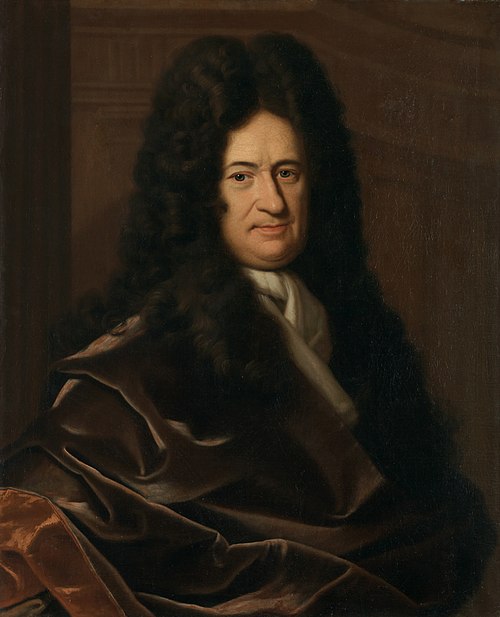
Leibniz's Notation for Calculus
By Christoph Bernhard Francke - Herzog Anton Ulrich-Museum, online, Public domain, https://commons.wikimedia.org/w/index.php?curid=53159699
1682 CE

Seki Takakazu's Discovery of Determinants

Japanese mathematician Seki Takakazu independently discovers determinants and develops methods for solving systems of linear equations. #mathematics #history

Seki Takakazu's Discovery of Determinants
By upload by AMorozov - Gakken, Public domain, https://commons.wikimedia.org/w/index.php?curid=710154
1683 CE

Leibniz's Work on Determinants

Gottfried Wilhelm Leibniz develops the theory of determinants, laying groundwork for linear algebra. #mathematics #history

1693 CE

Leibniz's Matrix Notation

Leibniz uses matrix-like notation in correspondence, an early step toward matrix algebra. #mathematics #history )

Leibniz's Matrix Notation
By Mavaddat - Own work, CC BY-SA 4.0, https://commons.wikimedia.org/w/index.php?curid=126575964
1700 CE

Algebraic Notation Standardisation

By 1700, European mathematicians have largely standardised symbolic algebra, with widespread use of letters and operational symbols. #mathematics #history