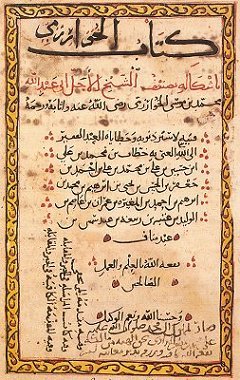
Al-Khwarizmi: Compendious Book on Calculation by Completion & Balancing, Algebra & Algorithms
Encyclopedia/1. The Cosmos & The Natural World/1. Mathematics & Formal Systems/14. Mathematical Biographies • Curated by Admin Timeline.sg
Timeline of Muhammad ibn Musa al-Khwarizmi, Persian polymath at the House of Wisdom whose works 'The Compendious Book on Calculation by Completion and Balancing' and on Hindu-Arabic numerals gave rise to algebra and algorithms, shaping mathematics and computing.
Chronological Storyline (44 Milestones)
780 CE
Birth of Al-Khwarizmi
Muhammad ibn Musa al-Khwarizmi is born in the region of Khwarazm (modern-day Khiva, Uzbekistan). His early life is not well documented, but he likely received a strong education in mathematics, astronomy, and geography. #mathematics #history
Birth of Al-Khwarizmi By Zarateman - Own work, CC0, https://commons.wikimedia.org/w/index.php?curid=162213187
800 CE
Travel to Baghdad
Al-Khwarizmi moves to Baghdad, the capital of the Abbasid Caliphate, which was a center of learning and culture. He joins the House of Wisdom (Bayt al-Hikma), a premier academy and library. #history #islamicgoldenage
813 CE
Caliph al-Ma'mun's Patronage
Caliph al-Ma'mun becomes the patron of the House of Wisdom, commissioning translations and scientific works. Al-Khwarizmi flourishes under his patronage, producing many of his major works. #history #science
Caliph al-Ma'mun's Patronage By Classical Numismatic Group; [1] - https://www.cngcoins.com/Coin.aspx?CoinID=201200, CC BY-SA 3.0, https://commons.wikimedia.org/w/index.php?curid=33419858
820 CE
Completion of Zij al-Sindhind
Al-Khwarizmi completes his astronomical tables (Zij al-Sindhind), based on Indian and Greek sources. These tables were used for centuries in the Islamic world and later translated into Latin. #astronomy #mathematics
820 CE
Invention of 'Al-Jabr' Method
Al-Khwarizmi introduces the method of 'al-jabr' (completion) to solve equations by adding equal terms to both sides, creating a systematic approach to algebra. #algebra #mathematics
820 CE
Writing of Al-Jabr (Algebra)
Al-Khwarizmi completes 'The Compendious Book on Calculation by Completion and Balancing' (Al-Kitab al-mukhtasar fi hisab al-jabr wa'l-muqabala), which introduces systematic algebraic methods. The term 'algebra' derives from 'al-jabr' in the title. #algebra #mathematics
Writing of Al-Jabr (Algebra) By Muḥammad ibn Musa al-Khwarizmi - Esposito, John L., ed. (1999) The Oxford History of Islam, Oxford University Press ISBN: 0195107993. ; April 2006 (upload date) by Spm, Public domain, https://commons.wikimedia.org/w/index.php?curid=716423
820 CE
Translation of Sindhind
Al-Khwarizmi translates the Indian astronomical work 'Sindhind' (from Sanskrit Siddhanta) into Arabic, incorporating Indian astronomy into Islamic science. This work later influences European astronomy. #astronomy #science
825 CE
Treatise on Hindu-Arabic Numerals
Al-Khwarizmi writes a treatise explaining the Hindu-Arabic numeral system, including zero and place value. This work, though now lost in Arabic, survives in Latin translation as 'Algoritmi de numero Indorum', popularizing the system in Europe. #mathematics #numerals
825 CE
Work on Hindu Numerals with Zero
Al-Khwarizmi explains the use of zero as a placeholder in the Hindu numeral system, which was critical for the development of decimal arithmetic. #mathematics #numerals
Work on Hindu Numerals with Zero By Cmglee - Own work, CC BY-SA 4.0, https://commons.wikimedia.org/w/index.php?curid=187178022
830 CE
Measurement of Earth's Circumference
Al-Khwarizmi participates in a project sponsored by al-Ma'mun to measure the Earth's circumference, using methods from Greek and Indian astronomy. This demonstrated the advanced state of Islamic science. #geography #science
830 CE
Coordination of Geographical Coordinates
Al-Khwarizmi revises Ptolemy's coordinates for over 2400 places in his 'Kitab Surat al-Ard', significantly improving the accuracy of maps of the known world. #geography #maps
830 CE
Method for Solving Linear Equations
Al-Khwarizmi provides clear geometric and algebraic solutions for linear equations, setting the stage for systematic problem-solving. #algebra #mathematics
833 CE
Publication of Kitab Surat al-Ard
Al-Khwarizmi writes 'Kitab Surat al-Ard' (Book on the Shape of the Earth), a major work of geography that revises Ptolemy's Geography with more accurate coordinates and a world map. #geography #maps
835 CE
Contributions to Spherical Astronomy
Al-Khwarizmi writes on spherical astronomy, improving methods for calculating celestial positions and times of prayer. #astronomy #mathematics
835 CE
Work on the Astrolabe
Al-Khwarizmi composes a treatise on the astrolabe, an essential tool for astronomy and timekeeping. His work on its use and construction advanced Islamic and later European astronomy. #astronomy #technology
835 CE
Treatise on Sundials
Al-Khwarizmi writes a work on sundials, describing their construction and use for timekeeping, which was important for religious observances. #technology #time
840 CE
Contributions to the Jewish Calendar
Al-Khwarizmi writes a work on the Jewish calendar, helping to synchronize Islamic and religious calendars. This shows his interdisciplinary expertise. #calendar #mathematics
840 CE
Influence on Islamic Arithmetic
Al-Khwarizmi's arithmetic works become standard texts in the Islamic world, influencing later mathematicians like Al-Karaji and Al-Tusi. #mathematics #education
840 CE
Influence on European Renaissance Mathematics
Al-Khwarizmi's works transmitted via Latin translations fuel the European Renaissance in mathematics and science. #renaissance #mathematics
845 CE
Development of Algebraic Methods
Al-Khwarizmi's algebra book systematically solves linear and quadratic equations using 'al-jabr' (restoration) and 'al-muqabala' (balancing). He also introduces rules for signs and operations with polynomials. #algebra #mathematics
850 CE
Death of Al-Khwarizmi
Al-Khwarizmi dies in Baghdad, leaving a legacy that transforms mathematics. His works continue to be studied and translated for centuries. #history #mathematics
850 CE
Legacy of Algebraic Notations
Al-Khwarizmi's algebraic notation and methods spread across the Islamic world and later to Europe, forming the basis of modern algebra. #algebra #history
1145 CE
Latin Translation of Algebra by Robert of Chester
Robert of Chester translates Al-Khwarizmi's algebra book into Latin, introducing European mathematicians to systematic algebra and the word 'algebra'. #algebra #translation
1145 CE
Latin Term 'Algorismus' Coined
The term 'algorismus' (algorithm) enters Latin vocabulary from Al-Khwarizmi's name, referring to arithmetic with Hindu-Arabic numerals. #terminology #history
1145 CE
Translation by Gerard of Cremona
Gerard of Cremona translates Al-Khwarizmi's astronomical tables and algebra into Latin, further disseminating his works in Europe. #translation #astronomy
Translation by Gerard of Cremona By Gerard of Cremona - Gerardus Cremonensis "Recueil des traités de médecine" 1250-1260. Reproduction in "Inventions et découvertes au Moyen-Âge", Samuel Sadaune, Public domain, https://commons.wikimedia.org/w/index.php?curid=3691634
1150 CE
Latin Translation of Hindu-Arabic Numerals
Al-Khwarizmi's treatise on Hindu-Arabic numerals is translated into Latin as 'Algoritmi de numero Indorum'. The term 'algorithm' comes from the Latinized form of his name, 'Algoritmi'. #algorithms #mathematics
1200 CE
Use of Algorithm in European Texts
The term 'algorithm' becomes common in European mathematical texts, derived from the Latinization of Al-Khwarizmi's name. #algorithms #terminology
Use of Algorithm in European Texts By Arthur Baelde - Own work, CC BY-SA 4.0, https://commons.wikimedia.org/w/index.php?curid=70282331
1202 CE
Fibonacci's Liber Abaci Adopts Arabic Numerals
Leonardo Fibonacci publishes 'Liber Abaci', which popularizes Hindu-Arabic numerals in Europe, heavily based on Al-Khwarizmi's works. This revolutionizes European commerce and mathematics. #mathematics #numerals
Fibonacci's Liber Abaci Adopts Arabic Numerals By Unknown author, Public domain, https://commons.wikimedia.org/w/index.php?curid=720501
1500 CE
Algebra Becomes a Core Mathematical Discipline
Al-Khwarizmi's algebra lays the foundation for this branch of mathematics, which becomes essential in fields from engineering to economics. #algebra #mathematics
1800 CE
Al-Khwarizmi as a Historical Figure in Mathematics Education
Western mathematics textbooks begin including Al-Khwarizmi's biography and contributions, recognizing his role as the father of algebra. #education #history
1835 CE
Publication of English Translation
An English translation of Al-Khwarizmi's algebra by Frederic Rosen is published, making the work accessible to a wider audience. #algebra #translation
1857 CE
Rediscovery of Latin Manuscripts
Medieval Latin translations of Al-Khwarizmi's works are rediscovered in European libraries, sparking scholarly interest in his contributions to mathematics and science. #history #mathematics
1915 CE
Publication of Arabic Original of Algebra
The unique Arabic manuscript of Al-Khwarizmi's algebra is published in a critical edition, allowing modern scholars to study the original text. #algebra #history
1950 CE
Al-Khwarizmi's Work on Algorithms in Computing
The term 'algorithm' becomes central to computer science, with Al-Khwarizmi recognized as a founding figure. #computing #algorithms
1963 CE
Crater Al-Khwarizmi Named on Moon
A lunar crater is named Al-Khwarizmi in honor of his contributions to astronomy and mathematics, recognizing his enduring legacy. #astronomy #moon )
Crater Al-Khwarizmi Named on Moon By Unknown author, Public domain, https://commons.wikimedia.org/w/index.php?curid=533236
1973 CE
Arabic Edition of Algebra Reissued
A critical Arabic edition of Al-Khwarizmi's algebra is published, allowing new scholarly analysis. #algebra #history
1983 CE
Algorithmic Thinking in Modern Science
Al-Khwarizmi's systematic approach is recognized as an early example of algorithmic thinking, influencing fields like artificial intelligence. #ai #algorithms
1985 CE
UNESCO Recognition
UNESCO includes Al-Khwarizmi in its list of notable scientists and scholars, highlighting his impact on world civilization and mathematics. #history #unesco
2000 CE
Al-Khwarizmi in Popular Culture
Al-Khwarizmi's name appears in movies, books, and games, often as a symbol of scientific genius and invention. #culture #history
2007 CE
Google Doodle Celebrating Al-Khwarizmi
Google features a Doodle on Al-Khwarizmi's 1200th birth anniversary (approximate), bringing his contributions to a global audience. #technology #mathematics
2018 CE
Stamps Issued Commemorating Al-Khwarizmi
Several countries issue postage stamps featuring Al-Khwarizmi, celebrating his contributions to mathematics and astronomy. #philately #history
2019 CE
World Year of Al-Khwarizmi
UNESCO declares 2019 as the World Year of Al-Khwarizmi to commemorate his 1200th birth anniversary, promoting his contributions to algebra and algorithms. #history #mathematics
2020 CE
Al-Khwarizmi's Algorithm in Robotics
Concepts from Al-Khwarizmi's algebraic and algorithmic works are applied in modern robotics and automation. #robotics #algorithms
2023 CE
Al-Khwarizmi's Papers Digitally Preserved
Digital archives of Al-Khwarizmi's surviving manuscripts are created, ensuring his work is preserved for future generations. #preservation #history