Agricultural Science & Botanical Classification: From Qimin Yaoshu to Hybrid Rice
Encyclopedia/1. The Cosmos & The Natural World/5. Life Sciences/04. Botany & Agricultural Science • Curated by Admin Timeline.sg
This timeline traces the evolution of agricultural science and botanical classification from ancient Chinese agronomy to modern hybrid rice, highlighting key works like Jia Sixie's Qimin Yaoshu, Li Shizhen's Bencao Gangmu, Linnaeus's binomial nomenclature, and Yuan Longping's hybrid rice.
Chronological Storyline (45 Milestones)
544 CE
Jia Sixie Completes Qimin Yaoshu
Jia Sixie, a Chinese official, compiles Qimin Yaoshu, the earliest known agricultural encyclopedia. It covers crop rotation, soil management, and horticulture, influencing East Asian farming for centuries. #agriculture #history #China
Jia Sixie Completes Qimin Yaoshu By Unknown author - http://www.las.ac.cn/service/rear/doc/nongxue/qimin.htm, Public domain, https://commons.wikimedia.org/w/index.php?curid=1488793
1100 CE
Song Dynasty Agricultural Expansion
During the Song Dynasty, new rice varieties from Champa (Vietnam) are introduced to China, enabling double-cropping and population growth. This marks early agricultural innovation through plant selection. #agriculture #China #history
Song Dynasty Agricultural Expansion By NASA - http://history.msfc.nasa.gov/rocketry/03.html, Public domain, https://commons.wikimedia.org/w/index.php?curid=36912299
1240 CE
Albertus Magnus Writes De Vegetabilibus
Albertus Magnus, a German scholar, produces De Vegetabilibus, a botanical work describing plant anatomy and classification. It bridges ancient Greek botany and medieval European knowledge. #botany #medieval #science
Albertus Magnus Writes De Vegetabilibus By Vicente Salvador Gómez - [2], Public domain, https://commons.wikimedia.org/w/index.php?curid=8528799
1493 CE
Columbian Exchange Begins
Christopher Columbus's second voyage brings crops like wheat, sugarcane, and citrus to the Americas, while maize, potatoes, and tomatoes are introduced to Europe. This global exchange transforms agriculture worldwide. #agriculture #history #globalization
Columbian Exchange Begins By Unknown author, Public domain, https://commons.wikimedia.org/w/index.php?curid=153505656
1530 CE
Otto Brunfels Publishes Herbarum Vivae Eicones
Otto Brunfels, a German botanist, publishes Herbarum Vivae Eicones, a pioneering botanical book with accurate plant illustrations. It advances plant identification and classification. #botany #Renaissance #science
Otto Brunfels Publishes Herbarum Vivae Eicones By Hans Baldung Grien - Annotationes in quatuor Evangelia et Acta Apostolorum, Public domain, https://commons.wikimedia.org/w/index.php?curid=37103895
1551 CE
Li Shizhen Begins Bencao Gangmu
Chinese physician Li Shizhen starts compiling Bencao Gangmu, a comprehensive materia medica with detailed botanical descriptions. Published in 1578, it classifies over 1,800 plants and remains influential in East Asian medicine. #botany #China #medicine
Li Shizhen Begins Bencao Gangmu By Unknown author - http://huntbot.andrew.cmu.edu/hibd/departments/Library/ChineseHerbal.shtml, Public domain, https://commons.wikimedia.org/w/index.php?curid=19570678
1583 CE
Andrea Cesalpino Publishes De Plantis
Italian botanist Andrea Cesalpino publishes De Plantis, proposing a plant classification system based on fruit and seed structure. It foreshadows later systematic botany. #botany #Renaissance #classification
Andrea Cesalpino Publishes De Plantis By Battista Ricci - originally uploaded to de.wikipedia by Rsabbatini (talk · contribs) on 7 September 2006 under the file name Andrea Cesalpino.jpg.(+/−), Public domain, https://commons.wikimedia.org/w/index.php?curid=1147698
1623 CE
Gaspard Bauhin Publishes Pinax Theatri Botanici
Swiss botanist Gaspard Bauhin publishes Pinax Theatri Botanici, a catalog of about 6,000 plants with binomial-like names. It lays groundwork for Linnaeus's binomial nomenclature. #botany #classification #history
Gaspard Bauhin Publishes Pinax Theatri Botanici By Unknown author - Caspar Bauhin. Porträt in der Rektoratsmatrikel, Public domain, https://commons.wikimedia.org/w/index.php?curid=155075912
1682 CE
Nehemiah Grew Publishes The Anatomy of Plants
English botanist Nehemiah Grew publishes The Anatomy of Plants, describing plant cells and tissues. His work establishes plant anatomy as a scientific discipline. #botany #science #anatomy
Nehemiah Grew Publishes The Anatomy of Plants By "R. White" - Makers of British Botany, Plate 4; this scan obtained from https://archive.org/details/makersofbritishb00oliv, Public domain, https://commons.wikimedia.org/w/index.php?curid=8140330
1694 CE
Rudolf Camerarius Demonstrates Plant Sexuality
German botanist Rudolf Camerarius publishes letters proving that plants have male and female organs, and that pollen is necessary for seed production. This discovery revolutionizes plant breeding. #botany #science #reproduction
1735 CE
Linnaeus Publishes Systema Naturae
Carl Linnaeus publishes Systema Naturae, introducing his hierarchical classification system. The 10th edition (1758) establishes binomial nomenclature for species, becoming the foundation of modern taxonomy. #botany #classification #Linnaeus
Linnaeus Publishes Systema Naturae By Carl Linnaeus - Sourced from https://resolver.sub.uni-goettingen.de/purl?PPN362053006, Public domain, https://commons.wikimedia.org/w/index.php?curid=11136563
1753 CE
Linnaeus Publishes Species Plantarum
Linnaeus publishes Species Plantarum, listing all known plant species with binomial names. This work is the starting point for modern botanical nomenclature. #botany #classification #Linnaeus
Linnaeus Publishes Species Plantarum By Carl Linnaeus - bibbild.abo.fi, Public domain, https://commons.wikimedia.org/w/index.php?curid=744585
1763 CE
Michel Adanson Publishes Familles des Plantes
French botanist Michel Adanson publishes Familles des Plantes, proposing a natural classification system based on multiple characters. It challenges Linnaeus's artificial system. #botany #classification #history
Michel Adanson Publishes Familles des Plantes By Unknown author - Gallica, Public domain, https://commons.wikimedia.org/w/index.php?curid=68880954
1774 CE
Joseph Priestley Discovers Photosynthesis
English chemist Joseph Priestley shows that plants release oxygen, a key step in understanding photosynthesis. This discovery links plant biology to atmospheric chemistry. #botany #science #photosynthesis
Joseph Priestley Discovers Photosynthesis By James Sharples - https://npg.si.edu/object/npg_NPG.77.160?destination=node/63231%3Fedan_local%3D1%26edan_q%3DJoseph, Public domain, https://commons.wikimedia.org/w/index.php?curid=193629762
1793 CE
Christian Sprengel Publishes The Secret of Nature
German botanist Christian Konrad Sprengel publishes The Secret of Nature in the Form and Fertilization of Flowers, describing plant-pollinator interactions. It lays the foundation for floral ecology. #botany #ecology #pollination
Christian Sprengel Publishes The Secret of Nature By Christian Konrad Sprengel - Scanned book, Public domain, https://commons.wikimedia.org/w/index.php?curid=57203092
1800 CE
Jethro Tull's Seed Drill Gains Popularity
Jethro Tull's seed drill, invented in 1701, becomes widely adopted in the 19th century. It enables efficient planting in rows, boosting crop yields and mechanizing agriculture. #agriculture #technology #history
Jethro Tull's Seed Drill Gains Popularity By Unknown author - thoughtco.com, Public domain, https://commons.wikimedia.org/w/index.php?curid=77996845
1805 CE
Alexander von Humboldt Publishes Essay on Plant Geography
Alexander von Humboldt publishes Essay on the Geography of Plants, linking plant distribution to climate and altitude. This work founds biogeography and ecological thinking. #botany #geography #ecology
Alexander von Humboldt Publishes Essay on Plant Geography By Joseph Karl Stieler - [1], Public domain, https://commons.wikimedia.org/w/index.php?curid=10393110
1813 CE
Augustin Pyramus de Candolle Publishes Théorie Élémentaire
Swiss botanist Augustin Pyramus de Candolle publishes Théorie Élémentaire de la Botanique, introducing the concept of 'taxonomy' and natural classification. He emphasizes plant anatomy and morphology. #botany #classification #history
Augustin Pyramus de Candolle Publishes Théorie Élémentaire By Joseph Hornung - Bibliothèque de Genève, Public domain, https://commons.wikimedia.org/w/index.php?curid=84859017
1838 CE
Schleiden and Schwann Propose Cell Theory
German botanist Matthias Jakob Schleiden and zoologist Theodor Schwann formulate cell theory, stating that all living organisms are composed of cells. This unifies plant and animal biology. #botany #science #cellbiology
Schleiden and Schwann Propose Cell Theory By TenOfAllTrades at English Wikipedia - Own work, Public domain, https://commons.wikimedia.org/w/index.php?curid=1583880
1840 CE
Justus von Liebig Publishes Organic Chemistry in Its Application to Agriculture
German chemist Justus von Liebig publishes his work on plant nutrition, identifying nitrogen, phosphorus, and potassium as essential nutrients. This leads to the development of chemical fertilizers. #agriculture #chemistry #fertilizer
Justus von Liebig Publishes Organic Chemistry in Its Application to Agriculture By Unknown author - http://ihm.nlm.nih.gov/images/B17480, Public domain, https://commons.wikimedia.org/w/index.php?curid=19141954
1859 CE
Charles Darwin Publishes On the Origin of Species
Charles Darwin's On the Origin of Species explains evolution by natural selection, providing a framework for understanding plant diversity and adaptation. It revolutionizes botany and agriculture. #evolution #botany #science
Charles Darwin Publishes On the Origin of Species By John Murray, Publisher - This image has an extracted file: Origin of Species.jpg., Public domain, https://commons.wikimedia.org/w/index.php?curid=320416
1866 CE
Gregor Mendel Publishes Experiments on Plant Hybrids
Gregor Mendel publishes his work on pea plant inheritance, establishing the laws of segregation and independent assortment. His work, though initially ignored, becomes the foundation of genetics. #genetics #botany #science
Gregor Mendel Publishes Experiments on Plant Hybrids By Unknown author - http://0.tqn.com/d/biology/1/0/l/e/3244238.jpg, Public domain, https://commons.wikimedia.org/w/index.php?curid=33347279
1875 CE
Oscar Hertwig Observes Fertilization in Sea Urchins
German biologist Oscar Hertwig observes the fusion of sperm and egg nuclei in sea urchins, confirming the role of fertilization in inheritance. This applies to plants as well. #biology #reproduction #science
Oscar Hertwig Observes Fertilization in Sea Urchins By Nicola Perscheid - one or more third parties have made copyright claims against Wikimedia Commons in relation to the work from which this is sourced or a purely mechanical reproduction thereof. This may be due to recognition of the "sweat of the brow" doctrine, allowing works to be eligible for protection through skill and labour, and not purely by originality as is the case in the United States (where this website is hosted). These claims may or may not be valid in all jurisdictions. As such, use of this image in the jurisdiction of the claimant or other countries may be regarded as copyright infringement. Please see Commons:When to use the PD-Art tag for more information., Public domain, https://commons.wikimedia.org/w/index.php?curid=1020140
1882 CE
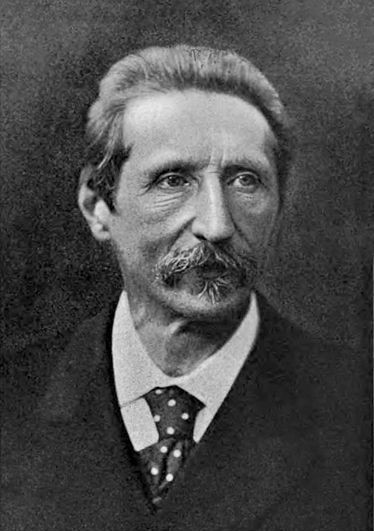
Eduard Strasburger Describes Mitosis in Plants
German botanist Eduard Strasburger describes mitosis in plant cells, showing chromosome division during cell division. His work advances cytogenetics. #botany #cytology #science
Eduard Strasburger Describes Mitosis in Plants By Unknown author - Linnean Society of London, Public domain, https://commons.wikimedia.org/w/index.php?curid=148034209
1900 CE
Rediscovery of Mendel's Laws
Hugo de Vries, Carl Correns, and Erich von Tschermak independently rediscover Mendel's work, sparking the field of genetics. This leads to modern plant breeding. #genetics #botany #history
Rediscovery of Mendel's Laws By Unknown author - NIH, Public domain, https://commons.wikimedia.org/w/index.php?curid=1394893
1908 CE
George Harrison Shull Develops Hybrid Corn
American botanist George Harrison Shull demonstrates heterosis (hybrid vigor) in maize, leading to the development of hybrid corn. This dramatically increases yields and transforms agriculture. #agriculture #hybrid #corn
George Harrison Shull Develops Hybrid Corn By Unknown author - Empire State Notables, 1914, page 416, Public domain, https://commons.wikimedia.org/w/index.php?curid=169792131
1920 CE
Nikolai Vavilov Proposes Centers of Origin
Russian botanist Nikolai Vavilov publishes his theory of centers of origin for cultivated plants, identifying regions where crop diversity is highest. This guides plant genetic resource conservation. #botany #agriculture #genetics
Nikolai Vavilov Proposes Centers of Origin By World Telegram staff photographer - Library of Congress. New York World-Telegram & Sun Collection. http://hdl.loc.gov/loc.pnp/cph.3c18109, Public domain, https://commons.wikimedia.org/w/index.php?curid=1273924
1927 CE
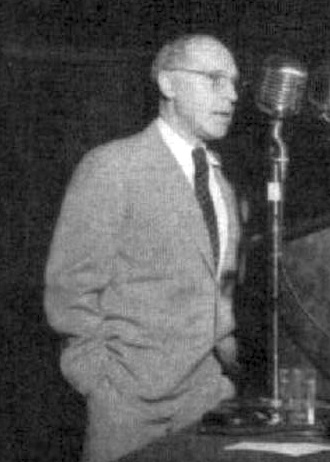
Hermann Joseph Muller Discovers X-ray Mutagenesis
American geneticist Hermann Joseph Muller shows that X-rays induce mutations in fruit flies. This technique is later applied to plants for mutation breeding. #genetics #mutation #science
Hermann Joseph Muller Discovers X-ray Mutagenesis By Alfred De Bat - The Journal of Science Fiction #4, 1953, Public domain, https://commons.wikimedia.org/w/index.php?curid=77035739
1940 CE
Barbara McClintock Discovers Transposons in Maize
American cytogeneticist Barbara McClintock discovers transposable elements (jumping genes) in maize, revolutionizing genetics. Her work explains genetic instability and regulation. #genetics #maize #science
Barbara McClintock Discovers Transposons in Maize By Smithsonian Institution/Science Service; Restored by Adam Cuerden - Flickr: Barbara McClintock (1902-1992)Smithsonian original, Public domain, https://commons.wikimedia.org/w/index.php?curid=25629182
1944 CE
Green Revolution Begins with Dwarf Wheat
American agronomist Norman Borlaug develops high-yielding, disease-resistant dwarf wheat varieties in Mexico. This marks the start of the Green Revolution, saving millions from famine. #agriculture #GreenRevolution #wheat
Green Revolution Begins with Dwarf Wheat By Ben Zinner, USAID - http://www.usaid.gov/; source; exact image URL, Public domain, https://commons.wikimedia.org/w/index.php?curid=75331192
1953 CE
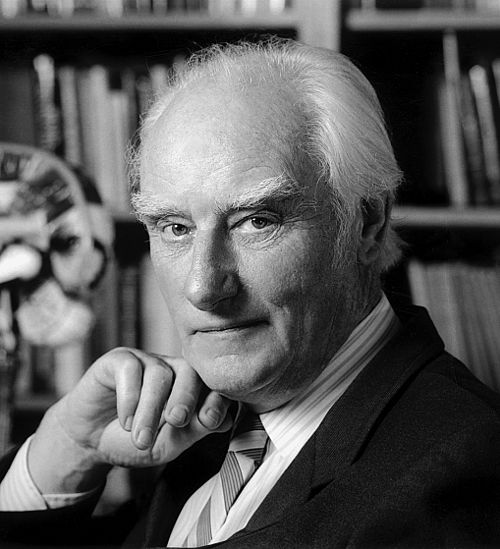
Watson and Crick Discover DNA Structure
James Watson and Francis Crick propose the double helix structure of DNA, explaining genetic inheritance. This discovery underpins all modern plant biotechnology. #genetics #DNA #science
Watson and Crick Discover DNA Structure By Francis_Crick.png: Photo: Marc Lieberman, per ticket:2015100910022707 derivative work: Materialscientist (talk) - This file was derived from: Francis Crick.png:, CC BY 2.5, https://commons.wikimedia.org/w/index.php?curid=18346375
1960 CE
International Rice Research Institute (IRRI) Founded
IRRI is established in the Philippines to develop improved rice varieties. It plays a key role in the Green Revolution in Asia, creating high-yielding rice strains. #agriculture #rice #research
International Rice Research Institute (IRRI) Founded By Abrahamdsl - Regular work day, CC BY-SA 3.0, https://commons.wikimedia.org/w/index.php?curid=179102722
1966 CE
IR8 Rice Variety Released
IRRI releases IR8, a high-yielding semi-dwarf rice variety that doubles yields. It becomes a flagship of the Green Revolution in Asia, alleviating hunger. #agriculture #rice #GreenRevolution
1970 CE
Yuan Longping Discovers Wild Male-Sterile Rice
Chinese agronomist Yuan Longping discovers a wild male-sterile rice plant, enabling hybrid rice breeding. This breakthrough leads to dramatic yield increases in China. #agriculture #rice #hybrid
Yuan Longping Discovers Wild Male-Sterile Rice By China News Service - YouTube: https://www.youtube.com/watch?v=qsY6qWxCtV4 – View/save archived versions on archive.org 0:35, CC BY 3.0, https://commons.wikimedia.org/w/index.php?curid=105654860
1973 CE
First Successful Hybrid Rice Developed
Yuan Longping and his team develop the first commercial hybrid rice variety, achieving a 20-30% yield increase over conventional rice. This innovation helps feed millions. #agriculture #rice #China
First Successful Hybrid Rice Developed By China News Service - YouTube: 第三代杂交水稻晚稻亩产911.7公斤 周年亩产超1500公斤 – View/save archived versions on archive.org, CC BY 3.0, https://commons.wikimedia.org/w/index.php?curid=108022271
1983 CE
First Transgenic Plant Created
Scientists produce the first genetically modified plant (tobacco) using Agrobacterium tumefaciens. This opens the door for genetic engineering in agriculture. #biotechnology #GMO #science
First Transgenic Plant Created By Ciencias Españolas KoS - File:ADN_2.png File:Pince_a_épiler.png, CC BY-SA 3.0, https://commons.wikimedia.org/w/index.php?curid=75624775
1994 CE
Flavr Savr Tomato Approved for Sale
The Flavr Savr tomato, the first genetically modified food crop, is approved by the FDA. It has delayed ripening, but commercial success is limited due to production issues. #biotechnology #GMO #tomato
1996 CE
First Genetically Modified Soybeans Planted
Monsanto introduces Roundup Ready soybeans, engineered to tolerate glyphosate herbicide. They become widely adopted, sparking debates on GMOs and sustainable agriculture. #agriculture #GMO #biotechnology
2000 CE
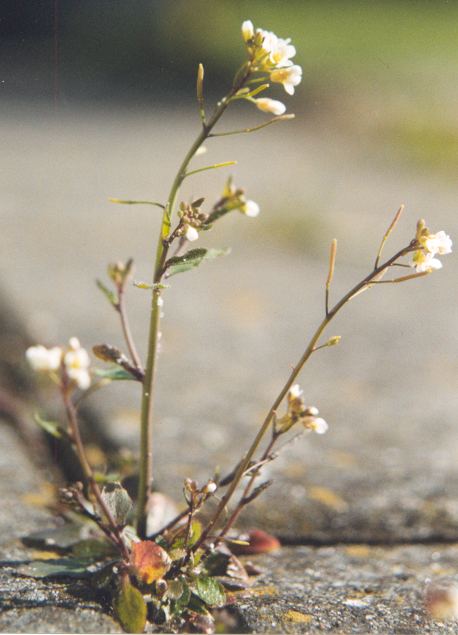
Arabidopsis Genome Sequenced
The complete genome of Arabidopsis thaliana, a model plant, is sequenced. This milestone accelerates plant molecular biology and functional genomics research. #genomics #botany #science
Arabidopsis Genome Sequenced By Original uploader was Brona at en.wikipedia. User:Roepers at nl.wikipedia - Transferred from en.wikipedia to Commons by Million_Moments., CC BY-SA 3.0, https://commons.wikimedia.org/w/index.php?curid=3668208
2004 CE
Golden Rice Developed
Scientists create Golden Rice, genetically engineered to produce beta-carotene (vitamin A). It aims to combat vitamin A deficiency in developing countries, but faces regulatory hurdles. #biotechnology #rice #nutrition
Golden Rice Developed By International Rice Research Institute (IRRI) - https://www.flickr.com/photos/ricephotos/5516789000/in/set-72157626241604366, CC BY 2.0, https://commons.wikimedia.org/w/index.php?curid=14908001
2010 CE
First Synthetic Plant Chromosome Created
Researchers synthesize the first artificial plant chromosome in Arabidopsis, demonstrating the potential for synthetic biology in crop improvement. #biotechnology #syntheticbiology #botany
First Synthetic Plant Chromosome Created By Alexander van Dijk from San Francisco, United States - Synthetic Biology Research at NASA Ames, CC BY 2.0, https://commons.wikimedia.org/w/index.php?curid=26376516
2012 CE
CRISPR-Cas9 Genome Editing in Plants
CRISPR-Cas9 is first applied to edit plant genomes, enabling precise gene modifications. This technology revolutionizes crop breeding and functional genomics. #biotechnology #genomeediting #agriculture
CRISPR-Cas9 Genome Editing in Plants By Deposition authors: Nishimasu, H., Ishitani, R., Nureki, O.; Visualization author: Synpath - Atom coordinates: https://www.rcsb.org/structure/4OO8; Visualization: Own work, CC0, https://commons.wikimedia.org/w/index.php?curid=133423568
2016 CE
FAO Reports on Plant Genetic Resources
The Food and Agriculture Organization publishes the Second Report on the State of the World’s Plant Genetic Resources for Food and Agriculture, highlighting conservation needs. #agriculture #conservation #genetics
FAO Reports on Plant Genetic Resources By FAO, original uploader: Cptnemo - File:FAO_logo.svg Originally uploaded in July 2009 to en:Wikipedia (log) by Cptnemo (talk)., Public domain, https://commons.wikimedia.org/w/index.php?curid=7905914
2020 CE
Yuan Longping's Hybrid Rice Grown in Saline Soil
Yuan Longping's team successfully grows hybrid rice in saline-alkaline soil, achieving yields of 4.5 tons per hectare. This expands arable land for rice cultivation. #agriculture #rice #innovation
2021 CE
China Approves Gene-Edited Wheat
China approves the first gene-edited wheat variety for commercial production, using CRISPR to improve disease resistance. This marks a step forward for gene editing in agriculture. #biotechnology #wheat #China