Encyclopedia/1. The Cosmos & The Natural World/1. Mathematics & Formal Systems • Curated by Admin Timeline.sg
Actuarial mathematics and financial modeling trace their origins to ancient risk-sharing practices, evolving through the development of life tables, probability theory, and stochastic calculus to modern quantitative finance tools like the Black-Scholes model.
Chronological Storyline (45 Milestones)
1754 BCE
Code of Hammurabi includes insurance provisions
The Code of Hammurabi in Babylon includes provisions for bottomry contracts, an early form of marine insurance where lenders forgave loans if ships were lost. This represents one of the earliest recorded risk-transfer mechanisms. #history #insurance
Code of Hammurabi includes insurance provisions By Mbzt - Own work, CC BY 3.0, https://commons.wikimedia.org/w/index.php?curid=16931676
300 BCE
Ancient Greek bottomry loans
Greek merchants use bottomry loans to finance maritime trade, where loan repayment is contingent on safe arrival of the ship. This early form of insurance spreads across the Mediterranean. #history #finance
1200 CE
Chinese merchant guilds provide mutual aid
Chinese merchant guilds and associations offer mutual aid for members, including compensation for losses from piracy or shipwreck. These practices predate formal insurance companies. #history #insurance
Chinese merchant guilds provide mutual aid By N. Hurd, engraver - Yale University. http://beinecke.library.yale.edu/dl_crosscollex/brbldl_getrec.asp?fld=img&id=1028933, Public domain, https://commons.wikimedia.org/w/index.php?curid=9027227
1347 CE
Earliest known insurance contract in Genoa
A marine insurance policy is issued in Genoa, Italy, covering a ship voyage. This is one of the earliest surviving insurance contracts, formalizing risk transfer. #history #insurance
1662 CE
John Graunt publishes life tables
John Graunt analyzes London's Bills of Mortality and publishes 'Natural and Political Observations...', creating the first life table. This foundational work enables mortality risk assessment and is a cornerstone of actuarial science. #actuarial #statistics
1693 CE
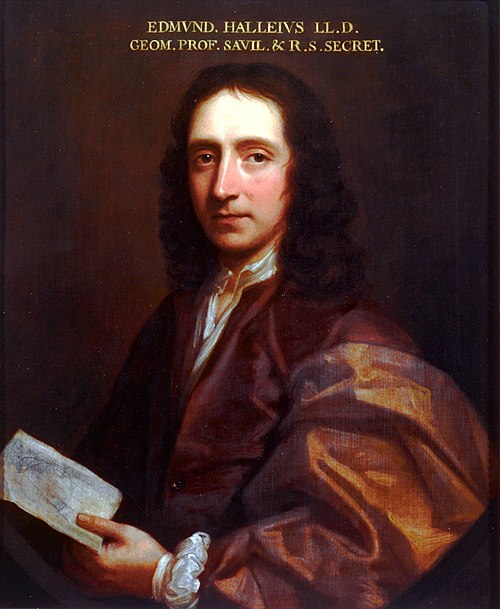
Edmond Halley constructs mortality table
Edmond Halley publishes a mortality table based on Breslau, Germany data, showing the probability of death at each age. This table is used to price life annuities, advancing actuarial science. #actuarial #mathematics
Edmond Halley constructs mortality table By Thomas Murray - https://commons.wikimedia.org/wiki/File:Edmund_Halley.gif, Public domain, https://commons.wikimedia.org/w/index.php?curid=128394552
1703 CE
First actuarial textbook by Abraham de Moivre
Abraham de Moivre publishes 'Annuities upon Lives', which applies probability theory to life contingencies. This work provides a mathematical foundation for pricing life insurance and annuities. #actuarial #mathematics
First actuarial textbook by Abraham de Moivre By Joseph Highmore - https://prints.royalsociety.org/products/portrait-of-abraham-de-moivre-1667-1754-rs-9548, Public domain, https://commons.wikimedia.org/w/index.php?curid=167394521
1756 CE
James Dodson calculates premiums using life tables
James Dodson, a mathematician, uses Graunt's and Halley's life tables to calculate level premiums for life insurance. His work leads to the establishment of the Society for Equitable Assurances in 1762. #actuarial #insurance )
1762 CE
Society for Equitable Assurances founded
The Society for Equitable Assurances on Lives and Survivorships is founded in London, the first mutual life insurance company. It uses scientific premium calculations based on mortality tables, marking the birth of modern actuarial practice. #actuarial #history
1805 CE
First life insurance company in Asia: Oriental Life Insurance
The Oriental Life Insurance Company is established in Calcutta, India, by European merchants. It is the first life insurer in Asia, bringing actuarial methods to the region. #actuarial #insurance
1812 CE
First actuarial society founded in England
The Society for Equitable Assurances forms an actuarial committee, but the first professional actuarial society is the Institute of Actuaries, founded in 1848. However, in 1812, the first known actuarial examination is held. #actuarial #history
1848 CE
Institute of Actuaries founded in London
The Institute of Actuaries is established as the first professional body for actuaries, setting standards and examinations. This formalizes the profession and promotes actuarial science globally. #actuarial #history
1889 CE
Actuarial Society of America founded
The Actuarial Society of America is founded in New York, later merging with other bodies to form the Society of Actuaries. It advances actuarial education and research in North America. #actuarial #history
1900 CE
Bachelier's thesis on speculation and Brownian motion
Louis Bachelier publishes 'Théorie de la Spéculation', introducing Brownian motion as a model for stock prices. This pioneering work lays the foundation for stochastic calculus and modern financial mathematics. #finance #mathematics
Bachelier's thesis on speculation and Brownian motion By Louis_jeune_.gif - http://www.york.ac.uk/depts/maths/histstat/people/sources.htm, Public domain, https://commons.wikimedia.org/w/index.php?curid=15679520
1905 CE
Einstein's paper on Brownian motion
Albert Einstein publishes a paper explaining Brownian motion mathematically, independently of Bachelier. This work influences stochastic processes used later in financial modeling. #physics #mathematics
Einstein's paper on Brownian motion By Toshiyouri - Own work, CC BY-SA 4.0, https://commons.wikimedia.org/w/index.php?curid=69356582
1930 CE
Kolmogorov formalizes probability theory
Andrey Kolmogorov publishes 'Foundations of the Theory of Probability', axiomatizing probability theory. This rigorous framework underpins actuarial science and financial modeling. #mathematics #probability
Kolmogorov formalizes probability theory By Konrad Jacobs - https://opc.mfo.de/detail?photoID=7493, CC BY-SA 2.0 de, https://commons.wikimedia.org/w/index.php?curid=11829175
1944 CE
Von Neumann and Morgenstern publish game theory
John von Neumann and Oskar Morgenstern publish 'Theory of Games and Economic Behavior', introducing expected utility theory. This becomes fundamental for decision-making under uncertainty in finance and insurance. #economics #mathematics
1952 CE
Markowitz portfolio theory
Harry Markowitz publishes 'Portfolio Selection', introducing modern portfolio theory and the efficient frontier. This quantitative approach to risk and return revolutionizes investment management. #finance #economics
1956 CE
First computer-based actuarial models
Actuaries begin using early computers like the IBM 650 to perform complex calculations for life insurance and pension valuations. This marks the start of computational actuarial science. #actuarial #technology
First computer-based actuarial models By Elizabeth Arias, Ph.D., Division of Vital Statistics, Natonal Center for Health Statistics, Center for Disease Control - https://www.cdc.gov/nchs/data/nvsr/nvsr54/nvsr54_14.pdf, Public domain, https://commons.wikimedia.org/w/index.php?curid=15089976
1958 CE
Modigliani-Miller theorem
Franco Modigliani and Merton Miller publish their theorem on capital structure irrelevance, laying groundwork for corporate finance and risk management. It influences actuarial approaches to firm valuation. #finance #economics
1960 CE
First actuarial textbook on risk theory
Hans Bühlmann publishes 'Mathematical Methods in Risk Theory', a seminal text that formalizes collective risk theory and ruin probability. This becomes a standard reference for actuaries. #actuarial #mathematics
1964 CE
Sharpe's capital asset pricing model (CAPM)
William Sharpe develops the Capital Asset Pricing Model, linking expected return to systematic risk. CAPM becomes a cornerstone of financial economics and risk management. #finance #economics
Sharpe's capital asset pricing model (CAPM) By Munasca - Own work, CC BY-SA 4.0, https://commons.wikimedia.org/w/index.php?curid=40604660
1969 CE
Black-Scholes option pricing model development begins
Fischer Black and Myron Scholes begin working on their option pricing model, publishing a preliminary paper in 1970. Their work revolutionizes derivatives pricing and risk management. #finance #mathematics
Apr 26, 1973 CE
Chicago Board Options Exchange opens
The Chicago Board Options Exchange (CBOE) begins trading standardized options, providing a marketplace for the new pricing models. This accelerates the adoption of quantitative methods in finance. #finance #markets
Chicago Board Options Exchange opens By Cboe Global Markets - Extracted from: https://www.cboe.com/micro/vix/vixwhite.pdf, Public domain, https://commons.wikimedia.org/w/index.php?curid=77896994
1973 CE
Black-Scholes model published
Fischer Black and Myron Scholes publish 'The Pricing of Options and Corporate Liabilities' in the Journal of Political Economy. The Black-Scholes formula provides a closed-form solution for European option prices, sparking the growth of quantitative finance. #finance #mathematics
1976 CE
Ross's arbitrage pricing theory
Stephen Ross publishes the Arbitrage Pricing Theory (APT), a multi-factor model for asset pricing. APT offers an alternative to CAPM and influences risk modeling in actuarial finance. #finance #economics
1977 CE
Cox-Ross-Rubinstein binomial options pricing model
John Cox, Stephen Ross, and Mark Rubinstein develop the binomial options pricing model, a discrete-time method for valuing options. It is widely used for its simplicity and flexibility. #finance #mathematics
1982 CE
Engle's ARCH model for volatility
Robert Engle introduces the Autoregressive Conditional Heteroskedasticity (ARCH) model to capture time-varying volatility in financial time series. This is crucial for risk management and derivatives pricing. #finance #statistics
1986 CE
GARCH model by Bollerslev
Tim Bollerslev extends ARCH to the Generalized Autoregressive Conditional Heteroskedasticity (GARCH) model, which becomes a standard tool for modeling financial volatility and risk. #finance #statistics
Oct 19, 1987 CE
Black Monday and risk management failures
Global stock markets crash, with the Dow Jones falling 22.6% in one day. The event highlights the limitations of existing risk models, including portfolio insurance, and spurs development of more robust risk management techniques. #finance #risk )
Black Monday and risk management failures By Mark Carlson, US Federal Reserve Board of Governors - Mark Carlson, "A Brief History of the 1987 Stock Market Crash with a Discussion of the Federal Reserve Response", p. 6 http://www.federalreserve.gov/Pubs/feds/2007/200713/200713pap.pdf, Public domain, https://commons.wikimedia.org/w/index.php?curid=64141790
1990 CE
First actuarial science degree programs in Asia
Universities in Japan, China, and India begin offering dedicated actuarial science programs, reflecting the growing demand for actuaries in Asian insurance markets. #actuarial #education
1992 CE
Long-Term Capital Management founded
LTCM is founded as a hedge fund employing quantitative models, including arbitrage strategies. Its collapse in 1998 demonstrates the dangers of model risk and leverage in financial markets. #finance #risk
1994 CE
RiskMetrics launched by J.P. Morgan
J.P. Morgan launches RiskMetrics, a methodology for measuring market risk using Value at Risk (VaR). This becomes an industry standard for risk management in banks and financial institutions. #finance #risk
1997 CE
Nobel Prize for Black-Scholes and Merton
Myron Scholes and Robert C. Merton receive the Nobel Prize in Economics for their work on option pricing (Fischer Black had died in 1995). The award recognizes the profound impact of quantitative finance. #finance #awards
1999 CE
Gramm-Leach-Bliley Act repeals Glass-Steagall
The U.S. Gramm-Leach-Bliley Act allows commercial banks, investment banks, and insurance companies to merge, leading to the creation of financial conglomerates and increasing the need for integrated risk modeling. #finance #regulation
Gramm-Leach-Bliley Act repeals Glass-Steagall By U.S. Government - Extracted from PDF version of Our Flag, available here (direct PDF URL here.), Public domain, https://commons.wikimedia.org/w/index.php?curid=41373752
2000 CE
First actuarial standards on enterprise risk management
The Casualty Actuarial Society (CAS) publishes its first framework for enterprise risk management (ERM), expanding the actuary's role beyond traditional insurance to holistic risk assessment. #actuarial #risk
First actuarial standards on enterprise risk management By Unknown author, CC BY-SA 3.0, https://commons.wikimedia.org/w/index.php?curid=243386
2004 CE
Basel II capital accord
The Basel Committee on Banking Supervision releases Basel II, which allows banks to use internal risk models (including actuarial methods) to determine regulatory capital. This integrates actuarial science into banking regulation. #finance #regulation
Sep 15, 2008 CE
Lehman Brothers collapse and financial crisis
The bankruptcy of Lehman Brothers triggers a global financial crisis, exposing flaws in risk models and leading to a reevaluation of quantitative finance. The crisis spurs new regulations and risk management practices. #finance #crisis
Lehman Brothers collapse and financial crisis By David Shankbone - Own work, CC BY-SA 3.0, https://commons.wikimedia.org/w/index.php?curid=2559779
Jul 21, 2010 CE
Dodd-Frank Act in the United States
The Dodd-Frank Wall Street Reform and Consumer Protection Act is signed into law, imposing stricter regulation on financial institutions and requiring enhanced risk management, including stress testing and living wills. #finance #regulation
2012 CE
Solvency II directive in the European Union
The EU adopts Solvency II, a comprehensive regulatory framework for insurance companies that requires risk-based capital calculations using actuarial models. It harmonizes insurance regulation across Europe. #actuarial #regulation
2013 CE
Machine learning applications in actuarial science
Actuaries begin adopting machine learning techniques for pricing, underwriting, and claims modeling. These methods improve predictive accuracy but also raise concerns about interpretability and bias. #actuarial #AI
2015 CE
China's insurance market becomes second largest
China's insurance market surpasses Japan to become the second largest in the world, driven by economic growth and regulatory reforms. This increases demand for actuaries in China. #actuarial #insurance
2017 CE
IFRS 17 insurance contracts standard
The International Accounting Standards Board issues IFRS 17, a new accounting standard for insurance contracts that requires actuarial models to measure liabilities. This significantly impacts financial reporting for insurers. #actuarial #accounting
2020 CE
COVID-19 pandemic challenges actuarial models
The COVID-19 pandemic causes unprecedented mortality and economic disruption, testing actuarial models for pandemics and leading to revisions in assumptions for life insurance and pension valuations. #actuarial #pandemic
COVID-19 pandemic challenges actuarial models By Gustavo Basso - https://www.flickr.com/photos/gustavocb/49913440386, CC BY-SA 4.0, https://commons.wikimedia.org/w/index.php?curid=112916636
2023 CE
AI-driven actuarial platforms emerge
Startups and established firms develop AI-driven platforms for actuarial analysis, automating tasks like reserve estimation and fraud detection. These tools promise efficiency but require careful validation. #actuarial #AI