Abstract Algebra & Group Theory: Key Innovations & Milestones
Encyclopedia/1. The Cosmos & The Natural World/1. Mathematics & Formal Systems • Curated by Admin Timeline.sg
Abstract algebra and group theory have evolved from ancient solutions of polynomial equations to modern structural mathematics, with key contributions from Lagrange, Abel, Galois, Noether, and others, shaping fields from number theory to physics.
Chronological Storyline (44 Milestones)
2000 BCE
Babylonian Quadratic Equations
Babylonian mathematicians solve quadratic equations using geometric methods, laying early foundations for algebraic thinking. #math #history
Babylonian Quadratic Equations By Urcia, A., Yale Peabody Museum of Natural History, https://peabody.yale.edu, http://hdl.handle.net/10079/8931zqj derivative work, user:Theodor Langhorne Franklin - File:YBC-7289-OBV.jpg, CC0, https://commons.wikimedia.org/w/index.php?curid=76347956
300 BCE
Euclid's Elements
Euclid's Elements includes geometric algebra and the Euclidean algorithm, influencing later algebraic structures. #math #geometry
Euclid's Elements By University of Pennsylvania Museum of Archaeology and Anthropology - https://openn.library.upenn.edu/Data/0016/html/e2748.html, CC BY-SA 4.0, https://commons.wikimedia.org/w/index.php?curid=169166171
250 CE
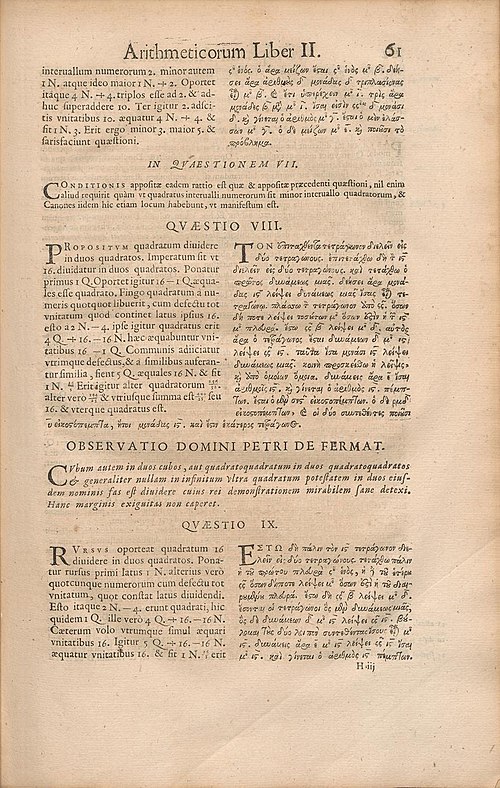
Diophantus' Arithmetica
Diophantus writes Arithmetica, a treatise on solving polynomial equations, introducing syncopated algebra. #math #algebra
830 CE
Al-Khwarizmi's Al-Jabr
Al-Khwarizmi writes 'The Compendious Book on Calculation by Completion and Balancing', introducing systematic linear and quadratic equations. #math #algebra
Al-Khwarizmi's Al-Jabr By Zarateman - Own work, CC0, https://commons.wikimedia.org/w/index.php?curid=162213187
1070 CE
Omar Khayyam's Cubic Equations
Omar Khayyam classifies cubic equations and solves them geometrically using conic sections. #math #algebra
Omar Khayyam's Cubic Equations By Alireza Javaheri - https://web.archive.org/web/20161024154356/http://www.panoramio.com/photo/85093358, CC BY 3.0, https://commons.wikimedia.org/w/index.php?curid=55909539
1202 CE
Fibonacci's Liber Abaci
Fibonacci introduces Hindu-Arabic numerals and algebraic methods to Europe, including the Fibonacci sequence. #math #history
Fibonacci's Liber Abaci By Unknown author, Public domain, https://commons.wikimedia.org/w/index.php?curid=720501
1545 CE
Cardano's Ars Magna
Gerolamo Cardano publishes Ars Magna, containing solutions to cubic and quartic equations, a milestone in algebra. #math #algebra )
1572 CE
Bombelli's Algebra
Rafael Bombelli introduces complex numbers in his Algebra, advancing polynomial equation theory. #math #algebra
Bombelli's Algebra By Unknown author - Book printed by editor Giovanni Rossi, Public domain, https://commons.wikimedia.org/w/index.php?curid=1591687
1637 CE
Descartes' La Géométrie
René Descartes links algebra and geometry, introducing Cartesian coordinates and polynomial notation. #math #geometry
Descartes' La Géométrie By Original uploader was User:Caton at [1] - Originally from fr.wikipedia; description page is/was here., Public domain, https://commons.wikimedia.org/w/index.php?curid=1379032
1682 CE
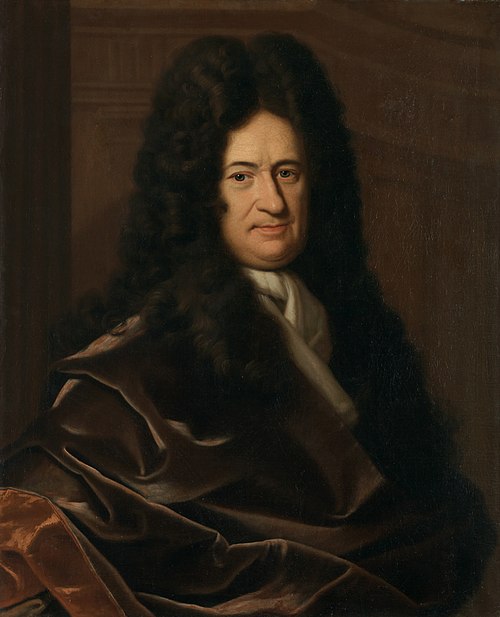
Leibniz's Determinants
Gottfried Wilhelm Leibniz develops the theory of determinants, a precursor to linear algebra. #math #algebra
Leibniz's Determinants By Christoph Bernhard Francke - Herzog Anton Ulrich-Museum, online, Public domain, https://commons.wikimedia.org/w/index.php?curid=53159699
1770 CE
Lagrange's Reflections on Equations
Joseph-Louis Lagrange analyzes polynomial equations using permutations, laying groundwork for group theory. #math #grouptheory
Lagrange's Reflections on Equations By Unknown author - File:Joseph_Louis_Lagrange.jpg, CC0, https://commons.wikimedia.org/w/index.php?curid=155608232
1799 CE
Gauss's Disquisitiones Arithmeticae
Carl Friedrich Gauss publishes Disquisitiones Arithmeticae, founding modern number theory and introducing modular arithmetic. #math #numbertheory
Gauss's Disquisitiones Arithmeticae By Unknown author, Public domain, https://commons.wikimedia.org/w/index.php?curid=641724
1824 CE
Abel-Ruffini Impossibility Theorem
Niels Henrik Abel proves that general quintic equations cannot be solved by radicals, a key result in algebra. #math #algebra
1832 CE
Galois Theory
Évariste Galois develops Galois theory, linking field theory and group theory to solve polynomial equations. #math #grouptheory
Galois Theory By Unknown author - Iyanaga, Shokichi, "ガロアの時代 ガロアの数学 第一部 時代篇" , Springer-Verlag Tokyo, 1999 http://www.win.tue.nl/~aeb/at/GaloisCorrespondence.html, Public domain, https://commons.wikimedia.org/w/index.php?curid=103351
1843 CE
Hamilton's Quaternions
William Rowan Hamilton discovers quaternions, a non-commutative division algebra, expanding algebraic structures. #math #algebra
Hamilton's Quaternions By Cmglee - Own work, CC BY-SA 4.0, https://commons.wikimedia.org/w/index.php?curid=145997978
1844 CE
Grassmann's Ausdehnungslehre
Hermann Grassmann publishes Die lineale Ausdehnungslehre, introducing vector spaces and exterior algebra. #math #linearalgebra
Grassmann's Ausdehnungslehre By Unknown author - From the beginning of vol. 1 of Grassmann's collected works (1894), Public domain, https://commons.wikimedia.org/w/index.php?curid=174414110
1847 CE
Boole's The Mathematical Analysis of Logic
George Boole develops Boolean algebra, linking logic and algebra. #math #logic
Boole's The Mathematical Analysis of Logic By Unknown author - The Illustrated London News, 21 January 1865, Public domain, https://commons.wikimedia.org/w/index.php?curid=39762976
1854 CE
Cayley's Abstract Group Definition
Arthur Cayley gives the first abstract definition of a group, formalizing group theory. #math #grouptheory
Cayley's Abstract Group Definition By Herbert Beraud (1845–1896) - http://www-groups.dcs.st-and.ac.uk/~history/PictDisplay/Cayley.html, Public domain, https://commons.wikimedia.org/w/index.php?curid=904674
1858 CE
Cayley-Hamilton Theorem
Arthur Cayley and William Rowan Hamilton independently prove that every square matrix satisfies its own characteristic polynomial. #math #linearalgebra
1870 CE
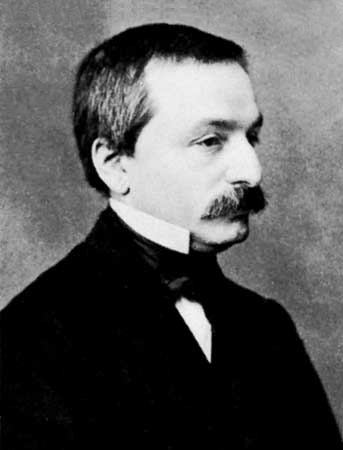
Kronecker's Theorem on Abelian Groups
Leopold Kronecker proves the fundamental theorem of finite abelian groups. #math #grouptheory
Kronecker's Theorem on Abelian Groups By Unknown author - http://www.britannica.com/EBchecked/media/28346/Kronecker-1865, Public domain, https://commons.wikimedia.org/w/index.php?curid=33753789
1872 CE
Klein's Erlangen Program
Felix Klein proposes the Erlangen Program, classifying geometries via group theory. #math #geometry
Klein's Erlangen Program By Unknown author, Public domain, https://commons.wikimedia.org/w/index.php?curid=38617
1874 CE
Lie's Continuous Groups
Sophus Lie develops the theory of continuous groups (Lie groups), linking algebra and differential equations. #math #liegroups
Lie's Continuous Groups By L. Szaciński (Christiania) - Flickr: Portrett av Sophus Lie, 1896, No restrictions, https://commons.wikimedia.org/w/index.php?curid=64917266
1882 CE
Dedekind's Ideal Theory
Richard Dedekind introduces ideals in ring theory, generalizing unique factorization. #math #ringtheory
Dedekind's Ideal Theory By Unknown (Mondadori Publishers) - https://www.gettyimages.co.uk/detail/news-photo/portrait-of-the-german-mathematician-richard-dedekind-1900s-news-photo/141551154, Public domain, https://commons.wikimedia.org/w/index.php?curid=41284791
1893 CE
Frobenius' Group Representations
Ferdinand Georg Frobenius develops representation theory of finite groups. #math #grouptheory
Frobenius' Group Representations By Furfur - (de): Oberwolfach Photo Collection, aus einem Fotoalbum der Mathematischen Gesellschaft (Hamburg)(en): Oberwolfach Photo Collection, from a photo album of the Mathematische Gesellschaft (Hamburg), CC BY-SA 3.0, https://commons.wikimedia.org/w/index.php?curid=59417515
1897 CE
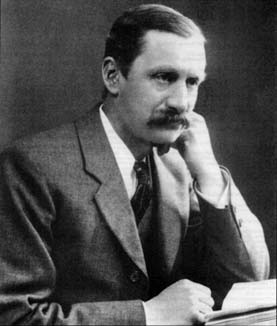
Burnside's Theory of Groups
William Burnside publishes 'Theory of Groups of Finite Order', a seminal text. #math #grouptheory
Burnside's Theory of Groups By Unknown author, Copyrighted free use, https://commons.wikimedia.org/w/index.php?curid=545215
1900 CE
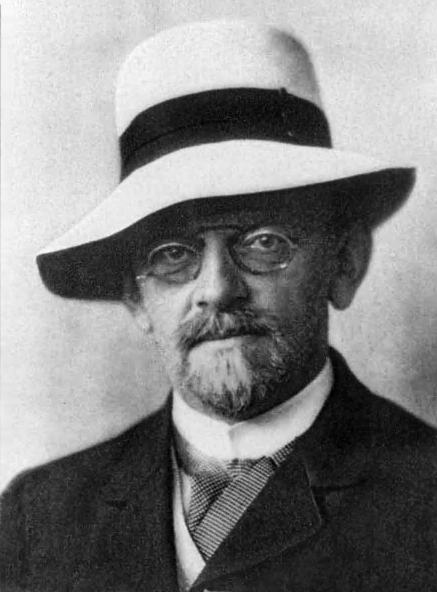
Hilbert's Problems
David Hilbert presents 23 problems, including the classification of finite simple groups and algebraic number theory. #math #history
Hilbert's Problems By Unknown author - Possibly Reid, Constance (1970) Hilbert, Berlin, Heidelberg: Springer Berlin Heidelberg Imprint Springer, p. 230 ISBN: 978-3-662-27132-2., Public domain, https://commons.wikimedia.org/w/index.php?curid=36302
1905 CE
Wedderburn's Little Theorem
Joseph Wedderburn proves that every finite division ring is a field. #math #algebra
1910 CE
Steinitz's Field Theory
Ernst Steinitz publishes 'Algebraische Theorie der Körper', systematizing field theory. #math #algebra
Steinitz's Field Theory By Ar2r4alll - Own work, CC BY 3.0, https://commons.wikimedia.org/w/index.php?curid=8545862
1921 CE
Noether's Ideal Theory
Emmy Noether publishes 'Ideal Theory in Rings', founding modern ring theory. #math #ringtheory
Noether's Ideal Theory By Unknown authorUnknown author Publisher: Mathematical Association of America [3], Brooklyn Museum [4], Agnes Scott College [5], [6] - Emmy Noether (1882-1935), Archived, Public domain, https://commons.wikimedia.org/w/index.php?curid=158126186
1925 CE
Artin's Reciprocity Law
Emil Artin proves the Artin reciprocity law, a cornerstone of class field theory. #math #numbertheory
1928 CE
von Neumann's Continuous Geometry
John von Neumann introduces continuous geometry, a generalization of projective geometry. #math #algebra
1931 CE
Gödel's Incompleteness Theorems
Kurt Gödel proves incompleteness theorems, impacting foundations of mathematics and logic. #math #logic
1933 CE
Haar Measure on Groups
Alfréd Haar introduces Haar measure, enabling integration on locally compact groups. #math #grouptheory
1935 CE
Birkhoff's Lattice Theory
Garrett Birkhoff publishes 'Lattice Theory', establishing lattice theory as a branch of algebra. #math #algebra
1939 CE
Bourbaki's Éléments de mathématique
The Bourbaki group publishes the first volume, emphasizing structuralist approach to algebra. #math #history
1940 CE
Brauer's Modular Representation Theory
Richard Brauer develops modular representation theory of finite groups. #math #grouptheory
Brauer's Modular Representation Theory By Jacobs, Konrad - https://opc.mfo.de/detail?photo_id=467, CC BY-SA 2.0 de, https://commons.wikimedia.org/w/index.php?curid=7756475
1945 CE
Eilenberg-Mac Lane: Category Theory
Samuel Eilenberg and Saunders Mac Lane introduce categories and functors, revolutionizing algebra. #math #categorytheory
Eilenberg-Mac Lane: Category Theory By User:Cepheus - Own work, based on en:Image:MorphismComposition-01.png, Public domain, https://commons.wikimedia.org/w/index.php?curid=1425613
1955 CE
Cartan's Classification of Simple Lie Groups
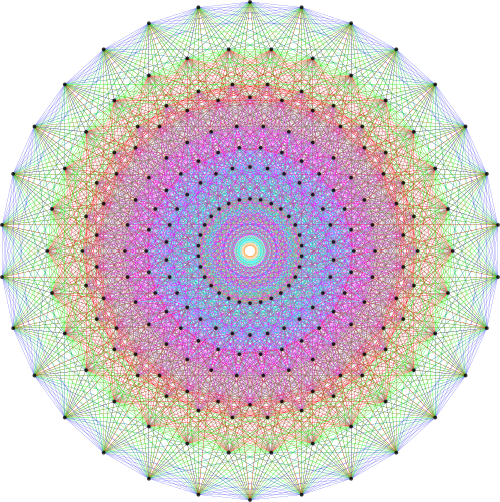
Claude Chevalley and others complete classification of simple Lie groups and algebras. #math #liegroups
Cartan's Classification of Simple Lie Groups By Jgmoxness - Own work, CC BY-SA 3.0, https://commons.wikimedia.org/w/index.php?curid=8893046
1963 CE
Feit-Thompson Theorem
Walter Feit and John G. Thompson prove that every finite group of odd order is solvable, a major step in classifying finite simple groups. #math #grouptheory
1970 CE
Gorenstein's Classification Program
Daniel Gorenstein launches the classification of finite simple groups, completed around 2004. #math #grouptheory
Gorenstein's Classification Program By Original: Jakob.scholbach Vector: Pbroks13 - Own work based on: Cyclic group.png, CC BY-SA 3.0, https://commons.wikimedia.org/w/index.php?curid=4370108
1981 CE
Monster Group Construction
Robert Griess constructs the Monster group, the largest sporadic simple group. #math #grouptheory
1994 CE
Wiles Proves Fermat's Last Theorem
Andrew Wiles proves Fermat's Last Theorem using modular forms and Galois representations. #math #numbertheory
Wiles Proves Fermat's Last Theorem By Unknown author, Public domain, https://commons.wikimedia.org/w/index.php?curid=533640
2002 CE
AKS Primality Test
Manindra Agrawal, Neeraj Kayal, and Nitin Saxena develop a deterministic polynomial-time primality test. #math #computerscience
2004 CE
Classification of Finite Simple Groups Completed
The classification of finite simple groups is declared complete after decades of work. #math #grouptheory