Abstract Algebra & Group Theory: Galois, Abel & Symmetry Structures
Encyclopedia/1. The Cosmos & The Natural World/1. Mathematics & Formal Systems/02. Algebra & Symbolic Systems • Curated by Admin Timeline.sg
Abstract algebra and group theory emerged from the study of polynomial equations, evolving into a foundational branch of mathematics exploring symmetry and algebraic structures. Key milestones include the Abel-Ruffini theorem on quintic insolvability, Galois theory, and Emmy Noether's contributions to ring theory.
Chronological Storyline (42 Milestones)
1799 CE
Ruffini's Proof on Quintic Solvability
Paolo Ruffini publishes an attempted proof that the general quintic equation cannot be solved by radicals, though it contains gaps. This work foreshadows the Abel-Ruffini theorem. #mathematics #history
1801 CE
Gauss Publishes Disquisitiones Arithmeticae
Carl Friedrich Gauss lays foundations for number theory and implicitly uses group-theoretic ideas in the classification of binary quadratic forms. #mathematics #numbertheory
Gauss Publishes Disquisitiones Arithmeticae By Unknown author, Public domain, https://commons.wikimedia.org/w/index.php?curid=641724
1815 CE
Cauchy's Work on Permutation Groups
Augustin-Louis Cauchy studies permutations and presents foundational results that later contribute to group theory. #mathematics #groups
Cauchy's Work on Permutation Groups By Public domain - Library of Congress Prints and Photographs Division. From an illustration in: Das neunzehnte Jahrhundert in Bildnissen / Karl Werckmeister, ed. Berlin : Kunstverlag der photographische gesellschaft, 1840, vol. V, no. 581., Public domain, https://commons.wikimedia.org/w/index.php?curid=7059486
1824 CE
Abel Proves Quintic Unsolvability
Niels Henrik Abel provides a rigorous proof that the general quintic equation cannot be solved by radicals, settling a long-standing problem. #mathematics #algebra
1830 CE
Galois Develops Theory of Equations
Évariste Galois writes his first memoir on the solvability of polynomial equations, introducing the concept of a group and field extensions. #mathematics #galoistheory
Galois Develops Theory of Equations By Unknown author - Iyanaga, Shokichi, "ガロアの時代 ガロアの数学 第一部 時代篇" , Springer-Verlag Tokyo, 1999 http://www.win.tue.nl/~aeb/at/GaloisCorrespondence.html, Public domain, https://commons.wikimedia.org/w/index.php?curid=103351
May 31, 1832 CE
Galois's Death and Posthumous Legacy
Évariste Galois dies in a duel; his groundbreaking manuscripts on group theory and Galois theory are later published by Joseph Liouville. #mathematics #history
Oct 16, 1843 CE
Hamilton Discovers Quaternions
William Rowan Hamilton invents quaternions, a non-commutative algebraic system that influences later algebra and geometry. #mathematics #algebra
Hamilton Discovers Quaternions By Cmglee - Own work, CC BY-SA 4.0, https://commons.wikimedia.org/w/index.php?curid=145997978
1846 CE
Liouville Publishes Galois's Works
Joseph Liouville publishes Galois's manuscripts in his journal, bringing Galois's insights to the mathematical community. #mathematics #history
Liouville Publishes Galois's Works By Marie Liouville - https://www.lajauneetlarouge.com/le-college-de-france-et-les-x-au-xixe-siecle-le-savant-et-le-politique/, Public domain, https://commons.wikimedia.org/w/index.php?curid=183132639
1854 CE
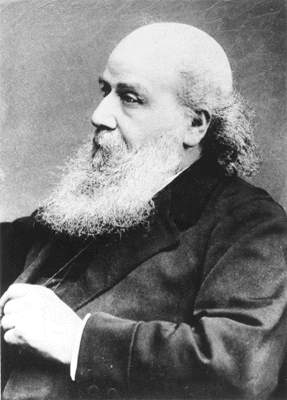
Cayley Defines Abstract Group
Arthur Cayley gives the first abstract definition of a group, moving beyond permutation groups. #mathematics #grouptheory
Cayley Defines Abstract Group By Herbert Beraud (1845–1896) - http://www-groups.dcs.st-and.ac.uk/~history/PictDisplay/Cayley.html, Public domain, https://commons.wikimedia.org/w/index.php?curid=904674
1858 CE
Cayley Introduces Matrix Notation
Arthur Cayley formalizes matrix multiplication and notation, laying groundwork for matrix theory and linear algebra. #mathematics #algebra )
Cayley Introduces Matrix Notation By Mavaddat - Own work, CC BY-SA 4.0, https://commons.wikimedia.org/w/index.php?curid=126575964
1870 CE
Jordan's Traité des Substitutions
Camille Jordan publishes a comprehensive treatise on permutation groups, influencing later group theory and Galois theory. #mathematics #grouptheory
Jordan's Traité des Substitutions By Eugène Pirou - Archivio storico dell'Accademia delle Scienze - Catalogo digitale, Public domain, https://commons.wikimedia.org/w/index.php?curid=106265667
1872 CE
Dedekink Introduces Ideals
Richard Dedekind develops the theory of ideals in rings, a cornerstone of modern algebra. #mathematics #algebra
Dedekink Introduces Ideals By Unknown (Mondadori Publishers) - https://www.gettyimages.co.uk/detail/news-photo/portrait-of-the-german-mathematician-richard-dedekind-1900s-news-photo/141551154, Public domain, https://commons.wikimedia.org/w/index.php?curid=41284791
1872 CE
Klein's Erlangen Program
Felix Klein proposes that geometries be classified by their underlying symmetry groups, linking group theory to geometry. #mathematics #geometry
Klein's Erlangen Program By Unknown author, Public domain, https://commons.wikimedia.org/w/index.php?curid=38617
1873 CE
Lie's Theory of Continuous Groups
Sophus Lie begins developing the theory of continuous transformation groups (Lie groups), essential in geometry and physics. #mathematics #liegroups
Lie's Theory of Continuous Groups By L. Szaciński (Christiania) - Flickr: Portrett av Sophus Lie, 1896, No restrictions, https://commons.wikimedia.org/w/index.php?curid=64917266
1878 CE
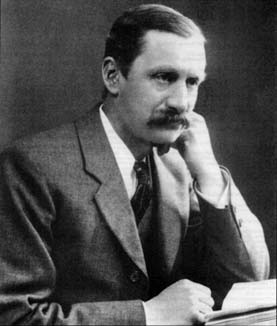
Sylvester's Invariant Theory
James Joseph Sylvester advances the theory of invariants and matrix algebra, coining the term 'matrix'. #mathematics #algebra
Sylvester's Invariant Theory By Unknown author - from:http://en.wikipedia.org/wiki/Image:Untitled04.jpg, Public domain, https://commons.wikimedia.org/w/index.php?curid=268041
1882 CE
von Dyck's Abstract Group Definition
Walther von Dyck gives a purely abstract definition of a group using generators and relations. #mathematics #grouptheory
von Dyck's Abstract Group Definition By Unknown author - MacTutor History of Mathematics: http://www-history.mcs.st-andrews.ac.uk/PictDisplay/Von_Dyck.html, Public domain, https://commons.wikimedia.org/w/index.php?curid=69894344
1884 CE
Klein's Lectures on the Icosahedron
Felix Klein publishes 'Lectures on the Icosahedron', linking symmetries of solids to Galois theory and modular forms. #mathematics #symmetry
Klein's Lectures on the Icosahedron By Gebruder Noelle (m. 1917, attivo a Gottingen) - Archivio storico dell'Accademia delle Scienze - Catalogo digitale, Public domain, https://commons.wikimedia.org/w/index.php?curid=105609901
1888 CE
Killing Classifies Simple Lie Algebras
Wilhelm Killing classifies simple Lie algebras over complex numbers, a monumental achievement in algebra. #mathematics #liealgebras
Killing Classifies Simple Lie Algebras By Unknown author - http://www-history.mcs.st-andrews.ac.uk/Mathematicians/Killing.html, Public domain, https://commons.wikimedia.org/w/index.php?curid=26763585
1890 CE
Hölder's Work on Simple Groups
Otto Hölder introduces the concept of simple groups and studies their role in finite group theory. #mathematics #grouptheory
Hölder's Work on Simple Groups By Archiv Universität Leipzig, Public domain, https://commons.wikimedia.org/w/index.php?curid=9110118
1897 CE
Burnside's Theory of Finite Groups
William Burnside publishes his influential book 'Theory of Groups of Finite Order', a comprehensive text on group theory. #mathematics #grouptheory
Burnside's Theory of Finite Groups By Unknown author, Copyrighted free use, https://commons.wikimedia.org/w/index.php?curid=545215
1898 CE
Frobenius Creates Representation Theory
Georg Frobenius develops character theory for finite groups, launching representation theory. #mathematics #representationtheory
Frobenius Creates Representation Theory By Furfur - (de): Oberwolfach Photo Collection, aus einem Fotoalbum der Mathematischen Gesellschaft (Hamburg)(en): Oberwolfach Photo Collection, from a photo album of the Mathematische Gesellschaft (Hamburg), CC BY-SA 3.0, https://commons.wikimedia.org/w/index.php?curid=59417515
1900 CE
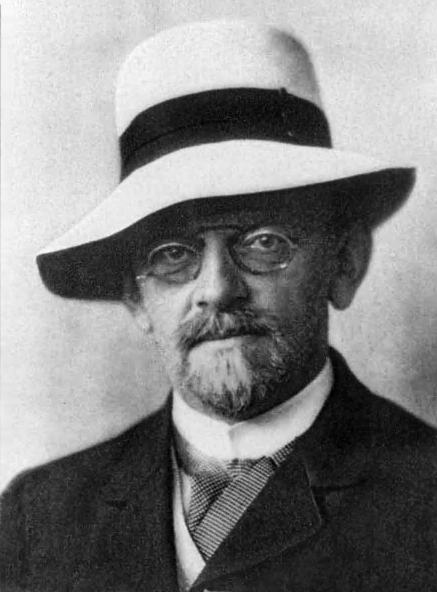
Hilbert's Problems Include Group Theory
David Hilbert presents his famous list of problems; several involve group theory and algebra, stimulating research. #mathematics #history
Hilbert's Problems Include Group Theory By Unknown author - Possibly Reid, Constance (1970) Hilbert, Berlin, Heidelberg: Springer Berlin Heidelberg Imprint Springer, p. 230 ISBN: 978-3-662-27132-2., Public domain, https://commons.wikimedia.org/w/index.php?curid=36302
1905 CE
Wedderburn's Finite Division Algebras
Joseph Wedderburn proves that every finite division ring is a field, a cornerstone of ring theory. #mathematics #algebra
1910 CE
Steinitz's Abstract Field Theory
Ernst Steinitz publishes a seminal paper on the abstract theory of fields, including algebraic closure and transcendence bases. #mathematics #algebra
Steinitz's Abstract Field Theory By Ar2r4alll - Own work, CC BY 3.0, https://commons.wikimedia.org/w/index.php?curid=8545862
1913 CE
Weyl's Representation Theory
Hermann Weyl publishes 'The Theory of Groups and Quantum Mechanics' and advances representation theory of compact groups. #mathematics #physics
Weyl's Representation Theory By ETH Zürich - ETH-Bibliothek Zürich, Bildarchiv, CC BY-SA 3.0, https://commons.wikimedia.org/w/index.php?curid=8098412
1915 CE
Noether's Theorem on Symmetries
Emmy Noether proves that every continuous symmetry of a physical system corresponds to a conservation law, linking group theory to physics. #mathematics #physics #womenscientists
Noether's Theorem on Symmetries By Emmy Noether - "Invariante Variationsprobleme" (Nachrichten von der Gesellschaft der Wissenschaften zu Göttingen, Mathematisch-Physikalische Klasse 1918 (1918): 235-257. <http://eudml.org/doc/59024>), Public domain, https://commons.wikimedia.org/w/index.php?curid=69398536
1920 CE
Takagi's Class Field Theory
Teiji Takagi establishes class field theory, generalizing Kronecker's and using Galois theory to study abelian extensions of number fields. #mathematics #numbertheory
Takagi's Class Field Theory By Shigeru Tamura - 文藝春秋新社 現代日本の百人(1953年刊), Public domain, https://commons.wikimedia.org/w/index.php?curid=46916329
1921 CE
Noether's Ideal Theory
Emmy Noether publishes 'Idealtheorie in Ringbereichen', founding commutative algebra and the theory of Noetherian rings. #mathematics #algebra
Noether's Ideal Theory By Unknown authorUnknown author Publisher: Mathematical Association of America [3], Brooklyn Museum [4], Agnes Scott College [5], [6] - Emmy Noether (1882-1935), Archived, Public domain, https://commons.wikimedia.org/w/index.php?curid=158126186
1924 CE
Artin and Schreier's Real Fields
Emil Artin and Otto Schreier develop the theory of formally real fields and real closed fields, important in Galois theory. #mathematics #algebra
Artin and Schreier's Real Fields By Konrad Jacobs, Erlangen - Mathematisches Forschungsinstitut Oberwolfach, https://opc.mfo.de/detail?photoID=116, CC BY-SA 2.0 de, https://commons.wikimedia.org/w/index.php?curid=3898471
1926 CE
Artin's Reciprocity Law
Emil Artin proves the reciprocity law for abelian extensions, a key result in class field theory. #mathematics #numbertheory
1927 CE
Noether and Artin on Noncommutative Algebra
Emmy Noether and Emil Artin collaborate on the structure of noncommutative algebras, leading to the Artin–Wedderburn theorem. #mathematics #algebra
1930 CE
van der Waerden's Moderne Algebra
Bartel Leendert van der Waerden publishes 'Moderne Algebra', a textbook that codifies abstract algebra based on lectures by Noether and Artin. #mathematics #textbook
van der Waerden's Moderne Algebra By Bartel Leendert van der Waerden - https://archive.org/details/modernalgebra02waer/page/n5/mode/2up, Public domain, https://commons.wikimedia.org/w/index.php?curid=151846892
1931 CE
Krull's Principal Ideal Theorem
Wolfgang Krull proves the principal ideal theorem for Noetherian rings, a fundamental result in commutative algebra. #mathematics #algebra
1933 CE
Jacobson's Radical and Ring Structure
Nathan Jacobson introduces the Jacobson radical and develops the structure theory of rings. #mathematics #algebra
Jacobson's Radical and Ring Structure By Konrad Jacobs, Erlangen - https://opc.mfo.de/detail?photo_id=1941, CC BY-SA 2.0 de, https://commons.wikimedia.org/w/index.php?curid=11192158
1935 CE
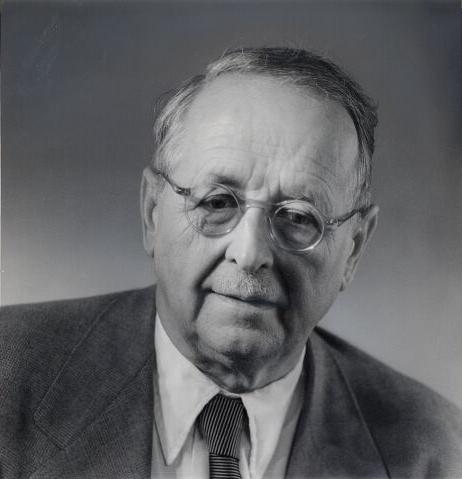
Brauer's Modular Representations
Richard Brauer pioneers modular representation theory of finite groups, using group characters in positive characteristic. #mathematics #grouptheory
Brauer's Modular Representations By Jacobs, Konrad - https://opc.mfo.de/detail?photo_id=467, CC BY-SA 2.0 de, https://commons.wikimedia.org/w/index.php?curid=7756475
1940 CE
Hall's Counting Theorem
Philip Hall publishes his counting theorem for finite groups, a key tool in group theory. #mathematics #grouptheory
Hall's Counting Theorem By Konrad Jacobs, Erlangen, Copyright is MFO - Mathematisches Forschungsinstitut Oberwolfach,https://opc.mfo.de/detail?photo_id=1531, CC BY-SA 2.0 de, https://commons.wikimedia.org/w/index.php?curid=12364673
1945 CE
Eilenberg and Mac Lane Found Homological Algebra
Samuel Eilenberg and Saunders Mac Lane develop homological algebra using derived functors, applying it to group theory and topology. #mathematics #homologicalalgebra
Eilenberg and Mac Lane Found Homological Algebra By IkamusumeFan - Own work, CC BY-SA 4.0, https://commons.wikimedia.org/w/index.php?curid=36817104
1950 CE
Chevalley's Algebraic Groups
Claude Chevalley constructs Chevalley groups, giving a uniform description of finite simple groups of Lie type. #mathematics #grouptheory
Chevalley's Algebraic Groups By Original: Jakob.scholbach Vector: Pbroks13 - Own work based on: Cyclic group.png, CC BY-SA 3.0, https://commons.wikimedia.org/w/index.php?curid=4370108
1952 CE
Pontryagin's Duality for Locally Compact Groups
Lev Pontryagin establishes Pontryagin duality, a fundamental result in harmonic analysis and topological group theory. #mathematics #topology
Pontryagin's Duality for Locally Compact Groups By Melchoir - Own work, CC BY-SA 3.0, https://commons.wikimedia.org/w/index.php?curid=18406119
1955 CE
Iwasawa's Theory of p-adic Lie Groups
Kenkichi Iwasawa initiates Iwasawa theory, connecting p-adic Lie groups with number theory. #mathematics #numbertheory
1958 CE
Serre's GAGA Correspondence
Jean-Pierre Serre proves the GAGA (Géométrie Algébrique et Géométrie Analytique) correspondence, linking algebraic geometry and analytic geometry via sheaf theory. #mathematics #algebraicgeometry
1960 CE
Serre's Lectures on Lie Algebras
Jean-Pierre Serre publishes 'Lie Algebras and Lie Groups', a foundational text combining algebra and geometry. #mathematics #liealgebras
Serre's Lectures on Lie Algebras By Jgmoxness - Own work, CC BY-SA 3.0, https://commons.wikimedia.org/w/index.php?curid=8893046