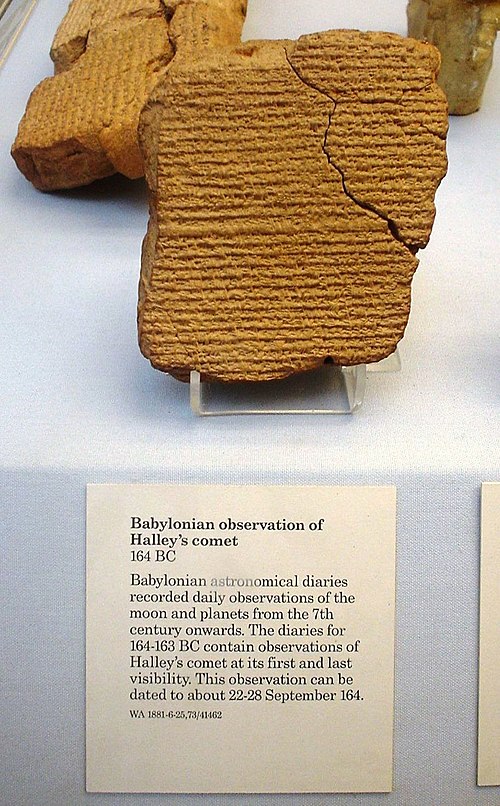
Babylonian astronomers systematically recorded planetary movements, laying foundational observational methods that later influenced Greek and Islamic astronomy and humanity's understanding of the cosmos. · Wikipedia: https://en.wikipedia.org/wiki/Babylonian_astronomy
A Babylonian tablet recording Halley's comet during an appearance in 164 BC. At the British Museum in London By The original uploader was Linguica at English Wikipedia. - Transferred from en.wikipedia to Commons by Calliopejen1 using CommonsHelper., Public domain, https://commons.wikimedia.org/w/index.php?curid=17674029
300 BCE
Aristarchus proposes heliocentrism
Greek astronomer Aristarchus of Samos proposed that the Earth revolves around the Sun, an early radical repositioning of humanity's place in the cosmos that prefigured modern astronomy. Source — Wikipedia:
250 BCE
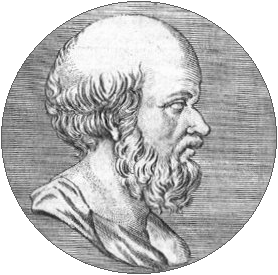
Eratosthenes measures Earth's circumference
Eratosthenes calculated Earth's circumference with remarkable accuracy, demonstrating that empirical geography could quantify the scale of the human world from which space would later be contemplated. · Wikipedia: https://en.wikipedia.org/wiki/Eratosthenes
Eratosthenes measures Earth's circumference By Unknown author, Public domain, https://commons.wikimedia.org/w/index.php?curid=494949
150 CE
Ptolemy's geocentric model codified
Claudius Ptolemy's Almagest codified a geocentric model of the universe that dominated Western and Islamic astronomy for over 1,400 years, shaping conceptions of humanity's cosmic position. · Wikipedia: https://en.wikipedia.org/wiki/Ptolemy
Ptolemy with a armillary sphere model. With a large version he claimed his solstice observations. By Justus van Gent / Pedro Berruguete - Public domainPublic domainfalsefalse This work is in the public domain in its country of origin and other countries and areas where the copyright term is the author's life plus 100 years or fewer. You must also include a United States public domain tag to indicate why this work is in the public domain in the United States. This file has been identified as being free of known restrictions under copyright law, including all related and neighboring rights. https://creativecommons.org/publicdomain/mark/1.0/PDMCreative Commons Public Domain Mark 1.0falsefalse, Public domain, https://commons.wikimedia.org/w/index.php?curid=16043714
850 CE
Al-Kindi and Islamic cosmology
Arab philosopher Al-Kindi and successors advanced systematic inquiry into the nature of the cosmos, integrating Aristotelian and Neoplatonic thought in ways that shaped later medieval and Renaissance cosmology. Source — Wikipedia:
An Iraqi postage stamp of 6 money issued in 1962 on the occasion of the millennium anniversary of the founding of the city of Baghdad and in memory of the philosopher Yacoub bin Ishaq Al-Kindi. By Iraqi Post - Personal collection, Public domain, https://commons.wikimedia.org/w/index.php?curid=91832934
1543 CE
Copernicus publishes heliocentric theory
Nicolaus Copernicus published De revolutionibus, placing the Sun at the center of the universe and fundamentally displacing Earth—and humanity—from the cosmic center. · Wikipedia: https://en.wikipedia.org/wiki/Nicolaus_Copernicus
Nicolaus Copernicus portrait from Town Hall in Toruń - 1580) By Unknown author - http://www.frombork.art.pl/Ang10.htm https://www.welt.de/img/kultur/mobile152954235/1212503297-ci102l-w1024/Kopernikus-Gemaelde-in-Krakau.jpg https://muzeum.torun.pl/wp-content/uploads/2023/03/Portert-Mikolaja-Kopernika-MOT.jpg, Public domain, https://commons.wikimedia.org/w/index.php?curid=147956893
1600 CE
Giordano Bruno executed
Italian philosopher Giordano Bruno was burned at the stake for, among other heresies, proposing an infinite universe filled with countless inhabited worlds—a radical early multiverse and pluralism thesis. · Wikipedia: https://en.wikipedia.org/wiki/Giordano_Bruno
Portrait of Giordano Bruno Rare Books Keywords: Giordano Bruno By Unknown author - https://wellcomeimages.org/indexplus/obf_images/bc/3d/265d1be073eb34224006d0d35b02.jpg Gallery: https://wellcomeimages.org/indexplus/image/L0015152.html Wellcome Collection gallery (2018-04-01): https://wellcomecollection.org/works/qgt4dt8k CC-BY-4.0, CC BY 4.0, https://commons.wikimedia.org/w/index.php?curid=133537203
1610 CE
Galileo discovers Jupiter's moons
Galileo Galilei's telescopic discovery of Jupiter's moons proved that not all celestial bodies orbit Earth, supporting heliocentrism and opening the question of other worlds. Source — Wikipedia:
Galileo Galilei (1564-1642) A half-length portrait, in old age, of the Italian mathematician, philosopher and astronomer, who was appointed court mathematician to the Medici dukes of Tuscany at Florence in 1610. He is dressed in black, wears a white beard and is seated in a chair holding a telescope in his right hand. His left hand rests on the arm of the chair and he wears a ring with a clear stone on his fourth finger. He faces forward towards the viewer. Galileo, though not first inventor of the refracting telescope in 1609, enhanced its power, which enabled him to see that the Moon had mountains and that Jupiter had satellites. His championship of the Copernican (Sun-centred) planetary system brought him into serious conflict with the Roman Catholic church, which forced him to make a public recantation and put him under restriction in later life, as noted by the poet John Milton, who met him in Florence in 1638 and recorded in his 'Areopagitica': 'There it was I found the famous Galileo, grown old, a prisoner to the Inquisition for thinking in astronomy otherwise than the Franciscan and Dominican licensers thought.' The artist was a Flemish painter and draughtsman who worked in Florence as court painter to the Medici. He was considered the foremost portrait painter in Italy, with a strong interest in Venetian Renaissance art. This is one of the last portraits of Galileo and several versions and/or copies were made. This one, painted for the Florentine Pandolfini family, may be the original, though there are other contenders. The principal evidence is the inscription on the back of the original canvas: 'No 51. / Galileo / da Giusto Sustermans / della Casa Pandolfini / a Firenza', while an old English label on the stretcher adds that it is 'the best known' portrait and 'That in the Pitti Palace is without hands and has all the appearances of a copy'. The longstanding Pitti version (no. 2397), which is otherwise the best known and often assumed to be the original is cut down all round, just showing the rim of the telescope at the bottom. NMM inspection in 1971 also concluded it was more likely to be a copy. The present painting has a near-intact provenance since 1833. It was purchased in Florence on 26 April that year for 534 pauli (£12 10s) including its fine Florentine frame, from the Marchesa Nimini: its previous history is not known, or whether the Marchesa had a family connection with the Pandolfini. The buyer was a long-resident English collector, the Revd John Sanford (d. 1855). He returned with his large collection to England in 1837 and subsequently put much on the market. The Galileo appears as no.51 (as added above the Italian inscription) in an 1838 printed catalogue of Yates, the dealer, with a reserve of £200 but it did not sell. It was exhibited at the British Institution in 1849 and passed with Sanford's remaining collection to his only daughter, who in 1844 married Frederick Methuen (later second Lord Methuen) of Corsham Court, Wiltshire, the whole becoming part of the larger Methuen collection. It was sold from Corsham at Christie's on 14 May 1920 (lot 38, for 58 guineas), the buyer being the 'Art Collections Association' and probably quickly passed to George H. Gabb, though exactly how is unknown. His collection - mainly of scientific instruments - was purchased and presented to the Museum by Sir James Caird early in 1937. At another Christie’s sale in 1920 he also purchased directly, again for 58 guineas, a pear-wood bust of Galileo from the Sanford holdings at Corsham (SCU0023) and was the immediate source of both the Museum’s other two Galileo oil portraits (BHC2699 and BHC2701), and another bust of him in bronze (SCU0022). The good 19th-century catalogues of the Sanford and Methuen collections are still at Corsham and the Sustermans is no 18. in Sanford’s manuscript catalogue raisonnee of 1847. Like much of his collection it was also recorded in a watercolour copy, also still at Corsham, made in Florence about 1835 by Giovanni Gozzini. The oil features in all three printed catalogues of the Methuen collection (c.1876-1903) and hung near the bust in the lower corridor at Corsham for over 45 years preceding its sale. Waagen, who also saw it in the house, briefly described the Sanford collection origins and noted the painting as 'From the Pandolfini family, for whom it was painted. Of lively conception and broad treatment'. ('Galleries and Cabinets of Art in Great Britain', 1857, p. 397). A more complete account is Benedict Nicolson’s well-illustrated 'The Sanford Collection', in the ‘Burlington Magazine’ (vol. 97, no. 628, July 1955, pp. 207-14), though neither he nor Corsham then knew where the painting was and the image included is from the Gozzini watercolour. NMM notes made in Florence in 1971 mention the Pitti having recently acquired another version of BHC2700 from the Rosselli del Turco collection (only then seen as a photograph in the German Art Institute there), but no further mention of this has been found and it may be a misunderstanding: a third was also noted as existing in Frankfurt. A fourth (exhibited at the B.I. in 1854) was in the Lansdowne sale at Christie's on 7 March 1930 and may be the same as that recorded on the RKD database as again passing through Christie's on 7 May 1995 though, curiously, also from the 'Marquis of Lansdowne, Meikleour House'. The last appears to be early and good, with a fragmentary Latin inscription. Nicholson in 1955 also noted one in the Torre al Gallo, Florence, but the present status and relationship of all these is not yet known to the Museum. The Bodleian Library, Oxford, also has an early copy (omitting the left hand) presented by Galileo's disciple, Vincenzo Viviani, in 1661. Confusion is not helped by the fact that two separate Sustermans portraits of Galileo are sometimes treated as versions of each other, whereas they are somewhat different. The earlier one of 1636, in the Uffizi and of which BHC2701 is a copy, is more dynamic in pose, and probably shows him standing, compared to this later seated ‘Pandofini’ one. For the most modern Italian commentary see Federico Tognoni in 'Iconografia Galileiana' (Le Opere di Galileo Galilei': Appendice, vol 1, Florence, 2013) in which it is item D22, pp.70-71, as by 'Justus Suttermans(?)'. Galileo Galilei, 1564-1642 By Justus Sustermans - http://collections.rmg.co.uk/collections/objects/14174, Public domain, https://commons.wikimedia.org/w/index.php?curid=62614082
1687 CE
Newton's Principia published
Isaac Newton's Principia Mathematica established universal gravitation and laws of motion, providing the physical framework that made spaceflight theoretically possible. Source — Wikipedia:
Title page of the 1687 first edition of Philosophiae Naturalis Principia Mathematica, by Isaac Newton. PHILOSOPHIÆ NATURALIS PRINCIPIA MATHEMATICA. Autore IS. NEWTON, Trin. Coll. Cantab. Soc. Matheseos Professore Lucasiano, & Societatis Regalis Sodali. IMPRIMATUR. S. PEPYS, Reg. Soc. PRÆSES. Julii 5. 1686. LONDINI, Jussu Societatis Regiæ ac Typis Josephi Streater. Prostat apud plures Bibliopolas. Anno MDCLXXXVII. By The original uploader was Zhaladshar at English Wikisource. - Transferred from en.wikisource to Commons. (previous image from another copy) Internet Archive (current image from the Bern Dibner copy), Public domain, https://commons.wikimedia.org/w/index.php?curid=2681838
1865 CE
Jules Verne's From the Earth to the Moon
French author Jules Verne published a scientifically grounded novel about a lunar voyage, popularizing the idea of space travel and inspiring future rocket pioneers globally. · Wikipedia: https://en.wikipedia.org/wiki/From_the_Earth_to_the_Moon
Jules Verne's From the Earth to the Moon By Unknown author, Public domain, https://commons.wikimedia.org/w/index.php?curid=1522641
1903 CE
Tsiolkovsky's rocket equation
Russian schoolteacher Konstantin Tsiolkovsky published the rocket equation, establishing the mathematical foundation for spaceflight and proposing multi-stage rockets and space colonies. Source — Wikipedia:
Константин Эдуардович Циолковский (1857—1935). Портрет. Изображение ниже колен, голова - анфас. Сидит на скамейке с тростью в правой руке. В сером в широкую полоску пиджаке, тёмных брюках и накинутой на плечи чёрной крылатке. В очках. На паспарту. 1924 (?). г. Калуга. Позитив: 13,5x9,7; 16,3x10,5 (паспарту). Снимок сделан в одном из фотоателье г. Калуги. Оригинал - ГМИК Ф-I-288. Второй экземпляр оригинала - ГМИК Ф-I-537. Первая публикация: журнал "Связь", 1925, № 18, с.14. (информация по каталогу "Фотодокументы о жизни и деятельности К.Э.Циолковского", Калуга, "Золотая аллея", 2004, с.31) By Unknown author - http://21mm.ru/news/lichnost/preziraemyy-za-mechtu-kem-byl-uchenyy-konstantin-tsiolkovskiy-/, Public domain, https://commons.wikimedia.org/w/index.php?curid=93935880
1929 CE
O'Neill colonies conceptualized
Hermann Oberth published influential works on rocketry and space stations, building on earlier ideas that would later inspire Gerard O'Neill's space habitat concepts for permanent orbital civilization. · Wikipedia: https://en.wikipedia.org/wiki/Hermann_Oberth
Hermann Oberth By Unknown (Mondadori Publishers) - http://www.gettyimages.co.uk/detail/news-photo/portrait-of-the-austro-hungarian-born-german-physicist-news-photo/141553137, Public domain, https://commons.wikimedia.org/w/index.php?curid=41220843
Oct 4, 1957 CE
Sputnik 1 launched
The Soviet Union launched Sputnik 1, the first artificial satellite, inaugurating the Space Age and making humanity a spacefaring species for the first time. · Wikipedia: https://en.wikipedia.org/wiki/Sputnik_1
Музей космонавтики и ракетной техники (в Иоанновском равелине Петропавловской крепости). Первый в мире искусственный спутник Земли By Andrey Butko - Own work, CC BY-SA 3.0, https://commons.wikimedia.org/w/index.php?curid=4894894The Sputnik 1 Launch: The First Artificial Satellite To Enter Earth's Orbit | Mach | NBC News
Apr 12, 1961 CE
First human in space
Soviet cosmonaut Yuri Gagarin became the first human to orbit Earth, a milestone in human spaceflight that demonstrated people could survive space travel. Source — Wikipedia:
Ceremonial portrait of the Soviet cosmonaut Yuri Alekseevich Gagarin with awards. By Александр Моклецов / СовИнформБюро - Мигулин С. И. К 80-летию со дня рождения первого космонавта Земли Ю.А. Гагарина. Министерство обороны Российской Федерации., РИА Новости Медиабанк, CC BY 4.0, https://commons.wikimedia.org/w/index.php?curid=187735892
1967 CE
Outer Space Treaty signed
The Outer Space Treaty established that space is the province of all humankind, prohibiting territorial claims and laying governance foundations for future space civilization. · Wikipedia: https://en.wikipedia.org/wiki/Outer_Space_Treaty
Parties to the en:Outer Space Treaty Parties Signatories Non-parties By User:Happenstance, User:Danlaycock et al. - File:Seabed Arms Control Treaty parties.svg, CC BY-SA 2.5, https://commons.wikimedia.org/w/index.php?curid=38680050
Jul 20, 1969 CE
First Moon landing
NASA's Apollo 11 mission placed the first humans on the Moon, a landmark in planetary exploration and a proof of concept for human expansion beyond Earth. · Wikipedia: https://en.wikipedia.org/wiki/Apollo_11
Apollo 11 Hasselblad image from film magazine 40/S - EVA. The image of astronaut Neil Armstrong photographing astronaut Aldrin is clearly seen in the reflections on the helmet visor of astronaut Aldrin. Astronaut Armstrong, the Lunar Module Eagle, and the shadow cast by Aldrin are mirrored in the reflection. Astronaut Aldrin showing boots and suit discoloration caused by adhering lunar soil. By Neil A. Armstrong - https://tothemoon.im-ldi.com/gallery/Apollo/11/7#AS11-40-5903, Public domain, https://commons.wikimedia.org/w/index.php?curid=170640780Apollo 11: Landing on the Moon
1973 CE
Drake's Arecibo Message sent
Frank Drake and colleagues transmitted the Arecibo Message, humanity's first intentional interstellar radio communication, toward globular cluster M13 as a SETI milestone. Source — Wikipedia:
Sep 5, 1977 CE
Voyager Golden Record launched
NASA launched Voyager 1 carrying the Golden Record, a compendium of Earth's sounds and images intended as an interstellar message to possible extraterrestrial civilizations. · Wikipedia: https://en.wikipedia.org/wiki/Voyager_Golden_Record
Flying aboard Voyagers 1 and 2 are identical "golden" records, carrying the story of Earth far into deep space. The 12 inch gold-plated copper discs contain greetings in 60 languages, samples of music from different cultures and eras, and natural and man-made sounds from Earth. They also contain electronic information that an advanced technological civilization could convert into diagrams and photographs. The cover of each gold plated aluminum jacket, designed to protect the record from micrometeorite bombardment, also serves a double purpose in providing the finder a key to playing the record. The explanatory diagram appears on both the inner and outer surfaces of the cover, as the outer diagram will be eroded in time. Currently, both Voyager probes are sailing adrift in the black sea of interstellar space, having left our solar system years ago. By NASA - Great Images in NASA Description, Public domain, https://commons.wikimedia.org/w/index.php?curid=6455682
Apr 12, 1981 CE
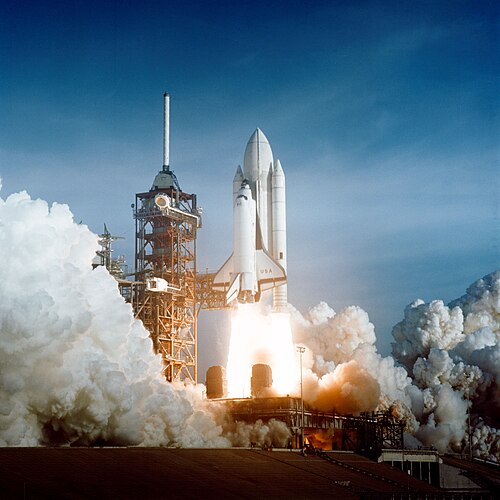
First space shuttle launched
NASA's STS-1 Columbia mission inaugurated the Space Shuttle program, introducing reusable spacecraft that became central to building orbital infrastructure like space stations. · Wikipedia: https://en.wikipedia.org/wiki/STS-1
The April 12 launch at Pad 39A of STS-1, just seconds past 7 a.m., carries astronauts John Young and Robert Crippen into an Earth orbital mission scheduled to last for 54 hours, ending with unpowered landing at Edwards Air Force Base in California. By NASA - https://images.nasa.gov/details/81pc0382 http://grin.hq.nasa.gov/ABSTRACTS/GPN-2000-000650.html on the Wayback Machine at the Wayback Machine http://grin.hq.nasa.gov/IMAGES/LARGE/GPN-2000-000650.jpg on the Wayback Machine at the Wayback Machine, Public domain, https://commons.wikimedia.org/w/index.php?curid=199486
Feb 20, 1986 CE
Mir space station launched
The Soviet Union launched the core module of Mir, the first continuously inhabited long-duration space station, demonstrating the feasibility of sustained human life in orbit. Source — Wikipedia: )
Apr 24, 1990 CE
Hubble Space Telescope deployed
The Hubble Space Telescope was deployed from Discovery, revolutionizing observational astronomy and informing future searches for habitable exoplanets and extraterrestrial life. · Wikipedia: https://en.wikipedia.org/wiki/Hubble_Space_Telescope
en:Hubble Space Telescope as seen from the en:Space Shuttle Columbia on mission en:STS-109. By NASA - http://spaceflight.nasa.gov/gallery/images/shuttle/sts-109/hires/s109e5700.jpg http://spaceflight.nasa.gov/gallery/images/shuttle/sts-109/html/sts109-730-027.html Originally from en.wikipedia; description page is/was here., Public domain, https://commons.wikimedia.org/w/index.php?curid=20693341990: STS-31 Discovery, Hubble Space Telescope (NASA)
Nov 20, 1998 CE
ISS first module launched
Russia launched Zarya, the first module of the International Space Station, beginning the largest collaborative orbital infrastructure project in history and a model for future governance. Source — Wikipedia:
The station pictured from the SpaceX Crew Dragon jsc2021e064211_alt (Dec. 8, 2021) --- This mosaic depicts the International Space Station pictured from the SpaceX Crew Dragon Endeavour during a fly around of the orbiting lab that took place following its undocking from the Harmony module’s space-facing port on Nov. 8, 2021. By NASA - https://www.flickr.com/photos/nasa2explore/51749924967/in/photostream/; see also https://images.nasa.gov/details-jsc2021e064211_alt, Public domain, https://commons.wikimedia.org/w/index.php?curid=113438072
Oct 15, 2003 CE
China's first taikonaut in space
China launched Yang Liwei aboard Shenzhou 5, becoming the third nation to independently send a human into space and signaling its emergence as a major spacefaring power. Source — Wikipedia:
Shenzhou-5 spacecraft mockup and parachute displayed at the National Museum of China. By Shujianyang - Own work, CC BY-SA 4.0, https://commons.wikimedia.org/w/index.php?curid=134224775
2008 CE
Mars Reconnaissance Orbiter confirms water ice
NASA's Mars Reconnaissance Orbiter confirmed subsurface water ice on Mars, strengthening the case for future human colonization by identifying a critical in-situ resource. · Wikipedia: https://en.wikipedia.org/wiki/Mars_Reconnaissance_Orbiter
This artist's concept of NASA's Mars Reconnaissance Orbiter features the spacecraft's main bus facing down, toward the red planet. The large silver circular feature above the spacecraft bus is the high-gain antenna, the spacecraft's main means of communicating with Earth. The long, thin pole behind the bus is the antenna for the Shallow Subsurface Radar instrument (SHARAD). Seeking liquid or frozen water, this instrument will probe the subsurface using radar waves at frequencies of 15 to 25 megahertz, "seeing" in the first few hundred feet (up to 1 kilometer) of Mars' crust. The large instrument covered in black thermal blanketing in the center is the High Resolution Imaging Science Experiment camera (HiRISE). It will provide the highest-resolution images ever taken from Mars orbit. The Electra telecommunications package is the gold-colored instrument directly left of the high-resolution camera. It will act as a communications relay and navigation aid for Mars spacecraft. To the right of the high-resolution camera is the Context Imager (CTX). By NASA/JPL/Corby Waste - http://photojournal.jpl.nasa.gov/catalog/PIA07245 (image link), Public domain, https://commons.wikimedia.org/w/index.php?curid=31199077
2013 CE
Mars One colonization proposal
Dutch organization Mars One announced plans for one-way human Mars colonization missions, sparking global debate about the ethics and feasibility of permanent planetary settlement. · Wikipedia: https://en.wikipedia.org/wiki/Mars_One
Sep 24, 2014 CE
India's Mars Orbiter Mission arrives
India's ISRO successfully placed Mangalyaan into Mars orbit on its first attempt, making India the first Asian nation and the fourth space agency to reach Mars at very low cost. Source — Wikipedia:
India's Mars Orbiter Mission spacecraft over Mars. Rendered using a combination of Blender 2.71 with Cycles (Background, Mars) and Autodesk Maya 2015 (spacecraft). Final processing in Adobe Photoshop. By Kevin Gill from Nashua, NH, United States - Mars Orbiter Mission Over Mars, CC BY-SA 2.0, https://commons.wikimedia.org/w/index.php?curid=42599194
Jul 14, 2015 CE
New Horizons flies by Pluto
NASA's New Horizons spacecraft conducted the first flyby of Pluto, extending humanity's reach to the edge of the planetary system and informing future interstellar precursor missions. · Wikipedia: https://en.wikipedia.org/wiki/New_Horizons
A transparent image of the New Horizons spacecraft. By National Aeronautics and Space Administration (NASA), Applied Physics Laboratory - "PEPSSI Instrument Tastes Pluto's Atmosphere" from the Applied Physics Laboratory New Horizons website., Public domain, https://commons.wikimedia.org/w/index.php?curid=41340864
Dec 21, 2015 CE
SpaceX lands first orbital booster
SpaceX successfully landed a Falcon 9 first stage, achieving reusable orbital rocket technology that could dramatically reduce the cost of space access for colonization efforts. Source — Wikipedia:
USA - Texas - Boca Chica - Starbase By Alexander Hatley from Spring, Texas, USA - USA - Texas - Boca Chica - Starbase, CC BY 2.0, https://commons.wikimedia.org/w/index.php?curid=110298635"The Falcon has landed" | Recap of Falcon 9 launch and landing
Apr 12, 2016 CE
Breakthrough Starshot announced
Yuri Milner, Stephen Hawking, and Mark Zuckerberg announced Breakthrough Starshot, a project to develop gram-scale interstellar probes propelled by light sails toward Alpha Centauri at 20% light speed. · Wikipedia: https://en.wikipedia.org/wiki/Breakthrough_Starshot
On 24 August 2016 at 13:00 CEST, ESO hosted a press conference at its Headquarters in Garching, near Munich, Germany. In this picture, Dr. S. Pete Worden gives a speech. By ESO - http://www.eso.org/public/news/eso1629/, CC BY 4.0, https://commons.wikimedia.org/w/index.php?curid=50908360
2016 CE
Breakthrough Listen SETI program launched
Breakthrough Listen, the most comprehensive SETI search to date, began scanning the sky for technosignatures using the Green Bank and Parkes telescopes, backed by $100 million in funding. · Wikipedia: https://en.wikipedia.org/wiki/Breakthrough_Listen
The Robert C. Byrd Green Bank Telescope, a 100 meter diameter radio telescope located in Green Bank, West Virginia, USA. It is the largest fully steerable radio telescope in the world. By Geremia at English Wikipedia - Transferred from en.wikipedia to Commons by Geremia using CommonsHelper., Public domain, https://commons.wikimedia.org/w/index.php?curid=4207232
2018 CE
China's Tiangong program advances
China launched the Tiangong-2 precursor module and announced plans for a permanent space station, reflecting its long-term ambition for sustained human presence in orbit and lunar exploration. Source — Wikipedia:
Drawing of the Tiangong-1. By Tiangong_1_drawing.png: Craigboy derivative work: 70.49.127.65 Vectorized by Waterced, CC BY-SA 3.0, https://commons.wikimedia.org/w/index.php?curid=70263662
Jan 3, 2019 CE
Chang'e 4 lands on Moon's far side
China's Chang'e 4 became the first spacecraft to soft-land on the far side of the Moon, demonstrating capabilities relevant to future lunar surface infrastructure and resource utilization. Source — Wikipedia:
The Chang’e-4 lander imaged by the Yutu-2 rover on the lunar far side. [1] By CSNA/Siyu Zhang/Kevin M. Gill - ChangE-4 - PCAM, CC BY 2.0, https://commons.wikimedia.org/w/index.php?curid=106499801
Apr 11, 2019 CE
First image of a black hole
The Event Horizon Telescope collaboration released the first direct image of a black hole, advancing understanding of extreme astrophysics relevant to interstellar navigation and cosmic-scale civilization. · Wikipedia: https://en.wikipedia.org/wiki/Event_Horizon_Telescope
WATCH: Scientists reveal first picture of a black hole
Jul 23, 2020 CE
UAE's Hope Probe launched
The United Arab Emirates launched the Hope Probe to Mars, becoming the first Arab and Middle Eastern nation to send an interplanetary mission and expanding global participation in space exploration. · Wikipedia: https://en.wikipedia.org/wiki/Hope_Mars_Mission
Jul 30, 2020 CE
NASA Perseverance rover launched
NASA launched Perseverance to Mars carrying the Ingenuity helicopter, explicitly seeking signs of ancient microbial life and demonstrating technologies for future human Mars missions. · Wikipedia: https://en.wikipedia.org/wiki/Perseverance_(rover)
NASA’s Perseverance Mars rover took these 2 selfie versions over a rock nicknamed “Rochette,” on September 10, 2021, the 198th Martian day, or sol of the mission. Two holes are visible where the rover used its robotic arm to drill rock core samples. There are two versions of the selfie: Figure 1 shows Perseverance looking at the rock holes and Figure 2 shows it looking back at the camera. Each version is made up of 57 individual images that are sent back down to Earth and stitched into the resulting selfies. Perseverance uses a camera called WATSON (Wide Angle Topographic Sensor for Operations and eNgineering) on the end of its seven-foot-long (two-meter-long) robotic arm to take its selfies. NASA's Jet Propulsion Laboratory built and manages operations of Perseverance and Ingenuity for the agency. Caltech in Pasadena, California, manages JPL for NASA. WATSON was built by Malin Space Science Systems (MSSS) in San Diego and is operated jointly by MSSS and JPL. By NASA/JPL-Caltech - https://mars.nasa.gov/resources/26253/perseverances-selfie-at-rochette/, Public domain, https://commons.wikimedia.org/w/index.php?curid=110255084
May 15, 2021 CE
China's Zhurong rover lands on Mars
China's Tianwen-1 mission successfully landed the Zhurong rover on Mars, making China the second nation to successfully operate a rover on the Martian surface. Source — Wikipedia:
Dec 25, 2021 CE
James Webb Space Telescope launched
NASA launched the JWST, the most powerful space telescope ever built, capable of analyzing exoplanet atmospheres for biosignatures and advancing the search for habitable worlds. · Wikipedia: https://en.wikipedia.org/wiki/James_Webb_Space_Telescope
The James Webb Space Telescope (sometimes called JWST or Webb) is an orbiting infrared observatory that complements and extends the discoveries of the Hubble Space Telescope, with longer wavelength coverage and greatly improved sensitivity. The longer wavelengths enable Webb to look much closer to the beginning of time and to hunt for the unobserved formation of the first galaxies, as well as to look inside dust clouds where stars and planetary systems are forming today. By NASA - https://www.jwst.nasa.gov/content/webbLaunch/whereIsWebb.html, Public domain, https://commons.wikimedia.org/w/index.php?curid=114125719
Nov 30, 2022 CE
Artemis I Orion completes lunar flyby
NASA's uncrewed Artemis I mission sent the Orion capsule around the Moon and back, the first step in a program intended to return humans to the Moon and establish a sustainable lunar presence. · Wikipedia: https://en.wikipedia.org/wiki/Artemis_1
Original caption: "A portion of the far side of the Moon looms large just beyond the Orion spacecraft in this image taken on the sixth day of the Artemis I mission by a camera on the tip of one of Orion’s solar arrays. The spacecraft entered the lunar sphere of influence Sunday, Nov. 20, making the Moon, instead of Earth, the main gravitational force acting on the spacecraft. On Monday, Nov. 21, it came within 80 miles of the lunar surface, the closest approach of the uncrewed Artemis I mission, before moving into a distant retrograde orbit around the Moon." NASA ID: art001e000268 By NASA - https://images.nasa.gov/details-art001e000268, Public domain, https://commons.wikimedia.org/w/index.php?curid=125982381
Apr 20, 2023 CE
SpaceX Starship first integrated flight
SpaceX conducted the first integrated flight test of Starship, the fully reusable super heavy launch vehicle designed for lunar, Martian, and eventually interstellar transportation. Source — Wikipedia:
SpaceX Starship ignition during its launch on IFT-5. By Steve Jurvetson - Flickr, CC BY 2.0, https://commons.wikimedia.org/w/index.php?curid=153992086
Aug 23, 2023 CE
India lands on Moon's south pole
ISRO's Chandrayaan-3 mission achieved the first soft landing near the lunar south pole, a region of high scientific and resource interest for future lunar colonization. · Wikipedia: https://en.wikipedia.org/wiki/Chandrayaan-3
Image of Vikram lander on lunar surface taken by Pragyan rover at 1104 IST, 30 August 2023 from 15 meters away By Indian Space Research Organisation - https://www.isro.gov.in/chandrayaan3_gallery.html, GODL-India, https://commons.wikimedia.org/w/index.php?curid=136741774
Jun 6, 2024 CE
China's Chang'e 6 returns lunar far-side samples
China's Chang'e 6 mission completed the first-ever sample return from the far side of the Moon, advancing understanding of lunar geology and demonstrating capabilities for future resource extraction. Source — Wikipedia:




![The Chang’e-4 lander imaged by the Yutu-2 rover on the lunar far side. [1]](https://upload.wikimedia.org/wikipedia/commons/thumb/4/48/ChangE-4_-_PCAM.png/500px-ChangE-4_-_PCAM.png)


