Encyclopedia/3. History, Societies & Civilizations/01. East Asian Civilizations/01. Chinese Dynasties • Curated by Admin Timeline.sg
The Sui Dynasty (581–618 CE) reunified China after centuries of division, launched massive construction projects, and expanded empire-wide before collapsing from overextension.
Chronological Storyline (31 Milestones)
Mar 4, 581 CE
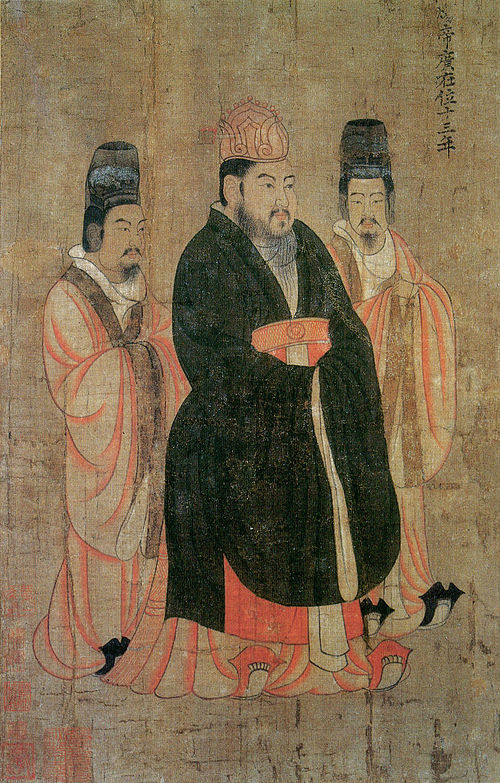
Yang Jian 杨坚 seizes throne, founds Sui
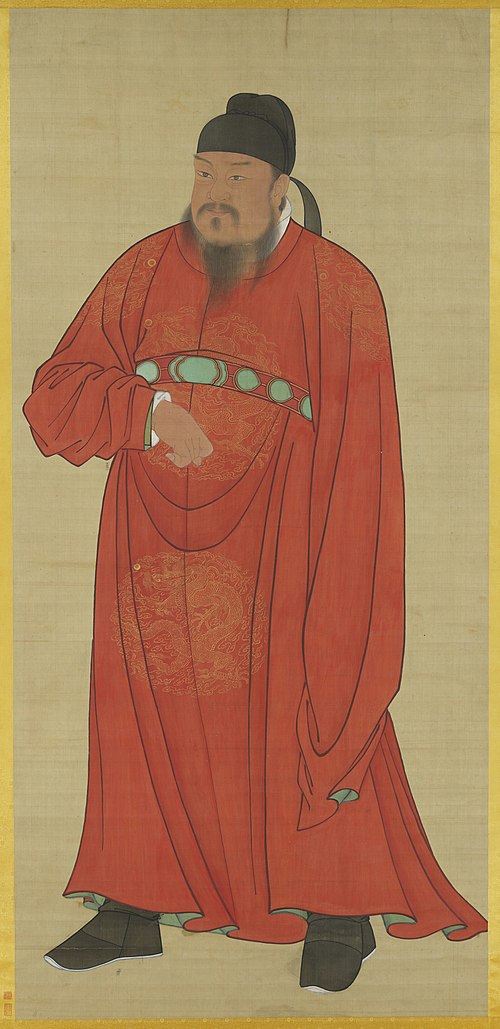
Yang Jian (杨坚 Yáng Jiān), a Northern Zhou regent, deposes the child emperor and establishes the Sui Dynasty, taking the throne name Emperor Wen (隋文帝 Suí Wén Dì). He immediately begins centralizing power and reforming administration. #politics #founding
Yang Jian 杨坚 seizes throne, founds Sui By Yan Li-pen - http://www.mfa.org/collections/search_art.asp?, Public domain, https://commons.wikimedia.org/w/index.php?curid=1971153
581 CE
Three Departments system restored
Emperor Wen (文帝 Wéndì) revives the Three Departments and Six Ministries (三省六部 Sān Shěng Liù Bù) system, creating a streamlined bureaucracy that influences Chinese governance for over a millennium. #governance #reform
583 CE
New legal code promulgated
The Kaihuang Code (开皇律 Kāihuáng Lǜ) is issued, reducing harsh penalties from earlier dynasties and establishing principles later adopted by the Tang Code. #law #governance
584 CE
Guangtong Canal 广通渠 construction begins
Engineer Yuwen Kai (宇文恺 Yǔwén Kǎi) designs the Guangtong Canal (广通渠 Guǎngtōng Qú), connecting Chang'an (长安 Cháng'ān) to the Yellow River (黄河 Huáng Hé) and beginning the Sui's massive waterway projects. #engineering #commerce
Wanning Bridge By EditQ - Own work, CC BY-SA 4.0, https://commons.wikimedia.org/w/index.php?curid=136061119
587 CE
Abolition of hereditary provincial posts
Emperor Wen (文帝 Wéndì) abolishes the zhoujun system of hereditary provincial governorships, replacing aristocratic military governors with appointed civil officials answerable to the center. #governance #reform
Abolition of hereditary provincial posts By Yan Li-pen - http://www.mfa.org/collections/search_art.asp?, Public domain, https://commons.wikimedia.org/w/index.php?curid=1971153
Feb 10, 589 CE
Chen 陈 Dynasty conquered, China reunified
Sui forces under Yang Guang (杨广 Yáng Guǎng) capture Jiankang (建康 Jiànkāng, modern Nanjing 南京 Nánjīng), ending the Chen Dynasty (陈朝 Chén Cháo) and reunifying China after nearly 300 years of division since the fall of the Han. #conquest #unification
Map of the Chen Dynasty By naturalearthdata.com, offered to the Public Domain per Terms of Use - This image has been extracted from another file, CC0, https://commons.wikimedia.org/w/index.php?curid=128687259
590 CE
Equal-field land system implemented
The juntian (均田 Jūntián) equal-field system is extended nationwide, allocating land to adult males to ensure tax revenue and agricultural productivity while preventing aristocratic land accumulation. #agriculture #economy
593 CE
Buddhist relic distribution campaign
Emperor Wen (文帝 Wéndì) distributes Buddha's purported relics to 107 prefectures across China, commissioning stone reliquaries and promoting Buddhism (佛教 Fójiào) as a unifying state ideology alongside Confucianism (儒教 Rújiào). #religion #Buddhism
Leshan Giant Buddha By xiquinhosilva - https://www.flickr.com/photos/xiquinho/49067661068/, CC BY 2.0, https://commons.wikimedia.org/w/index.php?curid=135449299
594 CE
Confucian ritual reforms enacted
Scholar Niu Hong (牛弘 Niú Hóng) compiles comprehensive ritual codes reviving Zhou Dynasty (周朝 Zhōu Cháo) ceremonies, establishing state sacrifices and court protocols that reinforce imperial legitimacy. #Confucianism #culture
595 CE
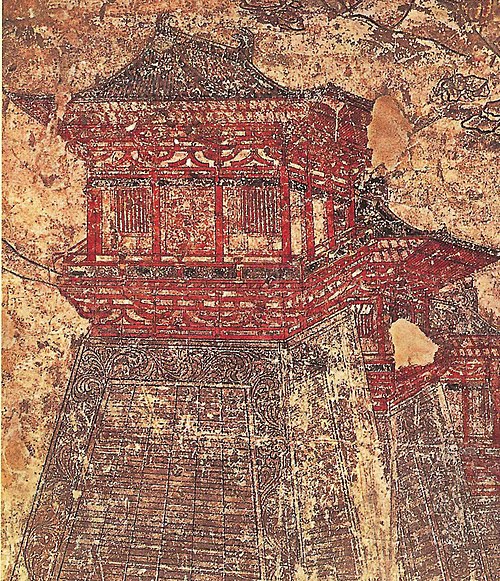
Chang'an 长安 Daxing 大兴 city completed
Yuwen Kai (宇文恺 Yǔwén Kǎi) completes the new capital Daxing (大兴城 Dàxīng Chéng, later Chang'an 长安), one of history's largest planned cities with a grid layout, imperial palace, and population exceeding one million. #architecture #urbanism
From Paludan's source: "Early 8th century murals in Prince Yide's tomb give an idea of the magnificence of Chang'an's city walls with their towering gate and corner towers." By Unknown Tang-era tomb artist - Paludan, Ann. (1998). Chronicle of the Chinese Emperors: the Reign-by-Reign Record of the Rulers of Imperial China. London: Thames & Hudson Ltd. ISBN 0500050902. Page 106., Public domain, https://commons.wikimedia.org/w/index.php?curid=6860728
597 CE
Gao Xianzhi's Korean campaign fails
Sui naval and land forces attack Goguryeo (高句丽 Gāogōulì) Korea but suffer disastrous defeat due to supply failures and Korean resistance, foreshadowing later catastrophes. #war #foreignrelations
5th century Goguryeo By Asieon - Own work, CC0, https://commons.wikimedia.org/w/index.php?curid=192465789
598 CE
Turkic khaganate divided diplomatically
Emperor Wen (文帝 Wéndì) employs marriage alliances and subsidies to split the Eastern and Western Turkic Khaganates (突厥 Tūjué), preventing unified nomadic threat to China's northern frontier. #diplomacy #defence
Volga Bulgaria map. By Татарин116 - Own work, CC BY-SA 4.0, https://commons.wikimedia.org/w/index.php?curid=92654595
600 CE
Crown Prince Yang Yong 杨勇 deposed
Yang Guang (杨广 Yáng Guǎng) manipulates court officials to have his elder brother Yang Yong (杨勇 Yáng Yǒng) removed as heir apparent, securing his own succession through political intrigue and accusations of extravagance. #intrigue #politics
Aug 13, 604 CE
Emperor Wen 文帝 dies, Yang Guang 杨广 succeeds
Emperor Yang (隋炀帝 Suí Yáng Dì) ascends the throne amid rumors of patricide; he immediately shifts policy toward grandiose projects and military expansion, abandoning his father's frugality. #succession #politics
Emperor Wen 文帝 dies, Yang Guang 杨广 succeeds By Yan Liben - Taken from http://www.sxlbl.com/web/idccc/minghua/200810159105.html, Public domain, https://commons.wikimedia.org/w/index.php?curid=1971182
605 CE
Grand Canal 大运河 construction accelerates
Emperor Yang (隋炀帝 Suí Yáng Dì) mobilizes millions of laborers to connect existing waterways into the Grand Canal (大运河 Dà Yùnhé), linking the Yellow River (黄河 Huáng Hé) and Yangtze River (长江 Cháng Jiāng) basins for grain transport and economic integration. #engineering #commerce
Wanning Bridge By EditQ - Own work, CC BY-SA 4.0, https://commons.wikimedia.org/w/index.php?curid=136061119
605 CE
Luoyang 洛阳 eastern capital established
A new eastern capital is built at Luoyang (洛阳 Luòyáng) with elaborate palaces and gardens, designed to control the eastern plains and reduce dependence on the northwestern aristocracy. #architecture #politics
Caves of Longmen By Rialfver Original uploader was Rialfver at nl.wikipedia - Transferred from nl.wikipedia (Original text : Eigen werk), CC BY-SA 3.0, https://commons.wikimedia.org/w/index.php?curid=4810278
606 CE
Imperial examination system expanded
The jinshi (进士 Jìnshì) degree examination is institutionalized, creating a meritocratic pathway for officials that gradually reduces aristocratic monopoly on government positions. #education #governance
Excerpt from the handscroll Viewing the Pass List. Imperial examination candidates gather around the wall where results had been posted. Traditionally attributed to Qiu Ying, but now suspected to be the work of a late-Ming painter with Qiu Ling's name added. By Qiu Ying (仇英) (attributed) - In the collection of the National Palace Museum, Public domain, https://commons.wikimedia.org/w/index.php?curid=598340
607 CE
Japanese envoy Ono no Imoko 小野妹子 arrives
The first Japanese embassy to Sui China arrives, with envoy Ono no Imoko (小野妹子 Ono no Imoko) presenting a controversial letter; cultural exchange begins despite diplomatic tensions over wording. #diplomacy #culture
Japanese envoy Ono no Imoko 小野妹子 arrives By Unknown author - The Japanese book "聖徳太子信仰の美術", 東方出版, 1996 ISBN 9784885914478, Public domain, https://commons.wikimedia.org/w/index.php?curid=163023061
607 CE
Sui law code revised as Daye Code 大业律
The Daye Code (大业律 Dàyè Lǜ) is issued under Emperor Yang (隋炀帝 Suí Yáng Dì), though enforcement becomes increasingly arbitrary and harsh as the emperor's rule grows more despotic. #law #governance
Xiling Gorge downstream of the Three Gorges Dam on the Yangtze River, China in October 2016 By Fredlyfish4 - Own work, CC BY-SA 4.0, https://commons.wikimedia.org/w/index.php?curid=52400893
608 CE
Zhuojun 涿郡 Canal extends to Beijing 北京
The Yongji Canal (永济渠 Yǒngjì Qú) is completed, extending the waterway network north to Zhuojun (涿郡, near modern Beijing 北京) to supply military campaigns against Goguryeo (高句丽 Gāogōulì). #engineering #military
609 CE
Western Regions 西域 campaign succeeds
Emperor Yang (隋炀帝 Suí Yáng Dì) personally leads forces into the Tarim Basin (塔里木盆地 Tǎlǐmù Péndì), receiving submission of various oasis states and reestablishing Chinese influence in Central Asia after centuries of absence. #conquest #foreignrelations
This map shows the western area(Western Regions) nations of the first century at B.C.. By トムル - Uploader makes it based on File:Asia 600ad 2.jpg, Public domain, https://commons.wikimedia.org/w/index.php?curid=9703288
610 CE
Great canal system fully operational
The complete Grand Canal (大运河 Dà Yùnhé) network stretches over 2,500 kilometers, enabling annual transport of millions of shi of grain from the Yangtze (扬子 Jiāng) delta to the northern capitals and military frontiers. #commerce #engineering
611 CE
First massive Goguryeo 高句丽 invasion launched
Emperor Yang (隋炀帝 Suí Yáng Dì) mobilizes over one million troops for the first of three catastrophic campaigns against Goguryeo (高句丽 Gāogōulì) Korea, with supply requirements devastating northern Chinese agriculture. #war #disaster
612 CE
Sui defeat at Salsu River 萨水
Goguryeo (高句丽 Gāogōulì) general Eulji Mundeok ambushes Sui forces at the Salsu River (萨水 Sà Shuǐ), destroying most of the 305,000-man army; only 2,700 soldiers return to China. #war #disaster
It is a documentary paint depicting the annihilation of Sui soldiers crossing the river in Salsu in 612. By War Memorial of Korea Open Archives - https://archives.warmemo.or.kr:8443/pss/media/pssMediaDetail.do?MID=UM00015&archvNttNo=5916 – The source is archived here ( - Archive.today), KOGL Type 1, https://commons.wikimedia.org/w/index.php?curid=142004790
613 CE
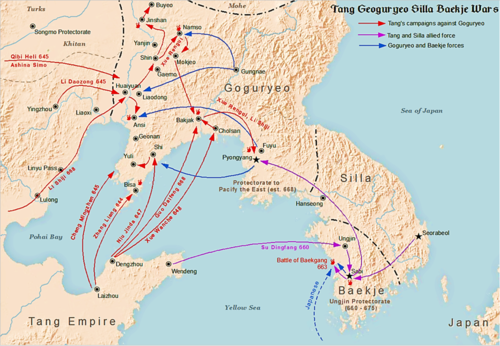
Second Goguryeo 高句丽 campaign fails
The second invasion collapses when Yang Xuangan (杨玄感 Yáng Xuángǎn), son of a powerful minister, rebels near Luoyang (洛阳 Luòyáng); Emperor Yang (隋炀帝 Suí Yáng Dì) abandons the Korean front to suppress this internal threat. #rebellion #war
Wars between Tang dynasty and kingdoms of Korean Peninsula, including Goguryeo, Silla and Baekje. By SY - Own work, CC BY-SA 4.0, https://commons.wikimedia.org/w/index.php?curid=61409525
614 CE
Third Goguryeo 高句丽 campaign, nominal victory
Emperor Yang (隋炀帝 Suí Yáng Dì) launches a third invasion but achieves only a face-saving negotiated settlement as Goguryeo (高句丽 Gāogōulì) refuses full submission; the emperor's prestige is irreparably damaged. #war #diplomacy
616 CE
Emperor Yang 隋炀帝 flees to Jiangdu 江都
Abandoning the north to widespread rebellion, Emperor Yang (隋炀帝 Suí Yáng Dì) retreats to Jiangdu (江都 Jiāngdū, modern Yangzhou 扬州), where he lives in decadent isolation while the empire disintegrates around him. #collapse #politics
617 CE
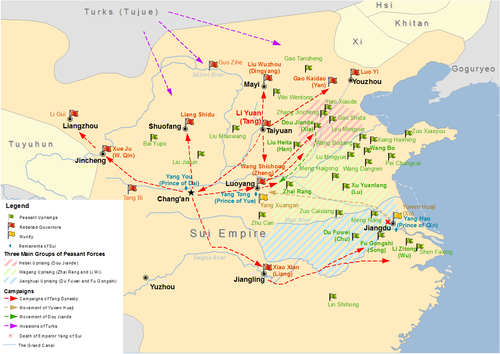
Wagang 瓦岗 Army rises in Henan 河南
The Wagang (瓦岗 Wǎgǎng) rebel army under Li Mi (李密 Lǐ Mì) becomes the largest anti-Sui force, controlling the central plains and severing grain transport along the Grand Canal (大运河 Dà Yùnhé). #rebellion #war
Map showing major uprisings and rebellions in the last years of Sui dynasty. By SY - Own work, CC BY-SA 4.0, https://commons.wikimedia.org/w/index.php?curid=60788594
617 CE
Li Yuan 李渊 rebels, captures Chang'an 长安
Li Yuan (李渊 Lǐ Yuān), Sui governor of Taiyuan (太原 Tàiyuán), rebels and captures Chang'an (长安), proclaiming Yang You (杨侑 Yáng Yòu) as puppet emperor while consolidating power in the northwest. #rebellion #politics
Emperor Gaozu of Tang By Unknown author - Digitized by NPM; image is directly from Shuge, Public domain, https://commons.wikimedia.org/w/index.php?curid=922552
Mar 11, 618 CE
Emperor Yang 隋炀帝 assassinated at Jiangdu 江都
Yuwen Huaji (宇文化及 Yǔwén Huàjí) leads a palace coup, strangling Emperor Yang (隋炀帝 Suí Yáng Dì); the Sui Dynasty (隋朝 Suí Cháo) effectively ends, though puppet emperors briefly persist before Li Yuan (李渊 Lǐ Yuān) establishes Tang (唐朝 Táng Cháo). #assassination #collapse
Jun 18, 618 CE
Li Yuan 李渊 founds Tang 唐 Dynasty
Li Yuan (李渊 Lǐ Yuān) forces the abdication of Yang You (杨侑 Yáng Yòu) and proclaims himself Emperor Gaozu of Tang (唐高祖 Táng Gāo Zǔ), formally ending the Sui Dynasty (隋朝 Suí Cháo) and beginning three centuries of Tang (唐朝 Táng Cháo) rule. #founding #politics