Encyclopedia/3. History, Societies & Civilizations/01. East Asian Civilizations/01. Chinese Dynasties • Curated by Admin Timeline.sg
The Sixteen Kingdoms (304–439 CE) was a turbulent era of non-Han Chinese states in northern China, marked by ethnic conflict, Buddhist flourishing, and eventual reunification by the Northern Wei.
Chronological Storyline (39 Milestones)
Oct 1, 304 CE
Liu Yuan Establishes Han-Zhao (刘渊建汉赵)
The Xiongnu chieftain Liu Yuan (刘渊, Liú Yuān) declares independence from the Western Jin, establishing the Han-Zhao kingdom (汉赵, Hàn-Zhào) in Shanxi. This marks the beginning of the Sixteen Kingdoms period and the first major non-Han state in northern China. #politics #war #history
Map showing China during the Sixteen Kingdoms period in 317 AD, shortly after the fall of the Western Jin dynasty. By SY - This image has been extracted from another file, CC BY 4.0, https://commons.wikimedia.org/w/index.php?curid=143280714
308 CE
Liu Yuan Claims Imperial Title (刘渊称帝)
Liu Yuan (刘渊, Liú Yuān) formally declares himself emperor of Han-Zhao, adopting the reign title Yongfeng (永凤). He presents himself as a legitimate successor to the Han dynasty through claimed descent from a Han princess, employing Confucian legitimist strategies. #politics #history
金人瑞. 繡像三國演義續編 :8卷. 上海 : 廣百宋齋, 光緖19年[1893]. By see below - https://iiif.lib.harvard.edu/manifests/view/drs:49802792, Public domain, https://commons.wikimedia.org/w/index.php?curid=146056725
Jun 1, 311 CE
Disaster of Yongjia (永嘉之乱)
Han-Zhao forces under Liu Cong (刘聪, Liú Cōng) capture and sack Luoyang (洛阳), executing Emperor Huai of Jin. Known as the Yongjia Disturbance (永嘉之乱, Yǒngjiā zhī luàn), this catastrophe kills tens of thousands and symbolizes Jin collapse in the north. #war #disaster #history
Dec 1, 316 CE
Fall of Chang'an to Han-Zhao (长安陷落)
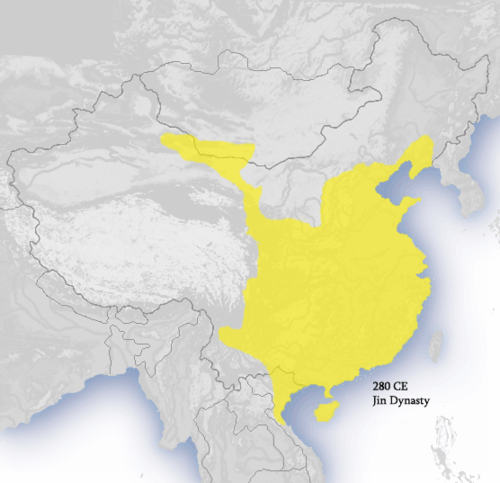
Han-Zhao forces capture Chang'an (长安, Cháng'ān), the last Western Jin stronghold in the north. Emperor Min of Jin surrenders, ending Western Jin rule in northern China. The Eastern Jin continues in Jiankang (建康, Jiànkāng, modern Nanjing). #war #politics #history
Western Jeun Dynasty 280 CE.png By Ian Kiu - Own work, CC BY-SA 3.0, https://commons.wikimedia.org/w/index.php?curid=3708103
319 CE
Shi Le Founds Later Zhao (石勒建后赵)
The Jie (羯, Jié) general Shi Le (石勒, Shí Lè) breaks from Han-Zhao and establishes the Later Zhao (后赵, Hòu Zhào) kingdom. A former slave who rose through military merit, Shi Le represents the social mobility possible in this chaotic era. #politics #war #history
Tripartite stalemate between the Later Zhao, Cheng-Han and Eastern Jin during the Jin dynasty in 338 AD. By SY - This image has been extracted from another file, CC BY 4.0, https://commons.wikimedia.org/w/index.php?curid=143478427
320 CE
Zhang Shi Establishes Former Liang (张寔建前凉)
Zhang Shi (张寔, Zhāng Shí) establishes the Former Liang (前凉, Qián Liáng) in the Gansu Corridor, maintaining Han Chinese rule and preserving Jin cultural traditions. The state becomes a crucial conduit for Buddhism entering China from Central Asia. #politics #religion #history
330 CE
Shi Le Declares Himself Emperor (石勒称帝)
Shi Le (石勒, Shí Lè) formally assumes imperial title of Later Zhao, implementing the dual administrative system of 'barbarian' and Han Chinese officials. He patronizes Buddhism and employs Buddhist monk Fotucheng (佛图澄, Fótúchéng) as advisor. #politics #religion #history
A Ming dynasty depiction of Shi Le from the painting "Shi Le Reverencing a Buddhist Monk", formerly attributed to Qian Xuan. By Qian Xuan (formerly attributed), Freer Gallery of Art (owner) - https://asia.si.edu/object/F1911.210/, CC0, https://commons.wikimedia.org/w/index.php?curid=128135417
337 CE
Murong Huang Founds Former Yan (慕容皝建前燕)
The Xianbei (鲜卑, Xiānbēi) leader Murong Huang (慕容皝, Mùróng Huǎng) declares himself Prince of Yan, establishing the Former Yan (前燕, Qián Yān) in Liaodong. The Murong clan develops effective cavalry armies and agricultural colonies. #politics #war #history
338 CE
Fotucheng Dies at Age 117 (佛图澄圆寂)
The Kuchean Buddhist monk Fotucheng (佛图澄, Fótúchéng) dies in Later Zhao after decades of state patronage. He reportedly converted millions and used magical demonstrations to gain influence, establishing precedent for monk-state relations. #religion #history
Buddhacinga, also known as Fotudeng (佛圖澄), a monk from Kucha (in what is now Xinjiang Uyghur) who came to China proper, propagating the teachings of Buddhism and Buddhist meditation. Wood block print illustration. By Anonymous ancient wood block print illustration. - http://jpkc.gxun.edu.cn/zgctwhgl/03zongjiao02.htm, Public domain, https://commons.wikimedia.org/w/index.php?curid=12097481
342 CE
Former Yan Moves Capital to Longcheng (前燕迁都龙城)
Murong Huang relocates the Former Yan capital to Longcheng (龙城, Lóngchéng, modern Chaoyang), consolidating Xianbei power in the northeast. The city becomes a center of Buddhist art and culture with Central Asian influences. #politics #culture #religion
349 CE
Ran Min Massacre of Jie (冉闵杀胡令)
The Han Chinese general Ran Min (冉闵, Rǎn Mǐn) seizes power in Later Zhao and issues the 'Order to Kill the Hu' (杀胡令, Shā Hú Lìng), massacring Jie and other non-Han peoples. This ethnic violence reflects deep tensions in multi-ethnic states. #war #disaster #history
350 CE
Ran Min Founds Ran Wei (冉闵建冉魏)
Ran Min (冉闵, Rǎn Mǐn) establishes the ephemeral Ran Wei (冉魏, Rǎn Wèi) state, claiming legitimate succession to Han Chinese rule. His regime collapses in 352 when captured by Former Yan forces, ending this restoration attempt. #politics #war #history
Map showing the aftermath of the Later Zhao's collapse in 350 during the Sixteen Kingdoms period By SY - This image has been extracted from another file, CC BY 4.0, https://commons.wikimedia.org/w/index.php?curid=143486699
351 CE
Fu Jian Founds Former Qin (苻健建前秦)
The Di (氐, Dī) leader Fu Jian (苻健, Fú Jiàn) establishes the Former Qin (前秦, Qián Qín) in Chang'an, adopting Chinese administrative models. His successors would temporarily reunify northern China under non-Han rule. #politics #history
Map showing China prior to Huan Wen's Third Northern Expedition around 369 AD. By SY - This image has been extracted from another file, CC BY 4.0, https://commons.wikimedia.org/w/index.php?curid=143451004
354 CE
Huan Wen's Northern Expedition (桓温北伐)
The Eastern Jin general Huan Wen (桓温, Huán Wēn) launches a major northern expedition against Former Qin, reaching the suburbs of Chang'an. Though ultimately unsuccessful, it demonstrates persistent southern claims to the north. #war #politics #history
Hanan collection, in rare books room. Double leaves, oriental style, in case. Gift of Prof. Patrick Hanan. Pai ji : Guangxu shi jiu nian [1893] dong yue Shanghai wen yu shan fang cang ben Guang bai Song zhai pai yin. By Unknown author - https://iiif.lib.harvard.edu/manifests/view/drs:49802792$43i, Public domain, https://commons.wikimedia.org/w/index.php?curid=187214225
357 CE
Fu Jian Seizes Former Qin Throne (苻坚夺位)
Fu Jian (苻坚, Fú Jiān) overthrows his cousin and becomes ruler of Former Qin, beginning a golden age. He appoints the Han Chinese advisor Wang Meng (王猛, Wáng Měng) and pursues ethnic integration policies. #politics #history
366 CE
First Caves at Mogao Founded (莫高窟开凿)
The monk Le Zun (乐僔, Lè Zūn) excavates the first cave at the Mogao Grottoes (莫高窟, Mògāokū) near Dunhuang, beginning one of Buddhism's greatest artistic treasures. Former Liang and Later Liang rulers patronize this desert sanctuary. #religion #art #culture
The Mogao Caves, also known as the Thousand Buddha Grottoes, are a magnificent ensemble of Buddhist art and culture located near Dunhuang, in the Gansu province of China. These caves are celebrated for their extensive collection of murals and sculptures that span a period of a thousand years, showcasing the evolution of Buddhist art in the region. As a UNESCO World Heritage Site, the Mogao Caves offer a unique glimpse into the religious, cultural, and intellectual exchanges that took place along the ancient Silk Road. By xiquinhosilva - Mogao Caves, CC BY 2.0, https://commons.wikimedia.org/w/index.php?curid=167654995
370 CE
Former Qin Conquers Former Yan (前秦灭前燕)
Under Wang Meng's (王猛, Wáng Měng) command, Former Qin destroys Former Yan at the Battle of Luchuan (潞川, Lùchuān), capturing Murong Wei. This begins Former Qin's rapid expansion across northern China. #war #politics #history
376 CE
Former Qin Unifies Northern China (前秦统一北方)
Former Qin conquers Former Liang and Dai, achieving temporary unification of all northern China. Fu Jian (苻坚, Fú Jiān) rules a multi-ethnic empire of unprecedented size, promoting Confucian education and Buddhist translation. #politics #religion #history
379 CE
Kumarajiva Captured by Former Qin (鸠摩罗什被俘)
The Kuchean Buddhist translator Kumarajiva (鸠摩罗什, Jiūmóluóshí) is captured by Former Qin forces and held in Liangzhou for nearly two decades. He later becomes the most influential translator of Buddhist texts into Chinese. #religion #culture #history
Kumarajiva in front of Kizil Caves, Kuqa, Xinjiang, China By Yoshi Canopus - Own work, CC BY-SA 3.0, https://commons.wikimedia.org/w/index.php?curid=110447098
Nov 1, 383 CE
Battle of Feishui (淝水之战)
The massive Former Qin invasion of Eastern Jin collapses at the Feishui River (淝水, Féishuǐ). Fu Jian's (苻坚, Fú Jiān) defeat with his 'million-man army' shatters northern unity and precipitates the kingdoms' fragmentation. #war #history
The map showing the situation of Battle of Fei River By SY - Own work, CC BY-SA 4.0, https://commons.wikimedia.org/w/index.php?curid=60984551
384 CE
Yao Chang Founds Later Qin (姚苌建后秦)
The Qiang (羌, Qiāng) general Yao Chang (姚苌, Yáo Cháng) establishes Later Qin (后秦, Hòu Qín) in Guanzhong, capturing and executing Fu Jian in 385. His state becomes a major patron of Buddhism and Kumarajiva's translation work. #politics #religion #history
Map of China showing the Later Qin at its peak and the Eastern Jin coalition against the Huan Chu dynasty during the Sixteen Kingdoms period in 404 AD. By SY - This image has been extracted from another file, CC BY 4.0, https://commons.wikimedia.org/w/index.php?curid=143573034
384 CE
Murong Chui Founds Later Yan (慕容垂建后燕)
The Former Yan prince Murong Chui (慕容垂, Mùróng Chuí) establishes Later Yan (后燕, Hòu Yān) in Hebei after rebelling against Former Qin. He restores Murong family fortunes and maintains Xianbei military traditions. #politics #war #history
Map of China in 391, 8 years after the Battle of Fei River. By SY - This image has been extracted from another file, CC BY 4.0, https://commons.wikimedia.org/w/index.php?curid=143527313
386 CE
Tuoba Gui Rebuilds Dai as Northern Wei (拓跋珪建北魏)
The Xianbei Tuoba (拓跋, Tuòbá) leader Tuoba Gui (拓跋珪, Tuòbá Guī) revives the Dai state, soon renaming it Wei (魏, Wèi) — the Northern Wei (北魏, Běi Wèi). This marks the beginning of the dynasty that would eventually reunify northern China. #politics #history
Map of the Northern Wei By Ktrinko - This image has been extracted from another file, CC BY-SA 4.0, https://commons.wikimedia.org/w/index.php?curid=128482219
394 CE
Later Qin Destroys Former Qin (后秦灭前秦)
Yao Xing (姚兴, Yáo Xīng) of Later Qin completes the destruction of Former Qin's remnants, consolidating Qiang power in Guanzhong. He invites Kumarajiva to Chang'an and establishes a major Buddhist translation center. #war #religion #history
397 CE
Tufa Wugu Founds Southern Liang (秃发乌孤建南凉)
The Xianbei Tufa (秃发, Tūfā) clan establishes Southern Liang (南凉, Nán Liáng) in Qinghai. These Hexi corridor kingdoms maintain trade routes connecting China to Central Asia and India, facilitating Buddhist transmission. #politics #commerce #religion
397 CE
Juqu Mengxun Founds Northern Liang (沮渠蒙逊建北凉)
The Xiongnu Juqu (沮渠, Jǔqú) clan establishes Northern Liang (北凉, Běi Liáng) in Gansu, becoming notable patrons of Buddhism and preservers of Central Asian artistic traditions, including the earliest dated Mogao cave paintings. #politics #religion #art
Map of China showing the final years of the Sixteen Kingdoms period in 436 AD. By SY - This image has been extracted from another file, CC BY 4.0, https://commons.wikimedia.org/w/index.php?curid=143573036
398 CE
Tuoba Gui Moves Capital to Pingcheng (北魏迁都平城)
Northern Wei relocates its capital to Pingcheng (平城, Píngchéng, modern Datong), establishing a permanent Xianbei power base in the northern heartland. Tuoba Gui adopts Chinese imperial titles and administrative structures. #politics #history
400 CE
Li Gao Founds Western Liang (李暠建西凉)
The Han Chinese Li Gao (李暠, Lǐ Hào) establishes Western Liang (西凉, Xī Liáng) in Dunhuang, maintaining Chinese cultural traditions at the Silk Road terminus. His grandson Li Xun preserves the family library during state's fall. #politics #culture #history
Map of China in 410 during Liu Yu's second northern expedition against Southern Yan which also highlights the speedy decline of the Later Qin. By SY - This image has been extracted from another file, CC BY 4.0, https://commons.wikimedia.org/w/index.php?curid=143629389
401 CE
Kumarajiva Arrives in Chang'an (鸠摩罗什到长安)
The Buddhist master Kumarajiva (鸠摩罗什, Jiūmóluóshí) reaches Chang'an and begins systematic translation of Mahayana sutras under Later Qin patronage. His elegant Chinese versions become canonical for East Asian Buddhism. #religion #culture #translation
403 CE
Huiyuan Founds Donglin Temple (慧远建东林寺)
The monk Huiyuan (慧远, Huìyuǎn) establishes Donglin Temple (东林寺, Dōnglín Sì) on Mount Lu, creating a major Buddhist center independent of court politics. His community practices Pure Land devotion and maintains contacts with South Asian monks. #religion #culture #history
407 CE
Helian Bobo Founds Xia (赫连勃勃建夏)
The Xiongnu Helian Bobo (赫连勃勃, Hèlián Bóbó) establishes the Xia (夏, Xià) kingdom in Ordos, building the formidable Tongwancheng (统万城, Tǒngwànchéng) capital with white clay walls said to be impervious to weapons. #politics #architecture #history
Map of China during the Sixteen Kingdoms in 423 AD showing the confrontation between the Helian Xia and Northern Wei dynasties. By SY - This image has been extracted from another file, CC BY 4.0, https://commons.wikimedia.org/w/index.php?curid=143573143
410 CE
Xuanyan She Debate at Mount Lu (庐山沙门不敬王者论)
Huiyuan (慧远, Huìyuǎn) composes 'On Why Monks Do Not Bow Before Kings' (沙门不敬王者论, Shāmén bù jìng wángzhě lùn), defending Buddhist clerical autonomy from state authority. This foundational text addresses church-state relations in East Asia. #religion #philosophy #politics
414 CE
Faxian Returns from India (法显归国)
The Chinese monk Faxian (法显, Fǎxiǎn) returns from his fifteen-year journey to India and Sri Lanka, bringing back numerous Sanskrit texts. His travelogue 'Record of Buddhist Kingdoms' (佛国记, Fóguó Jì) documents South Asian conditions. #religion #travel #history
This is a derivative work, extracted from the following image available on wikimedia commons with creative commons license: Statues of Faxian and Marco Polo, Maritime Experiential Museum & Aquarium - 20111006.jpg Please see the photo above for any requirements on attribution. By Ms Sarah Welch - Own work, CC0, https://commons.wikimedia.org/w/index.php?curid=110121875
417 CE
Liu Yu Captures Chang'an (刘裕入长安)
The Eastern Jin general Liu Yu (刘裕, Liú Yù) captures Chang'an and destroys Later Qin, briefly restoring northern territories to southern rule. His withdrawal leaves the north vulnerable to renewed fragmentation. #war #politics #history
Map showing Northern Wei and Liu Song By S - Own work, CC BY-SA 4.0, https://commons.wikimedia.org/w/index.php?curid=60793172
420 CE
Liu Yu Founds Liu Song (刘裕建刘宋)
Liu Yu (刘裕, Liú Yù) usurps the Eastern Jin throne, founding the Liu Song (刘宋, Liú Sòng) dynasty — the first of the Southern Dynasties. The Sixteen Kingdoms period in the south formally ends, though northern fragmentation continues. #politics #history
423 CE
Tuoba Tao Becomes Northern Wei Emperor (拓跋焘即位)
Tuoba Tao (拓跋焘, Tuòbá Tāo) — Emperor Taiwu of Northern Wei — ascends the throne, beginning aggressive military expansion. He would become the most militarily successful of Northern Wei rulers, conquering multiple rival states. #politics #war #history
426 CE
Northern Wei Destroys Xia (北魏灭夏)
Emperor Taiwu's forces capture Tongwancheng and destroy the Xia kingdom, incorporating Ordos into Northern Wei territory. Helian Chang is captured, ending the state founded by Helian Bobo. #war #history
431 CE
Northern Wei Destroys Northern Liang (北魏灭北凉)
Northern Wei conquers Northern Liang, the last of the Hexi corridor kingdoms. Juqu Mujian surrenders, ending the state that had preserved Buddhist art and Central Asian culture for three decades. #war #religion #history
Sep 1, 439 CE
Northern Wei Unifies North China (北魏统一北方)
Northern Wei completes conquest of Northern Liang remnants, formally ending the Sixteen Kingdoms period. For the first time since 304, northern China is unified under a single non-Han dynasty, setting the stage for the Northern and Southern Dynasties era. #politics #history

![金人瑞. 繡像三國演義續編 :8卷. 上海 : 廣百宋齋, 光緖19年[1893].](https://upload.wikimedia.org/wikipedia/commons/thumb/7/74/Harvard_drs_49802792_%E7%B9%A1%E5%83%8F%E4%B8%89%E5%9C%8B%E6%BC%94%E7%BE%A9%E7%BA%8C%E7%B7%A8_v.1_%28%E5%8A%89%E6%B7%B5%29.jpg/500px-Harvard_drs_49802792_%E7%B9%A1%E5%83%8F%E4%B8%89%E5%9C%8B%E6%BC%94%E7%BE%A9%E7%BA%8C%E7%B7%A8_v.1_%28%E5%8A%89%E6%B7%B5%29.jpg)


![Hanan collection, in rare books room. Double leaves, oriental style, in case. Gift of Prof. Patrick Hanan. Pai ji : Guangxu shi jiu nian [1893] dong yue Shanghai wen yu shan fang cang ben Guang bai Song zhai pai yin.](https://upload.wikimedia.org/wikipedia/commons/1/1d/Huan_Wen_%E6%A1%93%E6%BA%AB.png)


