Encyclopedia/3. History, Societies & Civilizations/01. East Asian Civilizations/01. Chinese Dynasties • Curated by Admin Timeline.sg
The Jin Dynasty reunified China after the Three Kingdoms period, flourished culturally under Western Jin, then collapsed into the Eastern Jin refugee state amid barbarian invasions and aristocratic intrigue.
Chronological Storyline (28 Milestones)
Feb 4, 265 CE
Sima Yan Claims Throne (司马炎)
Sima Yan (司马炎, Sīmǎ Yán) forces Cao Huan (曹奂, Cáo Huàn) to abdicate, founding the Western Jin Dynasty (西晋, Xī Jìn) and ending Cao Wei. He pursues centralization while granting princely fiefs that would later threaten stability. #politics #dynasty
Sima Yan Claims Throne (司马炎) By Yan Li-pen - https://www.mfa.org/collections/object/the-thirteen-emperors-29071, Public domain, https://commons.wikimedia.org/w/index.php?curid=1840339
Mar 15, 280 CE
Conquest of Eastern Wu (灭吴)
Jin forces under Wang Jun (王濬, Wáng Jùn) capture Jianye (建邺, Jiànyè), destroying Eastern Wu (东吴, Dōng Wú). This reunifies China after nearly a century of Three Kingdoms division, briefly restoring imperial unity. #war #conquest
Translation of the original file. Did not update the old one due its usage in other Wiki languages where the file is appropriate. By Zer0taku - File:Jindestroywu.png, CC0, https://commons.wikimedia.org/w/index.php?curid=37519063
281 CE
Bamboo Annals Discovered (汲冢竹书)
A Warring States-era tomb at Ji (汲, Jí) yields the Bamboo Annals (汲冢竹书, Jí Zhǒng Zhú Shū), a crucial historical text written on bamboo strips. Xun Xu (荀勖, Xún Xù) leads transcription, revolutionizing ancient Chinese historiography. #literature #history
May 16, 290 CE
Death of Emperor Wu (武帝崩)
Emperor Wu (武帝, Wǔdì) Sima Yan dies after 25-year reign of prosperity and excess. His developmentally disabled heir Sima Zhong (司马衷, Sīmǎ Zhōng) succeeds, enabling regent Yang Jun (杨骏, Yáng Jùn) and precipitating catastrophic succession struggles. #politics #disaster
Apr 23, 291 CE
War of Eight Princes Begins (八王之乱)
The War of the Eight Princes (八王之乱, Bā Wáng zhī Luàn) erupts as imperial relatives massacre each other for power. Over sixteen years, this civil war devastates northern China and exposes Jin military weakness to non-Han peoples. #war #disaster
304 CE
Five Barbarians Rise (五胡乱华)
Xiongnu chieftain Liu Yuan (刘渊, Liú Yuān) declares himself Han Zhao emperor, initiating the Uprising of the Five Barbarians (五胡乱华, Wǔ Hú Luàn Huá). Di, Jie, Qiang, Xianbei, and Xiongnu peoples establish independent kingdoms across northern China. #war #migration
Distribution of the Five Barbarians during the Western Jin dynasty. By SY - This image has been extracted from another file, CC BY-SA 4.0, https://commons.wikimedia.org/w/index.php?curid=159044251
307 CE
Sima Rui Becomes Prince (司马睿封王)
Sima Rui (司马睿, Sīmǎ Ruì) receives commandery at Jiankang (建康, Jiànkāng, modern Nanjing). With Wang Dao (王导, Wáng Dǎo) and northern refugee aristocrats, he builds the power base for Eastern Jin's southern survival. #politics #migration
Jun 1, 311 CE
Disaster of Yongjia (永嘉之乱)
Han Zhao forces sack Luoyang (洛阳, Luòyáng), capture Emperor Huai (晋怀帝, Jìn Huáidì), and massacre tens of thousands. This Yongjia Disaster (永嘉之乱, Yǒngjiā zhī Luàn) marks Western Jin's effective collapse and triggers massive Han Chinese southward migration. #war #disaster
313 CE
Zhang Gui Preserves Gansu (张轨保凉州)
Zhang Gui (张轨, Zhāng Guǐ) establishes the Former Liang (前凉, Qián Liáng) regime at Guzang (姑臧, Gūzāng), preserving Han Chinese governance and culture in the northwest while central authority collapses. #politics #regional
Tripartite stalemate between the Later Zhao, Cheng-Han and Eastern Jin during the Jin dynasty in 338 AD. By SY - This image has been extracted from another file, CC BY 4.0, https://commons.wikimedia.org/w/index.php?curid=143478427
Nov 1, 316 CE
Chang'an Falls to Zhao (长安陷落)
Liu Yao (刘曜, Liú Yào) captures Chang'an (长安, Cháng'ān) and Emperor Min (晋愍帝, Jìn Mǐndì), ending Western Jin. Sima Rui prepares succession in the south as northern China fragments among Sixteen Kingdoms. #war #dynasty
金人瑞. 繡像三國演義續編 :8卷. 上海 : 廣百宋齋, 光緖19年[1893]. By see below - https://iiif.lib.harvard.edu/manifests/view/drs:49802792, Public domain, https://commons.wikimedia.org/w/index.php?curid=146055501
Apr 6, 317 CE
Eastern Jin Founded (东晋建立)
Sima Rui declares himself Prince of Jin at Jiankang, formally establishing Eastern Jin (东晋, Dōng Jìn, 317–420). Wang Dao's (王导, Wáng Dǎo) policy of conciliating southern aristocrats enables fragile stability. #politics #dynasty
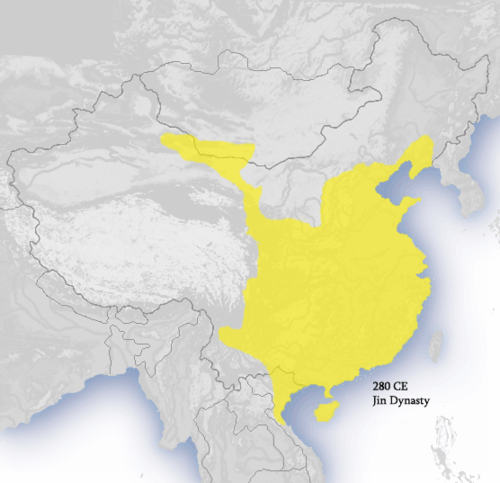
Western Jeun Dynasty 280 CE.png By Ian Kiu - Own work, CC BY-SA 3.0, https://commons.wikimedia.org/w/index.php?curid=3708103
322 CE
Wang Dun's Rebellion (王敦之乱)
Wang Dun (王敦, Wáng Dūn), Sima Rui's powerful cousin, rebels against imperial authority from Jingzhou. The crisis reveals Eastern Jin's structural weakness: military power held by great aristocratic clans, not the throne. #war #politics
327 CE
Su Jun's Rebellion (苏峻之乱)
General Su Jun (苏峻, Sū Jùn) rebels and briefly captures Jiankang, burning the imperial palace. The suppression by Wen Jiao (温峤, Wēn Qiáo) and Tao Kan (陶侃, Táo Kǎn) further empowers military strongmen. #war #politics
347 CE
Huan Wen Conquers Cheng Han (桓温灭成汉)
General Huan Wen (桓温, Huán Wēn) destroys Cheng Han (成汉, Chéng Hàn) in Sichuan, reuniting the upper Yangzi with Eastern Jin. His success breeds personal ambition and threatens the Jiankang court's precarious balance. #war #conquest
351 CE
Former Qin Unifies North (前秦统一北方)
Fu Jian (苻坚, Fú Jiān) of Di ethnicity establishes the Former Qin (前秦, Qián Qín), which temporarily unifies northern China. His multi-ethnic state presents both threat and model to the culturally Han Eastern Jin. #politics #regional
Map showing China prior to Huan Wen's Third Northern Expedition around 369 AD. By SY - This image has been extracted from another file, CC BY 4.0, https://commons.wikimedia.org/w/index.php?curid=143451004
354 CE
Huan Wen's First Northern Expedition (桓温北伐)
Huan Wen launches first of three northern expeditions, reaching Chang'an vicinity. Eastern Jin's inability to hold recovered territory demonstrates the limits of aristocratic military power against entrenched northern regimes. #war #politics
364 CE
Ge Hong Writes Baopuzi (葛洪著抱朴子)
Daoist scholar Ge Hong (葛洪, Gě Hóng) completes Baopuzi (抱朴子, Bàopǔzǐ), synthesizing Daoist alchemy, immortality practices, and Confucian ethics. This foundational text shapes religious Daoism and alchemical science for centuries. #religion #science
One of a series of woodcuts of illustrious physicians and legendary founders of Chinese medicine from an edition of Bencao mengquan (Introduction to the Pharmacopoeia), engraved in the Wanli reign period of the Ming dynasty (1573-1620) -- Volume preface, 'Lidai mingyi hua xingshi' (Portraits and names of famous doctors through history). The images are attributed to a Tang (618-907) creator, Gan Bozong. The account in 'Portraits and Names of Famous Doctors through History' states: Ge Hong, a native of Danyang, lived under the Eastern Jin dynasty (317-420). His style-name was Zhichuan, and he also called himself Bao Pu Zi (The one who embraces simplicity). He held the office of magistrate of Gaolou (present-day Beiliu in Guangxi province). He was expert at curing illnesses and well-versed in the classics. A Daoist adept, he knew how to make pills of immortality. He lived as a hermit in Luofu Mountain (a Daoist holy place), where he made pills of immortality and became an Immortal, after which he was known as Ge Xianweng (Ge the Immortal Sage). Ge Hong spent many years in retreat, wandering in the mountains, cultivating himself and writing. He is the author of Bao Pu Zi and Zhouhou jiuzu fang (Book of Remedies in Extremis to be Kept up one's Sleeve) in three volumes.Woodcut By: Gan Bozong (Tang period, 618-907) By Gan Bozong (Tang period, 618-907) - https://wellcomeimages.org/indexplus/obf_images/5f/87/4e750c334bb041db425934535c34.jpg (hi-res image) Gallery: https://wellcomeimages.org/indexplus/image/L0039323.html Wellcome Collection gallery (2018-03-28): https://wellcomecollection.org/works/f65bzfbc CC-BY-4.0, CC BY 4.0, https://commons.wikimedia.org/w/index.php?curid=33926771
372 CE
Wang Xizhi's Calligraphy Matures (王羲之书圣)
Wang Xizhi (王羲之, Wáng Xīzhī), later revered as Sage of Calligraphy (书圣, Shūshèng), produces masterworks including Preface to the Poems Composed at the Orchid Pavilion (兰亭集序, Lántíngjí Xù). His running script becomes the artistic standard. #art #culture
Wang Xizhi's Calligraphy Matures (王羲之书圣) By Unknown Chinese artist - https://www.philamuseum.org/collection/object/42768, Public domain, https://commons.wikimedia.org/w/index.php?curid=148608240
376 CE
Former Qin Conquers Former Liang (前秦灭前凉)
Fu Jian completes northern unification by absorbing Former Liang. The entire Yellow River basin under one power for the first time since Western Jin creates existential pressure on Eastern Jin's southern survival. #war #politics
Nov 1, 383 CE
Battle of Fei River (淝水之战)
Eastern Jin forces under Xie Xuan (谢玄, Xiè Xuán) shatter Fu Jian's massive invasion at Fei River (淝水, Féishuǐ). This stunning victory preserves southern Chinese culture and prevents immediate northern reunification. #war #defence
The map showing the situation of Battle of Fei River By SY - Own work, CC BY-SA 4.0, https://commons.wikimedia.org/w/index.php?curid=60984551
385 CE
Former Qin Collapses (前秦瓦解)
Fu Jian's death triggers Former Qin's rapid fragmentation into rival states: Later Qin, Western Qin, Later Liang, and more. Eastern Jin gains temporary opportunity for northern expansion amid the chaos. #war #politics
399 CE
Sun En's Rebellion (孙恩之乱)
Daoist magician Sun En (孙恩, Sūn Ēn) leads massive coastal rebellion against aristocratic exploitation. Liu Yu (刘裕, Liú Yù) distinguishes himself suppressing the revolt, beginning his rise from common soldier to emperor. #war #religion
400 CE
Kumarajiva Reaches Chang'an (鸠摩罗什到长安)
Koguryeo-monk-sponsored Kumarajiva (鸠摩罗什, Jiūmóluóshí), greatest Buddhist translator, arrives in Later Qin Chang'an. His Chinese translations of Madhyamaka texts revolutionize Buddhist philosophy across East Asia. #religion #culture
Kumarajiva in front of Kizil Caves, Kuqa, Xinjiang, China By Yoshi Canopus - Own work, CC BY-SA 3.0, https://commons.wikimedia.org/w/index.php?curid=110447098
404 CE
Huan Xuan's Usurpation (桓玄篡晋)
Huan Xuan (桓玄, Huán Xuán), Huan Wen's son, briefly overthrows Eastern Jin before Liu Yu's counter-coup. The episode demonstrates both aristocratic clan power and its vulnerability to military professionals. #politics #war
405 CE
Tao Yuanming Resigns (陶渊明归隐)
Poet-official Tao Yuanming (陶渊明, Táo Yuānmíng) resigns his post as Pengze magistrate, composing Returning Home (归去来兮辞, Guīqù Lái Xī Cí). His pastoral poetry establishes the reclusive literati ideal in Chinese culture. #literature #culture
Tao Yuanming Resigns (陶渊明归隐) By Chen Hongshou - The Yorck Project (2002) 10.000 Meisterwerke der Malerei (DVD-ROM), distributed by DIRECTMEDIA Publishing GmbH. ISBN: 3936122202., Public domain, https://commons.wikimedia.org/w/index.php?curid=149194
409 CE
Liu Yu's Northern Expedition (刘裕北伐南燕)
Liu Yu destroys Southern Yan (南燕, Nán Yān), capturing its ruler Murong Chao (慕容超, Mùróng Chāo). These campaigns demonstrate professional military effectiveness versus aristocratic-led failures of previous decades. #war #conquest )
416 CE
Liu Yu Captures Chang'an (刘裕克长安)
Liu Yu's forces destroy Later Qin, briefly recovering Chang'an and the western capitals. His recall to secure power in Jiankang sacrifices territorial gains for political ambition, foreshadowing dynastic replacement. #war #politics )
Jun 1, 420 CE
Liu Yu Ends Eastern Jin (刘裕篡晋建宋)
Liu Yu compels Emperor Gong (晋恭帝, Jìn Gōngdì) to abdicate, founding Liu Song (刘宋, Liú Sòng) and ending the Jin Dynasty. This inaugurates the Southern Dynasties period and confirms military strongman rule. #politics #dynasty
Emperor Wudi of Liu Song. By Unknown author - 中国历史博物馆保管部, ed. (2003) 中国历代名人画像谱 1, 福州: 海峡文艺出版社, p. 40 ISBN: 7806407855., Public domain, https://commons.wikimedia.org/w/index.php?curid=154034668


![金人瑞. 繡像三國演義續編 :8卷. 上海 : 廣百宋齋, 光緖19年[1893].](https://upload.wikimedia.org/wikipedia/commons/thumb/5/53/Harvard_drs_49802792_%E7%B9%A1%E5%83%8F%E4%B8%89%E5%9C%8B%E6%BC%94%E7%BE%A9%E7%BA%8C%E7%B7%A8_v.1_%28%E6%99%89%E6%84%8D%E5%B8%9D%29.jpg/500px-Harvard_drs_49802792_%E7%B9%A1%E5%83%8F%E4%B8%89%E5%9C%8B%E6%BC%94%E7%BE%A9%E7%BA%8C%E7%B7%A8_v.1_%28%E6%99%89%E6%84%8D%E5%B8%9D%29.jpg)