Encyclopedia/3. History, Societies & Civilizations/01. East Asian Civilizations/01. Chinese Dynasties • Curated by Admin Timeline.sg
Six Dynasties period. The tripartite division of China among Wei, Shu, and Wu kingdoms marked an era of military innovation, philosophical development, and cultural flourishing that shaped medieval Chinese civilization.
Chronological Storyline (29 Milestones)
Mar 15, 220 CE
Cao Pi deposes Emperor Xian (曹丕)
Cao Pi (曹丕) forces the abdication of the last Han emperor Xian (汉献帝), formally ending the Eastern Han dynasty and establishing the state of Wei (魏) with himself as Emperor Wen (魏文帝). This political ritual of 'abdication by yielding' (禅让) became a template for subsequent dynastic transitions in Chinese history. #politics #dynasty
Cao Pi deposes Emperor Xian (曹丕) By Yan Li-pen - http://hi.baidu.com/%CB%CE%BE%FC%D2%C5%C3%F1/album/%D1%D6%C1%A2%B1%BE%20%C0%FA%B4%FA%B5%DB%CD%F5%CD%BC%BE%ED, Public domain, https://commons.wikimedia.org/w/index.php?curid=1872130
Apr 6, 221 CE
Liu Bei declares Shu Han (刘备)
Liu Bei (刘备) proclaims himself emperor of Shu Han (蜀汉), claiming legitimate succession to the Han dynasty from his base in Chengdu (成都). His state controlled the Sichuan Basin and parts of modern Shaanxi and Yunnan, maintaining the Han imperial lineage against Cao Wei usurpation. #politics #dynasty
Liu Bei declares Shu Han (刘备) By Yan Liben (閻立本) - http://hi.baidu.com/%CB%CE%BE%FC%D2%C5%C3%F1/album/%D1%D6%C1%A2%B1%BE%20%C0%FA%B4%FA%B5%DB%CD%F5%CD%BC%BE%ED, Public domain, https://commons.wikimedia.org/w/index.php?curid=2230287
Sep 1, 221 CE
Sun Quan establishes Eastern Wu (孙权)
Sun Quan (孙权) accepts the title King of Wu (吴王) from Cao Pi, initially as a Wei vassal, then declares independence in 229 as Emperor of Eastern Wu (东吴). His kingdom dominated the Yangtze River valley and southeastern coast, developing naval power and southern economic resources. #politics #navy
Sun Quan establishes Eastern Wu (孙权) By Yan Liben - http://hi.baidu.com/%CB%CE%BE%FC%D2%C5%C3%F1/album/%D1%D6%C1%A2%B1%BE%20%C0%FA%B4%FA%B5%DB%CD%F5%CD%BC%BE%ED, Public domain, https://commons.wikimedia.org/w/index.php?curid=1872106
Jun 1, 222 CE
Battle of Yiling (夷陵之战)
Lu Xun (陆逊) commands Wu forces to decisive victory over Liu Bei's (刘备) massive invasion at Yiling (夷陵), also called Xiaoting (猇亭). Liu Bei's catastrophic defeat by fire attack destroyed Shu Han's eastern ambitions; he died within a year, leaving the kingdom to his son Liu Shan (刘禅) under regent Zhuge Liang (诸葛亮). #war #strategy
Map showing Battle of Yiling between Shu Han and Wu kingdoms. By SY - Own work, CC BY-SA 4.0, https://commons.wikimedia.org/w/index.php?curid=62795395
Mar 1, 225 CE
Zhuge Liang's Southern Campaign (诸葛亮南征)
Zhuge Liang (诸葛亮) leads military expedition against southern tribal peoples in modern Yunnan and Guizhou, subduing the Nanman (南蛮) including the legendary Meng Huo (孟获). The campaign secured Shu's rear before northern expeditions and integrated southwestern minorities into Chinese administration. #war #conquest
花戏楼木雕,诸葛亮征南蛮。 By 三猎 - Own work, CC BY-SA 4.0, https://commons.wikimedia.org/w/index.php?curid=51661380
Jan 1, 227 CE
Chu Shi Biao manifesto (出师表)
Zhuge Liang (诸葛亮) presents his famous 'Chu Shi Biao' (出师表, "Memorial on the Case to Arms") to the young emperor Liu Shan (刘禅), pledging personal loyalty and outlining plans for northern expedition against Wei. This literary masterpiece became a model of classical Chinese political prose, studied for its moral sincerity and rhetorical power. #literature #philosophy
Former Chu Shi Biao (前出師表) By Morio - Own work, CC BY-SA 4.0, https://commons.wikimedia.org/w/index.php?curid=49558975
Jan 1, 228 CE
First Northern Expedition (第一次北伐)
Zhuge Liang (诸葛亮) launches the first of five northern expeditions against Wei, initially surprising Cao Wei forces and capturing three commanderies. The campaign faltered when Ma Su (马谡) lost the critical Battle of Jieting (街亭); Zhuge Liang executed Ma Su for failure and accepted demotion, demonstrating strict military discipline. #war #strategy
A Qing Dynasty illustration of a Shu-Wei battle at River Wei. By Qing Dynasty - The Scholars of Chenzhou, Public domain, https://commons.wikimedia.org/w/index.php?curid=19104618
Apr 1, 229 CE
Sun Quan declares Wu emperor (孙权称帝)
Sun Quan (孙权) formally declares himself emperor of Wu (吴), completing the tripartite imperial system. He established his capital at Jianye (建业, modern Nanjing 南京), which became a major political and cultural center; the city layout influenced East Asian capital design for centuries. #politics #urban
Jan 1, 230 CE
Cao Wei constructs Great Wall segments (曹魏修长城)
Cao Wei (曹魏) undertakes major construction and repair of northern frontier defenses against Xianbei (鲜卑) and Xiongnu (匈奴) incursions, extending the Great Wall system in modern Gansu and Ningxia. These fortifications protected agricultural settlements and trade routes along the Silk Road's eastern terminus. #defense #agriculture
The Great Wall of China at Jinshanling By Severin.stalder - Own work, CC BY-SA 3.0, https://commons.wikimedia.org/w/index.php?curid=39661035
Mar 1, 231 CE
Wooden ox and flowing horse (木牛流马)
Zhuge Liang (诸葛亮) reportedly deploys innovative transport devices called 'wooden ox' (木牛) and 'flowing horse' (流马) to supply armies during fourth northern expedition against Wei. These mechanical transport mechanisms, possibly wheelbarrow variants or early vehicles, addressed the critical logistics challenge of mountainous terrain in northern Sichuan and southern Gansu. #science #invention
Wooden ox replica in the Ancient Chariot Museum in Zibo, China By Deadkid dk - Own work, CC BY-SA 3.0, https://commons.wikimedia.org/w/index.php?curid=20524917
Aug 1, 234 CE
Death of Zhuge Liang (诸葛亮卒)
Zhuge Liang (诸葛亮) dies of illness at Wuzhang Plains (五丈原) during his fifth and final northern expedition against Wei, aged 54. His death ended Shu Han's aggressive military policy; the kingdom adopted defensive strategies under successors Jiang Wan (蒋琬) and Fei Yi (费祎), preserving stability but abandoning reunification hopes. #death #politics
Portrait of Zhuge Liang, Ming Dynasty, painted on silk, 192 cm in height and 95.6 cm in width, now in the collection of the National Museum of China 《汉诸葛亮立像》轴,明,绢本设色,纵 192厘米,横 95.6 厘米,现藏中国国家博物馆 By Unknown author - https://www.chnmuseum.cn/portals/0/web/zt/202007mhsx/, Public domain, https://commons.wikimedia.org/w/index.php?curid=156116928
Jun 1, 238 CE
Gongsun Yuan destroyed, Liaodong annexed (平定辽东)
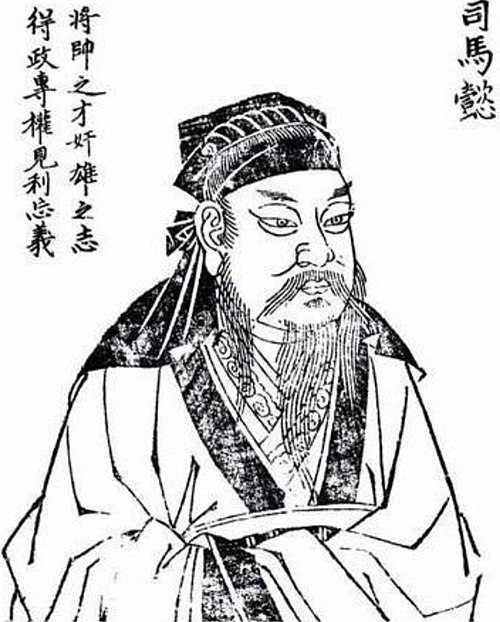
Sima Yi (司马懿) leads Wei expedition destroying Gongsun Yuan (公孙渊), the semi-independent warlord of Liaodong (辽东) in modern Liaoning. The campaign eliminated the last major regional power outside the three kingdoms system and extended Wei control to the Korean peninsula's frontier, establishing contact with Goguryeo (高句丽). #conquest #diplomacy
Portrait of Wei Taifu Sima Yi By Ming Zhu Tianran - Praise of the Ancients, Public domain, https://commons.wikimedia.org/w/index.php?curid=114034718
Jan 22, 239 CE
Cao Fang succeeds as Wei emperor (曹芳即位)
Eight-year-old Cao Fang (曹芳) becomes Wei emperor following the death of Cao Rui (曹叡); Sima Yi (司马懿) and Cao Shuang (曹爽) serve as co-regents. This succession began the gradual transfer of Wei state power from the Cao imperial clan to the Sima clan, culminating in the Jin dynasty's establishment. #politics #succession
Jan 1, 240 CE
Wang Bi's Daodejing commentary (王弼注老子)
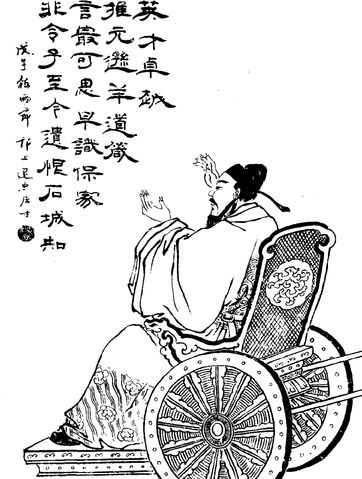
Wang Bi (王弼), the brilliant young Xuanxue (玄学, "Dark Learning") philosopher, completes his influential commentary on the Daodejing (道德经) before his death at age 23. His interpretations revolutionized Daoist studies, emphasizing 'non-being' (无) as ontological foundation and profoundly shaping Neo-Daoist metaphysics in medieval China. #philosophy #culture
至聖先賢半身像 冊,南薰殿旧藏,现藏于台北故宫博物院 By AnonymousUnknown author - Digitized by National Palace Museum; file is directly from Shuge, Public domain, https://commons.wikimedia.org/w/index.php?curid=126996540
Jan 1, 242 CE
Eastern Wu expedition to Yizhou (夷州)
Sun Quan (孙权) dispatches naval expedition under Wei Wen (卫温) and Zhuge Zhi (诸葛直) to Yizhou (夷州), identified with Taiwan (台湾), and Danzhou (亶州), possibly the Ryukyu Islands. The mission returned with thousands of indigenous people but heavy losses; it represents early Chinese state contact with Taiwan and expansion of maritime geographic knowledge. #exploration #navy
Mar 1, 244 CE
Battle of Xingshi (兴势之战)
Cao Shuang (曹爽) leads massive Wei invasion of Shu Han through Xingshi (兴势) but is repelled by Shu commander Wang Ping (王平). The defeat weakened Cao clan prestige and strengthened Sima Yi (司马懿) politically, contributing to the eventual power shift within Wei state structure. #war #politics
Jan 1, 249 CE
He Yan's Qingtan philosophy (何晏清谈)
He Yan (何晏), leading Qingtan (清谈, "Pure Conversation") intellectual and grandson of He Jin (何进), is executed following Sima Yi's coup. He had synthesized Confucian ethics with Daoist metaphysics, developing theories of human nature (性) and emotion (情) that dominated elite philosophical discourse until his political downfall ended the first phase of Xuanxue (玄学). #philosophy #culture
Commentaries of the Analects of Confucius, composed by He Yan in Cao Wei and published in Ming Dynasty. By AlexHe34 - Own work, CC BY-SA 3.0, https://commons.wikimedia.org/w/index.php?curid=15674234
Feb 5, 249 CE
Incident at Gaoping Tombs (高平陵之变)
Sima Yi (司马懿) launches coup against co-regent Cao Shuang (曹爽) at Gaoping Tombs (高平陵), executing him and his associates. This violent seizure of power eliminated Cao clan control over Wei government, establishing Sima clan dominance under the guise of protecting the young emperor Cao Fang (曹芳). #politics #coup
司马懿诈病赚曹爽《三国演义连环画》,1957年,上海人民美术出版社 By 冯墨农 - 《三国演义连环画》,1957年,上海人民美术出版社, Public domain, https://commons.wikimedia.org/w/index.php?curid=175208417
Sep 7, 251 CE
Death of Sima Yi (司马懿卒)
Sima Yi (司马懿) dies, passing power to his sons Sima Shi (司马师) and Sima Zhao (司马昭). His political and military legacy—including defensive victories against Zhuge Liang and the Gaoping Tombs coup—established the foundation for the Sima clan's eventual usurpation of Wei and unification of China under the Jin dynasty (晋朝). #death #politics
Feb 1, 252 CE
Sun Liang succeeds Sun Quan (孙亮即位)
Ten-year-old Sun Liang (孙亮) becomes Wu emperor following Sun Quan's (孙权) death; Zhuge Ke (诸葛恪) serves as regent. Sun Quan's long reign (222–252) had established Wu as stable southern power through naval development, agricultural colonization of the Jiangnan (江南) region, and diplomatic balancing between Wei and Shu. #succession #politics
Family Tree of Sun Quan (detailed) By zh-classical:User:曹孟德. - Own work, CC BY-SA 2.5, https://commons.wikimedia.org/w/index.php?curid=2058999
Mar 1, 253 CE
Zhuge Ke's failed Wei campaign (诸葛恪北伐)
Zhuge Ke (诸葛恪), regent of Wu and nephew of Zhuge Liang (诸葛亮), launches massive but disastrous invasion of Wei at Hefei (合肥). The catastrophic failure led to his assassination and the rise of Sun Chen (孙綝), beginning a period of violent court politics that weakened Wu's central authority. #war #politics
Qing dynasty illustration of Zhuge Ke By Unknown author - Taken from Gongjin's Campaign Memorials: a Three Kingdoms WikiZengxiang quantu Sanguoyanyi, Public domain, https://commons.wikimedia.org/w/index.php?curid=37590437
Mar 1, 255 CE
Sima Zhao consolidates power (司马昭掌权)
Sima Zhao (司马昭) assumes control of Wei government after his brother Sima Shi (司马师) dies from injuries sustained suppressing Guanqiu Jian (毌丘俭) and Wen Qin (文钦)'s rebellion. Sima Zhao's dominance became proverbial—"everyone on the street knows" (司马昭之心,路人皆知)—as his usurpation intentions were openly recognized. #politics #coup
Portrait of the statesman Sima Zhao (seated) from a Qing Dynasty edition of The Romance of the Three Kingdoms. By Unknown author - http://members.shaw.ca/jiuwan4/SimaZhao.jpg, Public domain, https://commons.wikimedia.org/w/index.php?curid=1252848
May 1, 257 CE
Zhuge Dan's rebellion (诸葛诞之乱)
Zhuge Dan (诸葛诞), Wei general and relative of Zhuge Liang (诸葛亮), rebels against Sima Zhao (司马昭) at Shouchun (寿春) with Wu support. Sima Zhao's successful siege and Zhuge Dan's death eliminated the last significant military opposition to Sima clan control within Wei territory. #war #politics
Third Rebellion in Shouchun By Kamek98 - Own work, CC BY-SA 4.0, https://commons.wikimedia.org/w/index.php?curid=37518633
Sep 26, 258 CE
Sun Xiu overthrows Sun Chen (孙休即位)
Sun Xiu (孙休), with support from generals, overthrows and executes the tyrannical regent Sun Chen (孙綝), then becomes Wu emperor. This palace coup temporarily stabilized Wu's court, but the pattern of violent ministerial power struggles had damaged the state's political coherence and military effectiveness. #coup #politics
Jun 2, 260 CE
Cao Mao's failed coup (曹髦之变)
Wei emperor Cao Mao (曹髦) attempts direct attack on Sima Zhao (司马昭) but is killed by Sima Zhao's guards before reaching his target. This unprecedented regicide of a reigning emperor by his own ministers shocked contemporary opinion and demonstrated the complete collapse of Wei imperial authority. #coup #death
Jan 1, 262 CE
Ji Kang executed, Seven Sages dispersed (嵇康之死)
Ji Kang (嵇康), renowned musician, poet, and philosopher among the Seven Sages of the Bamboo Grove (竹林七贤), is executed on trumped-up charges after refusing to serve Sima Zhao (司马昭). His death symbolized the end of free-spirited Wei intellectual culture and the political triumph of Sima orthodoxy over Daoist-inspired individualism. #death #culture
Nov 1, 263 CE
Conquest of Shu by Wei (魏灭蜀汉)
Deng Ai (邓艾) and Zhong Hui (钟会) lead Wei invasion of Shu; Deng Ai's daring mountain bypass captures Chengdu (成都), forcing Liu Shan (刘禅) to surrender. The 43-year existence of Shu Han ended; Jiang Wei (姜维)'s attempted restoration failed, and the tripartite system collapsed toward eventual Wei-Jin reunification. #conquest #war
The Conquest of Shu by Wei. 263 CE. By Kamek98 - Own work, CC BY-SA 3.0, https://commons.wikimedia.org/w/index.php?curid=18930425
Jan 1, 264 CE
Zhong Hui and Deng Ai destroyed (钟会邓艾之死)
Zhong Hui (钟会) rebels against Wei in Chengdu (成都), attempting to establish independent power in former Shu territory, but mutinous troops kill him and Deng Ai (邓艾). The destruction of both conquerors eliminated Wei/Sima's most capable military commanders, ironically clearing the path for civil usurpation rather than military dictatorship. #war #politics
Feb 4, 265 CE
Sima Yan establishes Jin dynasty (司马炎建晋)
Sima Yan (司马炎), grandson of Sima Yi (司马懿), forces final Wei emperor Cao Huan (曹奂) to abdicate, establishing the Western Jin dynasty (西晋) with himself as Emperor Wu (晋武帝). This formalized the Sima clan's decades-long de facto control and set the stage for Jin's 280 conquest of Wu, reunifying China after nearly a century of division. #politics #dynasty
Sima Yan establishes Jin dynasty (司马炎建晋) By Yan Li-pen - https://www.mfa.org/collections/object/the-thirteen-emperors-29071, Public domain, https://commons.wikimedia.org/w/index.php?curid=1840339