202 BCE
Liu Bang founds Han Dynasty
Liu Bang (刘邦, Liú Bāng) defeats Xiang Yu, founding the Han Dynasty. He establishes Chang'an as capital, initiating a golden age recorded in the Shiji. #ancient #history #east-asia
Liu Bang (刘邦, Liú Bāng) defeats Xiang Yu, founding the Han Dynasty. He establishes Chang'an as capital, initiating a golden age recorded in the Shiji. #ancient #history #east-asia
Han Xin (韩信, Hán Xìn), brilliant general who helped found Han, is executed by Empress Lü. His death highlights early internal purges detailed in Sima Qian's Shiji. #ancient #history #east-asia
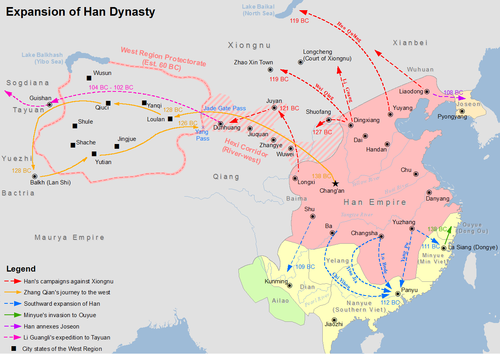
Emperor Wu (汉武帝, Hàn Wǔdì) ascends. He establishes Confucianism as state orthodoxy and expands borders, heavily documented in the Hanshu (Book of Han). #ancient #history #east-asia
Zhang Qian (张骞, Zhāng Qiān) is sent west to ally with the Yuezhi against Xiongnu. His journeys open the Silk Road, recorded in the Shiji and Hanshu. #ancient #history #east-asia
Generals Wei Qing (卫青, Wèi Qīng) and Huo Qubing (霍去病, Huò Qùbìng) decisively defeat the Xiongnu at the Battle of Mobei, securing the northern frontier. #ancient #history #east-asia
Sima Qian (司马迁, Sīmǎ Qiān) begins compiling the Shiji (史记, Records of the Grand Historian), China's first comprehensive universal history book. #ancient #history #east-asia
The Xiongnu confederation begins fragmenting into rival factions, weakening their threat to Han borders—a process that would eventually lead to the southern Xiongnu submitting to Han suzerainty. #war #diplomacy

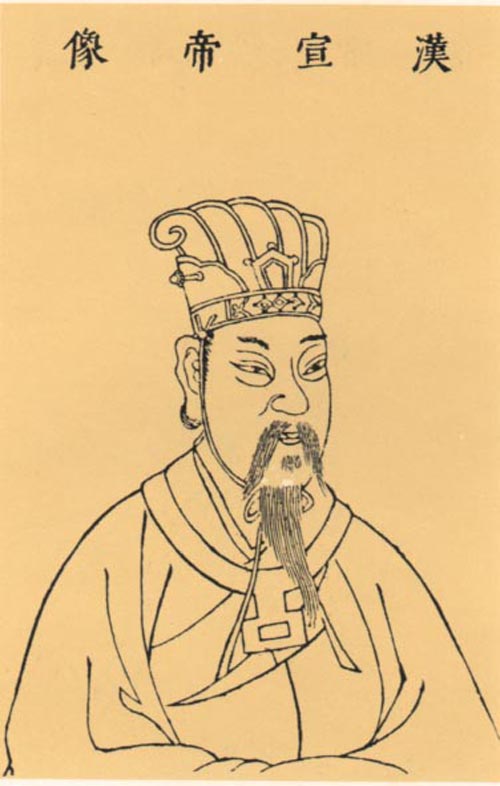
Emperor Xuan of Han dies after a 25-year reign marked by territorial expansion and administrative reform. His son Liu Shi ascends as Emperor Yuan (汉元帝), beginning a period of court factionalism between Confucian scholars and eunuchs that weakens central authority. #politics #succession

Emperor Xuan of Han (汉宣帝) continues policies of reducing taxes and promoting officials by merit rather than aristocratic birth, consolidating the dynasty's recovery from the Wang Mang interregnum. #politics #reform
The court-sponsored Stone Canal Pavilion (石渠阁, Shíqúgé) conference on classical texts, initiated under Emperor Xuan, concludes its work standardizing interpretations of Confucian classics for the imperial examination system. #education #philosophy

Han diplomat Chang Hui (常惠) finalizes arrangements with the Xiongnu Right Worthy King, consolidating the recent Han victory and securing frontier stability through a combination of military pressure and diplomatic engagement. #diplomacy #war

Han official Zheng Ji (郑吉) continues administering the Western Regions protectorate, maintaining Silk Road stability and Han influence over oasis city-states in the Tarim Basin. #diplomacy #trade

Sima Qian's monumental Shiji (Records of the Grand Historian), largely completed by this period, circulates among scholars in manuscript form. The work establishes the annalistic-biographical format that becomes the standard for subsequent Chinese official histories. #literature #history

The Protectorate of the Western Regions, established under Zheng Ji's administration, facilitates peak Silk Road commerce between Han China and Central Asian kingdoms including Ferghana and Sogdiana, with Chinese silk reaching Parthian markets. #trade #economy
Wang Mang (王莽, Wáng Mǎng) usurps the throne, ending the Western Han and founding the short-lived Xin Dynasty. His radical land reforms cause massive internal strife. #ancient #history #east-asia
At the Battle of Kunyang, Liu Xiu (刘秀, Liú Xiù) leads a vastly outnumbered rebel force to crush Wang Mang's army, a pivotal victory recorded in the Hou Hanshu. #ancient #history #east-asia
Liu Xiu proclaims himself Emperor Guangwu (汉光武帝, Hàn Guāngwǔdì), restoring the Han Dynasty (Eastern Han) and moving the capital to Luoyang. #ancient #history #east-asia
Ban Chao (班超, Bān Chāo) launches campaigns in the Western Regions, securing the Tarim Basin and Silk Road trade routes for the Eastern Han, per the Hou Hanshu. #ancient #history #east-asia
Cai Lun (蔡伦, Cài Lún) presents an improved papermaking process using bark and hemp to the emperor, revolutionizing literature and global scientific progress. #ancient #history #east-asia
Polymath Zhang Heng (张衡, Zhāng Héng) invents the world's first seismoscope (候风地动仪, Hòufēng Dìdòngyí) to detect distant earthquakes, advancing Han science. #ancient #history #east-asia
Zhang Daoling (张道陵, Zhāng Dàolíng) founds the Way of the Celestial Masters (Tianshi Dao), institutionalizing religious Taoism and influencing later rebellions. #ancient #history #east-asia
Envoys from Da Qin (大秦, Dà Qín - Roman Empire) arrive via the southern sea route. This first Sino-Roman contact is officially recorded in the Hou Hanshu. #ancient #history #east-asia
Emperor Ling (汉灵帝, Hàn Língdì) ascends. The Ten Attendants (十常侍, Shí Chángshì), a powerful eunuch faction, seize control, sparking severe court corruption. #ancient #history #east-asia
Zhang Jiao (张角, Zhāng Jiǎo) leads the Yellow Turban Rebellion (黄巾起义, Huángjīn Qǐyì), a massive Taoist peasant uprising that fatally weakens the Eastern Han. #ancient #history #east-asia
Warlord Dong Zhuo (董卓, Dǒng Zhuó) seizes Luoyang, deposes Emperor Shao, and installs Emperor Xian. His tyranny unites regional lords against him, per Sanguozhi. #ancient #history #east-asia
Cao Cao (曹操, Cáo Cāo) takes Emperor Xian (汉献帝, Hàn Xiàndì) under his protection in Xu, effectively controlling the Han court and acting as the de facto ruler. #ancient #history #east-asia
At the Battle of Red Cliffs (赤壁之战, Chìbì zhī Zhàn), the allied forces of Sun Quan and Liu Bei defeat Cao Cao's fleet, cementing the tripartite division of China. #ancient #history #east-asia
Cao Pi (曹丕, Cáo Pī) forces Emperor Xian to abdicate, officially ending the Han Dynasty and establishing the state of Cao Wei, as chronicled in the Sanguozhi. #ancient #history #east-asia