Encyclopedia/3. History, Societies & Civilizations/09. Modern Nations/01. Africa • Curated by Admin Timeline.sg
History of Zambia (AI-generated, sourced to Wikipedia).
Chronological Storyline (30 Milestones)
100000 BCE
Early Stone Age habitation
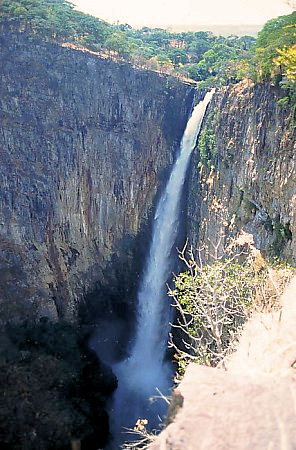
Archaeological evidence at Kalambo Falls and other sites shows continuous human habitation in what is now Zambia since the Early Stone Age. Source — Wikipedia, "Zambia":
Kalambo Falls, Zambia. By Worldtraveller at English Wikipedia - From gallery.world-traveller.org, CC BY-SA 3.0, https://commons.wikimedia.org/w/index.php?curid=585555
300 CE
Bantu migration reaches region
Bantu-speaking peoples migrated into the area, introducing iron-working, agriculture, and pastoralism, displacing or absorbing earlier inhabitants. Source — Wikipedia, "Zambia":
Spread of the "Early Iron Age" in Eastern, Central and Southern Africa, a proxy for the Bantu migrations. Based on K. Shillington, History of Africa (3rd ed. 2005), p. 63. Urewe (Lake Victoria) 250 BCE, Kwale 200 CE, Kisale 300 CE, , Kalundu/Dambwa 100 CE , Kalambo 300 CE, Nkope 300 CE, Gokmere-Ziwa/Bambata 300 CE, presence in South Africa (Kei river) by 400 CE. By Unknown author - East&southern africa early iron age.gif, Public domain, https://commons.wikimedia.org/w/index.php?curid=5444722
1500 CE
Lunda Empire established
The Lunda Empire arose in the Katanga region and extended influence over parts of northern Zambia, establishing trade networks and political structures. Source — Wikipedia, "Zambia":
Map of Major States in the Southern Savannas, Mid-Nineteenth Century. Based on information from Jan Vansina, Kingdoms of the Savanna, Madison, 1968. The map includes the Lunda Empire (with the Lunda heartland), the Luba kingdoms, the Luba-Kasai and the Kuba kingdom as they were thought to have been around 1850. By Library of Congress - Zaire : a country study (1994), Public domain, https://commons.wikimedia.org/w/index.php?curid=37840534
1600 CE
Lozi Kingdom founded
The Lozi Kingdom was established in the upper Zambezi floodplain, developing a distinctive political system centered on the Litunga (king). Source — Wikipedia, "Zambia":
Flag of Barotseland, homeland of the Lozi people in western Zambia. By Himasaram - Data from FOTW, Public domain, https://commons.wikimedia.org/w/index.php?curid=1049018
May 15, 1851 CE
Livingstone arrives in region
Scottish missionary and explorer David Livingstone first arrived in the territory, beginning European exploration of the upper Zambezi. Source — Wikipedia, "Zambia":
"David Livingstone, 1813 - 1873. Missionary and explorer", a carbon print of a photograph by Thomas Annan, 36.90 x 30.20 cm. Gift to the National Galleries of Scotland by T & R Annan and Sons, 1930 Restoration notes This was an interesting one. Quality was absolutely superb; detail's incredible. Printing technology is often what holds back image detail in this period, and the paper texture is really pretty much unnoticable at this scale. In any case, this is excellent work. This does show up some flaws. One knee is pretty badly out of focus. The edges had some pretty major damage, lower right hand corner was probably the worst. The background was very dirty - probably because people selectively handled it - but since that's just a smooth bokeh it's not that big of a deal; any minor variance from the original is not meaningful. Some noticable damage around the edges of a sharp transition from light to dark ; that might be some chemical thing, like dye leeching, might just be particularly noticable since it's more precise work; in any case, I fixed it. By Thomas Annan / Adam Cuerden - National Galleries of Scotland Accession number: PGP 74.2, Public domain, https://commons.wikimedia.org/w/index.php?curid=6887585
Nov 16, 1855 CE
Victoria Falls documented
David Livingstone became the first European to see Mosi-oa-Tunya, naming it Victoria Falls in honor of Queen Victoria. Source — Wikipedia, "Zambia":
Aerial view of the Victoria Falls of the Zambezi River, border between Zambia (left side) and Zimbabwe (right side). The Victoria Falls is the largest sheet of falling water in the world based on its combined width of 1,708 metres (5,604 ft) and height of 108 metres (354 ft). By Diego Delso - Own work, CC BY-SA 4.0, https://commons.wikimedia.org/w/index.php?curid=73750624
1888 CE
Lewanika signs BSAC concession
Lozi King Lewanika signed a mineral concession with representatives of Cecil Rhodes's British South Africa Company, opening the region to European exploitation. Source — Wikipedia, "Zambia":
Lewanika photographed during his visit to Edinburgh in 1902 By G.H. Tod - http://www.nrzam.org.uk/NRJ/V2N1/V2N1.html, Public domain, https://commons.wikimedia.org/w/index.php?curid=25369071
1899 CE
North-Western Rhodesia proclaimed
The British South Africa Company established administrative control over the territory west of the Kafue River, naming it North-Western Rhodesia. Source — Wikipedia, "Zambia":
North-Western Rhodesia proclaimed By Unknown author - This vector image includes elements that have been taken or adapted from this file:, CC BY-SA 4.0, https://commons.wikimedia.org/w/index.php?curid=129331281
Aug 17, 1911 CE
Northern Rhodesia formed
North-Western and North-Eastern Rhodesia were amalgamated into the single protectorate of Northern Rhodesia, establishing the colonial entity that would become Zambia. Source — Wikipedia, "Zambia":
Flag of Northern Rhodesia, 1939–1964Sable six palets wavy Argent on a Chief Azure an eagle reguardant wings expanded Or holding in the talons a Fish of the second. By Greentubing (en:WP talk) - This SVG coat of arms includes elements that have been taken or adapted from this coat of arms:, Public domain, https://commons.wikimedia.org/w/index.php?curid=582615
1924 CE
British Crown takes over
Administration of Northern Rhodesia transferred from the British South Africa Company to the British Colonial Office, formalizing it as a protectorate. Source — Wikipedia, "Zambia":
Flag of Northern Rhodesia, 1939–1964Sable six palets wavy Argent on a Chief Azure an eagle reguardant wings expanded Or holding in the talons a Fish of the second. By Greentubing (en:WP talk) - This SVG coat of arms includes elements that have been taken or adapted from this coat of arms:, Public domain, https://commons.wikimedia.org/w/index.php?curid=582615
May 1, 1935 CE
Copperbelt miners' strike
African copper miners staged a major strike on the Copperbelt, protesting low wages and poor conditions, marking early organized labor resistance. Source — Wikipedia, "Zambia":
Location of en:Copperbelt Province, Zambia in Zambia By User:Profoss - This vector image includes elements that have been taken or adapted from this file:, CC BY-SA 3.0, https://commons.wikimedia.org/w/index.php?curid=17218683
Aug 1, 1953 CE
Federation of Rhodesia and Nyasaland
Britain joined Northern Rhodesia, Southern Rhodesia, and Nyasaland into a federation, a move opposed by African nationalist leaders. Source — Wikipedia, "Zambia":
Flag of the Federation of Rhodesia and Nyasaland By UnknownUnknown , vector version by Lupin, Greentubing, Fenn-O-maniC and NikNaks - This SVG coat of arms includes elements from this flag:, Public domain, https://commons.wikimedia.org/w/index.php?curid=583771
1958 CE
Kaunda forms ZANC
Kenneth Kaunda broke from the African National Congress to form the more radical Zambia African National Congress, accelerating the independence movement. Source — Wikipedia, "Zambia":
The President of Zambia Kenneth David Kaunda By Unknown photographer - This image has been extracted from another file, Public domain, https://commons.wikimedia.org/w/index.php?curid=106689643
1960 CE
UNIP established
The United National Independence Party was formed with Kenneth Kaunda as leader, becoming the principal vehicle for Zambian independence. Source — Wikipedia, "Zambia":
UNIP logo By United National Independence Party - https://www.facebook.com/unip.za/, Public domain, https://commons.wikimedia.org/w/index.php?curid=104916047
Dec 31, 1963 CE
Federation dissolved
The Federation of Rhodesia and Nyasaland was officially dissolved, paving the way for separate independence for each territory. Source — Wikipedia, "Zambia":
Flag of the Federation of Rhodesia and Nyasaland By UnknownUnknown , vector version by Lupin, Greentubing, Fenn-O-maniC and NikNaks - This SVG coat of arms includes elements from this flag:, Public domain, https://commons.wikimedia.org/w/index.php?curid=583771
Oct 24, 1964 CE
Zambia gains independence
Northern Rhodesia became the independent Republic of Zambia with Kenneth Kaunda as its first president, ending British colonial rule. Source — Wikipedia, "Zambia":
Flag of Zambia By Gabriel Ellison - National Flag and Armorial Ensigns Act Construction sheet:, Public domain, https://commons.wikimedia.org/w/index.php?curid=401886Video
Dec 1, 1972 CE
One-party state declared
Kaunda's government formally established a one-party state under UNIP, banning opposition parties through the Chona Commission recommendations. Source — Wikipedia, "Zambia":
Flag of Zambia By Gabriel Ellison - National Flag and Armorial Ensigns Act Construction sheet:, Public domain, https://commons.wikimedia.org/w/index.php?curid=401886
Feb 5, 1975 CE
TAZARA railway agreement
Zambia and Tanzania signed an agreement with China to build the TAZARA railway, providing a trade route bypassing Rhodesia and apartheid South Africa. Source — Wikipedia, "Zambia":
Railway network of Tanzania Legend: ━━━ 1000 mm gauge tracks ━━━ 1067 mm gauge tracks ━━━ country borders By Jkan997 - http://sharemap.org/jkan/railway/Railways%20in%20Tanzania, CC BY 3.0, https://commons.wikimedia.org/w/index.php?curid=15846075
Jul 14, 1976 CE
TAZARA railway completed
The 1,860 km TAZARA railway from Kapiri Mposhi to Dar es Salaam was completed, a major Chinese-funded infrastructure project in Africa. Source — Wikipedia, "Zambia":
Railway network of Tanzania Legend: ━━━ 1000 mm gauge tracks ━━━ 1067 mm gauge tracks ━━━ country borders By Jkan997 - http://sharemap.org/jkan/railway/Railways%20in%20Tanzania, CC BY 3.0, https://commons.wikimedia.org/w/index.php?curid=15846075
1985 CE
Economic crisis deepens
Falling copper prices and debt forced Zambia to accept IMF structural adjustment programs, leading to food riots and severe economic hardship. Source — Wikipedia, "Zambia":
Downtown Lusaka showing the Findeco Building from the south end round-a-bout. By Matthew Grollnek - Own work, CC BY-SA 4.0, https://commons.wikimedia.org/w/index.php?curid=36379325
Dec 1, 1990 CE
Multiparty system restored
Under domestic and international pressure, Kaunda signed constitutional amendments ending the one-party state and allowing multiparty elections. Source — Wikipedia, "Zambia":
The President of Zambia Kenneth David Kaunda By Unknown photographer - This image has been extracted from another file, Public domain, https://commons.wikimedia.org/w/index.php?curid=106689643
Oct 31, 1991 CE
Chiluba elected president
Frederick Chiluba and the Movement for Multiparty Democracy defeated Kaunda in Zambia's first multiparty election, ending 27 years of UNIP rule. Source — Wikipedia, "Zambia":
Jacques Delors, President of the EC, and Manuel Marín, Vice-President of the EC in charge of Cooperation and Development (Economic Cooperation with Southern Mediterranean, Middle East, Latin America and Asia and the Lomé Convention) and the European Community Humanitarian Office, received Frederick Chiluba, President of Zambia. The visit was the occasion for a reconfirmation of the European Union's support for Zambia's political and economic transition. Among the issues discussed was the need to maintain, and in some areas to accelerate, economic reform (e.g. agricultural liberalisation, privatisation of certain parastatals, improvement of revenue collection); and - in particular - the importance of strengthening the democratic institutions and the rule of law. By European Communities, 1994 / EC - Audiovisual Service - Visit of Frederick Chiluba, President of Zambia, to the EC, CC BY 4.0, https://commons.wikimedia.org/w/index.php?curid=159662549
1998 CE
HIV/AIDS epidemic peaks
HIV prevalence in Zambia reached approximately 16% of adults, prompting major public health campaigns and international intervention programs. Source — Wikipedia, "Zambia":
Flag of Zambia By Gabriel Ellison - National Flag and Armorial Ensigns Act Construction sheet:, Public domain, https://commons.wikimedia.org/w/index.php?curid=401886
Dec 27, 2001 CE
Mwanawasa elected president
Levy Mwanawasa won the presidency in elections marked by controversy, later gaining recognition for anti-corruption efforts targeting predecessor Chiluba. Source — Wikipedia, "Zambia":
IMF Managing Director Rodrigo de Rato y Figaredo meeting with The Republic of Zambia's President H. E Levy Patric Mwanawasa By International Monetary Fund - http://www.imf.org/external/np/adm/pictures/captions.htm, Public domain, https://commons.wikimedia.org/w/index.php?curid=1178168
Aug 19, 2008 CE
Mwanawasa dies in office
President Levy Mwanawasa died after suffering a stroke in June, leading to Vice President Rupiah Banda assuming the presidency. Source — Wikipedia, "Zambia":
IMF Managing Director Rodrigo de Rato y Figaredo meeting with The Republic of Zambia's President H. E Levy Patric Mwanawasa By International Monetary Fund - http://www.imf.org/external/np/adm/pictures/captions.htm, Public domain, https://commons.wikimedia.org/w/index.php?curid=1178168
Sep 20, 2011 CE
Sata wins presidency
Opposition leader Michael Sata of the Patriotic Front defeated incumbent Rupiah Banda, marking another peaceful transfer of power in Zambia. Source — Wikipedia, "Zambia":
Michael Chilufya Sata, President of Zambia. By European Communities, 2014 / EC - Audiovisual Service - Visit of Michael Chilufya Sata, President of Zambia, to the EC, CC BY 4.0, https://commons.wikimedia.org/w/index.php?curid=159663333
Feb 12, 2012 CE
Zambia wins Africa Cup
The Zambia national football team won the Africa Cup of Nations for the first time, defeating Ivory Coast in a dramatic penalty shootout in Libreville. Source — Wikipedia, "Zambia":
Flag of Zambia By Gabriel Ellison - National Flag and Armorial Ensigns Act Construction sheet:, Public domain, https://commons.wikimedia.org/w/index.php?curid=401886
Oct 28, 2014 CE
Sata dies in office
President Michael Sata died in a London hospital, making Vice President Guy Scott acting president, the first white head of state in Africa since apartheid ended. Source — Wikipedia, "Zambia":
Michael Chilufya Sata, President of Zambia. By European Communities, 2014 / EC - Audiovisual Service - Visit of Michael Chilufya Sata, President of Zambia, to the EC, CC BY 4.0, https://commons.wikimedia.org/w/index.php?curid=159663333
Jan 25, 2015 CE
Lungu elected president
Edgar Lungu won a narrow presidential by-election following Sata's death, continuing the Patriotic Front's hold on power. Source — Wikipedia, "Zambia":
On December 19, 2018, Prime Minister Abe held a summit meeting with President Edgar Chagwa Lungu of the Republic of Zambia at the Prime Minister's Office. By 内閣官房内閣広報室 - https://www.kantei.go.jp/jp/98_abe/actions/201812/19zambia.html, CC BY 4.0, https://commons.wikimedia.org/w/index.php?curid=116674350
Aug 16, 2021 CE
Hichilema elected president
Opposition leader Hakainde Hichilema defeated incumbent Edgar Lungu in a landslide, marking Zambia's third peaceful democratic transfer of power. Source — Wikipedia, "Zambia":
Sergio Mattarella and Hakainde Hichilema in 2022 By Presidenza della Repubblica - https://www.quirinale.it/elementi/69373, Attribution, https://commons.wikimedia.org/w/index.php?curid=120303698