Encyclopedia/3. History, Societies & Civilizations/09. Modern Nations/01. Africa • Curated by Admin Timeline.sg
History of Tunisia (AI-generated, sourced to Wikipedia).
Chronological Storyline (29 Milestones)
814 BCE
Carthage Founded by Phoenicians
Phoenician settlers from Tyre, led by the legendary Queen Dido (Elissa), established the city-state of Carthage on the Gulf of Tunis, which would become a major Mediterranean power. Source — Wikipedia, "Tunisia":
Location of Carthage and Carthaginian sphere of influence prior to the First Punic War (264 BC) Source: Self-made, based on Putzger Atlas und Chronik zur Weltgeschichte, Berlin, 2002 Template: [1] Author: BishkekRocks By No machine-readable author provided. BishkekRocks assumed (based on copyright claims). - No machine-readable source provided. Own work assumed (based on copyright claims)., Public domain, https://commons.wikimedia.org/w/index.php?curid=641092
264 BCE
First Punic War Begins
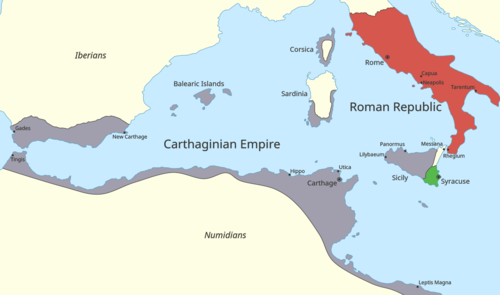
The First Punic War broke out between Rome and Carthage over control of Sicily, marking the start of a prolonged struggle for Mediterranean dominance lasting over two decades. Source — Wikipedia, "Tunisia":
Map of the western Mediterranean Sea in 264 BC, focusing on the states involved in the First Punic War. By Harrias - This file was derived from: First Punic War 264 BC v2.png Changes: Adjusted Carthaginian territory in Corsica and Sardinia. Information from: Muir, Ramsay; Treharne R. F.; Fullard, Harold (1969). Muir's Historical Atlas. London: George Philip and Son. OCLC 1090019533 p. 11, map B., CC BY-SA 4.0, https://commons.wikimedia.org/w/index.php?curid=93911131
218 BCE
Hannibal Crosses the Alps
Carthaginian general Hannibal Barca led his army, including war elephants, across the Alps into Italy during the Second Punic War, achieving several stunning victories against Rome. Source — Wikipedia, "Tunisia":
A glass plate photograph of the marble bust of Hannibal Barca. The bust of the Carthaginian general was discovered in the Italian city of Capua in 1667. The Roman era bust was made between the 1st century BC and 4 century AD (I sec.a.C.- IV sec. d.C.). It is preserved in the National Archaeological Museum of Naples. The photograph was taken by Fratelli Alinari in the National Archaeological Museum, Naples, Italy, circa 1900. By Fratelli Alinari - Reddit - https://www.reddit.com/r/europe/comments/d0szfs/a_marble_bust_of_hannibal_𐤇𐤍𐤁𐤏𐤋_originally_found/ . The original photograph source = alinari.it, Public domain, https://commons.wikimedia.org/w/index.php?curid=143554037
Oct 19, 202 BCE
Battle of Zama
Roman general Scipio Africanus decisively defeated Hannibal at Zama, ending the Second Punic War and cementing Roman supremacy over Carthage and the western Mediterranean. Source — Wikipedia, "Tunisia":
Flag of Tunisia. By Various Wikimedia Commons' contributors - Own work based on: on this PDF: Loi du 30 juin 1999 relative au drapeau de la République tunisienne - Journal Officiel de la République Tunisienne (54), page 1088 (6 juillet 1999)., Public domain, https://commons.wikimedia.org/w/index.php?curid=433047
146 BCE
Destruction of Carthage
After a three-year siege, Roman forces under Scipio Aemilianus destroyed Carthage at the end of the Third Punic War, ending Carthaginian civilization and establishing Roman Africa. Source — Wikipedia, "Tunisia":
A map of the key locations and features in the city of Carthage around 149 BC, when the city was besieged by the Romans during the Third Punic War. By Harrias - Own work, loosely based on Goldsworthy, Adrian (2006). The Fall of Carthage: The Punic Wars 265–146 BC. London: Phoenix. ISBN 978-0-304-36642-2, p. 342; and Miles, Richard (2011). Carthage Must be Destroyed. London: Penguin. ISBN 978-0-141-01809-6, p. 2., CC BY-SA 4.0, https://commons.wikimedia.org/w/index.php?curid=95555913
Oct 19, 439 CE
Vandals Capture Carthage
The Vandals under King Genseric captured Carthage, making it the capital of the Vandal Kingdom and ending Roman rule in North Africa after nearly six centuries. Source — Wikipedia, "Tunisia":
Münze: 50 Denari Silber, de:Gelimer, König der Vandalen, um 530, Münzstätte Karthago, Beschriftung: D N REX G-EILAMIR By Unknown author - [1], Public domain, https://commons.wikimedia.org/w/index.php?curid=26421215
Sep 15, 533 CE
Byzantine Reconquest of Carthage
Byzantine general Belisarius recaptured Carthage from the Vandals during the Vandal War, restoring Eastern Roman control over the region for the next century. Source — Wikipedia, "Tunisia":
Flag of Tunisia. By Various Wikimedia Commons' contributors - Own work based on: on this PDF: Loi du 30 juin 1999 relative au drapeau de la République tunisienne - Journal Officiel de la République Tunisienne (54), page 1088 (6 juillet 1999)., Public domain, https://commons.wikimedia.org/w/index.php?curid=433047
670 CE
Kairouan Founded
Arab general Uqba ibn Nafi founded the city of Kairouan, which became the first Islamic city in North Africa and a major center of learning and religion. Source — Wikipedia, "Tunisia":
From top to bottom and from left to right: 1) monument to Kairouan carpets; 2) Great Mosque; 3) almedina walls; 4) aglad water deposits; 5) zouïa de Sidi Abid el-Ghariani; 6) makrouds (pastel of pasta and dates); 7) Kairouan carpets; 8) zoco (market) of the goldsmiths. By ELEL09, montage et assemblage - Author: Mohamed Amine ABASSI Author: Dennis Jarvis Author: damian entwistle Author: Bgag Author: Dyolf77 Author: Alexandre Moreau Author: dearbarbie / 金娜 Kim S Author: Citizen59 Author: Moumou82, CC BY-SA 3.0, https://commons.wikimedia.org/w/index.php?curid=30691938
800 CE
Aghlabid Dynasty Established
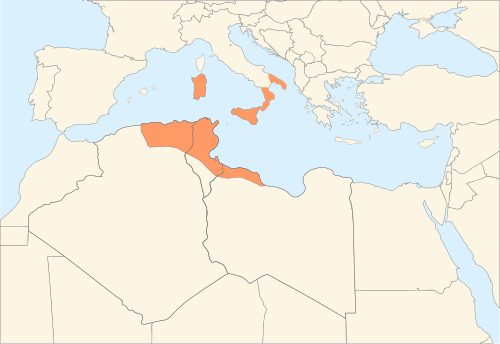
Ibrahim I ibn al-Aghlab became the first emir of the Aghlabid dynasty, governing Tunisia under nominal Abbasid suzerainty and launching conquests into Sicily and Malta. Source — Wikipedia, "Tunisia":
Carte de l'extension maximale du royaume des Aghlabides. By The original uploader was Nanoxyde at French Wikipedia. - Travail personnel, CC BY-SA 2.5, https://commons.wikimedia.org/w/index.php?curid=3972515
Mar 1, 909 CE
Fatimid Caliphate Founded
Ubayd Allah al-Mahdi Billah established the Fatimid Caliphate in Mahdia, overthrowing the Aghlabids and creating an Ismaili Shia empire spanning North Africa and beyond. Source — Wikipedia, "Tunisia":
Map the Fatimid Empire (chronological)Map drawn acc. to: Euratlas' map of the Fatimid Empire c.1000 [1] Qantara-Med's map of the Mediterranean c.1000 [2] Territories in green represent Hammadid and Zirid realms, resp. indep. in 1018 and 1048 Ian Mladjov's map of the Eastern Mediterranean in 1096 [3] Qantara-Med's map of the Mediterranean c.1100 [4] By Omar-toons - Own work, CC BY-SA 4.0, https://commons.wikimedia.org/w/index.php?curid=36397574
1050 CE
Banu Hilal Invasions
The Banu Hilal and Banu Sulaym tribes, sent by the Fatimids, invaded Ifriqiya, devastating the agricultural economy and accelerating the Arabization of the region. Source — Wikipedia, "Tunisia":
Historical tribal map of the Arabian Peninsula The image is a historical tribal map of the Arabian Peninsula, drawn by the English orientalist Harold Dixon approximately 100 years ago. The map depicts the distribution of various tribes across Arabia, including present-day Saudi Arabia, Yemen, Oman, UAE, Qatar, Kuwait, Iraq, and surrounding regions. Key Features of the Map: Towns and Cities: Major towns such as Mecca, Medina, Riyadh, Jeddah, Damascus, Baghdad, and others are marked in block letters and underlined. Tribal Boundaries: The boundaries of different tribes are indicated using fine dotted lines. Tribal Names: Various tribes, including Anizah, Ruwala, Mutair, Qahtan, Bani Yam, and others, are labeled in italicized text. Annotations & Notes: The map includes references and notes, explaining the tribal divisions and their approximate locations. This rough tribal map serves as a valuable historical document, offering insights into the tribal and socio-political landscape of the Arabian Peninsula in the early 20th century. By SPQR10 - Dixon, Harold. A Map of the Tribes of the Arabian Peninsula. Drawn by English orientalist Harold Dixon, approximately 1) Adaptation from https://commons.wikimedia.org/wiki/File:%D8%AE%D8%B1%D9%8A%D8%B7%D8%A9_%D9%82%D8%A8%D8%A7%D8%A6%D9%84_%D8%A7%D9%84%D8%AC%D8%B2%D9%8A%D8%B1%D8%A9_%D8%A7%D9%84%D8%B9%D8%B1%D8%A8%D9%8A%D8%A9_%D9%84%D9%85%D8%B3%D8%AA%D8%B4%D8%B1%D9%82_%D8%A3%D9%86%D8%AC%D9%84%D9%8A%D8%B2%D9%8A_%D9%82%D8%A8%D9%84_%D9%85%D8%A6%D8%A9_%D8%B3%D9%86%D8%A9_%D9%88%D8%B6%D8%B9%D9%87%D8%A7_%D8%A7%D9%84%D9%85%D8%B3%D8%AA%D8%B4%D8%B1%D9%82_%D9%87%D8%A7%D8%B1%D9%88%D9%84%D8%AF_%D8%AF%D9%8A%D9%83%D8%B3%D9%88%D9%86.jpg 2)https://en.wikipedia.org/wiki/File:Tribes_english.png by User Slackerlawstudent, CC0, https://commons.wikimedia.org/w/index.php?curid=161460231
1148 CE
Almohad Conquest of Tunis
The Almohad Caliphate under Abd al-Mu'min conquered Tunis, unifying the Maghreb under Berber Muslim rule and bringing Ifriqiya firmly under Almohad control. Source — Wikipedia, "Tunisia":
Almohad dynasty, was a ruling dynasty of Morocco, then Caliphate since 1147, at its greatest extent (early 13th century). By Flaspec - This file was derived from: Empire almohade-es.svg: RowanwindwhistlerSelon: Qantara-Med.org [1] [2], CC BY-SA 4.0, https://commons.wikimedia.org/w/index.php?curid=96587264
1228 CE
Hafsid Dynasty Established
Abu Zakariya Yahya declared independence from the Almohads and established the Hafsid dynasty in Tunis, which would rule Ifriqiya for over three centuries. Source — Wikipedia, "Tunisia":
Map of the Hafsid dynasty/kingdom in North Africa, AD 1400. By Gabagool - Own work, CC BY 3.0, https://commons.wikimedia.org/w/index.php?curid=6364825
1347 CE
Black Death Reaches Tunis
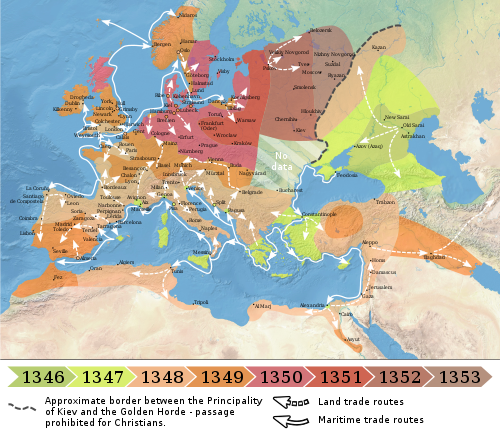
The Black Death pandemic reached Tunis, causing massive mortality and disrupting the Hafsid economy and society during one of history's deadliest outbreaks. Source — Wikipedia, "Tunisia":
Map showing the spread of the Black Death in Europe between 1346 and 1353. By Flappiefh - Own work from: Natural Earth ; Cesana, D.; Benedictow O.J., Bianucci R. (2017). "The origin and early spread of the Black Death in Italy: first evidence of plague victims from 14th-century Liguria (northern Italy)". Anthropological Science 125 (1): 15–24. DOI:10.1537/ase.161011. ISSN 0918-7960. (page 17), CC BY-SA 4.0, https://commons.wikimedia.org/w/index.php?curid=66468361
1377 CE
Ibn Khaldun Writes the Muqaddimah
The renowned Tunisian historian and sociologist Ibn Khaldun completed the Muqaddimah, a groundbreaking work on history, sociology, and economics, while in Tunis. Source — Wikipedia, "Tunisia":
The Muqaddimah of Ibn Khaldun By Riad Salih - Own work, CC BY 4.0, https://commons.wikimedia.org/w/index.php?curid=154963244
Sep 1, 1574 CE
Ottoman Conquest of Tunis
Ottoman forces under Sinan Pasha captured Tunis, incorporating Tunisia into the Ottoman Empire and ending Hafsid rule after over three centuries of governance. Source — Wikipedia, "Tunisia":
Flag of Tunisia. By Various Wikimedia Commons' contributors - Own work based on: on this PDF: Loi du 30 juin 1999 relative au drapeau de la République tunisienne - Journal Officiel de la République Tunisienne (54), page 1088 (6 juillet 1999)., Public domain, https://commons.wikimedia.org/w/index.php?curid=433047
Jul 1, 1705 CE
Husainid Dynasty Founded
Al-Husayn I ibn Ali established the Husainid dynasty, which would govern Tunisia as semi-autonomous Ottoman rulers until the French protectorate in 1881. Source — Wikipedia, "Tunisia":
Husainid Dynasty Founded By Unknown author - This vector image includes elements that have been taken or adapted from this file:, CC BY-SA 4.0, https://commons.wikimedia.org/w/index.php?curid=109277506
Apr 1, 1869 CE
Tunisia Declares Bankruptcy
Facing mounting debts from modernization projects, the Tunisian government declared bankruptcy, leading to international financial control and eventual French intervention. Source — Wikipedia, "Tunisia":
Carte de la Tunisie en 1844 By Meyer's Handatlas - http://bp1.blogger.com/_bgWdC6u3DCM/RZKYbW2MkBI/AAAAAAAAAqI/nxtcw6lvmtQ/s1600-h/tunisie_1844.jpg, Public domain, https://commons.wikimedia.org/w/index.php?curid=4344185
May 12, 1881 CE
French Protectorate Established
France imposed the Treaty of Bardo on Tunisia, establishing a protectorate over the country while preserving nominal sovereignty of the Husainid bey. Source — Wikipedia, "Tunisia":
Flag of the Beylik of Tunis (1831–1881) and Tunisia (1881–1959) By This vector image includes elements that have been taken or adapted from this file: - This file was derived from: Flag of Tunisia (1959–1999).svg, Public domain, https://commons.wikimedia.org/w/index.php?curid=89625669
Mar 2, 1934 CE
Neo Destour Party Founded
Habib Bourguiba co-founded the Neo Destour party, which became the leading force in the Tunisian independence movement and shaped the post-independence state. Source — Wikipedia, "Tunisia":
Flag of Tunisia. By Various Wikimedia Commons' contributors - Own work based on: on this PDF: Loi du 30 juin 1999 relative au drapeau de la République tunisienne - Journal Officiel de la République Tunisienne (54), page 1088 (6 juillet 1999)., Public domain, https://commons.wikimedia.org/w/index.php?curid=433047
Mar 20, 1956 CE
Tunisia Gains Independence
Tunisia officially gained independence from France, ending 75 years of French colonial rule with Habib Bourguiba becoming the country's first prime minister. Source — Wikipedia, "Tunisia":
Le jour de l'indépendance (20 mars 1956) à Tunis, Tunisie By Unknown author - http://www.vospiresamis.net/PAFmediaEscal/Tunis-indep.jpg, Public domain, https://commons.wikimedia.org/w/index.php?curid=5527373
Aug 13, 1956 CE
Code of Personal Status Enacted
Bourguiba's government enacted the Code of Personal Status, granting women unprecedented legal rights including divorce, polygamy abolition, and civil marriage. Source — Wikipedia, "Tunisia":
Jour de promulgation officielle du Code du Statut Personnel (CSP) tunisien. Ahmed Mestiri, ministre de la justice est assis à coté de Bourguiba. A droite de la photo est assis le cheikh Mohamed Tahar Ben Achour. En gris debout derrière Bourguiba, se dresse Abdallah Farhat. Dans cette réunion, la lecture du CSP fut donnée par cheikh Mohamed Tahar Ben Achour en présence aussi de quelques membres du gouvernement et aussi du cheikh Mohamed Abdelaziz Djaït (debout en jebba blanche). By Unknown author - https://www.facebook.com/143117465750409/photos/a.446139822114837.104262.143117465750409/1184940844901394/?type=3&theater, Public domain, https://commons.wikimedia.org/w/index.php?curid=52241541
Jul 25, 1957 CE
Republic Declared
The Tunisian monarchy was abolished and the Republic of Tunisia was proclaimed, with Habib Bourguiba becoming the country's first president and head of state. Source — Wikipedia, "Tunisia":
Carte de la Tunisie en 1844 By Meyer's Handatlas - http://bp1.blogger.com/_bgWdC6u3DCM/RZKYbW2MkBI/AAAAAAAAAqI/nxtcw6lvmtQ/s1600-h/tunisie_1844.jpg, Public domain, https://commons.wikimedia.org/w/index.php?curid=4344185
Nov 7, 1987 CE
Ben Ali Seizes Power
Prime Minister Zine El Abidine Ben Ali removed aging President Bourguiba in a bloodless constitutional coup, beginning a 23-year authoritarian regime. Source — Wikipedia, "Tunisia":
Flag of Tunisia. By Various Wikimedia Commons' contributors - Own work based on: on this PDF: Loi du 30 juin 1999 relative au drapeau de la République tunisienne - Journal Officiel de la République Tunisienne (54), page 1088 (6 juillet 1999)., Public domain, https://commons.wikimedia.org/w/index.php?curid=433047
Feb 14, 2004 CE
Tunisia Wins African Cup
Tunisia won the African Cup of Nations for the first time on home soil, defeating Morocco 2-1 in the final at the Stade 7 November in Tunis. Source — Wikipedia, "Tunisia":
Flag of Tunisia. By Various Wikimedia Commons' contributors - Own work based on: on this PDF: Loi du 30 juin 1999 relative au drapeau de la République tunisienne - Journal Officiel de la République Tunisienne (54), page 1088 (6 juillet 1999)., Public domain, https://commons.wikimedia.org/w/index.php?curid=433047
Dec 17, 2010 CE
Bouazizi Self-Immolation
Street vendor Mohamed Bouazizi set himself on fire in Sidi Bouzid, sparking mass protests that became the Tunisian Revolution and the wider Arab Spring. Source — Wikipedia, "Tunisia":
Flag of Tunisia. By Various Wikimedia Commons' contributors - Own work based on: on this PDF: Loi du 30 juin 1999 relative au drapeau de la République tunisienne - Journal Officiel de la République Tunisienne (54), page 1088 (6 juillet 1999)., Public domain, https://commons.wikimedia.org/w/index.php?curid=433047
Jan 14, 2011 CE
Ben Ali Flees Tunisia
President Ben Ali fled to Saudi Arabia after weeks of popular uprising, ending his 23-year regime and triggering democratic transitions across the Arab world. Source — Wikipedia, "Tunisia":
Photo prise lors de la manifestation du 14 janvier 2011 devant le ministère de l'intérieur à l'Avenue Habib Bourguiba - Tunis, un manifestant brandissant une pancarte avec le slogan : Ben Ali DEHORS By Skotch 79 - Own work, CC0, https://commons.wikimedia.org/w/index.php?curid=12875453
Jan 26, 2014 CE
New Constitution Adopted
The National Constituent Assembly adopted a new democratic constitution, enshrining civil liberties and establishing Tunisia as a civil state after the revolution. Source — Wikipedia, "Tunisia":
Flag of Tunisia. By Various Wikimedia Commons' contributors - Own work based on: on this PDF: Loi du 30 juin 1999 relative au drapeau de la République tunisienne - Journal Officiel de la République Tunisienne (54), page 1088 (6 juillet 1999)., Public domain, https://commons.wikimedia.org/w/index.php?curid=433047
Jul 25, 2021 CE
Saied Suspends Parliament
President Kais Saied suspended parliament, dismissed the government, and assumed extraordinary powers, a move critics described as a rollback of democratic gains. Source — Wikipedia, "Tunisia":
Above: an anti-coup demonstration, Tunis, October 10, 2021. Below: a pro Kais Saied demonstration, Tunis, October 3, 2021. By Mohatatou, CC BY-SA 4.0, https://commons.wikimedia.org/w/index.php?curid=111319803
![Location of Carthage and Carthaginian sphere of influence prior to the First Punic War (264 BC) Source: Self-made, based on Putzger Atlas und Chronik zur Weltgeschichte, Berlin, 2002 Template: [1] Author: BishkekRocks](https://upload.wikimedia.org/wikipedia/commons/thumb/4/44/CarthageMap.png/500px-CarthageMap.png)



![Map the Fatimid Empire (chronological)Map drawn acc. to: Euratlas' map of the Fatimid Empire c.1000 [1] Qantara-Med's map of the Mediterranean c.1000 [2] Territories in green represent Hammadid and Zirid realms, resp. indep. in 1018 and 1048 Ian Mladjov's map of the Eastern Mediterranean in 1096 [3] Qantara-Med's map of the Mediterranean c.1100 [4]](https://upload.wikimedia.org/wikipedia/commons/thumb/b/bc/Fatimid_Caliphate.PNG/500px-Fatimid_Caliphate.PNG)