Encyclopedia/3. History, Societies & Civilizations/09. Modern Nations/01. Africa • Curated by Admin Timeline.sg
History of Tanzania, sourced from Wikipedia's "Timeline of Tanzanian history".
Chronological Storyline (119 Milestones)
3000 BCE
Evidence of indigenous pottery and agriculture
Evidence of indigenous pottery and agriculture dating as far back as this period is found in the Tanzanian coast and offshore islands. Source — Wikipedia, "Timeline of Tanzanian history" (3rd millennium BC):
Evidence of indigenous pottery and agriculture By Unknown author, Public domain, https://commons.wikimedia.org/w/index.php?curid=343796
1000 BCE
Swahili coast
The earliest settlements in the Swahili coast appear on the archaeological record in Kwale in Kenya, Misasa in Tanzania and Ras Hafun in Somalia. Source — Wikipedia, "Timeline of Tanzanian history" (1st century BC):
The Swahili coast By Runehelmet - Own work, CC BY-SA 3.0, https://commons.wikimedia.org/w/index.php?curid=19847485
600 BCE
Graeco-Roman
International trade goods including Graeco-Roman pottery, Syrian glass vessels, Sassanian pottery from Persia and glass beads dating to this century are found at the Rufiji River delta. Source — Wikipedia, "Timeline of Tanzanian history" (6th century BC):
The Olympiaion was a temple dedicated to Zeus that was started in 515 BC. But which was only completed in Roman times under Emperor Hadrian in 131. This Roman emperor was a lover of Greek art but also of young ephebes like Antinous. In the background, we see the southern slope of the Acropolis and the Parthenon. By Jean-Pierre Dalbéra from Paris, France - L'Olympieion (Athènes), CC BY 2.0, https://commons.wikimedia.org/w/index.php?curid=75161515
1 CE
Periplus of the Erythrean Sea
The Periplus of the Erythrean Sea, a Graeco-Roman manuscript is written. It describes the East African coast (Azania) and an established Indian Ocean Trade route Source — Wikipedia, "Timeline of Tanzanian history" (1st century AD):
Locations, names and routes of the Periplus of the Erythraean Sea (1st century CE). By PHGCOM - self-made, background topographical map from Wikipedia Commons Image:Topographic30deg N0E60.png, CC BY-SA 4.0, https://commons.wikimedia.org/w/index.php?curid=7230440
1 CE
Oldowan
Oldowan stone tool culture at Olduvai Gorge. Source — Wikipedia, "Timeline of Tanzanian history" (Early Pleistocene):
Canto tallado de tradición Olduvayense procedente de la región del Sáhara atlántico Guelmim-Es Semara (Museo Arqueológico Nacional de Madrid) By José-Manuel Benito Álvarez (España) —> Locutus Borg - Own work, Public domain, https://commons.wikimedia.org/w/index.php?curid=1892114
100 CE
Haya people
Centuries ahead of European metallurgists, the Haya people from the western shores of Lake Victoria manufacture carbon steel. Source — Wikipedia, "Timeline of Tanzanian history" (2nd century AD):
This is an image of Cultural Fashion or Adornment from By Happiness Stephen - Own work, CC BY-SA 4.0, https://commons.wikimedia.org/w/index.php?curid=44826422
300 CE
Azania
Growth of Azanian and Zanj settlements in the Swahili coast. Local industry and international trade flourish. Source — Wikipedia, "Timeline of Tanzanian history" (4th century AD):
Identifier: descriptiondelun03mall (find matches) Title: Description de l'univers Year: 1683 (1680s) Authors: Mallet, Allain Manesson, 1630?-1706? Subjects: Geography Géographie Publisher: Paris, D. Thierry Contributing Library: University of Ottawa Digitizing Sponsor: University of Toronto View Book Page: Book Viewer About This Book: Catalog Entry View All Images: All Images From Book Click here to view book online to see this illustration in context in a browseable online version of this book. Text Appearing Before Image: ure. Ses principales Montagnes font les ^/£thhpici , Elephas & lesmonts de la Lune , &c. Ses principaux Lacs font Pains Orientais > faim Occidentallis 9 &c» Ses Rivières confiderables font le Nil, qui en reçoit plusieurs autresdont les plus remarquables font Aftaboras, Aftapus, &c Cette grande Région eft divifée en deux grandes parties , donclune eft au Septentrion & à lOrient, & que les Anciens nom-moient i^/£thiopiafub <^/£gypto, ou Ethiopie fous lEgypte ; lau-tre partie qui eftoit au Midy & à lOccident, eftoit appellee \^4Ltbio-m palnterior, ou Ethiopie Intérieure. Les principaux peuples ou pays de lEthiopie fous lEgypte/ont les Triaconta- Schoenum. TrogloditL Candace. Apiri. OrbadarL Àdulitae. Molybae. Aromata. Barbaria. Cinnamomifera. Pefèndarae. ElephantophagL Dufpi ou Duppi Daradi. Gapachi. Sebri, Evonymka?. Meroe, Ifle. Auximitae. Azania. Maftitae, Myrrhifera. Strutophagi. Mernnones, &c, DE LAFRIQJJE. F! <.;U RE LXXXr. 3 MJ Text Appearing After Image: AkcienneEthiopie Note About Images Please note that these images are extracted from scanned page images that may have been digitally enhanced for readability - coloration and appearance of these illustrations may not perfectly resemble the original work. By Internet Archive Book Images - https://www.flickr.com/photos/internetarchivebookimages/14597644498/ Source book page: https://archive.org/stream/descriptiondelun03mall/descriptiondelun03mall#page/n250/mode/1up, No restrictions, https://commons.wikimedia.org/w/index.php?curid=42023758
614 CE
Hijrah
Starting with the first Hijrah (migration) of Prophet Muhammad's followers to Ethiopia, Islam spreads across Eastern, Northern and Western Africa. Source — Wikipedia, "Timeline of Tanzanian history" (7th century AD):
Islamic miniature depicting Jibril delivering to Muhammad a message from God telling him to leave Makka for Madina By Unknown author - https://digitalcollections.nypl.org/items/cff0bdb0-d434-012f-fdaa-58d385a7bbd0?canvasIndex=571, Public domain, https://commons.wikimedia.org/w/index.php?curid=171918415
630 CE
crucible steel
Archaeological evidence indicates that crucible steel is manufactured at Galu, south of Mombasa. Metallurgical analysis of iron artefacts indicates that the techniques used by the inhabitants of the Swahili coast combined techniques used in other African sites as well as those in West and South Asian sites. Source — Wikipedia, "Timeline of Tanzanian history" (7th century AD):
Watered pattern on iranian sword blade. By Rahil Alipour Ata Abadi - Transferred from en.wikipedia to Commons., GFDL, https://commons.wikimedia.org/w/index.php?curid=50800188
1000 CE
Swahili literature
The oldest Swahili texts in existence date to this period. They are written in old Swahili script (Swahili-Arabic alphabet) based on Arabic letters. Source — Wikipedia, "Timeline of Tanzanian history" (11th century):
Geographic extent of Swahili. Dark green: native range. Medium green: official use. Light green: bilingual use but not official. By Kwamikagami - Own work by the original uploader, CC BY-SA 3.0, https://commons.wikimedia.org/w/index.php?curid=38323122
1000 CE
Swahili culture
Emergence of the Swahili City States. Source — Wikipedia, "Timeline of Tanzanian history" (11th century):
Bao players in Stone Town, Zanzibar. By Moongateclimber - Own work, Public domain, https://commons.wikimedia.org/w/index.php?curid=11842754
1178 CE
Sofala
Suleiman Hassan (c. 1178–1195), conquers the rival nation of Sofala. Source — Wikipedia, "Timeline of Tanzanian history" (12th century):
view of Sofala, Mozambique, in 1683 By Mallet - http://www.columbia.edu/itc/mealac/pritchett/00generallinks/mallet/africa/sofala1683.jpg, Public domain, https://commons.wikimedia.org/w/index.php?curid=6285446
1331 CE
Moroccan people
Moroccan explorer Ibn Battuta visits Kilwa. Source — Wikipedia, "Timeline of Tanzanian history" (14th century):
Map of the Moroccan diaspora in the world. (The map might include people with Moroccan ancestry or citizenship) Morocco + 1,000,000 + 100,000 + 10,000 + 1,000 By Allice Hunter - Blank map: File:BlankMap-World6.svg Information available on page Moroccans, Moroccan diaspora on the English Wikipedia, and at Joshua Project If you disagree with the data, please check all sources before questioning Since the map data is from Wikipedia's own pages, information may be omitted or out of date or maybe inaccurate. If you intend to make changes to this map, please provide a source and make them available here., CC BY-SA 4.0, https://commons.wikimedia.org/w/index.php?curid=104090526
1400 CE
Iraqw people
The ancestors of the Iraqw are credited as the builders of the Iron Age settlement at Engaruka in Northern Tanzania. Complex irrigation systems supporting intensive agriculture supported an estimated peak population of 40,000. It is recognised as the largest abandoned system of irrigated agricultural fields and terraces in sub-Saharan Africa. Source — Wikipedia, "Timeline of Tanzanian history" (15th century):
Iraqw man, Tanzania. By Nachimba - https://www.flickr.com/photos/55968265@N06/5178482099/, CC BY-SA 2.0, https://commons.wikimedia.org/w/index.php?curid=12060832
1410 CE
Mecca
Kilwa's ruler makes a recorded pilgrimage to Mecca. Source — Wikipedia, "Timeline of Tanzanian history" (15th century):
Great Mosque of Mecca (Masjid al-Haram) By Saudipics.com, CC BY-SA 4.0, https://commons.wikimedia.org/w/index.php?curid=82487698
Feb 25, 1498 CE
Portugal
The Portuguese explorer Vasco da Gama is the first known European to reach the East African coast, landing at Kilimane, where he stayed for 32 days. Source — Wikipedia, "Timeline of Tanzanian history" (15th century):
Flag of Portugal, created by Columbano Bordalo Pinheiro (1857-1929), officially adopted by Portuguese government in June 30, 1911 (in use since about November 1910). By Original: Columbano Bordalo Pinheiro Vector: Vítor Luís Rodrigues, António Martins-Tuválkin - Símbolos Nacionais, Public domain, https://commons.wikimedia.org/w/index.php?curid=92861585
Jul 24, 1505 CE
Sack of Kilwa
Sack of Kilwa by the Portuguese Empire marking an end to the Kilwan golden age in the Swahili coast. Source — Wikipedia, "Timeline of Tanzanian history" (16th century):
Quiloa - bird's-eye view of the city of Kilwa (Tanzania) from Georg Braun and Franz Hogenberg's atlas Civitates orbis terrarum, vol. I, 1572 By Georg Braun and Franz Hogenberg - Civitates orbis terrarum, Public domain, https://commons.wikimedia.org/w/index.php?curid=10711298
Aug 1, 1505 CE
Francisco de Almeida
Captain John Homere, part of Francisco de Almeida's fleet, captures the archipelago of Zanzibar, making it part of the Portuguese Empire. Source — Wikipedia, "Timeline of Tanzanian history" (16th century):
"Portrait of Dom Francisco de Almeida, Viceroy of Portuguese India" (after 1545), by Unknown. At the National Museum of Ancient Art, Lisbon. By Unknown author - Palácio do Correio Velho, Public domain, https://commons.wikimedia.org/w/index.php?curid=46210635
1698 CE
Sultan of Oman
Zanzibar falls under the control of the Sultan of Oman. Source — Wikipedia, "Timeline of Tanzanian history" (17th century):
Royal Standard of Oman By Sir Iain - Own work, Public domain, https://commons.wikimedia.org/w/index.php?curid=4186155
1698 CE
Yao people
Oman's conquest of Kilwa leds the Yao to flee to Mozambique island. Source — Wikipedia, "Timeline of Tanzanian history" (17th century):
9–10-year-old boys of the Yao tribe in Malawi participating in circumcision and initiation rites. By Steve Evans from Citizen of the World - Malawi, CC BY 2.0, https://commons.wikimedia.org/w/index.php?curid=5246384
1700 CE
Chagga states
The founding of the Chagga states of Kilimanjaro. Source — Wikipedia, "Timeline of Tanzanian history" (18th century):
View this map on the BL Georeferencer service. Image taken from: Title: "Across East African Glaciers. An account of the first ascent of Kilimanjaro ... Translated from the German by E. H. S. Calder. With ... illustrations and ... maps, etc. [With a biography and appendices.] L.P" Author: MEYER, Hans Heinrich Joseph. Contributor: CALDER, E. H. S. Shelfmark: "British Library HMNTS 10097.m.21." Page: 561 Place of Publishing: London Date of Publishing: 1891 Publisher: G. Philip & Son Issuance: monographic Identifier: 002477729 Explore: Find this item in the British Library catalogue, 'Explore'. Open the page in the British Library's itemViewer (page image 561) Download the PDF for this book Image found on book scan 561 (NB not a pagenumber)Download the OCR-derived text for this volume: (plain text) or (json) Click here to see all the illustrations in this book and click here to browse other illustrations published in books in the same year. Order a higher quality version from here. By The British Library - Image taken from page 561 of 'Across East African Glaciers. An account of the first ascent of Kilimanjaro ... Translated from the German by E. H. S. Calder. With ... illustrations and ... maps, etc. [With a biography and appendices.] L.P', No restrictions, https://commons.wikimedia.org/w/index.php?curid=66106724
1700 CE
Zanzibar slave trade
Over 100,000 slaves pass through Zanzibar as part of the Arab slave trade. Source — Wikipedia, "Timeline of Tanzanian history" (17th century):
Region dau Sultanat de Zanzibar vèrs 1875. By Algovia - Own work, CC BY-SA 3.0, https://commons.wikimedia.org/w/index.php?curid=28237283
1776 CE
Mascarene Islands
Kilwa was reviving and becomes East Africa's largest slave port with the Yao returning from Mozambique as slave taders. The enslaved were sold to the French colonies of the Mascarene islands. Source — Wikipedia, "Timeline of Tanzanian history" (18th century):
Mascarene Islands By Unknown author, Public domain, https://commons.wikimedia.org/w/index.php?curid=1898735
1776 CE
Smallpox
Smallpox plagues southern Tanzania. Source — Wikipedia, "Timeline of Tanzanian history" (18th century):
This young girl in Bangladesh was infected with smallpox in 1973. Freedom from smallpox was declared in Bangladesh in December, 1977 when a WHO International Commission officially certified that smallpox had been eradicated from that country. By Photo Credit: Content Providers(s): CDC/James Hicks - This media comes from the Centers for Disease Control and Prevention's Public Health Image Library (PHIL), with identification number #3265. Note: Not all PHIL images are public domain; be sure to check copyright status and credit authors and content providers. العربية | Deutsch | English | македонски | slovenščina | +/−, Public domain, https://commons.wikimedia.org/w/index.php?curid=4394235
1819 CE
Shambaa Kingdom
The Shambaa Kingdom enters a golden age under Kimweri ye Nyambai's reign. Source — Wikipedia, "Timeline of Tanzanian history" (19th century):
Sujet : Usambara, Monts -- 1897-1899 Échelle(s) : 1:50 000 Couverture : Tanzanie Langue : allemand Éditeur : D. Reimer (Berlin) By Böhler, H. (18..-19..). Auteur du texte Reimer, Dietrich (1818-1899). Auteur du texte - Bibliothèque nationale de France, Public domain, https://commons.wikimedia.org/w/index.php?curid=150509694
1820 CE
Ukerewe Island
Famine in Ukerewe. Source — Wikipedia, "Timeline of Tanzanian history" (19th century):
U-Kerewe and U-Sukuma By Unknown author - Internet Archive identifier: https://archive.org/details/africatheearth01recluoft, Public domain, https://commons.wikimedia.org/w/index.php?curid=72643292
1822 CE
Moresby Treaty
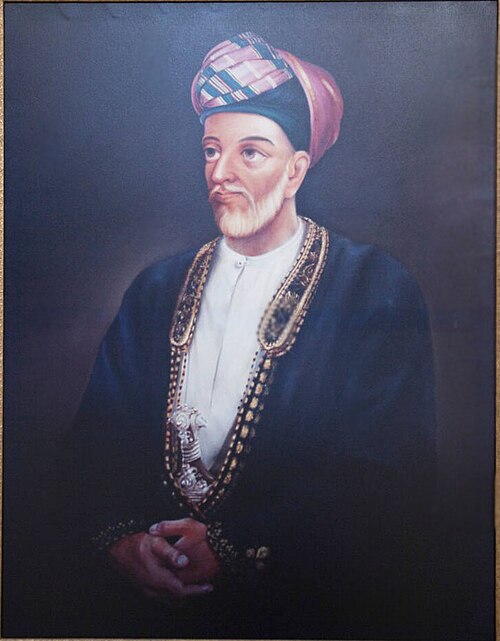
United Kingdom signs the Moresby Treaty with Sultan Seyyid Said to begin the abolition of slavery in Zanzibar. Source — Wikipedia, "Timeline of Tanzanian history" (19th century):
Said Bin Sultan of Muscat, Oman and Zanzibar By Unknown (Life time: circa. 19th century) - Original publication: 19th century Zanzibar Immediate source: http://www.royalark.net/Oman/oman5.htm, PD-US, https://en.wikipedia.org/w/index.php?curid=39266950
Dec 1, 1840 CE
Oman
Omani Sultan Seyyid Said moves his capital to Zanzibar City. <!-- this reference only covers year --> Source — Wikipedia, "Timeline of Tanzanian history" (19th century):
flag of Oman By See File history below for details. - Own work. Vectorized from qanoon.om, OGL-om 1.0, https://commons.wikimedia.org/w/index.php?curid=433216
1842 CE
Ngoni king Mputa Maseko arrives and
Ngoni king Mputa Maseko arrives and settles in Songea. While Zwangendaba settles in Ufipa. Source — Wikipedia, "Timeline of Tanzanian history" (19th century):
1843 CE
The last Sultan of Kilwa is
The last Sultan of Kilwa is deported to Oman. Source — Wikipedia, "Timeline of Tanzanian history" (19th century):
May 11, 1848 CE
Germany
German missionary Johannes Rebmann, accompanied by Johann Ludwig Krapf, become the first Europeans to report seeing Mount Kilimanjaro. Source — Wikipedia, "Timeline of Tanzanian history" (19th century):
Flag of Germany, Commons page → Germany. By User:SKopp, User:Madden, and other users - Own work, Public domain, https://commons.wikimedia.org/w/index.php?curid=343071
1850 CE
Zigua people
The Zigua burn Saadani to the ground. Source — Wikipedia, "Timeline of Tanzanian history" (19th century):
1850 CE
Gogo people
Swahili is spoken widely among the Gogo and Sagara. Source — Wikipedia, "Timeline of Tanzanian history" (19th century):
1855 CE
Hehe people
King Muyigumba conqueres the northern and central Hehe chiefdoms into a unified Hehe state. Source — Wikipedia, "Timeline of Tanzanian history" (19th century):
Description: CER.6/159. A Hehe warrior, Southern Highlands Province. Location: Southern Highlands Province, Tanganyika Our Catalogue Reference: Part of CO 1069/164 This image is part of the Colonial Office photographic collection held at The National Archives, uploaded as part of the Africa Through a Lens project. Feel free to share it within the spirit of the Commons. By The National Archives UK - Flickr account - This file is from the collections of The National Archives (United Kingdom), catalogued under document record CO1069. For high quality reproductions of any item from The National Archives collection please contact the image library., OGL v1.0, https://commons.wikimedia.org/w/index.php?curid=19009491
1856 CE
Thuwaini bin Said, Sultan of Muscat and Oman
Sultan Seyyid Said dies at sea and is succeeded by his sons Thuwaini bin Said, in Muscat and Oman and Majid bin Said, in Zanzibar. Source — Wikipedia, "Timeline of Tanzanian history" (19th century):
Thuwaini bin Said, Sultan of Muscat and Oman. By Unknown author - https://www.royalark.net/Oman/oman6.htm https://www.marefa.org/%D8%B9%D8%B2%D8%A7%D9%86_%D8%A8%D9%86_%D9%82%D9%8A%D8%B3_%D8%A8%D9%86_%D8%B9%D8%B2%D8%A7%D9%86, Public domain, https://commons.wikimedia.org/w/index.php?curid=98988182
Jun 26, 1857 CE
Richard Francis Burton
British explorers Richard Burton and John Speke travel from Zanzibar to the East African coast and begin their exploration of continental East Africa. Source — Wikipedia, "Timeline of Tanzanian history" (19th century):
Sir Richard Francis Burton (1821 - 1890) By Rischgitz/Stringer - one or more third parties have made copyright claims against Wikimedia Commons in relation to the work from which this is sourced or a purely mechanical reproduction thereof. This may be due to recognition of the "sweat of the brow" doctrine, allowing works to be eligible for protection through skill and labour, and not purely by originality as is the case in the United States (where this website is hosted). These claims may or may not be valid in all jurisdictions. As such, use of this image in the jurisdiction of the claimant or other countries may be regarded as copyright infringement. Please see Commons:When to use the PD-Art tag for more information., Public domain, https://commons.wikimedia.org/w/index.php?curid=29416317
1857 CE
Maize
Maize is grown in the Pangani Valley. Source — Wikipedia, "Timeline of Tanzanian history" (19th century):
Maize: (a) Lower part of the plant (b) top of plant with male inflorescense (c) middle of plant with female inflorescenses (d) ear/cob: (1) two pollen grains of a male inflorescense (3, 4) female flowers (5) female flowers with stigma (6) fruit bottom view (7) fruit side view (8) fruit cross-section views By Franz Eugen Köhler, Köhler's Medizinal-Pflanzen - Köhler's Medizinal-Pflanzen in naturgetreuen Abbildungen mit kurz erläuterndem Texte, Vol. 3, Plate 78 Old source: List of Koehler Images, Public domain, https://commons.wikimedia.org/w/index.php?curid=255643
Feb 13, 1858 CE
Lake Tanganyika
Burton and Speke reach Lake Tanganyika, the first known Europeans to do so. Source — Wikipedia, "Timeline of Tanzanian history" (19th century):
STS51G-034-0012 Lake Tanganyika, Tanzania, Zaire, and Zambia June 1985 By NASA - http://eol.jsc.nasa.gov/sseop/EFS/photoinfo.pl?PHOTO=STS51G-34-12, Public domain, https://commons.wikimedia.org/w/index.php?curid=26671324
1860 CE
Mirambo
King Mirambo of the Nyamwezi rises to power. Source — Wikipedia, "Timeline of Tanzanian history" (19th century):
Map of Unyamwezi By Mnazini - Own work, CC BY-SA 4.0, https://commons.wikimedia.org/w/index.php?curid=159190926
Apr 2, 1861 CE
principality
Zanzibar and Oman are split into two separate principalities with Majid bin Said becoming the first Sultan of Zanzibar. Source — Wikipedia, "Timeline of Tanzanian history" (19th century):
Flag of the Sultanate of Zanzibar from 10 Dec 1963 to 12 Jan 1964 By Orange Tuesday - Own work, CC BY-SA 3.0, https://commons.wikimedia.org/w/index.php?curid=16031716
1863 CE
The French Holy Ghost Father established
The French Holy Ghost Father established their first church in Zanzibar and move it to Bagamoyo in 1868. Source — Wikipedia, "Timeline of Tanzanian history" (19th century):
1863 CE
Mbunga people
Songea's king Mputa Maseko is killed by dissident Ndendeuli who flees east to the Kilombero valley and recreates Ngoni style military state forming the Mbunga people, forcing the Pogoro to flee eat to the Mahenge plateau. Source — Wikipedia, "Timeline of Tanzanian history" (19th century):
1869 CE
Kiva Rebellion of 1869
The Kiva rebellion, where Bondei rebel against the Shambaa Kingdom's rule. Source — Wikipedia, "Timeline of Tanzanian history" (19th century):
1:800,000; Relif shown by shading. By Baumann, Oskar, 1864-1899 - This file was contributed to Wikimedia Commons by University of Illinois Urbana-Champaign University Library as part of a cooperation project. The donation was facilitated by the Digital Public Library of America, via its partner Illinois Digital Heritage Hub. Record in source catalog DPLA identifier: cf3b59dc45aa5066c89f2b674be09569, Public domain, https://commons.wikimedia.org/w/index.php?curid=125010067
1870 CE
Zigua people
Islam becomes the major religion among the Zigua and Bondei. Source — Wikipedia, "Timeline of Tanzanian history" (19th century):
1873 CE
Barghash bin Said of Zanzibar
Zanzibari Sultan Barghash bin Said stops the export of slaves over the sea. Source — Wikipedia, "Timeline of Tanzanian history" (19th century):
Barghash bin Said of Zanzibar By Maull & Co. - National Maritime Museum, Public domain, https://commons.wikimedia.org/w/index.php?curid=34874528
1874 CE
Shambaa Kingdom
Civil war in the Shambaa Kingdom turns Pangani into a rival slave port to Bagamoyo and Kilwa. Source — Wikipedia, "Timeline of Tanzanian history" (19th century):
Sujet : Usambara, Monts -- 1897-1899 Échelle(s) : 1:50 000 Couverture : Tanzanie Langue : allemand Éditeur : D. Reimer (Berlin) By Böhler, H. (18..-19..). Auteur du texte Reimer, Dietrich (1818-1899). Auteur du texte - Bibliothèque nationale de France, Public domain, https://commons.wikimedia.org/w/index.php?curid=150509694
1875 CE
Mbugu people
The Mbugu of Gare kill a Kilindi royal in rebellion. Source — Wikipedia, "Timeline of Tanzanian history" (19th century):
Shaman's stoppered gourd vessel, Mbugu people, northeast Tanzania, late-19th-early 20th century, gourd, beads, fiber, metal, patina, Honolulu Museum of Art accession 2015-1-01 By Wmpearl - Own work, CC0, https://commons.wikimedia.org/w/index.php?curid=57410464
1875 CE
Zaramo people
Bagamoyo pays tribute to the Zaramo fearing attack. Source — Wikipedia, "Timeline of Tanzanian history" (19th century):
Outside look of traditional house of Zaramos tribe. By Nadya Issa - Own work, CC0, https://commons.wikimedia.org/w/index.php?curid=184969363
1876 CE
Natural rubber
Kilwa's biggest export switches from slaves to wild rubber. Source — Wikipedia, "Timeline of Tanzanian history" (19th century):
photo of natural rubber in a glass jar. Pieces of natural vulcanized rubber at Hutchinson's Research and Innovation Center in France. By Gradstudentscholar - Own work, CC BY-SA 4.0, https://commons.wikimedia.org/w/index.php?curid=89532135
1876 CE
Barghash bin Said closes Zanzibar's slave
Barghash bin Said closes Zanzibar's slave market. Source — Wikipedia, "Timeline of Tanzanian history" (19th century):
1878 CE
The Hehe and Ngoni go to
The Hehe and Ngoni go to war with the Invasion of Mshope by the Hehe. Source — Wikipedia, "Timeline of Tanzanian history" (19th century):
1880 CE
Fipa people
Fipa King Kapufi of Nkasi hires an Arab Prime minister in his court. Source — Wikipedia, "Timeline of Tanzanian history" (19th century):
1881 CE
Pare people
The Pare at Mbaga attack a slave trader settlement of Kisiwani. Source — Wikipedia, "Timeline of Tanzanian history" (19th century):
View of Kiswani Town, Kisiwani ward, Same District, Kilimanjaro Region. By Halidtz - Own work, CC BY-SA 4.0, https://commons.wikimedia.org/w/index.php?curid=115343061
1882 CE
Bena people
The Ngoni and Hehe end their war with Bena partitioned amongst them as a buffer. Source — Wikipedia, "Timeline of Tanzanian history" (19th century):
1882 CE
Ngindo people
King Songea Mbano of the Ngoni raids the eastern stateless peoples like the Ngindo, Makonde and Mwera forcing them to flee further eastwards leaving empty land. Source — Wikipedia, "Timeline of Tanzanian history" (19th century):
Reinata Sadimba, Mozambican artist, at her workshop on the premises of the Museum of Natural History in Maputo, on September 5 2017 By Daniel Gubler - Own work, CC BY-SA 4.0, https://commons.wikimedia.org/w/index.php?curid=99772164
Mar 28, 1884 CE
Society for German Colonization
The Society for German Colonization is formed by Karl Peters in order to acquire German colonial territories in overseas countries. Peters signs treaties with several native chieftains on the mainland opposite Zanzibar. Source — Wikipedia, "Timeline of Tanzanian history" (19th century):
First german colonial region in east africa, 1885. By Chrischerf - Own work, CC BY-SA 3.0, https://commons.wikimedia.org/w/index.php?curid=16833175
Nov 23, 1884 CE
Nguru Mountains
The Germans led by Peters land at Saadani and start the invasion reaching the Ngulu mountains and signing a sham treaty with Chief Mafungu Biniani of Ngulu . Source — Wikipedia, "Timeline of Tanzanian history" (19th century):
Dec 2, 1884 CE
Mirambo of the Nyamwezi empire dies.
Mirambo of the Nyamwezi empire dies. Source — Wikipedia, "Timeline of Tanzanian history" (19th century):
Mar 3, 1885 CE
protectorate
The German government announces its intention to establish a protectorate in East Africa. Source — Wikipedia, "Timeline of Tanzanian history" (19th century):
Nov 1, 1886 CE
Mafia Island
Pemba]], and Mafia. The area that is to become Tanganyika is assigned to Germany while the area to become Kenya is assigned to Britain. Source — Wikipedia, "Timeline of Tanzanian history" (19th century):
Mafia Island or "Chole Shamba" (Tanzania) By Nina R from Africa - Mafia Island, CC BY 2.0, https://commons.wikimedia.org/w/index.php?curid=113286667
May 25, 1887 CE
Dar es Salaam
The Germans occupy Dar es Salaam. Source — Wikipedia, "Timeline of Tanzanian history" (19th century):
Neo-Gothic St Joseph's Catholic Cathedral (1902) in Dar es Salaam, Tanzania, has some fine stained glass windows. By David Stanley from Nanaimo, Canada - St Joseph's Catholic Cathedral, CC BY 2.0, https://commons.wikimedia.org/w/index.php?curid=62026916
1887 CE
Zaramo people
The Zaramo attack two German stations in Dar es Salaam . Source — Wikipedia, "Timeline of Tanzanian history" (19th century):
Outside look of traditional house of Zaramos tribe. By Nadya Issa - Own work, CC0, https://commons.wikimedia.org/w/index.php?curid=184969363
Apr 1, 1888 CE
Khalifah bin Said of Zanzibar
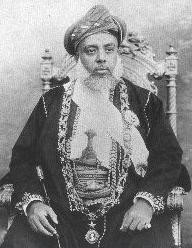
The German East Africa Company leases the coastal strip opposite Zanzibar from Sultan Khalifah bin Said for 50 years. <!-- this reference only gives year --> Source — Wikipedia, "Timeline of Tanzanian history" (19th century):
Khalifah bin Said of Zanzibar By Unknown author, Public domain, https://commons.wikimedia.org/w/index.php?curid=1563876
Sep 1, 1888 CE
Tanga, Tanzania
Tanga is bombed by German warships. Source — Wikipedia, "Timeline of Tanzanian history" (19th century):
Ngamiani Kusini View, Tanga District, Tanga Region By Halidtz - Own work, CC BY-SA 4.0, https://commons.wikimedia.org/w/index.php?curid=118543084
1888 CE
Old Korogwe
The Zigua boycott a station in Old Korogwe. Source — Wikipedia, "Timeline of Tanzanian history" (19th century):
Jun 1, 1889 CE
Germans capture Saadani after fierce fighting
Germans capture Saadani after fierce fighting Bwana Heri flees inland . Source — Wikipedia, "Timeline of Tanzanian history" (19th century):
Jul 1, 1889 CE
Germans capture Pangani after heavy shelling
Germans capture Pangani after heavy shelling from the sea. Source — Wikipedia, "Timeline of Tanzanian history" (19th century):
Dec 15, 1889 CE
Abushiri
Germans hang Abushiri . Source — Wikipedia, "Timeline of Tanzanian history" (19th century):
Abushiri ibn Salim al-Harthi By Perbandt, Conradin von (Verfasser) Richelmann, Georg (Verfasser) Schmidt, Rochus (Verfasser) - http://d-nb.info/575630213 Hermann von Wissmann : Deutschlands grösster Afrikaner ; Sein Leben u. Wirken unter Benutzg d. Nachlasses dargest. unter Mitw. von ... / C. v. Perbandt ; G. Richelmann ; Rochus Schmidt Erscheinungsdatum: 1906, Public domain, https://commons.wikimedia.org/w/index.php?curid=80247677
May 1, 1890 CE
Germans bombard Kilwa for three days
Germans bombard Kilwa for three days into submission. Source — Wikipedia, "Timeline of Tanzanian history" (19th century):
Jul 1, 1890 CE
Heligoland–Zanzibar Treaty
The Heligoland–Zanzibar Treaty makes Zanzibar and Pemba a British protectorate. <!-- Reference supports year, but not date --> Source — Wikipedia, "Timeline of Tanzanian history" (19th century):
For documentary purposes the German Federal Archive often retained the original image captions, which may be erroneous, biased, obsolete or politically extreme. Helgoland Besitzergreifung durch S.M. Kaiser Wilhelm II., Parademarsch, 10. August 1890 By Unknown - This image was provided to Wikimedia Commons by the German Federal Archive (Deutsches Bundesarchiv) as part of a cooperation project. The German Federal Archive guarantees an authentic representation only using the originals (negative and/or positive), resp. the digitalization of the originals as provided by the Digital Image Archive., CC BY-SA 3.0 de, https://commons.wikimedia.org/w/index.php?curid=5419879
Feb 1, 1891 CE
Battle of Kibosho
The Battle of Kibosho. Source — Wikipedia, "Timeline of Tanzanian history" (19th century):
The Anglo-Zanzibar War is fought between Zanzibar and the United Kingdom. It lasted approximately 38 minutes and is the shortest war in history. Source — Wikipedia, "Timeline of Tanzanian history" (19th century):
Destroyed Palace and other buildings after the attack in the Anglo-Zanzibar War. In Stone Town, Zanzibar City. By Richard Mohun - from zh wp (删除该图像的所有修订版本) (当前) 23:13 2005年5月12日 . . Captmjc (Talk) . . 574x425 (94376字节), Public domain, https://commons.wikimedia.org/w/index.php?curid=662260
Nov 1, 1896 CE
Sack of Meru
The Germans and Chagga sack Meru. Source — Wikipedia, "Timeline of Tanzanian history" (19th century):
Apr 5, 1897 CE
Hamoud bin Mohammed of Zanzibar
Sultan Hamoud bin Mohammed issues a decree making slavery illegal in Zanzibar. Source — Wikipedia, "Timeline of Tanzanian history" (19th century):
sultan Hamoud bin mhamed of zanzibar, he ruled between 1896 - 1902 By Unknown author - http://www.hukam.net/family.php?fam=296 (تاريخ الحكام والسلالات الحاكمة) arabic source, Public domain, https://commons.wikimedia.org/w/index.php?curid=99735583
1897 CE
Mangi Sina dies.
Mangi Sina dies. Source — Wikipedia, "Timeline of Tanzanian history" (19th century):
Jul 19, 1898 CE
Chief Mkwawa
Following years of resistance, Chief Mkwawa of the Hehe is cornered by German soldiers and commits suicide in lieu of capture. Source — Wikipedia, "Timeline of Tanzanian history" (19th century):
Return of Chief Mkwawa's skull to Tangangika and other photographs from the mid 1950s. By The National Archives UK - Flickr account - This file is from the collections of The National Archives (United Kingdom), catalogued under document record CO1069/159. For high quality reproductions of any item from The National Archives collection please contact the image library., OGL v1.0, https://commons.wikimedia.org/w/index.php?curid=19009329
1898 CE
Katukamoto of Urambo, who was held
Katukamoto of Urambo, who was held accountable for the murder of an askari, was imprisoned. Following this event, the remnants of Mirambo's empire were systematically dismantled. Source — Wikipedia, "Timeline of Tanzanian history" (19th century):
Mar 2, 1900 CE
Great Hanging at Old Moshi
Great Hanging at Old Moshi was a mass execution of 19 Chagga and Meru leaders together with their noblemen by German colonial officers. Source — Wikipedia, "Timeline of Tanzanian history" (20th century):
Chagga History By Mangapwani - Own work, CC BY-SA 4.0, https://commons.wikimedia.org/w/index.php?curid=131044551
Jul 1, 1905 CE
Maji Maji Rebellion
The Maji Maji Rebellion starts as a violent resistance to colonial rule in Tanganyika. Source — Wikipedia, "Timeline of Tanzanian history" (20th century):
Wilhelm Kuhnert: "Battle at Mahenge", German East Africa, 1905 By Wilhelm Kuhnert - https://www.flickr.com/photos/hen-magonza/46271183481, Public domain, https://commons.wikimedia.org/w/index.php?curid=102191917
Aug 1, 1907 CE
The Maji Maji Rebellion ends, leaving
The Maji Maji Rebellion ends, leaving between 200,000 and 300,000 rebels dead. Source — Wikipedia, "Timeline of Tanzanian history" (20th century):
Aug 8, 1914 CE
East African Campaign
The East African Campaign of the First World War begins. Source — Wikipedia, "Timeline of Tanzanian history" (20th century):
For documentary purposes the German Federal Archive often retained the original image captions, which may be erroneous, biased, obsolete or politically extreme. Askarikompanie fertig zum Abmarsch By Walther Dobbertin - This image was provided to Wikimedia Commons by the German Federal Archive (Deutsches Bundesarchiv) as part of a cooperation project. The German Federal Archive guarantees an authentic representation only using the originals (negative and/or positive), resp. the digitalization of the originals as provided by the Digital Image Archive., CC BY-SA 3.0 de, https://commons.wikimedia.org/w/index.php?curid=5482254
Sep 4, 1916 CE
Dar es Salaam is occupied by
Dar es Salaam is occupied by troops from the United Kingdom and South Africa. Source — Wikipedia, "Timeline of Tanzanian history" (20th century):
Jun 28, 1919 CE
Treaty of Versailles
Following the First World War, the Treaty of Versailles divides German East Africa, with the United Kingdom acquiring the largest section which it names the Tanganyika Territory. Source — Wikipedia, "Timeline of Tanzanian history" (20th century):
The cover of a publication of the Treaty of Versailles in EnglishThe text reads THETREATY OF PEACEBETWEENTHE ALLIED AND ASSOCIATED POWERSANDGERMANY,The protocol annexed thereto, the Agreement respectingthe military occupation of the territories of the Rhine,AND THETREATYBETWEENFRANCE AND GREAT BRITAINRESPECTINGAssistance to France in the event of unprovokedaggression by Germany.Signed at Versailles, June 28th, 1919. By David Lloyd George, Woodrow Wilson and Georges Clemenceau - Auckland War Memorial Museum Tāmaki Paenga Hira, Public domain, https://commons.wikimedia.org/w/index.php?curid=5309908
1920 CE
Horace Byatt
Sir Horace Byatt is appointed the first governor of Tanganyika. Source — Wikipedia, "Timeline of Tanzanian history" (20th century):
1929 CE
Tanganyika African Association
The Tanganyika African Association is founded by members of the Tanganyika Territory African Civil Service association. Source — Wikipedia, "Timeline of Tanzanian history" (20th century):
Dec 13, 1946 CE
United Nations Trusteeship
British mandate over Tanganyika is converted to a United Nations Trusteeship. Source — Wikipedia, "Timeline of Tanzanian history" (20th century):
Jun 9, 1954 CE
Chief Mkwawa
Germany returns the skull of Hehe chief Mkwawa (died 1898) to Tanzania and it is put on display near Iringa. Source — Wikipedia, "Timeline of Tanzanian history" (20th century):
Return of Chief Mkwawa's skull to Tangangika and other photographs from the mid 1950s. By The National Archives UK - Flickr account - This file is from the collections of The National Archives (United Kingdom), catalogued under document record CO1069/159. For high quality reproductions of any item from The National Archives collection please contact the image library., OGL v1.0, https://commons.wikimedia.org/w/index.php?curid=19009329
Oct 1, 1961 CE
University of East Africa
The University College, Dar es Salaam is established as one of three constituent colleges of the University of East Africa, with 14 law students. Source — Wikipedia, "Timeline of Tanzanian history" (20th century):
Jan 22, 1962 CE
Rashidi Kawawa
Julius Nyerere resigns as Prime Minister and is succeeded by Rashidi Kawawa. Source — Wikipedia, "Timeline of Tanzanian history" (20th century):
Location: Tanganyika Our Catalogue Reference: Part of CO 1069/166 This image is part of the Colonial Office photographic collection held at The National Archives, uploaded as part of the Africa Through a Lens project. Feel free to share it within the spirit of the Commons. By The National Archives UK - Flickr account - This file is from the collections of The National Archives (United Kingdom), catalogued under document record CO1069. For high quality reproductions of any item from The National Archives collection please contact the image library., OGL v1.0, https://commons.wikimedia.org/w/index.php?curid=71819588
Dec 16, 1963 CE
Zanzibar becomes a member of the
Zanzibar becomes a member of the United Nations. Source — Wikipedia, "Timeline of Tanzanian history" (20th century):
Jan 12, 1964 CE
Zanzibar Revolution
The Zanzibar Revolution by local Africans overthrows the Sultan of Zanzibar and his primarily Arab government. Sheikh Abeid Karume becomes the first President of Zanzibar. Source — Wikipedia, "Timeline of Tanzanian history" (20th century):
Stamp By Post of Zanzibar - https://colnect.com/en/stamps/stamp/413541-Soldier_and_map-First_Anniversary_of_the_Revolution-Zanzibar, Public domain, https://commons.wikimedia.org/w/index.php?curid=115889814
Sep 21, 1965 CE
President Nyerere is returned to power
President Nyerere is returned to power in a one-party election. Source — Wikipedia, "Timeline of Tanzanian history" (20th century):
Feb 5, 1967 CE
Arusha Declaration
President Nyerere issues the Arusha Declaration, outlining the principles of Ujamaa. Source — Wikipedia, "Timeline of Tanzanian history" (20th century):
Uhuru Monument in Arusha, Tanzania By Arthur Buliva - Own work, CC BY-SA 3.0, https://commons.wikimedia.org/w/index.php?curid=16049021
Sep 24, 1969 CE
Arusha Agreement
The Arusha Agreement is signed between the European Union and the East African states of Kenya, Tanzania, and Uganda. Source — Wikipedia, "Timeline of Tanzanian history" (20th century):
The Flag of Europe is the flag and emblem of the European Union (EU) and Council of Europe (CoE). It consists of a circle of 12 golden (yellow) stars on a blue background. It was created in 1955 by the CoE and adopted by the EU, then the European Communities, in the 1980s. The CoE and EU are distinct in membership and nature. The CoE is an international organisation with 46 members, dealing with human rights and rule of law, while the EU is a quasi-federal union of 27 states, focused on economic integration and political cooperation. Today, the flag is mostly associated with the latter. It was the intention of the CoE that the flag should come to represent Europe as a whole, and since its adoption the membership of the CoE covers nearly the entire Europe by the number of states involved, although only a little over half of the European continent by territory. This is why the EU adopted the same flag. The flag has been used to represent Europe in sporting events and as a pro-democracy banner outside the European Union. By User:Verdy p, User:-xfi-, User:Paddu, User:Nightstallion, User:Funakoshi, User:Jeltz, User:Dbenbenn, User:Zscout370 - File created by various Wikimedia users (see "Author"). File based on the specification given at [1]., Public domain, https://commons.wikimedia.org/w/index.php?curid=2615952
Jul 1, 1970 CE
University of Dar es Salaam
Tanzania's first university, the University of Dar es Salaam is founded from the split of the University of East Africa into three national universities. Source — Wikipedia, "Timeline of Tanzanian history" (20th century):
Nkrumah Hall at the University of Dar es Salaam in Dar es Salaam, Tanzania. Picture by Alexander Landfair(kwmame of ghana) By Xlandfair at English Wikipedia - Transferred from en.wikipedia to Commons by Zscout370 using CommonsHelper., Public domain, https://commons.wikimedia.org/w/index.php?curid=12792431
Jan 1, 1971 CE
The Arusha Agreement is enacted.
The Arusha Agreement is enacted. Source — Wikipedia, "Timeline of Tanzanian history" (20th century):
Apr 7, 1972 CE
Zanzibar Town
Vice President Abeid Karume is assassinated in Zanzibar Town. Source — Wikipedia, "Timeline of Tanzanian history" (20th century):
Zanzibar with the Sultan's Palace. Photograped by Brocken Inaglory By No machine-readable author provided. Mbz1 assumed (based on copyright claims). - No machine-readable source provided. Own work assumed (based on copyright claims)., CC BY-SA 3.0, https://commons.wikimedia.org/w/index.php?curid=1998699
Feb 1, 1973 CE
Dar es Salaam
The Tanzanian parliament moves from Dar es Salaam to the new capital of Dodoma. Source — Wikipedia, "Timeline of Tanzanian history" (20th century):
Neo-Gothic St Joseph's Catholic Cathedral (1902) in Dar es Salaam, Tanzania, has some fine stained glass windows. By David Stanley from Nanaimo, Canada - St Joseph's Catholic Cathedral, CC BY 2.0, https://commons.wikimedia.org/w/index.php?curid=62026916
1976 CE
Mary Leakey
Archaeologist Mary Leakey and her team discover homoinid fossil footprints at Laetoli, south of the Olduvai Gorge. Source — Wikipedia, "Timeline of Tanzanian history" (20th century):
Mary Leakey, British archaeologist and anthropologist By National Institutes of Health - https://ihm.nlm.nih.gov/images/A16794, Public domain, https://commons.wikimedia.org/w/index.php?curid=6719114
Feb 5, 1977 CE
Tanganyika African National Union
Tanganyika African National Union (TANU) and Zanzibar's Afro-Shirazi Party merge to become Chama Cha Mapinduzi (CCM). Source — Wikipedia, "Timeline of Tanzanian history" (20th century):
Flag of the Tanganyika African National Union. Was the unofficial national flag of Tanganyika from 1 May 1961 to 9 december 1961 By Amit6 - Own work, according to http://www.crwflags.com/fotw/flags/tz-tng.html#md and http://www.crwflags.com/fotw/flags/tz%7D.html#tanu, Public domain, https://commons.wikimedia.org/w/index.php?curid=12250557
Oct 27, 1978 CE
Uganda
Ugandan forces under Idi Amin invade Tanzania, starting the Uganda–Tanzania War, also known as the Liberation War. Source — Wikipedia, "Timeline of Tanzanian history" (20th century):
Flag of Uganda By tobias - From the Open ClipArt Library website., Public domain, https://commons.wikimedia.org/w/index.php?curid=433085
Apr 11, 1979 CE
Kampala
Tanzanian troops capture the Ugandan capital of Kampala, heralding the end of the Uganda–Tanzania War and Amin's regime. Source — Wikipedia, "Timeline of Tanzanian history" (20th century):
{{Wiki Loves Africa 2022 country, Uganda By Chapelle musa - Own work, CC BY-SA 4.0, https://commons.wikimedia.org/w/index.php?curid=117488898
1983 CE
Kagera Region
Tanzania's first AIDS diagnosis is made in Bukoba district, Kagera Region. Source — Wikipedia, "Timeline of Tanzanian history" (20th century):
Picture of the Mater Misericordiae Church in Bukoba town. By Macabe5387 - Own work, CC BY-SA 4.0, https://commons.wikimedia.org/w/index.php?curid=47010024
Jan 31, 1984 CE
Ali Hassan Mwinyi
Ali Hassan Mwinyi is sworn in as the third President of Zanzibar and Vice President of Tanzania. Source — Wikipedia, "Timeline of Tanzanian history" (20th century):
Former Tanzanian president Ali Hassan Mwinyi. By Apollo Temu - This is a retouched picture, which means that it has been digitally altered from its original version. Modifications: Crop from File:Ali Hassan Mwinyi na Joseph Butiku.jpg.. The original can be found here: https://www.flickr.com/photos/36151448@N00/4096840374. Flickr: [1], CC BY 2.0, https://commons.wikimedia.org/w/index.php?curid=18376916
Nov 5, 1985 CE
Joseph Sinde Warioba
Julius Nyerere retires and Ali Hassan Mwinyi becomes the second President of Tanzania. Mwinyi is succeeded as vice president by Joseph Sinde Warioba. Source — Wikipedia, "Timeline of Tanzanian history" (20th century):
Oct 1, 1990 CE
Ali Hassan Mwinyi wins a single-party
Ali Hassan Mwinyi wins a single-party election with 95.5% of the vote and is sworn in for a second presidential term. Source — Wikipedia, "Timeline of Tanzanian history" (20th century):
May 28, 1992 CE
Civic United Front
The Civic United Front is formed. Source — Wikipedia, "Timeline of Tanzanian history" (20th century):
Oct 29, 1995 CE
Tanzanian general election, 1995
Tanzania holds its first multi-party election. Source — Wikipedia, "Timeline of Tanzanian history" (20th century):
Region results of the 1995 Tanzanian presidential election By Wowzers122 - Election results from the African Elections Database Modified version of a map from the Berkely Libary originally made by the United States Agency for International Development and Famine Early Warning System Network, CC BY-SA 4.0, https://commons.wikimedia.org/w/index.php?curid=145471259
Aug 7, 1998 CE
Nairobi
The United States embassies in Dar es Salaam, Tanzania and Nairobi, Kenya are simultaneously bombed. Source — Wikipedia, "Timeline of Tanzanian history" (20th century):
Nairobi skyline, with slight smog layer, seen from the rooftop restaurant at the Gem Hotel in Gigiri By Daniel Case - Own work, CC BY-SA 4.0, https://commons.wikimedia.org/w/index.php?curid=173675477
Oct 14, 1999 CE
Julius Nyerere
Julius Nyerere dies of leukaemia in London. Source — Wikipedia, "Timeline of Tanzanian history" (20th century):
Photo of Julius Nyerere By Rob Mieremet / Anefo - This image has been extracted from another file, CC0, https://commons.wikimedia.org/w/index.php?curid=183730774
Jul 7, 2000 CE
The East African Community Treaty comes
The East African Community Treaty comes into force. Source — Wikipedia, "Timeline of Tanzanian history" (20th century):
Jan 28, 2001 CE
Demonstrators in Zanzibar protesting the 2000
Demonstrators in Zanzibar protesting the 2000 elections, clash with police and 32 people are killed. Source — Wikipedia, "Timeline of Tanzanian history" (21st century):
Jun 24, 2002 CE
Igandu train disaster
The Igandu train disaster kills more than 200 people and is Tanzania's worst train crash. Source — Wikipedia, "Timeline of Tanzanian history" (21st century):
Dec 1, 2003 CE
Kipunji
The Kipunji, a new species of monkey, is found in Tanzania—the first new African monkey species since 1974. It is also independently discovered in July 2004. Source — Wikipedia, "Timeline of Tanzanian history" (21st century):
Full-body view of Lophocebus kipunji (Ehardt et al. 2005 sp. nov.). Note the animal's long fur, coat color, lighter area on chest and distal tail and characteristic tail carriage. The artist's reconstruction was drawn from research video taken by C. L. Ehardt in Tanzania in the Ndundulu Forest of the Udzungwa Mountains and in the Southern Highlands. By Zina Deretsky, National Science Foundation - http://www.nsf.gov/news/news_images.jsp?cntn_id=104165&org=BCS, Public domain, https://commons.wikimedia.org/w/index.php?curid=4059597
Dec 14, 2005 CE
Tanzanian general election, 2005
General elections are held. Anna Senkoro of the Progressive Party of Tanzania–Maendeleo is the first woman in Tanzania to run for president. Source — Wikipedia, "Timeline of Tanzanian history" (21st century):
May 11, 2006 CE
genus
Scientists announce that the Kipunji monkey found in 2003 belongs to a new genus of African monkey—the first to be discovered since 1923. Source — Wikipedia, "Timeline of Tanzanian history" (21st century):
Biological classification image created for Wikimediasphere (Wikipedia and all the other Wikimedia sister projects). About the Domains/Kingdoms This diagram implies 3 Domains / 6 Kingdoms (Woese et al. 1990[1]): Archaea, Domain (and Kingdom) Eukarya, Domain Protista, Kingdom Fungi, Kingdom Animalia, Kingdom Plantae, Kingdom Bacteria, Domain (and Kingdom) References ↑ Carl R. Woese, Otto Kandler, Mark L. Wheelis, 1990: "Towards a natural system of organisms: proposal for the domains Archaea, Bacteria, and Eucarya". Proceedings of the National Academy of Sciences of the United States of America, 87(12):4576-9. doi:10.1073/pnas.87.12.4576 By Peter Halasz. (User:Pengo) - Own work, Public domain, https://commons.wikimedia.org/w/index.php?curid=2480732
Feb 6, 2008 CE
A parliamentary committee reports on corruption
A parliamentary committee reports on corruption within the cabinet. Source — Wikipedia, "Timeline of Tanzanian history" (21st century):
Mar 17, 2021 CE
John Magufuli
John Magufuli, President of Tanzania, dies. Source — Wikipedia, "Timeline of Tanzanian history" (21st century):
John Magufuli, President of Tanzania By Issa Michuzi / issamichuzi.blogspot.co.uk - https://www.flickr.com/photos/issamichuzi/22488326290/, CC BY-SA 2.0, https://commons.wikimedia.org/w/index.php?curid=44689229


![View this map on the BL Georeferencer service. Image taken from: Title: "Across East African Glaciers. An account of the first ascent of Kilimanjaro ... Translated from the German by E. H. S. Calder. With ... illustrations and ... maps, etc. [With a biography and appendices.] L.P" Author: MEYER, Hans Heinrich Joseph. Contributor: CALDER, E. H. S. Shelfmark: "British Library HMNTS 10097.m.21." Page: 561 Place of Publishing: London Date of Publishing: 1891 Publisher: G. Philip & Son Issuance: monographic Identifier: 002477729 Explore: Find this item in the British Library catalogue, 'Explore'. Open the page in the British Library's itemViewer (page image 561) Download the PDF for this book Image found on book scan 561 (NB not a pagenumber)Download the OCR-derived text for this volume: (plain text) or (json) Click here to see all the illustrations in this book and click here to browse other illustrations published in books in the same year. Order a higher quality version from here.](https://upload.wikimedia.org/wikipedia/commons/thumb/9/9d/561_of_%27Across_East_African_Glaciers._An_account_of_the_first_ascent_of_Kilimanjaro_..._Translated_from_the_German_by_E._H._S._Calder._With_..._illustrations_and_..._maps%2C_etc._%28With_a_biography_and_appendices.%29_L.P%27_%2811208295136%29.jpg/500px-thumbnail.jpg)














![Biological classification image created for Wikimediasphere (Wikipedia and all the other Wikimedia sister projects). About the Domains/Kingdoms This diagram implies 3 Domains / 6 Kingdoms (Woese et al. 1990[1]): Archaea, Domain (and Kingdom) Eukarya, Domain Protista, Kingdom Fungi, Kingdom Animalia, Kingdom Plantae, Kingdom Bacteria, Domain (and Kingdom) References ↑ Carl R. Woese, Otto Kandler, Mark L. Wheelis, 1990: "Towards a natural system of organisms: proposal for the domains Archaea, Bacteria, and Eucarya". Proceedings of the National Academy of Sciences of the United States of America, 87(12):4576-9. doi:10.1073/pnas.87.12.4576](https://upload.wikimedia.org/wikipedia/commons/thumb/a/a5/Biological_classification_L_Pengo_vflip.svg/500px-Biological_classification_L_Pengo_vflip.svg.png)