Encyclopedia/3. History, Societies & Civilizations/01. East Asian Civilizations/01. Chinese Dynasties • Curated by Admin Timeline.sg
From regional state to first unified empire (221–206 BCE), the Qin Dynasty established centralized governance, standardization, and the Great Wall before collapsing rapidly after the First Emperor's death.
Chronological Storyline (30 Milestones)
361 BCE
Shang Yang Reforms (商鞅变法)
Legalist reformer Shang Yang (商鞅, Shāng Yāng) implements radical reforms in Qin state: land privatization, military meritocracy, harsh laws, and collective responsibility. Transforms Qin from backward state into dominant military power. #politics #law #reform
Statue of Shang Yang, an Ancient Chinese celebrity By Taken by Fanghong - Own work, CC BY 2.5, https://commons.wikimedia.org/w/index.php?curid=844037
316 BCE
Qin Conquers Ba and Shu (秦灭巴蜀)
Qin conquers Ba (巴, Bā) and Shu (蜀, Shǔ) states in Sichuan basin, securing fertile Chengdu Plain and strategic resources. Engineer Li Bing (李冰, Lǐ Bīng) later builds Dujiangyan irrigation system. #conquest #agriculture #engineering
Qin's wars of unification Describe the Strength of 6 states before the wars and the year and the process of unification. Compare the annual change in the territory. By Benedetta blair - Own work, CC BY-SA 4.0, https://commons.wikimedia.org/w/index.php?curid=45623632
256 BCE
Qin Extinguishes Zhou (秦灭周室)
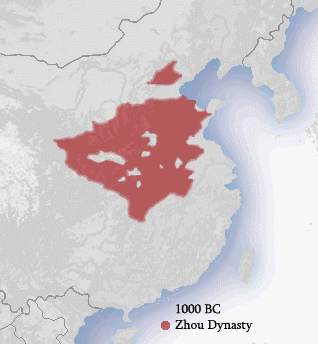
Qin extinguishes remnant Zhou (周, Zhōu) royal house, symbolically ending 800-year Zhou dynasty. King Zhaoxiang (秦昭襄王, Qín Zhāoxiāng Wáng) asserts Qin's supremacy over all rival states. #politics #conquest #history
The approximate territory of the Zhou dynasty in China. Drawn by Ian Kiu. Derived from China_map.png by Nat. By Territories_of_Dynasties_in_China.gif: Ian Kiu - Territories_of_Dynasties_in_China.gif: Albert Herrmann (1935). History and Commercial Atlas of China. Harvard University Press. from "The Chou Dynasty, 11th-9th Centuries B.C.", CC BY-SA 3.0, https://commons.wikimedia.org/w/index.php?curid=13309273
247 BCE
Ying Zheng Ascends Throne (嬴政即位)
Ying Zheng (嬴政, Yíng Zhèng), age 13, ascends as King of Qin under regency of Lü Buwei (吕不韦, Lǚ Bùwéi). Will become First Emperor (秦始皇, Qín Shǐhuáng). #politics #history #monarchy
Qin Shi Huang in a 19th century portrait, with Korean colophons, in an album portraying famous historical figures. It's a copy of a 1609 Chinese portrait. By Unknown (18??–18??) - Portal, Jane (Ed.). The first emperor: China's Terracotta Army. Cambridge, Massachusetts: Harvard University Press, 2007 ISBN 978-0-674-02697-7 Invalid ISBN (p.29), Public domain, https://commons.wikimedia.org/w/index.php?curid=164928091
238 BCE
King Zheng Takes Power (秦王亲政)
King Zheng assumes personal rule at age 21, suppresses Lü Buwei (吕不韦, Lǚ Bùwéi) and Lao Ai (嫪毐, Lào Àǐ) rebellions. Begins systematic elimination of rival states. #politics #power #history
230 BCE
Qin Conquers Han (秦灭韩)
Qin conquers Han (韩, Hán) state, first of the six rival states to fall. General Neishi Teng (内史腾, Nèishǐ Téng) leads campaign. Systematic unification wars begin. #conquest #war #history
China Map, Han State, 260BCE By Philg88 - Own work, CC BY-SA 3.0, https://commons.wikimedia.org/w/index.php?curid=11919084
228 BCE
Qin Destroys Zhao (秦灭赵)
Qin destroys Zhao (赵, Zhào) after failed assassination attempt by Jing Ke (荆轲, Jīng Kē). Qin general Wang Jian (王翦, Wáng Jiǎn) captures Zhao capital Handan (邯郸, Hándān). #conquest #war #history
Jin Ke's assassination attempt on Qin Shi Huang. Jin Ke (right) is held by one of Qin Shi Huang's physicians ( background). The dagger used in the assassination attempt is seen stuck in the pillar. Qin Shi Huang (left) is trying to escape. Qin Wuyang, Qin Wuyang, the follower of Jin Ke, kneels (central). A box with the general Fan Wuqi's head (front central). Rubbing detail from Stone Chamber 1 on the 1st stone wall of the Wu Family Shrine in Shandong Province, China, dated 2nd century AD during the Eastern Han Dynasty. By ReijiYamashina777 - Own work, CC BY-SA 4.0, https://commons.wikimedia.org/w/index.php?curid=131470789
225 BCE
Qin Conquers Wei (秦灭魏)
Qin conquers Wei (魏, Wèi) by diverting Yellow River to flood capital Daliang (大梁, Dàliáng). Wang Ben (王贲, Wáng Bēn), son of Wang Jian, commands forces. #conquest #war #engineering
Map of China proper in with the state of Wei highlighted, 260 BCE By Philg88 - Own work, CC BY-SA 3.0, https://commons.wikimedia.org/w/index.php?curid=11944658
223 BCE
Qin Conquers Chu (秦灭楚)
Qin finally conquers vast Chu (楚, Chǔ) state after initial defeat. Wang Jian (王翦, Wáng Jiǎn) leads 600,000 troops in massive campaign. Largest of unification wars. #conquest #war #history
Warring States Period By Jiu Qiaozai - Own work 地形圖數據:ETOPO1 矢量底图数据:www.naturalearthdata.com 参考地图:zh:中国历史地图_(1980年)战国部分、zh:中国历史地图集战国部分 参考书籍:周振鹤主编《中国行政区划通史·总论、先秦卷》, CC BY-SA 3.0, https://commons.wikimedia.org/w/index.php?curid=20477957
222 BCE
Qin Eliminates Yan and Qi (秦灭燕齐)
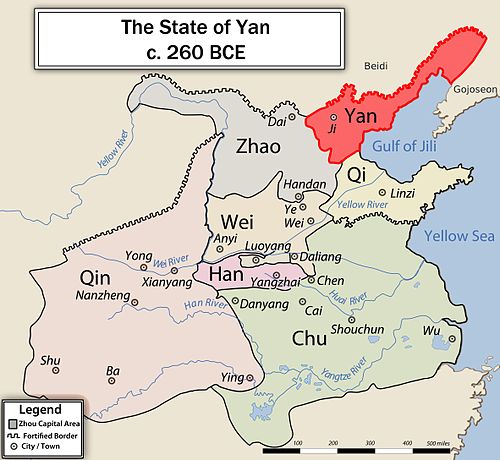
Qin eliminates Yan (燕, Yān) and Qi (齐, Qí), completing conquest of all Warring States. Crown Prince Dan (太子丹, Tàizǐ Dān) of Yan executed. Wang Ben takes Qi without battle. #conquest #war #history
China Map, Yan State, 260BCE By Philg88 - Own work, CC BY-SA 3.0, https://commons.wikimedia.org/w/index.php?curid=11953752
221 BCE
Standardization Decrees (书同文车同轨)
Standardization decrees: unified script (小篆, xiǎozhuàn seal script by Li Si 李斯, Lǐ Sī), weights, measures, axle widths, currency. Abolishes regional variations. #governance #culture #standardization
Rubbing of 1st edict on bronze standard weight in Qin dynasty, circa 221 BC. About 10cm high. The Qin dynasty unified China alongside its written styles and measures. Original weight is in Yūrinkan Museum, Kyoto, Japan. The rubbing was made in early 20th century, Beijing, China, By ReijiYamashina777 - Own work, CC0, https://commons.wikimedia.org/w/index.php?curid=153809022
221 BCE
First Emperor Proclaimed (秦始皇称帝)
Ying Zheng (嬴政, Yíng Zhèng) proclaims himself Qin Shi Huang (秦始皇, Qín Shǐhuáng), 'First Emperor.' Creates unprecedented title 'Huangdi' (皇帝), rejecting old 'king.' Birth of Chinese empire. #politics #history #monarchy
214 BCE
Southern Campaign Against Baiyue (南征百越)
Qin armies conquer Baiyue (百越, Bǎiyuè) peoples in south, establishing Nanhai (南海, Nánhǎi) and Guilin (桂林, Guìlín) commanderies. Lingqu Canal (灵渠, Líng Qú) built to supply armies. #conquest #engineering #frontier
A statue of a man, dating from State of Yue, located in the State Museum of Zhejiang province, Hangzhou, Zhejiang, China. By Discott - Own work, CC BY-SA 3.0, https://commons.wikimedia.org/w/index.php?curid=15807372
214 BCE
Meng Tian Defeats Xiongnu (蒙恬北击匈奴)
General Meng Tian (蒙恬, Méng Tián) leads 300,000 troops north, defeats Xiongnu (匈奴, Xiōngnú), seizes Ordos Loop. Begins construction of Great Wall connecting earlier fortifications. #defence #war #frontier
The Great Wall of China at Jinshanling By Severin.stalder - Own work, CC BY-SA 3.0, https://commons.wikimedia.org/w/index.php?curid=39661035
213 BCE
Book Burning Edict (焚书令)
Li Si (李斯, Lǐ Sī) proposes burning all non-Qin historical records, private copies of Poetry and Documents, and all philosophy books except Qin archives. Agricultural and medical texts spared. #culture #censorship #history
Map of the Qin Dynasty (in c. 210 BCE) — in China. ::*The first unifying Imperial dynasty of China. ::*The coloured territories show the approximate extent of Qin political control at the death of Emperor Qin Shi Huang in 210 BC. By Itsmine - Self-published work by Itsmine, CC BY-SA 3.0, https://commons.wikimedia.org/w/index.php?curid=1389340
212 BCE
Scholars Buried Alive (坑儒事件)
First Emperor buries alive approximately 460 alchemists and scholars (方士, fāngshì and 儒生, rúshēng) at Xianyang (咸阳, Xiányáng) for deceiving him about immortality elixirs. #culture #religion #disaster
212 BCE
Epang Palace Construction (阿房宫兴建)
Construction begins on Epang Palace (阿房宫, Ēpáng Gōng), massive imperial complex south of Xianyang (咸阳, Xiányáng). Symbol of Qin grandeur and labor exploitation. Never completed. #architecture #culture #labor
阿房宫前殿遗址夯土台西侧 By Kcx36 - Own work, CC BY-SA 4.0, https://commons.wikimedia.org/w/index.php?curid=138426500
210 BCE
Terracotta Army Burial (兵马俑陪葬)
Terracotta Army (兵马俑, Bīngmǎyǒng) buried with First Emperor near modern Xi'an (西安, Xī'ān). Over 8,000 life-sized soldiers, horses, chariots guard tomb. Masterpiece of Qin art. #art #culture #burial
Terracotta Army in Xi'an, China By xiquinhosilva - https://www.flickr.com/photos/xiquinho/27718581472/in/album-72157669496699682/, CC BY 2.0, https://commons.wikimedia.org/w/index.php?curid=147287690
210 BCE
First Emperor Dies at Shaqiu (秦始皇崩于沙丘)
First Emperor dies at Shaqiu (沙丘, Shāqiū) during fifth tour. Eunuch Zhao Gao (赵高, Zhào Gāo) and Li Si (李斯, Lǐ Sī) conceal death, forge will favoring Hu Hai (胡亥, Hú Hài). #politics #history #succession
210 BCE
Zhida Road Completed (秦直道竣工)
Meng Tian (蒙恬, Méng Tián) completes Zhida (直道, Zhídào), 'Direct Road' from Xianyang (咸阳, Xiányáng) to northern frontier. 800-km military highway enabling rapid troop movement. #engineering #defence #transport
209 BCE
Hu Hai Seizes Throne (胡亥篡位)
Zhao Gao (赵高, Zhào Gāo) and Li Si (李斯, Lǐ Sī) install Hu Hai (胡亥, Hú Hài) as Second Emperor (秦二世, Qín Èrshì). Eldest son Fusu (扶苏, Fú Sū) forced to commit suicide. #politics #intrigue #history
Qin Shi Huang, first emperor of China. Qin dynasty, 221-210 B.C.,Colour portrait. By Unknown author - The British Library, Public domain, https://commons.wikimedia.org/w/index.php?curid=164940169
209 BCE
Daze Township Uprising (大泽乡起义)
Chen Sheng (陈胜, Chén Shèng) and Wu Guang (吴广, Wú Guǎng) launch first major anti-Qin uprising at Daze Township (大泽乡, Dàzé Xiāng). 'Are kings and nobles born to their lot?' #rebellion #history #politics
Uprisings of Qin Dynasty, including uprisings of Dazexiang (Chen Sheng and Wu Guang), Liu Bang and Xiang Yu. By SY - Own work, CC BY-SA 4.0, https://commons.wikimedia.org/w/index.php?curid=63577599
208 BCE
Li Si Executed (李斯腰斩)
Chancellor Li Si (李斯, Lǐ Sī), architect of Qin centralization, executed by waist-cutting (腰斩, yāozhǎn) after Zhao Gao's (赵高, Zhào Gāo) intrigue. Victim of his own Legalist system. #politics #law #tragedy
208 BCE
Battle of Julu (巨鹿之战)
Xiang Yu (项羽, Xiàng Yǔ) destroys Qin main army at Julu (巨鹿, Jùlù), 'breaking cauldrons and sinking boats' (破釜沉舟, pò fǔ chén zhōu). Qin general Zhang Han (章邯, Zhāng Hán) surrenders. #war #rebellion #history
巨鹿之戰_邢台博物館 By Vitsuha - Own work, CC0, https://commons.wikimedia.org/w/index.php?curid=170999727
207 BCE
Zhao Gao Murders Emperor (赵高弑君)
Zhao Gao (赵高, Zhào Gāo) assassinates Second Emperor Hu Hai (胡亥, Hú Hài), installs Ziying (子婴, Zǐyīng) as diminished 'king' rather than emperor. Qin authority collapses. #politics #intrigue #tragedy
207 BCE
Liu Bang Enters Pass (刘邦入关)
Liu Bang (刘邦, Liú Bāng), rebel leader from Pei (沛, Pèi), enters Hangu Pass (函谷关, Hángǔ Guān) with minimal resistance. Ziying (子婴, Zǐyīng) surrenders at Xianyang (咸阳, Xiányáng). #rebellion #politics #history
汉高祖(前256一前195) 明人绘 By Unknown author - http://earlyworldhistory.blogspot.com/2012/03/liu-bang.html, Public domain, https://commons.wikimedia.org/w/index.php?curid=70464970
206 BCE
Three Articles of Law (约法三章)
Liu Bang (刘邦, Liú Bāng) establishes 'Three Articles of Law': kill no more, steal no more, harm no more. Contrast with Qin harshness wins popular support in Guanzhong (关中, Guānzhōng). #law #politics #history
206 BCE
Ziying Surrenders to Xiang Yu (子婴降项羽)
Ziying (子婴, Zǐyīng) executed by Xiang Yu (项羽, Xiàng Yǔ). Xiang Yu burns Epang Palace (阿房宫, Ēpáng Gōng), slaughters population. Formal end of Qin dynasty. #war #destruction #history
206 BCE
Feast at Hong Gate (鸿门宴)
Famous banquet at Hongmen (鸿门, Hóng Mén) where Xiang Yu (项羽, Xiàng Yǔ) spares Liu Bang (刘邦, Liú Bāng). Fan Zeng (范增, Fàn Zēng) urges assassination; Xiang Yu refuses. #politics #history #intrigue
Western Han Dynasty mural depicting the Hongmen Banquet, discovered in Northwest 61th Tomb now in the Luoyang Ancient Tombs Museum. One of the earliest excavated depictions of the event. 鸿门宴图, 河南洛阳老城西北61号墓,现藏于洛阳古墓博物馆 By ChenDaoIsHere - Own work, Public domain, https://commons.wikimedia.org/w/index.php?curid=117303712
202 BCE
Han Dynasty Founded (汉朝建立)
Liu Bang (刘邦, Liú Bāng) defeats Xiang Yu (项羽, Xiàng Yǔ) at Gaixia (垓下, Gāixià), proclaims Han dynasty. Qin's centralized model adapted, Legalism rejected for Confucianism. #politics #history #succession
Map of Han Dynasty in 2 CE. Modification of Image:Han Dynasty Plain map.PNG Darkest blue represents the commanderies and principalities of the Han Empire. Light blue represents the Tarim Basin protectorate. By DannamEmpire - Own work using: Based on: Map, p. 63, Mapping History: World History (London: Cartographica, 2007), by Dr. Ian Barnes. ISBN 978-1-84573-323-0, CC BY 4.0, https://commons.wikimedia.org/w/index.php?curid=162847450