Encyclopedia/3. History, Societies & Civilizations/09. Modern Nations/05. Europe • Curated by Admin Timeline.sg
History of Slovenia, sourced from Wikipedia's "Timeline of Slovenian history".
Chronological Storyline (139 Milestones)
250 BCE
Celt
The Celtic La Tène culture comes to the territories of modern Slovenia, replacing the Hallstatt culture. Source — Wikipedia, "Timeline of Slovenian history" (third century BC):
Celts in Europe the core Hallstatt territory, expansion before 500 BC maximum Celtic expansion by the 270s BC Lusitanian, Autrigones, Varduli and Caristi areas of Iberia, "Celticity" uncertain the boundaries of the six commonly-recognized 'Celtic nations', which remained Celtic speaking throughout the Middle Ages (viz. Brittany, Wales, Cornwall, Isle of Man, Ireland, Scotland) areas that remain Celtic-speaking today By QuartierLatin1968,The Ogre,Dbachmann - Atlas of the Celtic World, by John Haywood; London Thames & Hudson Ltd., 2001, pp.30-37 and other sources (see talkpage for details)., CC BY-SA 3.0, https://commons.wikimedia.org/w/index.php?curid=638312
221 BCE
Roman Republic
The border of the Roman Republic arrives at the Julian Alps. Source — Wikipedia, "Timeline of Slovenian history" (third century BC):
Territory of the Roman republic in 44 BC. Map based on territory depicted in Hammond's 8 x 11 Map of Roman Dominions 44 BC (1906). Coastlines from the Ancient World Mapping Center shape files. Map tiles from Consortium of Ancient World Mappers. Both are released under CC-BY 4.0. The projection is Europe Equidistant Conic (ESRI:102031). Contra Hammond, Cyprus is excluded from the map per Goldsworthy Caesar (2006) p 444, citing Dio 42.35.5, noting that Cyprus was returned to the Ptolemaic kingdom after Caesar's intervention in Alexandria. By Ifly6 - Own work, CC BY-SA 4.0, https://commons.wikimedia.org/w/index.php?curid=155519121
181 BCE
Roman Republic
The Roman foundation of Aquileia marks the beginning of a gradual conquering of the territories of modern Slovenia by the Romans. Source — Wikipedia, "Timeline of Slovenian history" (second century BC):
Territory of the Roman republic in 44 BC. Map based on territory depicted in Hammond's 8 x 11 Map of Roman Dominions 44 BC (1906). Coastlines from the Ancient World Mapping Center shape files. Map tiles from Consortium of Ancient World Mappers. Both are released under CC-BY 4.0. The projection is Europe Equidistant Conic (ESRI:102031). Contra Hammond, Cyprus is excluded from the map per Goldsworthy Caesar (2006) p 444, citing Dio 42.35.5, noting that Cyprus was returned to the Ptolemaic kingdom after Caesar's intervention in Alexandria. By Ifly6 - Own work, CC BY-SA 4.0, https://commons.wikimedia.org/w/index.php?curid=155519121
178 BCE
Roman Republic
Romans conquer Histria. Subsequently, in 129 <small>BC</small>, they subjugated the Taurisci people and in 115 <small>BC</small> the Carni people. Source — Wikipedia, "Timeline of Slovenian history" (second century BC):
Territory of the Roman republic in 44 BC. Map based on territory depicted in Hammond's 8 x 11 Map of Roman Dominions 44 BC (1906). Coastlines from the Ancient World Mapping Center shape files. Map tiles from Consortium of Ancient World Mappers. Both are released under CC-BY 4.0. The projection is Europe Equidistant Conic (ESRI:102031). Contra Hammond, Cyprus is excluded from the map per Goldsworthy Caesar (2006) p 444, citing Dio 42.35.5, noting that Cyprus was returned to the Ptolemaic kingdom after Caesar's intervention in Alexandria. By Ifly6 - Own work, CC BY-SA 4.0, https://commons.wikimedia.org/w/index.php?curid=155519121
48 BCE
Julius Caesar
Noricans take the side of Julius Caesar (c. 100–44 <small>BC</small>) in the civil war against Pompey (106–48 <small>BC</small>). Source — Wikipedia, "Timeline of Slovenian history" (first century BC):
Portrait of Julius Caesar By Ángel M. Felicísimo from Mérida, España - Retrato de Julio César, Public domain, https://commons.wikimedia.org/w/index.php?curid=91281949
16 BCE
Pannonians
Noricans, having joined with the Pannonians in invading Histria, are defeated by Publius Silius, proconsul of Illyricum. Source — Wikipedia, "Timeline of Slovenian history" (first century BC):
Map depicting the Illyrians in the 7th–4th centuries BC (tribal distribution and settlement locations). By Ahmet Q. - Own work, based on following sources: Eichner, Heiner (2004) "Illyrisch – die unbekannte Sprache" in Eichner, Heiner, ed. (in German) Die Illyrer. Archäologische Funde des 1. Vorchristlichen Jahrtausends aus Albanien, Museum für Urgeschichte Asparn an der Zaya, pp. 92–117 ISBN: 3-85460-215-4. Matijašić, Ivan (2011). ""Shrieking like Illyrians": Historical geography and the Greek perspective of the Illyrian world in the 5th century BC". Arheološki Vestnik 62: 289–316. Research Centre of the Slovenian Academy of Sciences and Arts. Šašel Kos, Marjeta (2013). "The 'great lake' and the Autariatai in Pseudo-Skylax". Mélanges de l'École française de Rome: Antiquité 125 (1): 247–257. DOI:10.4000/mefra.1376. Shipley, Graham (2020) Pseudo-Skylax's Periplous: The Circumnavigation of the Inhabited World : Text, Translation and Commentary, Liverpool University Press Series (2nd ed.), Oxford University Press ISBN: 9781789620917. Topography taken from the vectorial map of the Balkans, made by Ikonast. File:Geographic_map_of_Balkan_Peninsula.svg, CC BY-SA 4.0, https://commons.wikimedia.org/w/index.php?curid=119772507
12 BCE
Tiberius
The army of Romans, led by Tiberius (42–37 <small>BC</small>, reigned 14–37), starts conquering Pannonia. Source — Wikipedia, "Timeline of Slovenian history" (first century BC):
Rome, Ara Pacis museum: cast of a portrait of emperor Tiberius. From the collection of casts of busts showing the members of the Julio-Claudian dynasty. The original artwork is exhibited in the Ny Carlsberg Glyptotek (Copenhagen). Picture by Giovanni Dall'Orto, March 28 2008. By Giovanni Dall'Orto - Own work, Attribution, https://commons.wikimedia.org/w/index.php?curid=3882531
9 BCE
Danube River
Pannonia is subdued and incorporated with Illyricum, the frontier of which was thus extended as far as the Danube. Source — Wikipedia, "Timeline of Slovenian history" (first century BC):
Hungary - Budapest By Visions of Domino - https://www.flickr.com/photos/99092496@N00/28493220635/, CC BY 2.0, https://commons.wikimedia.org/w/index.php?curid=57456497
7 CE
Pannonians
Pannonians, with the Dalmatians and other Illyrian tribes, revolt, and are overcome by Tiberius and Germanicus (15 BC–19 AD), after a hard-fought campaign which lasted for two years. Source — Wikipedia, "Timeline of Slovenian history" (first century):
Map depicting the Illyrians in the 7th–4th centuries BC (tribal distribution and settlement locations). By Ahmet Q. - Own work, based on following sources: Eichner, Heiner (2004) "Illyrisch – die unbekannte Sprache" in Eichner, Heiner, ed. (in German) Die Illyrer. Archäologische Funde des 1. Vorchristlichen Jahrtausends aus Albanien, Museum für Urgeschichte Asparn an der Zaya, pp. 92–117 ISBN: 3-85460-215-4. Matijašić, Ivan (2011). ""Shrieking like Illyrians": Historical geography and the Greek perspective of the Illyrian world in the 5th century BC". Arheološki Vestnik 62: 289–316. Research Centre of the Slovenian Academy of Sciences and Arts. Šašel Kos, Marjeta (2013). "The 'great lake' and the Autariatai in Pseudo-Skylax". Mélanges de l'École française de Rome: Antiquité 125 (1): 247–257. DOI:10.4000/mefra.1376. Shipley, Graham (2020) Pseudo-Skylax's Periplous: The Circumnavigation of the Inhabited World : Text, Translation and Commentary, Liverpool University Press Series (2nd ed.), Oxford University Press ISBN: 9781789620917. Topography taken from the vectorial map of the Balkans, made by Ikonast. File:Geographic_map_of_Balkan_Peninsula.svg, CC BY-SA 4.0, https://commons.wikimedia.org/w/index.php?curid=119772507
9 CE
Roman Empire
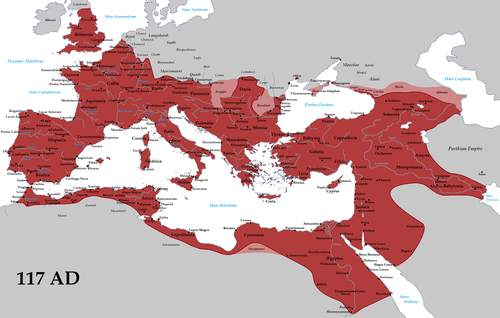
The Roman Empire finally conquers Pannonia (which includes the biggest part of present-day Slovenia). Roman legions stay in Poetovio (modern Ptuj). Source — Wikipedia, "Timeline of Slovenian history" (first century):
The Roman Empire (red) and its clients (pink) in 117 AD during the reign of emperor Trajan. By Tataryn - Own work, CC BY-SA 3.0, https://commons.wikimedia.org/w/index.php?curid=19625326
40 CE
Noricum
The Noricum Kingdom is ultimately incorporated to the Roman Empire by the Roman caesar Claudius (10 BC–54 AD, reigned 41–54). Noricum includes Carinthia and most of Styria. Hence, the entire territory of modern Slovenia is within the borders of the Roman Empire. Source — Wikipedia, "Timeline of Slovenian history" (first century):
Locator map of the Noricum province in the Roman Empire (125). Extracted from File:Roman Empire 125 political map.svg By Milenioscuro - Own work, CC BY-SA 4.0, https://commons.wikimedia.org/w/index.php?curid=45059734
46 CE
Celje
Celeia (modern Celje) gets its municipal rights under the name municipium Claudia Celeia. Source — Wikipedia, "Timeline of Slovenian history" (first century):
Celjski dom By Reisevogel - Own work, CC BY-SA 4.0, https://commons.wikimedia.org/w/index.php?curid=98682339
103 CE
Trajan
Roman caesar Trajan (53–117, reigned 98–117) moves the Legio XIII Gemina to the north border in Karnunt (Carnuntum) (today Deutsch Altenburg in Lower Austria) in Pannonia along the Danube River. Source — Wikipedia, "Timeline of Slovenian history" (second century):
Head of Trajan (reign 98–117 CE), from an oversized statue (around 2.70 m height). By Unknown artist - User:Bibi Saint-Pol, own work, 2007-02-08, Public domain, https://commons.wikimedia.org/w/index.php?curid=1954815
290 CE
Diocletian
Noricum is divided under Roman Emperor Diocletian (245–313, reigned 284–305) into Noricum Ripense (along the Danube) and Noricum Mediterraneum (the southern mountainous district). Source — Wikipedia, "Timeline of Slovenian history" (third century):
Diocletian, 284-305, from Nikomedia, Izmit, end 3rd century AD. By Dosseman - Own work, CC BY-SA 4.0, https://commons.wikimedia.org/w/index.php?curid=187730312
320 CE
Aquileia
Celeia is incorporated with Aquileia (Oglej) under Roman Emperor Constantine I. (272–337, reigned 307–337). Source — Wikipedia, "Timeline of Slovenian history" (fourth century):
Basilica Patriarcale (Aquileia) - Exterior By ThePhotografer - Own work, CC BY-SA 4.0, https://commons.wikimedia.org/w/index.php?curid=118357268
550 CE
Slavic settlement of Eastern Alps
The first wave of Slavic settlement, originating from Moravia, reaches the Eastern Alps region and the western margin of the Pannonian plain. Source — Wikipedia, "Timeline of Slovenian history" (sixth century):
This is a photo of a cultural monument of the Czech Republic,number: By Tadeáš Bednarz - Own work, CC BY-SA 4.0, https://commons.wikimedia.org/w/index.php?curid=89926075
568 CE
Lombards
Lombards leave the territories of modern Slovenia and the borderlands of Pannonia, moving into Italy. Source — Wikipedia, "Timeline of Slovenian history" (sixth century):
Italy in the time of the Lombards By Johann Gustav Droysen - Allgemeiner Historischer Handatlas, Public domain, https://commons.wikimedia.org/w/index.php?curid=16243299
585 CE
Slavs
The second and most important wave of Slavic settlement takes place. Slavs and Avars settle in Eastern Alps (Julian Alps, Karavanke), eventually occupying an area more than twice the size of today's Slovenia. Slavic settlement is proven by the decline of dioceses in the Eastern Alpine region in second half of the sixth century, as well as in the change of population, the material culture and the linguistic identity of the area. Source — Wikipedia, "Timeline of Slovenian history" (sixth century):
Countries where a West Slavic language is the national language Countries where an East Slavic language is the national language Countries where a South Slavic language is the national language By CrazyPhunk - self-made - based upon: Image:Slavic europe.png, CC BY-SA 3.0, https://commons.wikimedia.org/w/index.php?curid=159412311
610 CE
Avars
Avars attempt to invade Italy. After their power is weakened, a relatively independent March of Slavs ( ) appears. Source — Wikipedia, "Timeline of Slovenian history" (seventh century):
Map of the Avar Khaganate and surrounding states and peoples, showing the archeological Avar sites found, its approximate settlement area, and main cities of the period. By Wario2 - Own work Omeljan Pritsak The Slavs and the Avars The victorious refugees established themselves in the Northern Caucasus, near the Byzantine holdings in the Crimea. In 558, through the good services of the Alan ruler, they established relations with the Byzantines and soon were granted the status of foederati on Byzantine territory in Scythia Minor, that is, Dobrudja, CC BY-SA 4.0, https://commons.wikimedia.org/w/index.php?curid=124091844
623 CE
Avars
Uprising of Slavs led by Samo<sup>1</sup> against Avars. Samo's Tribal Union is formed. Source — Wikipedia, "Timeline of Slovenian history" (seventh century):
Map of the Avar Khaganate and surrounding states and peoples, showing the archeological Avar sites found, its approximate settlement area, and main cities of the period. By Wario2 - Own work Omeljan Pritsak The Slavs and the Avars The victorious refugees established themselves in the Northern Caucasus, near the Byzantine holdings in the Crimea. In 558, through the good services of the Alan ruler, they established relations with the Byzantines and soon were granted the status of foederati on Byzantine territory in Scythia Minor, that is, Dobrudja, CC BY-SA 4.0, https://commons.wikimedia.org/w/index.php?curid=124091844
631 CE
Austrasia
The Battle of Wogastisburg (probably Forchheim) between Samo's army and Austrasian forces, led by Merovingian king Dagobert I of the Franks (603–639, reigned 629–639). Source — Wikipedia, "Timeline of Slovenian history" (seventh century):
Map of the rise of Frankish Empire, from 481 to 814. By Sémhur - Own work using: Image:Frankish empire.jpg, itself from File:Growth of Frankish Power, 481-814.jpg, from the Historical Atlas by William R. Shepherd (Shepherd, William. Historical Atlas. New York: Henry Holt and Company, 1911.), CC BY-SA 3.0, https://commons.wikimedia.org/w/index.php?curid=2919958
658 CE
Carantania
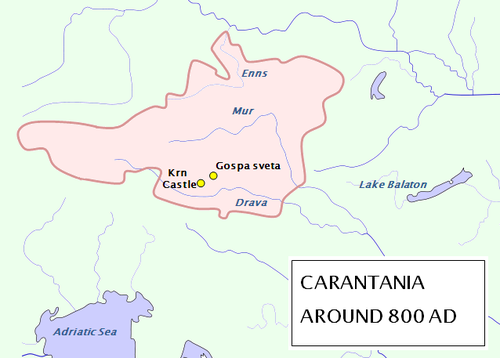
Samo's death. The Tribal Union declines, but a part of the March of Slavs maintains independence and becomes known in historical sources under the name of Carantania. The center of Karantania was Zollfeld, north of modern Klagenfurt. Source — Wikipedia, "Timeline of Slovenian history" (seventh century):
Carantania (Karantanija) at 800 AD; for approximate borders: look at Inzko Valentin (1978): Zgodovina Slovencev do leta 1918. Mohorjeva založba, Celovec. Str. 21; Čepič Zdenko et al. (1979): Zgodovina Slovencev. Cankarjeva založba, Ljubljana 1979, str. 127 in 133; Peršič Janez et al. (1983): Stare kulture. Mladinska knjiga, Ljubljana, str. 144. By Carantania_800_AD.PNG: *Waterways_of_SE_Central_Europe.svg: Kmiki87 derivative work: Bostjan46 (talk) Waterways_of_SE_Central_Europe.svg: Kmiki87 derivative work: Bostjan46 (talk) - Carantania_800_AD.PNG Waterways_of_SE_Central_Europe.svg, Public domain, https://commons.wikimedia.org/w/index.php?curid=9973947
745 CE
Franks
Karantania loses its independence and becomes a margraviate and tantamount part of the semifeudal Frankish empire later under the rule of king Charlemagne (742–814, reigned 771–814) due to pressing danger of Avar tribes from the east. Source — Wikipedia, "Timeline of Slovenian history" (eighth century):
Roads and Towns in Germania Inferior By Hans Erren - eigen werk (own work), Modified from Germanie-inferieure.jpg by Moutschen based on a map from the DVD: Free Software Foundation Europe, Free Layers (licensed under GFDL)., CC BY-SA 3.0, https://commons.wikimedia.org/w/index.php?curid=7802075
796 CE
duke
The Slavic duke of Carniola, Vojnomir, aids the Carolingian duke Eric of Friuli against the Avars. Source — Wikipedia, "Timeline of Slovenian history" (eighth century):
Portrait of His Grace James Duke of Chandos (1673–1744) By Michael Dahl - Berger Collection: Website; Archived webpage (work no longer in collection as of February 2011), Public domain, https://commons.wikimedia.org/w/index.php?curid=6436291
798 CE
Salzburg is raised to the rank
Salzburg is raised to the rank of an archdiocese Source — Wikipedia, "Timeline of Slovenian history" (eighth century):
811 CE
Drava
The southern boundary of the archdiocese of Salzburg is moved south to the Drava river at the expense of the Patriarchate of Aquileia. Source — Wikipedia, "Timeline of Slovenian history" (ninth century):
River Drava By Nick Savchenko from Kiev, Ukraine - River Drava, CC BY-SA 2.0, https://commons.wikimedia.org/w/index.php?curid=66690156
840 CE
Balaton Principality
The Balaton Principality emerges in Pannonia. Source — Wikipedia, "Timeline of Slovenian history" (ninth century):
Map of the settlement of the Slavs and their neighbors at the end of the 8th century. The borders of some states are shown starting from the 7th century. It was founded in the East Slavic part mainly on archaeological maps and descriptions, in particular, taken from the works of V.V. mainly data on the Balts and Finno-Ugric peoples). Details added 2023: Venice was still in the Byzantine Empire at this time. Avars were also present around Vienna and in central Transylvania, evidenced by graves & toponyms. There was a linguistic contact between Albanians and Vlachs, evidenced by the non-Slavic words present in both languages. Placed the Etelköz of the Magyars and the Crimean byzantine Greeks. South-Slavic toponyms (as Trnava for "tip, hillock, mound") evidenced a South-Slavic presence in southern Transylvania. Concerning the Eastern romance speakers (called Vlachs or Volokhs), to choose a nationalist positioning, as the 2022 revert, is reductive: here is no reason to show only the theory A ("Awarenwüste" or "Desert of the Avars" of Franz-Josef Sulzer, Josef-Karl Eder, Johann-Christian von Engel and Eduard-Robert Rössler in Romänische Studien: untersuchungen zur älteren Geschichte Rumäniens, Leipzig 1871: see Béla Köpeczi's Erdély rövid története, Akadémiai Kiadó ISBN 963 05 5901 3) which affirms that the Vlachs lived only on the south of the Danube during Late antiquity and High Middle ages, and to exclude the theory B which affirms that the Volokhs lived only on the north of the Danube (see Rumen Daskalov and Aleksander Vezenkov's « Entangled Histories of the Balkans - Shared Pasts, Disputed Legacies » Vol. III in Balkan Studies Library, Brill 2015, ISBN 9004290362). Unaware the pastoral nomadism which, in the general opinion of historians, ethnologists and linguists, was until the end of the Middle Ages the main activity of the Vlachs, the both theories affirming that the Danube and the Carpathians were, before the 13-th century, open borders for the Slavs and the Magyars, but impassable obstacles for the Vlachs / Volokhs and only for them, the lack of indisputable proof of their presence being worth proof of absence. This applies to the northern left bank of the Danube in the theory A and to the southern right bank of the Danube in the theory B, but the illusion thus created in the secondary sources, that the Vlachs disappeared for a thousand years to miraculously reappear afterwards (see Gheorghe I. Brătianu, "The Romanians, an enigma and historical miracle" Academia Civică Publ., Bucharest 2019, ISBN 9786068924069) is a nonsense. By Koryakov Yuri - Own work, CC BY-SA 3.0, https://commons.wikimedia.org/w/index.php?curid=3689309
843 CE
Louis the German
Karantania passes into the hands of Louis the German (804–876). Source — Wikipedia, "Timeline of Slovenian history" (ninth century):
Louis the German By Unknown author, Public domain, https://commons.wikimedia.org/w/index.php?curid=525879
871 CE
Conversio Bagoariorum et Carantanorum
The earliest written record of the ancient Karantanian ritual of installing dukes Conversio Bagoariorum et Carantanorum, where is written: ... illi eum ducem fecerunt... (they were made dukes). Source — Wikipedia, "Timeline of Slovenian history" (ninth century):
Conversio Bagoariorum et Carantanorum By Unknown author, Public domain, https://commons.wikimedia.org/w/index.php?curid=143581115
876 CE
principality
The principality of Prince Kocelj (Balaton Principality) loses its independence. Source — Wikipedia, "Timeline of Slovenian history" (ninth century):
Map of the settlement of the Slavs and their neighbors at the end of the 8th century. The borders of some states are shown starting from the 7th century. It was founded in the East Slavic part mainly on archaeological maps and descriptions, in particular, taken from the works of V.V. mainly data on the Balts and Finno-Ugric peoples). Details added 2023: Venice was still in the Byzantine Empire at this time. Avars were also present around Vienna and in central Transylvania, evidenced by graves & toponyms. There was a linguistic contact between Albanians and Vlachs, evidenced by the non-Slavic words present in both languages. Placed the Etelköz of the Magyars and the Crimean byzantine Greeks. South-Slavic toponyms (as Trnava for "tip, hillock, mound") evidenced a South-Slavic presence in southern Transylvania. Concerning the Eastern romance speakers (called Vlachs or Volokhs), to choose a nationalist positioning, as the 2022 revert, is reductive: here is no reason to show only the theory A ("Awarenwüste" or "Desert of the Avars" of Franz-Josef Sulzer, Josef-Karl Eder, Johann-Christian von Engel and Eduard-Robert Rössler in Romänische Studien: untersuchungen zur älteren Geschichte Rumäniens, Leipzig 1871: see Béla Köpeczi's Erdély rövid története, Akadémiai Kiadó ISBN 963 05 5901 3) which affirms that the Vlachs lived only on the south of the Danube during Late antiquity and High Middle ages, and to exclude the theory B which affirms that the Volokhs lived only on the north of the Danube (see Rumen Daskalov and Aleksander Vezenkov's « Entangled Histories of the Balkans - Shared Pasts, Disputed Legacies » Vol. III in Balkan Studies Library, Brill 2015, ISBN 9004290362). Unaware the pastoral nomadism which, in the general opinion of historians, ethnologists and linguists, was until the end of the Middle Ages the main activity of the Vlachs, the both theories affirming that the Danube and the Carpathians were, before the 13-th century, open borders for the Slavs and the Magyars, but impassable obstacles for the Vlachs / Volokhs and only for them, the lack of indisputable proof of their presence being worth proof of absence. This applies to the northern left bank of the Danube in the theory A and to the southern right bank of the Danube in the theory B, but the illusion thus created in the secondary sources, that the Vlachs disappeared for a thousand years to miraculously reappear afterwards (see Gheorghe I. Brătianu, "The Romanians, an enigma and historical miracle" Academia Civică Publ., Bucharest 2019, ISBN 9786068924069) is a nonsense. By Koryakov Yuri - Own work, CC BY-SA 3.0, https://commons.wikimedia.org/w/index.php?curid=3689309
887 CE
Arnulf of Carinthia
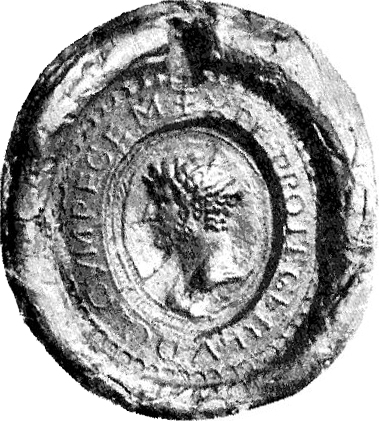
Arnulf of Carinthia (850–899) a grandson of Louis the German assumes his title of King of the East Franks and becomes the first Duke of Carinthia. Source — Wikipedia, "Timeline of Slovenian history" (ninth century):
Seal of Arnulph of Carinthia, from 896. By Unknown author - Cropped from [1], Public domain, https://commons.wikimedia.org/w/index.php?curid=30474227
894 CE
Great Moravia
Great Moravia probably loses a part of its territory—present-day Western Hungary—to Arnulf of Carinthia, who failed to conquer Great Moravia in 892, 893, 894/895 and 899. Source — Wikipedia, "Timeline of Slovenian history" (ninth century):
Great Moravia at its greatest extent during the reign of Svatopluk I with marked probable approximate location of its capital city (red dot) By Great_moravia_svatopluk.png: Tankred derivative work: Millenium187 (talk) - Great_moravia_svatopluk.png, Public domain, https://commons.wikimedia.org/w/index.php?curid=16071345
895 CE
Bohemia
Accord between Arnulf of Carinthia and the Bohemian Duke Bořivoj (reigned 870–895), Bohemia is freed from the danger of invasion. Source — Wikipedia, "Timeline of Slovenian history" (ninth century):
Karlštejn Castle, Czech Republic. 2015 By Ввласенко - Own work, CC BY-SA 3.0, https://commons.wikimedia.org/w/index.php?curid=44968077
896 CE
Magyars
Finno-Ugric Magyars, led by Árpád, settle in the Pannonian plain. The centre of their settlement becomes the region around the Theiss River (Hungary). Source — Wikipedia, "Timeline of Slovenian history" (ninth century):
Map of the Hungarian diaspora in the world. (The map might include people with Hungarian ancestry or citizenship) Hungary + 1,000,000 + 100,000 + 10,000 + 1,000 By Allice Hunter - Blank map: File:BlankMap-World6.svg Information available on page Hungarians, Hungarian diaspora on the English Wikipedia, and at Joshua Project If you disagree with the data, please check all sources before questioning Since the map data is from Wikipedia's own pages, information may be omitted or out of date or maybe inaccurate. If you intend to make changes to this map, please provide a source and make them available here., CC BY-SA 4.0, https://commons.wikimedia.org/w/index.php?curid=103878976
899 CE
Arnulf of Carinthia
Arnulf of Carinthia dies. Source — Wikipedia, "Timeline of Slovenian history" (ninth century):
Seal of Arnulph of Carinthia, from 896. By Unknown author - Cropped from [1], Public domain, https://commons.wikimedia.org/w/index.php?curid=30474227
906 CE
Magyars
Invading Magyars destroy the weakened empire of Great Moravia. Source — Wikipedia, "Timeline of Slovenian history" (10th century):
Map of the Hungarian diaspora in the world. (The map might include people with Hungarian ancestry or citizenship) Hungary + 1,000,000 + 100,000 + 10,000 + 1,000 By Allice Hunter - Blank map: File:BlankMap-World6.svg Information available on page Hungarians, Hungarian diaspora on the English Wikipedia, and at Joshua Project If you disagree with the data, please check all sources before questioning Since the map data is from Wikipedia's own pages, information may be omitted or out of date or maybe inaccurate. If you intend to make changes to this map, please provide a source and make them available here., CC BY-SA 4.0, https://commons.wikimedia.org/w/index.php?curid=103878976
907 CE
Slovene territory is settled by Magyars.
Slovene territory is settled by Magyars. Source — Wikipedia, "Timeline of Slovenian history" (10th century):
952 CE
The Great Carantania. (to 1180)
The Great Carantania. (to 1180) Source — Wikipedia, "Timeline of Slovenian history" (10th century):
955 CE
Otto the Great
German king Otto I (912–973, reigned 936–973) defeats the Magyars at the Battle of Lechfeld near Augsburg, halting their advance in Central Europe. Source — Wikipedia, "Timeline of Slovenian history" (10th century):
Seal of Otto I, detailed description: The Seals of the German Emperors and Kings: Volume 5:Page 12, No. 5 By Otto Posse - Die Siegel der Deutschen Kaiser und Könige, Band 5, Public domain, https://commons.wikimedia.org/w/index.php?curid=1668262
976 CE
March of Austria
The March of Austria is established. Carantania becomes a duchy in its own right, including Styria and today's East Tirol Source — Wikipedia, "Timeline of Slovenian history" (10th century):
A map of the Margraviate of Austria (German: Markgrafschaft Österreich; Old High German: Ostarrîchi) within the Duchy of Bavaria around the year 1000. The map is derived from a vectorised version of one found in Professor G. Droysens Allgemeiner Historischer Handatlas, which was published in 1886 by R. Andrée Plate, and is now in the public domain. Note that while it uses the same scheme as standard location/locator maps, this map technically does not conform to the standard, as it is not in equirectangular projection. Therefore grid lines for latitude and longitude are also included on the sub-map. By Alphathon /ˈæɫfə.θɒn/ (talk) - File: own workData: File:Droysens-22-23.jpg, CC BY-SA 4.0, https://commons.wikimedia.org/w/index.php?curid=48868858
1000 CE
Duchy of Carinthia
Carinthia, Styria and Carniola provinces emerge on the territory of Carantania. Source — Wikipedia, "Timeline of Slovenian history" (10th century):
A flag made up of a red and white stripe By Theodore Christopher - Own work, CC BY-SA 4.0, https://commons.wikimedia.org/w/index.php?curid=104968073
1112 CE
The first record mentions Ljubljana by
The first record mentions Ljubljana by its modern name (by its German name Castrum Laibach). (to 1125) Source — Wikipedia, "Timeline of Slovenian history" (12th century):
1122 CE
Middle Ages
The first mention of Celje in the early Middle Ages under the name of Cylie in Admont's Chronicle. (to 1137) Source — Wikipedia, "Timeline of Slovenian history" (12th century):
The Sower (second scene). The seed is scattered on the good ground, the thorny ground is at the front. The inscription "IDIATOR" is an intrusion from elsewhere. The sower is depicted in contaapposto, in an interesting 12th century landscape. By Jules & Jenny from Lincoln, UK - Canterbury Cathedral, window nXV detailMarks, Richard (2006) Stained Glass in England During the Middle Ages, Taylor and Francis, p. 121, 123 ISBN: 978-1-1349-6750-6., CC BY 2.0, https://commons.wikimedia.org/w/index.php?curid=80090658
1164 CE
Maribor
The first mention of Maribor as Castrum Marchburch. Source — Wikipedia, "Timeline of Slovenian history" (12th century):
Mariborski Glavni trg By Vlada Republike Slovenije - https://www.flickr.com/photos/vladars/54944039361/, Public domain, https://commons.wikimedia.org/w/index.php?curid=180956568
1269 CE
dynasty
The Carantanian dynasty becomes extinct. Source — Wikipedia, "Timeline of Slovenian history" (13th century):
日本の皇族2021年 By 日本国政府 - https://www.mofa.go.jp/ms/po/page22e_000943.html https://www.mofa.go.jp/files/100150747.pdf page 2, CC BY 4.0, https://commons.wikimedia.org/w/index.php?curid=110509227
1274 CE
Ottokar II of Bohemia
Bohemian king Ottokar II. (reigned as a king 1253–1278) a candidate for the German throne refuses to appear or to restore the provinces of Austria, Styria, Carinthia and Carniola, which he has seized. Source — Wikipedia, "Timeline of Slovenian history" (13th century):
Line art drawing of a dais. By Pearson Scott Foresman - This image has been extracted from another file, Public domain, https://commons.wikimedia.org/w/index.php?curid=5545918
1282 CE
The rule of Habsburg dukes over
The rule of Habsburg dukes over most Slovene lands begins. Source — Wikipedia, "Timeline of Slovenian history" (13th century):
1335 CE
Louis IV, Holy Roman Emperor
The Duchy of Carinthia is bestowed by Louis the Bavarian on the dukes of Austria. Source — Wikipedia, "Timeline of Slovenian history" (14th century):
Emperor Louis the Bavarian, cast of a relief in Mainz, c. 1330 (original in the Mainz State Museum, cast in Grünwald Castle). – The German king is depicted within a cycle of the Electors of the Empire. The dating suggests he is Louis the Bavarian. By Edelmauswaldgeist - https://commons.wikimedia.org/wiki/File:Burg_Gr%C3%BCnwald_11.jpg, CC0, https://commons.wikimedia.org/w/index.php?curid=192031959
1414 CE
Ernest of Austria
The Habsburg Duke Ernest the Iron (1377–1424) thrones according to the ancient Karantanian ritual of installing dukes on the Duke's Stone and he addresses again as an archduke. Source — Wikipedia, "Timeline of Slovenian history" (15th century):
Ernest the Iron By Anton Boys - http://www.kulturpool.at/plugins/kulturpool/showitem.action?itemId=17179958200&kupoContext=smartworkDetail, Public domain, https://commons.wikimedia.org/w/index.php?curid=41425576
1451 CE
Frederick II, Count of Celje
Celje acquires town rights by orders from Frederick II, the Count of Celje. Source — Wikipedia, "Timeline of Slovenian history" (15th century):
Frederic II. of Cilli, tournir at Constance (20th march 1415), at the time of Council of Constance (1414-1418). Richental Ulrich, Dacher Gebhard: Chronik des Konstanzer Konzils nach Ulrich Richental. Prague Manuscript, Cod XVI A 17, fol. 31a. Prague. By Richental Ulrich, Dacher Gebhard - Chronik des Konstanzer Konzils nach Ulrich Richental, Prague Manuscript, Public domain, https://commons.wikimedia.org/w/index.php?curid=11111927
1461 CE
diocese
Ljubljana becomes the seat of a diocese. Source — Wikipedia, "Timeline of Slovenian history" (15th century):
Pope's chair, Basilica di San Giovanni in Laterano, Roma, Italy. The text above the chair reads the following: LEO•XIII•CELLAM•MAXIMAM•VETVSTATE•FATISCENTEUM•INCENTI•MOLITIONE•PRODVCENDAM•LAXANDAMQVE•CVRAVIT VETVS•MVSIVVM•IAM•ANTEA•PARTIBVS•INSTAVRATVM•AD•ANTIQVVM•EXEMPLAR•RESTIVI ET•IN•NOVAM•ABSIDEM•OPERE•CVLTVQVE•MAGNIFICO•EXORNATAM•TRANSFERRI•AVLAM•TRANSVEERSAM LAQVEAPI•ET•CONTIGNATIONE•REFECTIS•EXPOLIRI•IVSSIT•ANNO•CHR•MDCCCLXXXIV•SACRI•PRINC•VIIDCP_2737 By Ern - Flickr, CC BY-SA 2.0, https://commons.wikimedia.org/w/index.php?curid=363597
1473 CE
Celje
The city walls and a defensive moat are built in Celje. Source — Wikipedia, "Timeline of Slovenian history" (15th century):
Celjski dom By Reisevogel - Own work, CC BY-SA 4.0, https://commons.wikimedia.org/w/index.php?curid=98682339
1511 CE
Ljubljana is devastated by an earthquake.
Ljubljana is devastated by an earthquake. Source — Wikipedia, "Timeline of Slovenian history" (16th century):
1532 CE
Siege of Maribor
The Siege of Maribor ends in a defensive victory. Source — Wikipedia, "Timeline of Slovenian history" (16th century):
1550 CE
Primož Trubar
Primož Trubar publishes the first books in Slovene, Catechismus and Abecedarium. Source — Wikipedia, "Timeline of Slovenian history" (16th century):
Primož Trubar, Jacob Lederlin, woodcut, 1578. By Jakob Lederlein - Portraitindex, Public domain, https://commons.wikimedia.org/w/index.php?curid=835613
1566 CE
Prekmurje
The region of Prekmurje is occupied by Ottomans during the Siege of Szigetvar. Source — Wikipedia, "Timeline of Slovenian history" (16th century):
Goričko Landscape By Iswoar - Own work, CC BY-SA 4.0, https://commons.wikimedia.org/w/index.php?curid=125954512
1583 CE
Jurij Dalmatin
Jurij Dalmatin translates to Slovene and publishes the Bible. Source — Wikipedia, "Timeline of Slovenian history" (16th century):
Dalmatinova Biblija. By Jurij Dalmatin, Public domain, https://commons.wikimedia.org/w/index.php?curid=12444608
1593 CE
Battle of Sisak
The Battle of Sisak restores the balance of power and brings the expansion of the Ottoman Empire into the Slovene Lands to a halt. Source — Wikipedia, "Timeline of Slovenian history" (16th century):
The Battle of Sisek (Bitka pri Sisku) in 1593. German painting By Unknown author - Military history of Hungary, Ed.: Ervin Liptai, 1985, Public domain, https://commons.wikimedia.org/w/index.php?curid=5773629
May 5, 1622 CE
Ljubljana
An earthquake occurs near Ljubljana. It measures about 5 on the Moment magnitude scale or 4.9 on the Richter scale Source — Wikipedia, "Timeline of Slovenian history" (17th century):
Ljubljana Old Town, Slovenia (Old Camera) By Andrew Milligan Sumo - Ljubljana Old Town, Slovenia (Old Camera), CC BY 2.0, https://commons.wikimedia.org/w/index.php?curid=57446373
1688 CE
Prekmurje
The Prekmurje region is occupied by Austrians. Source — Wikipedia, "Timeline of Slovenian history" (17th century):
Goričko Landscape By Iswoar - Own work, CC BY-SA 4.0, https://commons.wikimedia.org/w/index.php?curid=125954512
1693 CE
Academia operosorum Labacensis
The scholarly society Academia operosorum Labacensis is established in Ljubljana. Source — Wikipedia, "Timeline of Slovenian history" (17th century):
1701 CE
The Philharmonic Society (Academia philharmonicoru
The Philharmonic Society (Academia philharmonicorum) is established in Ljubljana. Source — Wikipedia, "Timeline of Slovenian history" (18th century):
1809 CE
Lower Carinthia incorporates to France as
Lower Carinthia incorporates to France as Duchy of Carinthia was divided into two parts, Upper or Western Carinthia and Lower or Eastern. Source — Wikipedia, "Timeline of Slovenian history" (19th century):
1813 CE
Lower Carinthia is re-conquered.
Lower Carinthia is re-conquered. Source — Wikipedia, "Timeline of Slovenian history" (19th century):
1821 CE
Congress of Laibach
Congress of Laibach takes place in Ljubljana. Source — Wikipedia, "Timeline of Slovenian history" (19th century):
Congress of Laibach By Leander Russ - repro from artbook, Public domain, https://commons.wikimedia.org/w/index.php?curid=10213530
1838 CE
Vienna
First works, tracings on Slovene territory of a railway route Vienna – Trieste in a so-called "Southern Railway" (Južna železnica) begin. Source — Wikipedia, "Timeline of Slovenian history" (19th century):
Konzert der Wiener Philharmoniker vor Schloss Schönbrunn, Wien By Superbass - Own work, CC BY-SA 3.0, https://commons.wikimedia.org/w/index.php?curid=19845088
1845 CE
Celje railway station
First works on the "Southern Railway" between Celje and Ljubljana begin Source — Wikipedia, "Timeline of Slovenian history" (19th century):
Celje train station (2020) By Petar Milošević - Own work, CC BY-SA 4.0, https://commons.wikimedia.org/w/index.php?curid=94002375
Apr 27, 1846 CE
locomotive
First locomotive of the "Southern Railway" comes to Celje. Source — Wikipedia, "Timeline of Slovenian history" (19th century):
R761 at Newport Workshops By Max Thum - Own work, CC BY-SA 4.0, https://commons.wikimedia.org/w/index.php?curid=67304700
1848 CE
United Slovenia
The United Slovenia (Zedinjena Slovenija), the first Slovene political programme rises. Source — Wikipedia, "Timeline of Slovenian history" (19th century):
A map of the Slovene Land and Provinces, author en:Peter Kozler By Peter Kozler - This image is available from the Digital Library of Slovenia under the reference number 84NAR7IP This tag does not indicate the copyright status of the attached work. A normal copyright tag is still required. See Commons:Licensing for more information., Public domain, https://commons.wikimedia.org/w/index.php?curid=16399229
1849 CE
The Duchy of Carinthia is created
The Duchy of Carinthia is created as a separate crownland. Source — Wikipedia, "Timeline of Slovenian history" (19th century):
May 14, 1850 CE
Franz Josef of Austria
Emperor Francis Joseph lays the foundation stone of Trieste railway station. Source — Wikipedia, "Timeline of Slovenian history" (19th century):
Depicted person: Franz Joseph I of Austria – Emperor of Austria and King of Hungary (1830-1916) By Carl Pietzner - Österreichische Nationalbibliothek - ÖNB, Public domain, https://commons.wikimedia.org/w/index.php?curid=168267139
1851 CE
Hermagoras Society
Hermagoras Society ( ), the first Slovene publisher, is established in Klagenfurt and publishes books in Slovene. Source — Wikipedia, "Timeline of Slovenian history" (19th century):
View of Klagenfurt from Kreuzbergl, 8th district "Villacher Vorstadt", statutary city Klagenfurt on the Lake Woerth, Carinthia, Austria, EU By Johann Jaritz - Own work, CC BY-SA 4.0, https://commons.wikimedia.org/w/index.php?curid=44368536
Jul 18, 1857 CE
Maribor railway station
The "Carinthian railway" between Maribor and Klagenfurt is being built. Source — Wikipedia, "Timeline of Slovenian history" (19th century):
Maribor train station, Slovenia By Shabicht - Own work, CC BY-SA 4.0, https://commons.wikimedia.org/w/index.php?curid=81118946
Nov 12, 1862 CE
Vuzenica
The railway line of the "Carintnhian railway" on the route Maribor – Vuzenica is built. Source — Wikipedia, "Timeline of Slovenian history" (19th century):
Vuzenica von Südwesten By Flodur63 - Own work, CC BY-SA 4.0, https://commons.wikimedia.org/w/index.php?curid=82191349
May 31, 1863 CE
The "Carinthian railway" is built
The "Carinthian railway" is built Source — Wikipedia, "Timeline of Slovenian history" (19th century):
1864 CE
Peter Kozler
The Kozler brothers establish the Pivovarna Union (The Union Brewery). Source — Wikipedia, "Timeline of Slovenian history" (19th century):
Peter Kozler By Ludwig Angerer - This image is available from the Digital Library of Slovenia under the reference number AE8IT9V2 This tag does not indicate the copyright status of the attached work. A normal copyright tag is still required. See Commons:Licensing for more information., Public domain, https://commons.wikimedia.org/w/index.php?curid=3833782
May 17, 1869 CE
Vižmarje
Rally at Vižmarje near Ljubljana gathers around 30,000 people where programme of the United Slovenia is demanded. Source — Wikipedia, "Timeline of Slovenian history" (19th century):
The former village of Vižmarje, Municipality of Ljubljana, Slovenia By Doremo - Own work, CC BY-SA 4.0, https://commons.wikimedia.org/w/index.php?curid=41365659
Jul 1, 1889 CE
Central Sava Valley
Strike of coal miners in the Central Sava Valley in Zagorje and Trbovlje. Source — Wikipedia, "Timeline of Slovenian history" (19th century):
Retje, then hamlet of Trbovlje, below the Church of Saint Cross, Slovenia By romanm (talk) - Own work, Public domain, https://commons.wikimedia.org/w/index.php?curid=10405891
1890 CE
Radgona
The railway line on the route Radgona – Ljutomer is built. Source — Wikipedia, "Timeline of Slovenian history" (19th century):
Stadtmauer in Bad Radkersburg vom Kurpark aus By Karl Gruber - Own work, CC BY-SA 3.0 at, https://commons.wikimedia.org/w/index.php?curid=31390107
1891 CE
Kamnik
The railway line on the route Ljubljana – Kamnik is built. Source — Wikipedia, "Timeline of Slovenian history" (19th century):
Kamnik 002 By Ramón from Llanera, España - Kamnik 002 Uploaded by sporti, CC BY-SA 2.0, https://commons.wikimedia.org/w/index.php?curid=27209304
1894 CE
Škofja Loka
First public power station in Škofja Loka is built. Source — Wikipedia, "Timeline of Slovenian history" (19th century):
Capuchin Bridge, Škofja Loka, Slovenia By Bernd Thaller from Graz, Austria - Cappuchin Bridge, CC BY 2.0, https://commons.wikimedia.org/w/index.php?curid=53204089
1895 CE
Ljudska posojilnica
People's loan bank (Ljudska posojilnica) is founded by Catholic middle class. Source — Wikipedia, "Timeline of Slovenian history" (19th century):
Celjski dom By Reisevogel - Own work, CC BY-SA 4.0, https://commons.wikimedia.org/w/index.php?curid=98682339
1896 CE
The National hall (Narodni dom) is
The National hall (Narodni dom) is built in Celje. Source — Wikipedia, "Timeline of Slovenian history" (19th century):
1898 CE
Kočevje
The railway line on the route Ljubljana – Kočevje is built. Source — Wikipedia, "Timeline of Slovenian history" (19th century):
Rinža river, at Kočevje, Slovenia By Sl-Ziga - Own work, CC BY-SA 3.0, https://commons.wikimedia.org/w/index.php?curid=15923619
1899 CE
Maribor National Hall
The Maribor National Hall is built. Source — Wikipedia, "Timeline of Slovenian history" (19th century):
1899 CE
Dravograd railway station
The railway line on the route Velenje – Dravograd is built. Source — Wikipedia, "Timeline of Slovenian history" (19th century):
Railway station in Dravograd, Slovenia,. A view from the road to Trbonje By Ajznponar - Own work, CC BY-SA 3.0, https://commons.wikimedia.org/w/index.php?curid=8114277
1900 CE
Liberal middle class founds the first
Liberal middle class founds the first Slovene bank, The Credit bank of Ljubljana (Ljubljanska kreditna banka). Source — Wikipedia, "Timeline of Slovenian history" (19th century):
1902 CE
First telephone is mounted in Celje.
First telephone is mounted in Celje. Source — Wikipedia, "Timeline of Slovenian history" (20th century):
1907 CE
Mežica
Electricity is used in a lead mine in Mežica. Source — Wikipedia, "Timeline of Slovenian history" (20th century):
Razglednica Mežice. By Jože Gal - https://www.europeana.eu/portal/record/08523/CC6A81BD52842495A8A210B40EB2275B7D58C101.html, Public domain, https://commons.wikimedia.org/w/index.php?curid=32211659
1908 CE
Karavanken
The "Karavanken railway" is built. Source — Wikipedia, "Timeline of Slovenian history" (20th century):
Karavanken By Unknown author, CC BY-SA 3.0, https://commons.wikimedia.org/w/index.php?curid=131273
1912 CE
Young Bosnia
The Preporod (Rebirth), a juvenile movement is established. Many members have political connections with the pro-Serb organization Young Bosnia (Mlada Bosna). Source — Wikipedia, "Timeline of Slovenian history" (20th century):
Young Bosnia members. Standing: 1. ?, 2. Bogdan Žerajić, 3. ?; Sitting: 1. Jovo Princip (Gavrilo's older brother), 2. Gavrilo Princip, 3. Nikola Princip (little brother of Gavrilo). By Unknown author - DVE ORGANIZACIJE, JEDAN IDEAL: Mlada Bosna i Crna ruka, Public domain, https://commons.wikimedia.org/w/index.php?curid=37956343
1913 CE
electricity
Celje is electrified. Westen's dishes factory uses electricity in industry. Source — Wikipedia, "Timeline of Slovenian history" (20th century):
Lightning over the Isle of Dogs in London. By mattbuck (category) - Own work by mattbuck., CC BY-SA 4.0, https://commons.wikimedia.org/w/index.php?curid=35759343
1914 CE
Karlovac
The railway on the route Novo Mesto – Karlovac begins to run. Source — Wikipedia, "Timeline of Slovenian history" (20th century):
Karlovačka zvijezda iz zraka - Izvor: Digitalni Tisak By Bukovacka - Own work, CC BY-SA 4.0, https://commons.wikimedia.org/w/index.php?curid=127057678
1915 CE
Soča River
The Soča River front. In 11 Soča offensives Italians captured just Gorizia (Gorica) and a few frontier sites. On these battlefields many Slovenes in Austro-Hungarian army died (for example at the Battle of Doberdò). (to 1918) Source — Wikipedia, "Timeline of Slovenian history" (20th century):
Soca in Slowenien bei Bovec By Florian Jesse - Own work, CC0, https://commons.wikimedia.org/w/index.php?curid=19569906
May 30, 1917 CE
Anton Korošec
May Declaration of Slovene, Croatian and Serb representatives in the Vienna parliament signed by Anton Korošec about arrangement of a unified common state of Slovenes, Croats, and Serbs living within the Habsburg monarchy. Source — Wikipedia, "Timeline of Slovenian history" (20th century):
For documentary purposes the German Federal Archive often retained the original image captions, which may be erroneous, biased, obsolete or politically extreme. Der jugoslavische Innenminister Korochecz [Korosec ] weilt in Berlin. 42183-29 By o.Ang. - This image was provided to Wikimedia Commons by the German Federal Archive (Deutsches Bundesarchiv) as part of a cooperation project. The German Federal Archive guarantees an authentic representation only using the originals (negative and/or positive), resp. the digitalization of the originals as provided by the Digital Image Archive., CC BY-SA 3.0 de, https://commons.wikimedia.org/w/index.php?curid=10197874
1918 CE
Ruše
Nitrogen factory (Tovarna dušika) in Ruše is built. Source — Wikipedia, "Timeline of Slovenian history" (20th century):
Ruše, town in Slovenia By Sl-Ziga - Own work, Public domain, https://commons.wikimedia.org/w/index.php?curid=7244731
1919 CE
University of Ljubljana
The University of Ljubljana (Univerza v Ljubljani) is established. Source — Wikipedia, "Timeline of Slovenian history" (20th century):
University of Ljubljana Palace, Slovenia. Seat of Rectorate. By Petar Milošević - Own work, CC BY-SA 4.0, https://commons.wikimedia.org/w/index.php?curid=40762869
1920 CE
The "Kulturbund"—a cultural and educational organi
The "Kulturbund"—a cultural and educational organization of German national minority—is established. Later becomes the nazi organization, which operates in Yugoslavia as a fifth column. Source — Wikipedia, "Timeline of Slovenian history" (20th century):
Jun 28, 1921 CE
monarchy
St. Vitus Day Constitution (Vidovdanska ustava) is adopted. It legalizes a monarchal regulation and centralism in a new state and also the supremacy of the court and the Serb politics linked with it. Source — Wikipedia, "Timeline of Slovenian history" (20th century):
Conversion from Centralization to Distributed Decentralization By Lina Etzkorn - Own work, CC BY-SA 4.0, https://commons.wikimedia.org/w/index.php?curid=111799322
1922 CE
Julian March
Julian March (Julijska krajina) is incorporated to Italy. Source — Wikipedia, "Timeline of Slovenian history" (20th century):
The provinces of Venezia Giulia from 1923 to 1947 By OttavianoUrsu - Own work, CC BY-SA 4.0, https://commons.wikimedia.org/w/index.php?curid=148748543
Mar 1, 1923 CE
Prefect of Julian March interdicts Slovene
Prefect of Julian March interdicts Slovene and Croatian language at the administration. Source — Wikipedia, "Timeline of Slovenian history" (20th century):
Oct 15, 1925 CE
Italian king issues a decree, which
Italian king issues a decree, which interdicts Slovene and Croatian language also at courts of justice. Source — Wikipedia, "Timeline of Slovenian history" (20th century):
1927 CE
TIGR
Founding of the TIGR at Goriško, Slovene anti-fascist organisation, first such European organization and a secret youth organization Borba (The fight) at the Trieste region. Source — Wikipedia, "Timeline of Slovenian history" (20th century):
Tigr sign in Ocizla By MORS - http://www.mors.si/fileadmin/mors/images/dogodki/2009/06/p20090608_3.jpg, CC BY 3.0, https://commons.wikimedia.org/w/index.php?curid=9107646
Jan 6, 1929 CE
The king Alexander I. with a
The king Alexander I. with a coup d'état dissolves the parliament and establishes the 6 January Dictatorship. He abolishes the St. Vitus Day constitution, freedom of the press and the pooling rights. Source — Wikipedia, "Timeline of Slovenian history" (20th century):
1930 CE
Bazovica
Italian fascists discover some TIGR's cells and five members of TIGR (other sources of Borba) are killed at Bazovica. Source — Wikipedia, "Timeline of Slovenian history" (20th century):
May 9, 1931 CE
To hide a dictatorship the king
To hide a dictatorship the king Alexander I. initiates the bestowal constitution, which introduces the two-chamber parliament. Source — Wikipedia, "Timeline of Slovenian history" (20th century):
Feb 16, 1933 CE
Little Entente
The Little Entente formed between Romania, the Kingdom of Yugoslavia and Czechoslovakia. Source — Wikipedia, "Timeline of Slovenian history" (20th century):
Map of the Little Entente alliance in Europe 1921-1938 By Tschechoslowakei - Own work, CC BY-SA 3.0, https://commons.wikimedia.org/w/index.php?curid=31235874
Feb 9, 1934 CE
Balkan Entente
The Balkan Entente formed between Romania, the Kingdom of Yugoslavia, Greece and Turkey. Source — Wikipedia, "Timeline of Slovenian history" (20th century):
Balkan Treaty By Alex:D - Own work, Public domain, https://commons.wikimedia.org/w/index.php?curid=3685878
1935 CE
Milan Stojadinović
Milan Stojadinović becomes prime minister. His government begins to drop Yugoslavia's traditional leaning toward France and starts to connect economically and politically with Germany and Italy. Source — Wikipedia, "Timeline of Slovenian history" (20th century):
Yugoslav politician By Unknown author - http://www.arhivyu.gov.rs/Data/Images/aj_10_03_01_stojadinovic_s.jpg, http://www.arhivyu.gov.rs/active/en/home/glavna_navigacija/leksikon_jugoslavije/licnosti/premijeri.html, Public domain, https://commons.wikimedia.org/w/index.php?curid=10064512
1937 CE
The National Academy of Sciences and
The National Academy of Sciences and Arts is established in Ljubljana. Source — Wikipedia, "Timeline of Slovenian history" (20th century):
1938 CE
Benito Mussolini
Some members of TIGR plan an attempt on Italian Fascist leader Benito Mussolini's life, when he visits Kobarid. Source — Wikipedia, "Timeline of Slovenian history" (20th century):
Portrait of Benito Mussolini from the second edition of Adolf Dresler's Mussolini als Journalist (1939). By Unknown author, Public domain, https://commons.wikimedia.org/w/index.php?curid=23248175
Apr 6, 1941 CE
German, Italian and Hungarian occupying forces
German, Italian and Hungarian occupying forces occupy Slovenia and divide it into three parts. Source — Wikipedia, "Timeline of Slovenian history" (20th century):
Mar 1, 1943 CE
Dolomiti Declaration
Dolomiti Declaration. Source — Wikipedia, "Timeline of Slovenian history" (20th century):
May 2, 1945 CE
Trieste
Troops of Yugoslav 4th Army together with Slovene 9th Corpus NOV, New Zealand units and Italian resistance liberate Trieste. Source — Wikipedia, "Timeline of Slovenian history" (20th century):
Trieste By Nick Savchenko from Kiev, Ukraine - Trieste, CC BY-SA 2.0, https://commons.wikimedia.org/w/index.php?curid=66690880
Feb 10, 1947 CE
21 countries sign the Paris peace
21 countries sign the Paris peace conference with Italy. Source — Wikipedia, "Timeline of Slovenian history" (20th century):
Mar 18, 1948 CE
Soviet Union
Soviet Union calls back all its specialists from Yugoslavia. The Communist Party of the Soviet Union accuses the Communist Party of Yugoslavia of not being democratic, that it leans toward imperial powers, that returns to capitalism, and that it diverts from Marxism. The Informbiro begins. Economic blockade and a threat of military intervention follow. Source — Wikipedia, "Timeline of Slovenian history" (20th century):
Logo of the Communist Party of the Soviet Union By Kosogorsky Yaroslav, and others. - Combo of http://openclipart.org/detail/151021/marx-engels-lenin-by-worker and File:КПСС.png, CC0, https://commons.wikimedia.org/w/index.php?curid=18711694
1954 CE
Free Territory of Trieste expires after
Free Territory of Trieste expires after the London Memorandum is signed between the US, Great Britain, Italy and Yugoslavia. Trieste becomes Italian. Slovenia gets the north of Istria. Source — Wikipedia, "Timeline of Slovenian history" (20th century):
1955 CE
Josip Broz Tito
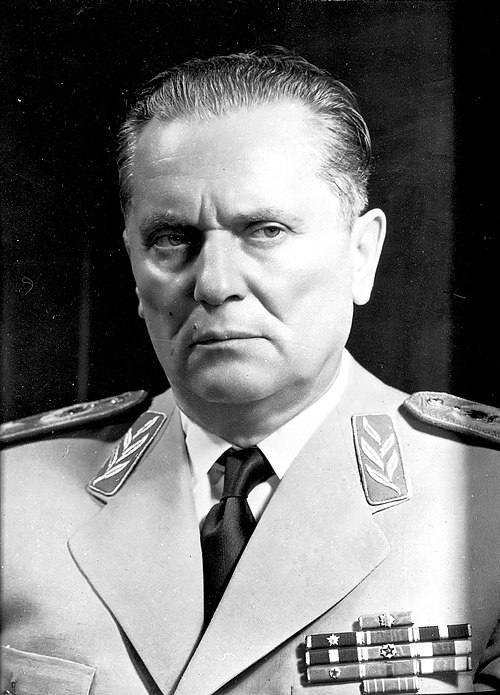
Informbiro ends. Josip Broz Tito and Nikita Khrushchev sign the Belgrade declaration, which also recognizes a Yugoslav form of socialism. Source — Wikipedia, "Timeline of Slovenian history" (20th century):
Josip Broz Tito By Unknown author - This image is available from the Digital Library of Slovenia under the reference number MJVNDGTF This tag does not indicate the copyright status of the attached work. A normal copyright tag is still required. See Commons:Licensing for more information., Public domain, https://commons.wikimedia.org/w/index.php?curid=28363974
1978 CE
The "South railway" is electrified.
The "South railway" is electrified. Source — Wikipedia, "Timeline of Slovenian history" (20th century):
May 4, 1980 CE
Ljubljana University Medical Centre
Tito dies at the Ljubljana University Medical Centre. Source — Wikipedia, "Timeline of Slovenian history" (20th century):
UKC Ljubljana glavna stavba By Pritlicjelevo - Own work, CC-BY-SA-4.0, https://en.wikipedia.org/w/index.php?curid=73170027
Apr 22, 1990 CE
Milan Kučan
Milan Kučan wins the presidential election, which is still held within the SFR Yugoslavia. Source — Wikipedia, "Timeline of Slovenian history" (20th century):
Slovenia becomes an independent state by adopting and approving relevant official documents. Source — Wikipedia, "Timeline of Slovenian history" (20th century):
Jan 15, 1992 CE
All members of the European Economic
All members of the European Economic Community recognize Slovenia as a state. Source — Wikipedia, "Timeline of Slovenian history" (20th century):
May 14, 1993 CE
Council of Europe
Slovenia joins the Council of Europe. Source — Wikipedia, "Timeline of Slovenian history" (20th century):
The Flag of Europe is the flag and emblem of the European Union (EU) and Council of Europe (CoE). It consists of a circle of 12 golden (yellow) stars on a blue background. It was created in 1955 by the CoE and adopted by the EU, then the European Communities, in the 1980s. The CoE and EU are distinct in membership and nature. The CoE is an international organisation with 46 members, dealing with human rights and rule of law, while the EU is a quasi-federal union of 27 states, focused on economic integration and political cooperation. Today, the flag is mostly associated with the latter. It was the intention of the CoE that the flag should come to represent Europe as a whole, and since its adoption the membership of the CoE covers nearly the entire Europe by the number of states involved, although only a little over half of the European continent by territory. This is why the EU adopted the same flag. The flag has been used to represent Europe in sporting events and as a pro-democracy banner outside the European Union. By User:Verdy p, User:-xfi-, User:Paddu, User:Nightstallion, User:Funakoshi, User:Jeltz, User:Dbenbenn, User:Zscout370 - File created by various Wikimedia users (see "Author"). File based on the specification given at [1]., Public domain, https://commons.wikimedia.org/w/index.php?curid=2615952
Nov 23, 1997 CE
1997 Slovenian presidential election
The second presidential election is held, with Milan Kučan securing his second mandate. Source — Wikipedia, "Timeline of Slovenian history" (20th century):
Slovenia becomes a non-permanent member of the UN Security Council. Source — Wikipedia, "Timeline of Slovenian history" (20th century):
The emblem of the United Nations By Joowwww - Own work, Public domain, https://commons.wikimedia.org/w/index.php?curid=4453401
Mar 31, 2002 CE
Most recent national census is conducted.
Most recent national census is conducted. Source — Wikipedia, "Timeline of Slovenian history" (21st century):
Mar 23, 2003 CE
Referendums on joining the EU and
Referendums on joining the EU and NATO are held and both initiatives are successful. Source — Wikipedia, "Timeline of Slovenian history" (21st century):
Mar 29, 2004 CE
Warsaw Pact
Slovenia, together with six former Warsaw Pact countries of Bulgaria, Estonia, Latvia, Lithuania, Romania and Slovakia, joins NATO. Source — Wikipedia, "Timeline of Slovenian history" (21st century):
Warsaw Pact in 1990. Member states (dark green) and Albania which left in 1968 (light green). By Rob984 - Derived from Union of Soviet Socialist Republics (orthographic projection).svg, CC BY-SA 4.0, https://commons.wikimedia.org/w/index.php?curid=53195631
Jan 1, 2005 CE
Organization for Security and Co-operation in Euro
Slovenia takes over the rotating presidency of the Organization for Security and Co-operation in Europe. Source — Wikipedia, "Timeline of Slovenian history" (21st century):
OSCE Outdoor Landscape Flag, 3:2 proportions By Organization for Security and Co-operation in Europe - security-oriented intergovernmental organization - This SVG flag includes elements that have been taken or adapted from this flag:, Public domain, https://commons.wikimedia.org/w/index.php?curid=85644569
Sep 25, 2006 CE
IAEA
Slovenia takes over the rotating presidency of the IAEA. Source — Wikipedia, "Timeline of Slovenian history" (21st century):
The logo of the International Atomic Energy Agency By International Atomic Energy Agency: IAEA emblem Derivative Work: Jesuiseduardo - Documents and Website of the IAEA, Public domain, https://commons.wikimedia.org/w/index.php?curid=74753124
Jan 1, 2007 CE
Slovenian euro coins
Slovenia adopts the euro as its legal tender currency, and begins issuing its own euro coins. Source — Wikipedia, "Timeline of Slovenian history" (21st century):
Jan 1, 2008 CE
European Union
Slovenia takes over the rotating presidency of the European Union as the first among the new member states. Source — Wikipedia, "Timeline of Slovenian history" (21st century):
The Flag of Europe is the flag and emblem of the European Union (EU) and Council of Europe (CoE). It consists of a circle of 12 golden (yellow) stars on a blue background. It was created in 1955 by the CoE and adopted by the EU, then the European Communities, in the 1980s. The CoE and EU are distinct in membership and nature. The CoE is an international organisation with 46 members, dealing with human rights and rule of law, while the EU is a quasi-federal union of 27 states, focused on economic integration and political cooperation. Today, the flag is mostly associated with the latter. It was the intention of the CoE that the flag should come to represent Europe as a whole, and since its adoption the membership of the CoE covers nearly the entire Europe by the number of states involved, although only a little over half of the European continent by territory. This is why the EU adopted the same flag. The flag has been used to represent Europe in sporting events and as a pro-democracy banner outside the European Union. By User:Verdy p, User:-xfi-, User:Paddu, User:Nightstallion, User:Funakoshi, User:Jeltz, User:Dbenbenn, User:Zscout370 - File created by various Wikimedia users (see "Author"). File based on the specification given at [1]., Public domain, https://commons.wikimedia.org/w/index.php?curid=2615952
Jul 18, 2009 CE
Council of Europe
Slovenia takes over the rotating presidency of the Council of Europe. Source — Wikipedia, "Timeline of Slovenian history" (21st century):
The Flag of Europe is the flag and emblem of the European Union (EU) and Council of Europe (CoE). It consists of a circle of 12 golden (yellow) stars on a blue background. It was created in 1955 by the CoE and adopted by the EU, then the European Communities, in the 1980s. The CoE and EU are distinct in membership and nature. The CoE is an international organisation with 46 members, dealing with human rights and rule of law, while the EU is a quasi-federal union of 27 states, focused on economic integration and political cooperation. Today, the flag is mostly associated with the latter. It was the intention of the CoE that the flag should come to represent Europe as a whole, and since its adoption the membership of the CoE covers nearly the entire Europe by the number of states involved, although only a little over half of the European continent by territory. This is why the EU adopted the same flag. The flag has been used to represent Europe in sporting events and as a pro-democracy banner outside the European Union. By User:Verdy p, User:-xfi-, User:Paddu, User:Nightstallion, User:Funakoshi, User:Jeltz, User:Dbenbenn, User:Zscout370 - File created by various Wikimedia users (see "Author"). File based on the specification given at [1]., Public domain, https://commons.wikimedia.org/w/index.php?curid=2615952
Jul 21, 2010 CE
OECD
Slovenia becomes a member of the OECD. Source — Wikipedia, "Timeline of Slovenian history" (21st century):
Château de la Muette, view from the park, Paris, France. By MySociety - TICTeC 2019: OECD in Paris, CC BY 2.0, https://commons.wikimedia.org/w/index.php?curid=89587338
Dec 2, 2012 CE
Borut Pahor
Borut Pahor wins the fifth presidential election, and becomes the fourth President of Slovenia. Source — Wikipedia, "Timeline of Slovenian history" (21st century):
Borut Pahor in 2010 By UKOM - vlada.si, CC BY 3.0, https://commons.wikimedia.org/w/index.php?curid=14208784
Nov 12, 2017 CE
Borut Pahor
Borut Pahor wins the sixth presidential election, and becomes the second president to win a second mandate. Source — Wikipedia, "Timeline of Slovenian history" (21st century):
Borut Pahor in 2010 By UKOM - vlada.si, CC BY 3.0, https://commons.wikimedia.org/w/index.php?curid=14208784
Jul 1, 2021 CE
European Union
Slovenia takes over the rotating presidency of the European Union for the second time. Source — Wikipedia, "Timeline of Slovenian history" (21st century):
The Flag of Europe is the flag and emblem of the European Union (EU) and Council of Europe (CoE). It consists of a circle of 12 golden (yellow) stars on a blue background. It was created in 1955 by the CoE and adopted by the EU, then the European Communities, in the 1980s. The CoE and EU are distinct in membership and nature. The CoE is an international organisation with 46 members, dealing with human rights and rule of law, while the EU is a quasi-federal union of 27 states, focused on economic integration and political cooperation. Today, the flag is mostly associated with the latter. It was the intention of the CoE that the flag should come to represent Europe as a whole, and since its adoption the membership of the CoE covers nearly the entire Europe by the number of states involved, although only a little over half of the European continent by territory. This is why the EU adopted the same flag. The flag has been used to represent Europe in sporting events and as a pro-democracy banner outside the European Union. By User:Verdy p, User:-xfi-, User:Paddu, User:Nightstallion, User:Funakoshi, User:Jeltz, User:Dbenbenn, User:Zscout370 - File created by various Wikimedia users (see "Author"). File based on the specification given at [1]., Public domain, https://commons.wikimedia.org/w/index.php?curid=2615952
Nov 13, 2022 CE
Nataša Pirc Musar
Nataša Pirc Musar wins the seventh presidential election, and becomes the fifth President of Slovenia, and the first woman in this role. Source — Wikipedia, "Timeline of Slovenian history" (21st century):
Nataša Pirc Musar By Hladnikm - Own work, CC BY-SA 4.0, https://commons.wikimedia.org/w/index.php?curid=138757025










![For documentary purposes the German Federal Archive often retained the original image captions, which may be erroneous, biased, obsolete or politically extreme. Der jugoslavische Innenminister Korochecz [Korosec ] weilt in Berlin. 42183-29](https://upload.wikimedia.org/wikipedia/commons/thumb/6/6d/Bundesarchiv_Bild_183-2010-0420-501%2C_Anton_Korosec.jpg/500px-Bundesarchiv_Bild_183-2010-0420-501%2C_Anton_Korosec.jpg)