Encyclopedia/3. History, Societies & Civilizations/09. Modern Nations/05. Europe • Curated by Admin Timeline.sg
History of Slovakia (AI-generated, sourced to Wikipedia).
Chronological Storyline (32 Milestones)
Jun 1, 828 CE
First Christian Church in Nitra
Pribina, ruler of the Principality of Nitra, consecrates the first known Christian church in the territory of present-day Slovakia, marking the arrival of Christianity among West Slavs. Source — Wikipedia, "Slovakia":
10 Slovak koruna (1944) - reverse By picture of an obsolete coin - http://worldcoingallery.com, CC BY-SA 3.0, https://commons.wikimedia.org/w/index.php?curid=1072025
833 CE
Great Moravia Founded
Mojmír I expels Pribina from Nitra and unites the Principality of Nitra with Moravia, creating the Great Moravian Empire, the first major West Slavic state. Source — Wikipedia, "Slovakia":
Great Moravia at its greatest extent during the reign of Svatopluk I with marked probable approximate location of its capital city (red dot) By Great_moravia_svatopluk.png: Tankred derivative work: Millenium187 (talk) - Great_moravia_svatopluk.png, Public domain, https://commons.wikimedia.org/w/index.php?curid=16071345
Jul 1, 863 CE
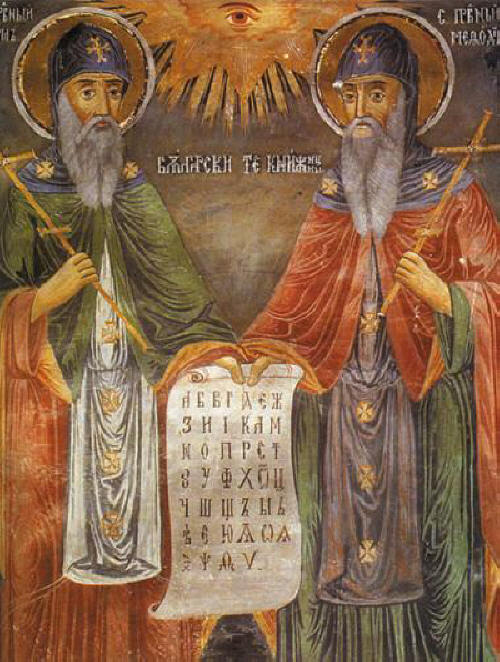
Cyril and Methodius Arrive
Byzantine missionaries Saints Cyril and Methodius arrive in Great Moravia at the invitation of Prince Rastislav, bringing the Slavic liturgy and creating the Glagolitic alphabet. Source — Wikipedia, "Slovakia":
Saints Cyril and Methodius - fresco in Troyan Monastery By painted by Zahari Zograf (Захарий Христович Димитров) - http://www.pravoslavieto.com/art/shkoli/samokovska/1810-1853_Zaharij_Zograf.htm, Public domain, https://commons.wikimedia.org/w/index.php?curid=4140266
Jul 4, 907 CE
Battle of Pressburg
A Magyar army decisively defeats the East Frankish-Bavarian forces near present-day Bratislava, cementing Hungarian control over the Carpathian Basin and ending Great Moravia's influence. Source — Wikipedia, "Slovakia":
Peter Johann Nepomuk Geiger: Schlacht bei Pressburg (1850) By Peter Johann Nepomuk Geiger - http://zaol.hu/data/cikk/168/2100/cikk_1682100/GeigerJP_terApozsonyicsa_4c.jpg, Public domain, https://commons.wikimedia.org/w/index.php?curid=41558766
Dec 25, 1000 CE
Hungarian Kingdom Crowned
Stephen I is crowned King of Hungary, and the Slovak-inhabited territories become an integral part of the Kingdom of Hungary for the next nine centuries. Source — Wikipedia, "Slovakia":
Hungarian Kingdom Crowned By Unknown author - Own work, scanned by Szilas from A magyar Szent Korona by Tóth Endre, Szelényi Károly, Kossuth 2000, Budapest, Public domain, https://commons.wikimedia.org/w/index.php?curid=23844243
Apr 1, 1241 CE
Mongol Invasion Devastates Slovakia
Mongol armies under Batu Khan invade and ravage Slovak towns and countryside, causing massive depopulation that later leads to German colonization of mining towns. Source — Wikipedia, "Slovakia":
The Mongol invasion in Hungary in Chronica Hungarorum by Johannes de Thurocz By Unknown author - Self-photographed, Public domain, https://commons.wikimedia.org/w/index.php?curid=3175554
1465 CE
Universitas Istropolitana Founded
King Matthias Corvinus establishes the Universitas Istropolitana in Pressburg (Bratislava), the first university on Slovak territory, reflecting the city's growing importance. Source — Wikipedia, "Slovakia":
Bratislava city centre By Wizzard - Own work, Public domain, https://commons.wikimedia.org/w/index.php?curid=1862162
Aug 29, 1526 CE
Battle of Mohács
The Ottoman army defeats the Hungarian forces at Mohács, killing King Louis II and leading to the partition of Hungary, with Slovakia falling under Habsburg rule as Royal Hungary. Source — Wikipedia, "Slovakia":
Battle of Mohács By Bertalan Székely - Székely Bertalan, Public domain, https://commons.wikimedia.org/w/index.php?curid=2831638
1536 CE
Pressburg Becomes Capital
Following the Ottoman conquest of Buda, Pressburg (Bratislava) becomes the capital of Royal Hungary and the coronation city of Hungarian kings, a status it holds until 1848. Source — Wikipedia, "Slovakia":
Bratislava By Arne Müseler - Own work, CC BY-SA 4.0, https://commons.wikimedia.org/w/index.php?curid=154726103
1787 CE
Bernolák Codifies Slovak Language
Catholic priest Anton Bernolák publishes the first codification of the Slovak language, 'Grammatica Slavica,' an early milestone of the Slovak National Revival. Source — Wikipedia, "Slovakia":
Bernolák Codifies Slovak Language By Unknown author, Public domain, https://commons.wikimedia.org/w/index.php?curid=741451
Jul 1, 1843 CE
Štúr Standardizes Slovak
Ľudovít Štúr and his followers agree on a new Slovak literary language based on Central Slovak dialects at the Hlboké meeting, unifying the Slovak national movement. Source — Wikipedia, "Slovakia":
Portrait of Ľudovít Štúr by Jozef Božetech Klemens from the mid 19th century. By Jozef Božetech Klemens - http://www.snk.sk/swift_data/source/alu/stur/foto1/fotka0002.jpg, Public domain, https://commons.wikimedia.org/w/index.php?curid=513281
May 1, 1848 CE
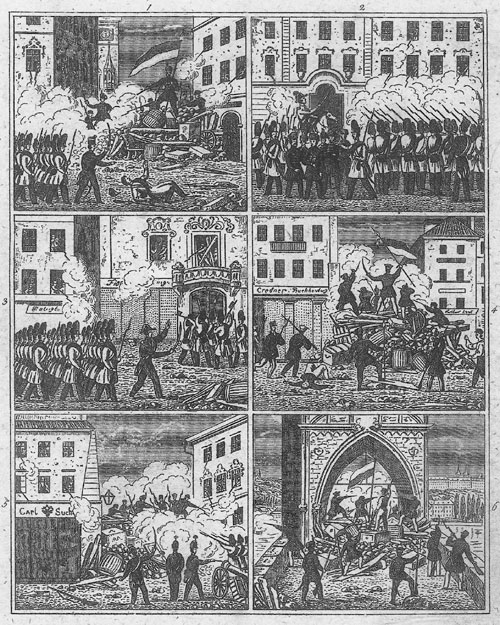
Slovaks Demand Self-Governance
Slovak nationalists led by Štúr publish 'Demands of the Slovak Nation,' calling for autonomy within Hungary, but the Hungarian Revolution suppresses Slovak aspirations. Source — Wikipedia, "Slovakia":
Slovaks Demand Self-Governance By Unknown author, Public domain, https://commons.wikimedia.org/w/index.php?curid=665402
Jun 8, 1867 CE
Austro-Hungarian Compromise
The Austro-Hungarian Compromise creates the Dual Monarchy, placing Slovakia fully under Hungarian administration and intensifying Magyarization policies against Slovak culture. Source — Wikipedia, "Slovakia":
Österreich-Ungarn Cisleithanien Transleithanien Bosnien und Herzegowina By en:User:Kpalion / modified by User:AndreasPraefcke - Auf der Basis [1] und der der Public-Domain-Karte en:Image:Austria-hungary blank.png von en:User:Kpalion., Public domain, https://commons.wikimedia.org/w/index.php?curid=474649
May 31, 1918 CE
Pittsburgh Agreement Signed
Czech and Slovak émigré leaders sign the Pittsburgh Agreement, promising Slovak autonomy within a future common Czechoslovak state, laying groundwork for independence. Source — Wikipedia, "Slovakia":
Pittsburgh Agreement Creates Czechoslovakia 1918 Memorial Plaque in Pittsburgh, PA, USA 2004 By Rehrenberg - With my Olympus digital camera, personally, CC BY-SA 3.0, https://commons.wikimedia.org/w/index.php?curid=32949298
Oct 28, 1918 CE
Czechoslovakia Founded
Czechoslovakia declares independence from Austria-Hungary, uniting Czech and Slovak lands into a single state with Tomáš Garrigue Masaryk as its first president. Source — Wikipedia, "Slovakia":
Flag of the Czech Republic By Jaroslav Kursa - Appendix No. 3 of Czech Legal Act 3/1993, Public domain, https://commons.wikimedia.org/w/index.php?curid=432452
Jun 1, 1919 CE
Hungarian-Slovak War
The Hungarian Soviet Republic's Red Army invades Slovakia and briefly establishes the Slovak Soviet Republic before being pushed back by Romanian and Czechoslovak forces. Source — Wikipedia, "Slovakia":
Military success of the Hungarian Soviet Republic By Kovács Ádám - The original description page was here. All following user names refer to hu.wikipedia., CC BY-SA 2.5, https://commons.wikimedia.org/w/index.php?curid=6824522
Jun 4, 1920 CE
Treaty of Trianon Signed
The Treaty of Trianon formally cedes Slovak and Ruthenian territories to Czechoslovakia, fixing the southern border with Hungary and confirming Slovakia's place in the new state. Source — Wikipedia, "Slovakia":
Cérémonie de signature du traité de Trianon : à l'avant en haut-de-forme Ágost Benárd, chef de la délégation hongroise, passant devant un piquet d'honneur à Versailles. By Agence Rol - This file comes from Gallica Digital Library and is available under the digital ID btv1b53037269t, Public domain, https://commons.wikimedia.org/w/index.php?curid=37807554
Nov 2, 1938 CE
First Vienna Award
Nazi Germany and Italy arbitrate the First Vienna Award, forcing Czechoslovakia to cede southern Slovakia and southern Carpathian Ruthenia to Hungary. Source — Wikipedia, "Slovakia":
Map of territories annexed by the Kingdom of Hungary in 1938–1941. By Jxxy - Own work – borders based on various maps from igrek.amzp.pl, CC0, https://commons.wikimedia.org/w/index.php?curid=76221747
Mar 14, 1939 CE
Slovak Republic Declared
Under German pressure, the Slovak Diet declares independence from Czechoslovakia, establishing the Slovak Republic as a client state of Nazi Germany led by Jozef Tiso. Source — Wikipedia, "Slovakia":
Flag of the First Slovak Republic (1939-1945) By DarkEvil, PhiLiP - Based on DarkEvil's Image:Flag of First Slovak Republic 1939-1945 bordered.svg, modified by PhiLiP., Public domain, https://commons.wikimedia.org/w/index.php?curid=8038201
Aug 29, 1944 CE
Slovak National Uprising
Slovak resistance forces launch an armed uprising against the pro-Nazi Slovak government and German occupation, one of the largest resistance operations in occupied Europe. Source — Wikipedia, "Slovakia":
Plastika "Obete varujú" v areáli Múzea SNP v Banskej Bystrici By Peter Zeli Bodružalský (photo) - cc-by-3.0 Jozef Jankovič (sculpture) - Own work, Public domain, https://commons.wikimedia.org/w/index.php?curid=17194420
Apr 4, 1945 CE
Slovakia Liberated by Soviets
Soviet Red Army troops enter Bratislava, completing the liberation of Slovak territory from Nazi German control and restoring Czechoslovakia as a unified state. Source — Wikipedia, "Slovakia":
Flag of Slovakia By Original: Ladislav Čisárik and Ladislav Vrtel Vector: SKopp - Own work using: here, colors, Public domain, https://commons.wikimedia.org/w/index.php?curid=343740
Feb 25, 1948 CE
Communist Coup in Prague
The Communist Party of Czechoslovakia seizes full power, ending democracy and placing Slovakia under Soviet-style communist rule for the next four decades. Source — Wikipedia, "Slovakia":
Flag of Slovakia By Original: Ladislav Čisárik and Ladislav Vrtel Vector: SKopp - Own work using: here, colors, Public domain, https://commons.wikimedia.org/w/index.php?curid=343740
Aug 21, 1968 CE
Warsaw Pact Invades Czechoslovakia
Warsaw Pact troops invade Czechoslovakia to crush the Prague Spring reforms, leading to two decades of 'normalization' under Soviet-backed hardline communist rule. Source — Wikipedia, "Slovakia":
Invasion of Czechoslovakia collage: Student protesters passing by a burning Soviet tank in Prague Hippies' inscriptions made on a Soviet military vehicle in Prague A crowd of protesters around a Soviet tank in Prague, at Balbinova and Vinohradská streets crossing A crowd of protesters around a Soviet BTR-60 armored vehicle in Ostrava Funeral of Jan Palach A refugee camp in Vienna, Austria, near Reichsbrücke bridge Street scene in Prague. A protester in front of burning Soviet tanks A streetfight in progress, with Soviet armor and civilian transport on fire, and people running in the center A graffiti comparing Soviets to Nazis, with USSR abbreviation written using ᛋᛋ (Schutzstaffel) runic symbol, painted at Husova street, Prague By Главцентроархив - Own work, CC0, https://commons.wikimedia.org/w/index.php?curid=174232098
Jan 1, 1969 CE
Slovak Socialist Republic Created
Czechoslovakia is reorganized as a federation, establishing the Slovak Socialist Republic as a constituent entity with its own government and limited autonomy. Source — Wikipedia, "Slovakia":
Map of Czechoslovakia in 1969-1990 By PANONIAN derivative: David1010 - File:Czechoslovakia.png, CC BY-SA 3.0, https://commons.wikimedia.org/w/index.php?curid=22088073
Nov 17, 1989 CE
Velvet Revolution Begins
Mass peaceful protests erupt in Prague and Bratislava following a student crackdown, leading to the collapse of communist rule and the election of Václav Havel as president. Source — Wikipedia, "Slovakia":
Prague during the Velvet Revolution. By ŠJů (cs:ŠJů) - This file is an electronic scan of a film (photochemical) photograph made by ŠJů. film No.: 159, picture No.: 30 camera: Vilia , film type: Foto 64 (Svema), scanner: scanned from a negative by Foto-graf, CC BY-SA 3.0, https://commons.wikimedia.org/w/index.php?curid=14684941
Jul 17, 1992 CE
Slovak Sovereignty Declared
The Slovak National Council adopts the Declaration of Sovereignty of the Slovak Republic, a key step toward independence following the failure of Czech-Slovak federal negotiations. Source — Wikipedia, "Slovakia":
Flag of Slovakia By Original: Ladislav Čisárik and Ladislav Vrtel Vector: SKopp - Own work using: here, colors, Public domain, https://commons.wikimedia.org/w/index.php?curid=343740
Sep 1, 1992 CE
Slovak Constitution Adopted
The Slovak National Council approves the Constitution of the Slovak Republic, establishing democratic institutions and fundamental rights for the future independent state. Source — Wikipedia, "Slovakia":
Flag of Slovakia By Original: Ladislav Čisárik and Ladislav Vrtel Vector: SKopp - Own work using: here, colors, Public domain, https://commons.wikimedia.org/w/index.php?curid=343740
Jan 1, 1993 CE
Slovakia Becomes Independent
Czechoslovakia peacefully dissolves in the 'Velvet Divorce,' and the Slovak Republic becomes a fully independent sovereign state with Michal Kováč as its first president. Source — Wikipedia, "Slovakia":
Map of Czechoslovakia in 1969-1990 By PANONIAN - Own work, Public domain, https://commons.wikimedia.org/w/index.php?curid=1449893
Sep 1, 1998 CE
Democratic Reversal of Mečiar
Parliamentary elections defeat the authoritarian-leaning government of Vladimír Mečiar, returning Slovakia to a pro-Western democratic path and reviving NATO and EU accession hopes. Source — Wikipedia, "Slovakia":
Results of the 1998 Slovak legislative election, showing the vote strength of the party winning a plurality in each district. By Erinthecute - Own work, CC BY-SA 4.0, https://commons.wikimedia.org/w/index.php?curid=83764898
Mar 29, 2004 CE
Slovakia Joins NATO
Slovakia officially becomes a member of the North Atlantic Treaty Organization, securing its place in the Western security alliance after years of reform. Source — Wikipedia, "Slovakia":
Flag of Slovakia By Original: Ladislav Čisárik and Ladislav Vrtel Vector: SKopp - Own work using: here, colors, Public domain, https://commons.wikimedia.org/w/index.php?curid=343740
May 1, 2004 CE
Slovakia Enters European Union
Slovakia accedes to the European Union alongside nine other countries, completing its post-communist reintegration into Euro-Atlantic institutions. Source — Wikipedia, "Slovakia":
European Union Die alten Mitgliedsländer Die zehn neuen Mitgliedsländer By Europe_countries.svg: Júlio Reis derivative work: Kolja21 (talk) - EU25-2004_European_Union_map.svg, CC BY-SA 2.5, https://commons.wikimedia.org/w/index.php?curid=6814207
Jan 1, 2009 CE
Slovakia Adopts the Euro
Slovakia becomes the 16th member of the eurozone, replacing the Slovak koruna with the euro and solidifying its economic integration with Western Europe. Source — Wikipedia, "Slovakia":
Flag of Slovakia By Original: Ladislav Čisárik and Ladislav Vrtel Vector: SKopp - Own work using: here, colors, Public domain, https://commons.wikimedia.org/w/index.php?curid=343740