Encyclopedia/3. History, Societies & Civilizations/09. Modern Nations/01. Africa • Curated by Admin Timeline.sg
History of Namibia (AI-generated, sourced to Wikipedia).
Chronological Storyline (41 Milestones)
25000 BCE
Stone Age habitation begins
Archaeological evidence at sites such as Apollo 11 Cave shows human occupation during the Late Stone Age in what is now Namibia. Source — Wikipedia, "Namibia":
Flag of Namibia By SVG by Vzb83~commonswiki et al. - SVG implementation of the description in Schedule 6, Page 66 of the Constitution of Namibia. "The National Flag of Namibia shall be rectangular in the proportion of three in the length to two in the width, tierced per bend reversed, blue, white and green; the white bend reversed, which shall be one third of the width of the flag, is charged with another of red, one quarter of the width of the flag. In the upper hoist there shall be a gold sun with twelve straight rays, the diameter of which shall be one third of the width of the flag, with its vertical axis one fifth of the distance from the hoist, positioned equidistant from the top edge and from the reversed bend. The rays, which shall each be two fifths of the radius of the sun, issue from the outer edge of a blue ring, which shall be one tenth of the radius of the sun." Pantone from National Symbols of the Republic of Namibia Act, 2018, Schedule 4. "The colours of the Presidential Standard must be the same as that of the National Flag of Namibia, namely: Pantone: Blue: 294c Yellow (gold): 116c Green: 347c Red: 186c", Public domain, https://commons.wikimedia.org/w/index.php?curid=327754
10000 BCE
Ancient rock art created
San peoples create some of Africa's oldest rock paintings at Apollo 11 Cave in southern Namibia, dated to around 10,000 BCE. Source — Wikipedia, "Namibia":
Flag of Namibia By SVG by Vzb83~commonswiki et al. - SVG implementation of the description in Schedule 6, Page 66 of the Constitution of Namibia. "The National Flag of Namibia shall be rectangular in the proportion of three in the length to two in the width, tierced per bend reversed, blue, white and green; the white bend reversed, which shall be one third of the width of the flag, is charged with another of red, one quarter of the width of the flag. In the upper hoist there shall be a gold sun with twelve straight rays, the diameter of which shall be one third of the width of the flag, with its vertical axis one fifth of the distance from the hoist, positioned equidistant from the top edge and from the reversed bend. The rays, which shall each be two fifths of the radius of the sun, issue from the outer edge of a blue ring, which shall be one tenth of the radius of the sun." Pantone from National Symbols of the Republic of Namibia Act, 2018, Schedule 4. "The colours of the Presidential Standard must be the same as that of the National Flag of Namibia, namely: Pantone: Blue: 294c Yellow (gold): 116c Green: 347c Red: 186c", Public domain, https://commons.wikimedia.org/w/index.php?curid=327754
5000 BCE
Twyfelfontein rock engravings
San communities produce thousands of rock engravings at Twyfelfontein over millennia, forming one of Africa's richest rock-art complexes. Source — Wikipedia, "Namibia":
نقش بمنطقة توفنيلتون بناميبيا. By Mike from Vancouver, Canada - Twyfelfontein 16, CC BY 2.0, https://commons.wikimedia.org/w/index.php?curid=2898729
200 CE
Bantu expansion reaches Namibia
Bantu-speaking agriculturalists migrate southward into Namibia, introducing iron-working and cattle-herding to the region. Source — Wikipedia, "Namibia":
Spread of the "Early Iron Age" in Eastern, Central and Southern Africa, a proxy for the Bantu migrations. Based on K. Shillington, History of Africa (3rd ed. 2005), p. 63. Urewe (Lake Victoria) 250 BCE, Kwale 200 CE, Kisale 300 CE, , Kalundu/Dambwa 100 CE , Kalambo 300 CE, Nkope 300 CE, Gokmere-Ziwa/Bambata 300 CE, presence in South Africa (Kei river) by 400 CE. By Unknown author - East&southern africa early iron age.gif, Public domain, https://commons.wikimedia.org/w/index.php?curid=5444722
1300 CE
Ovambo kingdoms established
Ovambo-speaking peoples establish settled kingdoms in northern Namibia, developing agriculture and complex political structures. Source — Wikipedia, "Namibia":
For documentary purposes the German Federal Archive often retained the original image captions, which may be erroneous, biased, obsolete or politically extreme. Ovambos By Walther Dobbertin - This image was provided to Wikimedia Commons by the German Federal Archive (Deutsches Bundesarchiv) as part of a cooperation project. The German Federal Archive guarantees an authentic representation only using the originals (negative and/or positive), resp. the digitalization of the originals as provided by the Digital Image Archive., CC BY-SA 3.0 de, https://commons.wikimedia.org/w/index.php?curid=5482399
1485 CE
Portuguese reach Namibian coast
Portuguese explorer Diogo Cão lands at Cape Cross, erecting a padrão stone marking Portugal's claim to the territory. Source — Wikipedia, "Namibia":
Portrait of Diogo Cão, as it appeared in an ancient Portuguese escudo bill. Copyright free. By Portuguese National Mint - Genea - Diogo Cão, Public domain, https://commons.wikimedia.org/w/index.php?curid=11484251
1488 CE
Bartolomeu Dias sails along coast
Portuguese navigator Bartolomeu Dias passes the Namibian coastline on his voyage around the southern tip of Africa. Source — Wikipedia, "Namibia":
Statue of Bartolomeu Dias at the High Commission of South Africa in London By Bartolomeu_Dias,_South_Africa_House.JPG: RedCoat (en:User:RedCoat10) derivative work: Biser Todorov (talk) - Bartolomeu_Dias,_South_Africa_House.JPG, CC BY-SA 3.0, https://commons.wikimedia.org/w/index.php?curid=7586424
1793 CE
Dutch occupy Walvis Bay
The Dutch East India Company briefly occupies Walvis Bay, one of the few natural harbours along the Namibian coast. Source — Wikipedia, "Namibia":
Close-up aerial photo of Walvis Bay (Walfischbucht) By Brian McMorrow - Pbase gallery, CC BY-SA 2.5, https://commons.wikimedia.org/w/index.php?curid=833766
1815 CE
Orlam peoples migrate northward
Orlam groups, fleeing colonial pressure in the Cape Colony, cross the Orange River into southern Namibia bringing firearms and new political dynamics. Source — Wikipedia, "Namibia":
Jan Jonker Afrikaner (* 1820 in Windhuk, Südwestafrika; † 10. August 1889 bei Tsoabis, Südwestafrika) By Unknown author - Deutsch-südwest-afrika: Forschungsreisen durch die deutschen Schutzgebiete, gross-nama- und Hereroland, nach dem Kunene, dem Ngami-see und der Kalaxari, 1884-1887, Hans Schinz, Published by Schulze, 1891, Public domain, https://commons.wikimedia.org/w/index.php?curid=5911466
1840 CE
Jonker Afriker dominates central Namibia
Orlam leader Jonker Afrikaner establishes hegemony over central Namibia from his base at Windhoek, controlling trade routes and subjugating Herero communities. Source — Wikipedia, "Namibia":
Jonker Afrikaner; illustration from p.232 of the 1861 book Lake Ngami. By Charles John Andersson - https://archive.org/details/lakengamiorexplo01ande, Public domain, https://commons.wikimedia.org/w/index.php?curid=32539849
1878 CE
Britain annexes Walvis Bay
Britain annexes Walvis Bay and the surrounding Penguin Islands, administratively attaching them to the Cape Colony. Source — Wikipedia, "Namibia":
Close-up aerial photo of Walvis Bay (Walfischbucht) By Brian McMorrow - Pbase gallery, CC BY-SA 2.5, https://commons.wikimedia.org/w/index.php?curid=833766
1884 CE
German South West Africa proclaimed
Germany declares a protectorate over South West Africa, beginning formal colonial rule after negotiations with local leaders such as Joseph Fredericks of the Bethanie Nama. Source — Wikipedia, "Namibia":
Inoffizielle Variante der Kaiserreichsflagge mit Hoheitszeichen, Deutsches Reich, 1871–1918 By Original: Imperial Colonial Office of the German Empire Vector: David Liuzzo - Own work, based on various photographs of physical flags such as the one depicted in File:Reichskolonialflagge WWI Imperial German colonial flag 1884–1918 Photo JC PLE 2022. Warriors Gate M.O.T.H. Museum of Militaria, Durban, South Africa.jpg – (Flickr source), Public domain, https://commons.wikimedia.org/w/index.php?curid=4481199
1893 CE
Hendrik Witbooi begins resistance
Nama leader Hendrik Witbooi launches armed resistance against German colonial forces, becoming one of the most prominent figures of early anti-colonial struggle. Source — Wikipedia, "Namibia":
Flag of Namibia By SVG by Vzb83~commonswiki et al. - SVG implementation of the description in Schedule 6, Page 66 of the Constitution of Namibia. "The National Flag of Namibia shall be rectangular in the proportion of three in the length to two in the width, tierced per bend reversed, blue, white and green; the white bend reversed, which shall be one third of the width of the flag, is charged with another of red, one quarter of the width of the flag. In the upper hoist there shall be a gold sun with twelve straight rays, the diameter of which shall be one third of the width of the flag, with its vertical axis one fifth of the distance from the hoist, positioned equidistant from the top edge and from the reversed bend. The rays, which shall each be two fifths of the radius of the sun, issue from the outer edge of a blue ring, which shall be one tenth of the radius of the sun." Pantone from National Symbols of the Republic of Namibia Act, 2018, Schedule 4. "The colours of the Presidential Standard must be the same as that of the National Flag of Namibia, namely: Pantone: Blue: 294c Yellow (gold): 116c Green: 347c Red: 186c", Public domain, https://commons.wikimedia.org/w/index.php?curid=327754
Jan 1, 1904 CE
Herero uprising begins
Herero people rise against German colonial rule, attacking settlements and triggering a brutal military response that escalated into genocide. Source — Wikipedia, "Namibia":
Prisoners from the Herero and Nama tribes during the 1904-1908 war against Germany. By Unknown author - Der Spiegel, Public domain, https://commons.wikimedia.org/w/index.php?curid=76347791
Oct 1, 1904 CE
Nama join anti-colonial war
Hendrik Witbooi's Nama forces join the Herero in armed resistance against German colonial troops, widening the conflict across southern Namibia. Source — Wikipedia, "Namibia":
Prisoners from the Herero and Nama tribes during the 1904-1908 war against Germany. By Unknown author - Der Spiegel, Public domain, https://commons.wikimedia.org/w/index.php?curid=76347791
Oct 1, 1905 CE
Witbooi dies in battle
Hendrik Witbooi is killed in action against German forces at Vaalgras, becoming an enduring symbol of Namibian resistance. Source — Wikipedia, "Namibia":
Flag of Namibia By SVG by Vzb83~commonswiki et al. - SVG implementation of the description in Schedule 6, Page 66 of the Constitution of Namibia. "The National Flag of Namibia shall be rectangular in the proportion of three in the length to two in the width, tierced per bend reversed, blue, white and green; the white bend reversed, which shall be one third of the width of the flag, is charged with another of red, one quarter of the width of the flag. In the upper hoist there shall be a gold sun with twelve straight rays, the diameter of which shall be one third of the width of the flag, with its vertical axis one fifth of the distance from the hoist, positioned equidistant from the top edge and from the reversed bend. The rays, which shall each be two fifths of the radius of the sun, issue from the outer edge of a blue ring, which shall be one tenth of the radius of the sun." Pantone from National Symbols of the Republic of Namibia Act, 2018, Schedule 4. "The colours of the Presidential Standard must be the same as that of the National Flag of Namibia, namely: Pantone: Blue: 294c Yellow (gold): 116c Green: 347c Red: 186c", Public domain, https://commons.wikimedia.org/w/index.php?curid=327754
Mar 1, 1907 CE
Etosha park proclaimed
German colonial governor Friedrich von Lindequist proclaims Game Reserve No. 2, the precursor to Etosha National Park, one of Africa's largest wildlife reserves. Source — Wikipedia, "Namibia":
Dust cloud at the Nebrownii waterhole in Etosha National Park By Yathin S Krishnappa - Own work, CC BY-SA 3.0, https://commons.wikimedia.org/w/index.php?curid=24541220
1908 CE
Diamonds discovered at Kolmanskop
Railway worker Zacharias Lewala discovers diamonds near Kolmanskop in the Namib Desert, sparking a diamond rush and transforming the colonial economy. Source — Wikipedia, "Namibia":
Kolmanskop, Coleman's hill, is a ghost town in the Namiba desert in southern Namibia, 10 kilometres inland from the port town of Lüderitz. By SkyPixels - Own work, CC BY-SA 4.0, https://commons.wikimedia.org/w/index.php?curid=50450485
Jul 1, 1915 CE
South African forces occupy SWA
South African Union troops defeat German colonial forces and occupy South West Africa during World War I, ending German rule. Source — Wikipedia, "Namibia":
Map of the South-West Africa Campaign in 1915. By Eduard Rothert - Eduard Rothert, Karten und Skizzen zum Weltkrieg, Druck und Verlag von A. Bagel, Düsseldorf, 1916., Public domain, https://commons.wikimedia.org/w/index.php?curid=3016207
Dec 1, 1920 CE
League of Nations mandate granted
The League of Nations grants South Africa a Class C mandate to administer South West Africa, formalising South African control over the territory. Source — Wikipedia, "Namibia":
Flag of South Africa, used between 1928 and 1982. It is identical to the 1982 to 1994 version except that the shade of blue is darker. It is also known as the "Oranje-Blanje-Blou". By Parliament of South Africa (Vector graphics image by Denelson83) - Vectorialized from description found in Southern African Vexillological Association. Flag specification sheets : South Africa national flag 1928-1994, Public domain, https://commons.wikimedia.org/w/index.php?curid=569034
1946 CE
UN rejects annexation attempt
The United Nations rejects South Africa's request to formally annex South West Africa, insisting the territory remain under international supervision. Source — Wikipedia, "Namibia":
Palau District Police greet the UN Visiting Mission By TTPI(Trust Territory of the Pacific Islands) Headquarters - Trust Territory of the Pacific Islands Archives Photograph Collection(http://digicoll.manoa.hawaii.edu/ttphotos/Pages/viewimage.php?img=4134&famNum=1), Public domain, https://commons.wikimedia.org/w/index.php?curid=11236501
1949 CE
SWA incorporated into South Africa
South Africa passes legislation extending its parliamentary representation to South West Africa's white minority, effectively incorporating the territory. Source — Wikipedia, "Namibia":
Flag of Namibia By SVG by Vzb83~commonswiki et al. - SVG implementation of the description in Schedule 6, Page 66 of the Constitution of Namibia. "The National Flag of Namibia shall be rectangular in the proportion of three in the length to two in the width, tierced per bend reversed, blue, white and green; the white bend reversed, which shall be one third of the width of the flag, is charged with another of red, one quarter of the width of the flag. In the upper hoist there shall be a gold sun with twelve straight rays, the diameter of which shall be one third of the width of the flag, with its vertical axis one fifth of the distance from the hoist, positioned equidistant from the top edge and from the reversed bend. The rays, which shall each be two fifths of the radius of the sun, issue from the outer edge of a blue ring, which shall be one tenth of the radius of the sun." Pantone from National Symbols of the Republic of Namibia Act, 2018, Schedule 4. "The colours of the Presidential Standard must be the same as that of the National Flag of Namibia, namely: Pantone: Blue: 294c Yellow (gold): 116c Green: 347c Red: 186c", Public domain, https://commons.wikimedia.org/w/index.php?curid=327754
Dec 1, 1959 CE
Old Location uprising
Namibian residents protest forced removal from Windhoek's Old Location; police open fire, killing 11 people and wounding many more, galvanising nationalist sentiment. Source — Wikipedia, "Namibia":
Flag of Namibia By SVG by Vzb83~commonswiki et al. - SVG implementation of the description in Schedule 6, Page 66 of the Constitution of Namibia. "The National Flag of Namibia shall be rectangular in the proportion of three in the length to two in the width, tierced per bend reversed, blue, white and green; the white bend reversed, which shall be one third of the width of the flag, is charged with another of red, one quarter of the width of the flag. In the upper hoist there shall be a gold sun with twelve straight rays, the diameter of which shall be one third of the width of the flag, with its vertical axis one fifth of the distance from the hoist, positioned equidistant from the top edge and from the reversed bend. The rays, which shall each be two fifths of the radius of the sun, issue from the outer edge of a blue ring, which shall be one tenth of the radius of the sun." Pantone from National Symbols of the Republic of Namibia Act, 2018, Schedule 4. "The colours of the Presidential Standard must be the same as that of the National Flag of Namibia, namely: Pantone: Blue: 294c Yellow (gold): 116c Green: 347c Red: 186c", Public domain, https://commons.wikimedia.org/w/index.php?curid=327754
Apr 1, 1960 CE
SWAPO founded
The South West Africa People's Organisation is founded, emerging as the leading movement for Namibian independence from South African rule. Source — Wikipedia, "Namibia":
Flag of the SWAPO party of Namibia By Original by Bries - SVG is own work, Public domain, https://commons.wikimedia.org/w/index.php?curid=1733295
Aug 1, 1966 CE
Armed struggle begins at Ongulumbashe
SWAPO guerrilla fighters launch their first armed operation against South African forces at Ongulumbashe in northern Namibia, beginning the Namibian War of Independence. Source — Wikipedia, "Namibia":
Description & Sources First Row from Left to Right: - Members of the South African Marine Corps brief prior to counter-insurgency operations in the Caprivi Strip near the Zambian border; - Members of 44 Parachute Brigade patrol the Angolan border during the early 1980s 2nd Row, L to R: - FAPLA staff car burns after being destroyed by machine gun fire during a South African ambush, late 1975 - FAPLA MiG-21bis fighter aircraft seized by the SADF after straying into Namibian airspace, 1989 Last Row, L to R: - Australian UNTAG peacekeepers prepare to deploy as election monitors in Namibia in 1989; - South African Eland armoured cars in a forward staging area during Operation Savannah, 1975 By Collage: User:Katangais. Individual constituent images used in the collage: User:Smikect, Chris Lofting, Allen Herweg, Sam van den Berg and the United States government. - 1st (top) row, left to right: File:SA_Marines_pre_patrol_briefing.jpg, File:SADF-Operations_4.jpg 2nd (centre) row, L to R: File:FAPLA_car_burning.PNG, File:Angolan_Mikoyan-Gurevich_MiG-21bis.jpg 3rd (bottom) row, L to R: File:C5_Namibia.jpg, File:OpSavannah1.jpg, CC BY-SA 3.0, https://commons.wikimedia.org/w/index.php?curid=106620395
Oct 1, 1966 CE
UN revokes South African mandate
The UN General Assembly passes Resolution 2145, revoking South Africa's mandate over South West Africa and asserting direct UN responsibility for the territory. Source — Wikipedia, "Namibia":
Flag of Namibia By SVG by Vzb83~commonswiki et al. - SVG implementation of the description in Schedule 6, Page 66 of the Constitution of Namibia. "The National Flag of Namibia shall be rectangular in the proportion of three in the length to two in the width, tierced per bend reversed, blue, white and green; the white bend reversed, which shall be one third of the width of the flag, is charged with another of red, one quarter of the width of the flag. In the upper hoist there shall be a gold sun with twelve straight rays, the diameter of which shall be one third of the width of the flag, with its vertical axis one fifth of the distance from the hoist, positioned equidistant from the top edge and from the reversed bend. The rays, which shall each be two fifths of the radius of the sun, issue from the outer edge of a blue ring, which shall be one tenth of the radius of the sun." Pantone from National Symbols of the Republic of Namibia Act, 2018, Schedule 4. "The colours of the Presidential Standard must be the same as that of the National Flag of Namibia, namely: Pantone: Blue: 294c Yellow (gold): 116c Green: 347c Red: 186c", Public domain, https://commons.wikimedia.org/w/index.php?curid=327754
1971 CE
ICJ advisory opinion on SWA
The International Court of Justice issues an advisory opinion declaring South Africa's continued presence in Namibia illegal under international law. Source — Wikipedia, "Namibia":
Flag of Namibia By SVG by Vzb83~commonswiki et al. - SVG implementation of the description in Schedule 6, Page 66 of the Constitution of Namibia. "The National Flag of Namibia shall be rectangular in the proportion of three in the length to two in the width, tierced per bend reversed, blue, white and green; the white bend reversed, which shall be one third of the width of the flag, is charged with another of red, one quarter of the width of the flag. In the upper hoist there shall be a gold sun with twelve straight rays, the diameter of which shall be one third of the width of the flag, with its vertical axis one fifth of the distance from the hoist, positioned equidistant from the top edge and from the reversed bend. The rays, which shall each be two fifths of the radius of the sun, issue from the outer edge of a blue ring, which shall be one tenth of the radius of the sun." Pantone from National Symbols of the Republic of Namibia Act, 2018, Schedule 4. "The colours of the Presidential Standard must be the same as that of the National Flag of Namibia, namely: Pantone: Blue: 294c Yellow (gold): 116c Green: 347c Red: 186c", Public domain, https://commons.wikimedia.org/w/index.php?curid=327754
Sep 1, 1975 CE
Turnhalle Conference convenes
South Africa sponsors the Turnhalle Constitutional Conference, bringing together various ethnic groups to discuss internal self-government, but SWAPO boycotts it. Source — Wikipedia, "Namibia":
SADC Tribunal, Windhoek, Namibia By Head - Own work, CC BY-SA 3.0, https://commons.wikimedia.org/w/index.php?curid=27362695
1978 CE
UN Security Council Resolution 435
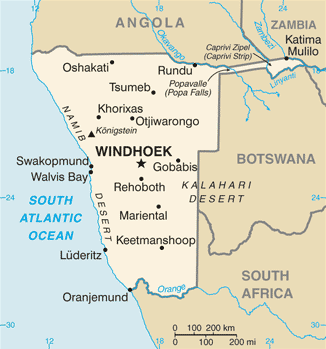
The UN Security Council adopts Resolution 435, setting the framework for Namibia's independence through free elections under UN supervision and a peacekeeping presence. Source — Wikipedia, "Namibia":
Namibia location By By Rei-artur pt en Rei-artur blog - Original by Vardion, A large blank world map with oceans marked in blue.svg, CC BY-SA 3.0, https://commons.wikimedia.org/w/index.php?curid=1446513
Dec 1, 1988 CE
Brazzaville Protocol signed
South Africa, Angola, and Cuba sign the Brazzaville Protocol, agreeing to a ceasefire and implementation of UN Resolution 435, paving the way for Namibian independence. Source — Wikipedia, "Namibia":
Flag of Namibia By SVG by Vzb83~commonswiki et al. - SVG implementation of the description in Schedule 6, Page 66 of the Constitution of Namibia. "The National Flag of Namibia shall be rectangular in the proportion of three in the length to two in the width, tierced per bend reversed, blue, white and green; the white bend reversed, which shall be one third of the width of the flag, is charged with another of red, one quarter of the width of the flag. In the upper hoist there shall be a gold sun with twelve straight rays, the diameter of which shall be one third of the width of the flag, with its vertical axis one fifth of the distance from the hoist, positioned equidistant from the top edge and from the reversed bend. The rays, which shall each be two fifths of the radius of the sun, issue from the outer edge of a blue ring, which shall be one tenth of the radius of the sun." Pantone from National Symbols of the Republic of Namibia Act, 2018, Schedule 4. "The colours of the Presidential Standard must be the same as that of the National Flag of Namibia, namely: Pantone: Blue: 294c Yellow (gold): 116c Green: 347c Red: 186c", Public domain, https://commons.wikimedia.org/w/index.php?curid=327754
Nov 1, 1989 CE
Independence elections held
Namibians vote in UN-supervised elections for a Constituent Assembly, with SWAPO winning a majority and beginning the transition to full independence. Source — Wikipedia, "Namibia":
Flag of Namibia By SVG by Vzb83~commonswiki et al. - SVG implementation of the description in Schedule 6, Page 66 of the Constitution of Namibia. "The National Flag of Namibia shall be rectangular in the proportion of three in the length to two in the width, tierced per bend reversed, blue, white and green; the white bend reversed, which shall be one third of the width of the flag, is charged with another of red, one quarter of the width of the flag. In the upper hoist there shall be a gold sun with twelve straight rays, the diameter of which shall be one third of the width of the flag, with its vertical axis one fifth of the distance from the hoist, positioned equidistant from the top edge and from the reversed bend. The rays, which shall each be two fifths of the radius of the sun, issue from the outer edge of a blue ring, which shall be one tenth of the radius of the sun." Pantone from National Symbols of the Republic of Namibia Act, 2018, Schedule 4. "The colours of the Presidential Standard must be the same as that of the National Flag of Namibia, namely: Pantone: Blue: 294c Yellow (gold): 116c Green: 347c Red: 186c", Public domain, https://commons.wikimedia.org/w/index.php?curid=327754
Mar 21, 1990 CE
Namibia gains independence
Namibia becomes an independent nation with Sam Nujoma as its first president, ending 75 years of South African rule and decades of armed struggle. Source — Wikipedia, "Namibia":
Flag of Namibia By SVG by Vzb83~commonswiki et al. - SVG implementation of the description in Schedule 6, Page 66 of the Constitution of Namibia. "The National Flag of Namibia shall be rectangular in the proportion of three in the length to two in the width, tierced per bend reversed, blue, white and green; the white bend reversed, which shall be one third of the width of the flag, is charged with another of red, one quarter of the width of the flag. In the upper hoist there shall be a gold sun with twelve straight rays, the diameter of which shall be one third of the width of the flag, with its vertical axis one fifth of the distance from the hoist, positioned equidistant from the top edge and from the reversed bend. The rays, which shall each be two fifths of the radius of the sun, issue from the outer edge of a blue ring, which shall be one tenth of the radius of the sun." Pantone from National Symbols of the Republic of Namibia Act, 2018, Schedule 4. "The colours of the Presidential Standard must be the same as that of the National Flag of Namibia, namely: Pantone: Blue: 294c Yellow (gold): 116c Green: 347c Red: 186c", Public domain, https://commons.wikimedia.org/w/index.php?curid=327754
Aug 1, 1992 CE
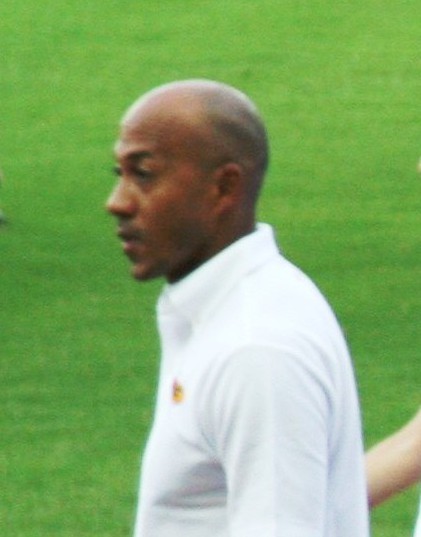
Frank Fredericks wins Olympic silver
Namibian sprinter Frank Fredericks wins silver medals in the 100m and 200m at the Barcelona Olympics, earning Namibia's first Olympic medals. Source — Wikipedia, "Namibia":
World Athletics Championships 2007 in Osaka - The IAAF flag carried by (in foreground) Frankie Fredericks, Rosa Mota, Heike Drechsler By Eckhard Pecher (Arcimboldo) - Own work, CC BY 2.5, https://commons.wikimedia.org/w/index.php?curid=28840172
Mar 1, 1994 CE
Walvis Bay transferred to Namibia
South Africa formally transfers Walvis Bay and the Penguin Islands to Namibian sovereignty, completing the territorial integrity of the new nation. Source — Wikipedia, "Namibia":
Close-up aerial photo of Walvis Bay (Walfischbucht) By Brian McMorrow - Pbase gallery, CC BY-SA 2.5, https://commons.wikimedia.org/w/index.php?curid=833766
Aug 1, 2004 CE
Germany acknowledges genocide
German development minister Heidemarie Wieczorek-Zeul acknowledges the colonial-era genocide of Herero and Nama peoples, marking a significant step in reconciliation efforts. Source — Wikipedia, "Namibia":
Prisoners from the Herero and Nama tribes during the 1904-1908 war against Germany. By Unknown author - Der Spiegel, Public domain, https://commons.wikimedia.org/w/index.php?curid=76347791
Mar 1, 2005 CE
Pohamba becomes second president
Hifikepunye Pohamba is inaugurated as Namibia's second president, succeeding Sam Nujoma in the country's first peaceful transfer of executive power. Source — Wikipedia, "Namibia":
Президент Республики Намибия Х.Похамба на встрече с Председателем Правительства Российской Федерации В.В.Путиным By Пресс-служба Правительства России - premier.gov.ru, CC BY 4.0, https://commons.wikimedia.org/w/index.php?curid=143724784
Jun 1, 2007 CE
Twyfelfontein named World Heritage Site
UNESCO inscribes the Twyfelfontein rock art site on the World Heritage List, recognising its outstanding universal value as one of Africa's densest rock-art concentrations. Source — Wikipedia, "Namibia":
نقش بمنطقة توفنيلتون بناميبيا. By Mike from Vancouver, Canada - Twyfelfontein 16, CC BY 2.0, https://commons.wikimedia.org/w/index.php?curid=2898729
Mar 1, 2015 CE
Geingob becomes third president
Hage Geingob is inaugurated as Namibia's third president, bringing extensive governance experience as a former prime minister and constitution-drafting leader. Source — Wikipedia, "Namibia":
Hage Geingob at the Global Gateway Forum. By Brussels - EC/Berlaymont - https://audiovisual.ec.europa.eu/en/photo-details/P-062154~2F00-02, CC BY 4.0, https://commons.wikimedia.org/w/index.php?curid=143993914
Oct 1, 2019 CE
Land reform conference held
Namibia hosts a national land reform conference to address enduring inequalities in land ownership dating back to colonial dispossession. Source — Wikipedia, "Namibia":
Land reform conference held By Unknown author, Public domain, https://commons.wikimedia.org/w/index.php?curid=69774
May 1, 2021 CE
Germany recognises genocide formally
Germany officially recognises the 1904–1908 massacres as genocide and commits to a development aid package, though some affected communities reject the agreement. Source — Wikipedia, "Namibia":
Prisoners from the Herero and Nama tribes during the 1904-1908 war against Germany. By Unknown author - Der Spiegel, Public domain, https://commons.wikimedia.org/w/index.php?curid=76347791
Feb 4, 2024 CE
President Geingob dies in office
President Hage Geingob passes away at age 82, and Vice President Nangolo Mbumba is sworn in as Namibia's fourth president. Source — Wikipedia, "Namibia":
Hage Geingob at the Global Gateway Forum. By Brussels - EC/Berlaymont - https://audiovisual.ec.europa.eu/en/photo-details/P-062154~2F00-02, CC BY 4.0, https://commons.wikimedia.org/w/index.php?curid=143993914