Encyclopedia/3. History, Societies & Civilizations/07. Human Evolution & Anthropology • Curated by Admin Timeline.sg
Paleoanthropology · Linguistics · Social complexity
Chronological Storyline (36 Milestones)
1899 BCE
Oracle bones rediscovered near Anyang
Qing antiquarian Wang Yirong identified carvations on 'dragon bones' as ancient writing, leading to the archaeological discovery of the Shang capital at Yinxu near Anyang.
1200 BCE
Oracle bones inscribed at Shang capital
Shang dynasty diviners carved questions on turtle plastrons and ox scapulae, creating China's earliest known writing and preserving records of ritual, society, and kinship.
1046 BCE
Western Zhou establishes ritual order
The Zhou dynasty introduced the Mandate of Heaven and ritual systems (li) that shaped Chinese social hierarchy and governance, concepts later central to Confucian social thought.
551 BCE
Confucius born in Lu state
Confucius (Kongzi) was born in the state of Lu; his teachings on ritual, filial piety, and moral governance became foundational to Chinese social and ethical thought.
500 BCE
Confucius teaches and compiles classics
Confucius traveled among feudal states teaching ethics and reportedly edited the Book of Documents and Book of Songs, preserving early ethnographic and historical records of Zhou society.
372 BCE
Mencius born in state of Zou
Mencius (Mengzi) was born in the state of Zou; he later became Confucianism's foremost exponent, arguing that human nature is innately good and requires cultivation through ritual.
320 BCE
Mencius debates human nature
Mencius articulated theories of innate human goodness and the role of environment in moral development, engaging debates with thinkers like Gaozi that resemble early philosophical anthropology.
300 BCE
Kautilya's Arthashastra composed
An ancient Indian treatise on statecraft, political economy, and military strategy, providing early systematic analysis of governance and social organization comparable to social science. #ancient #science
250 BCE
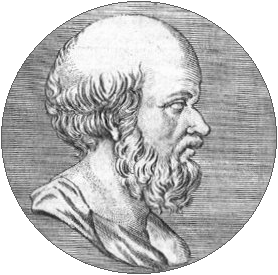
Eratosthenes measures Earth's circumference
Greek scholar Eratosthenes calculated Earth's size using geometry and ethnographic reports, exemplifying early cross-cultural geographical and anthropological inquiry. Source — Wikipedia:
Eratosthenes measures Earth's circumference By Unknown author, Public domain, https://commons.wikimedia.org/w/index.php?curid=494949
100 BCE
Sima Qian's Records of the Grand Historian
Sima Qian compiled China's first systematic history, documenting diverse peoples and cultures with ethnographic detail, establishing a model for cultural documentation. #ancient #science
1030 CE
Al-Biruni studies Indian society
Persian polymath al-Biruni wrote a detailed, objective comparative study of Indian culture, religion, and customs, founding comparative anthropology. Source — Wikipedia:
USSR stamp, Abū Rayhān al-Bīrūnī, 6 copecks, 1973. By The original uploader was Romanm at Slovenian Wikipedia. - Originally from sl.wikipedia; description page is/was here., Public domain, https://commons.wikimedia.org/w/index.php?curid=2590841
1355 CE
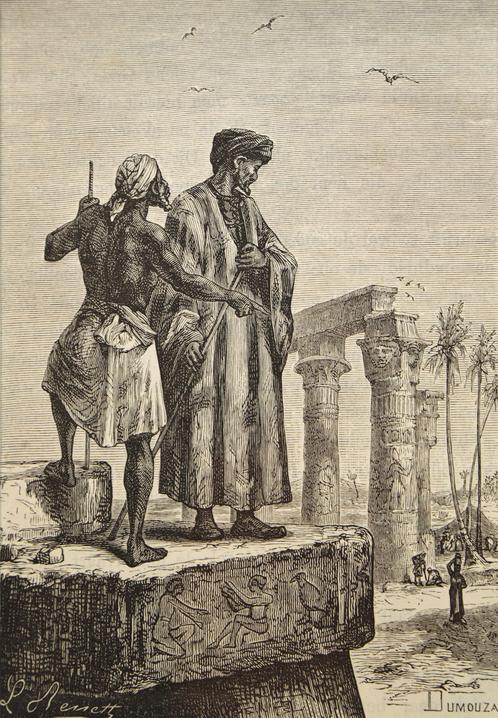
Ibn Battuta documents his travels
Moroccan explorer Ibn Battuta completed the Rihla, an extensive ethnographic account of societies across the Islamic world, Africa, and Asia. Source — Wikipedia:
An illustration from Jules Verne's book "Découverte de la terre" ("Discovery of the Earth") drawn by Léon Benett. Ibn Battuta (1304-68/69) was a Maghrebi Berber scholar and traveller By Léon Benett - Verne, Jules (1878). Les Grands voyages et les grands voyageurs. Découverte de la Terre. Paris: J. Hetzel. Page 81 available from Gallica.Immediate source: http://www.artfinder.com/work/ibn-battuta-in-egypt-hippolyte-leon-benett/, Public domain, https://commons.wikimedia.org/w/index.php?curid=17332982
1377 CE
Ibn Khaldun writes the Muqaddimah
Tunisian scholar Ibn Khaldun produced the Muqaddimah, introducing concepts of social cohesion (asabiyya), cyclical history, and pioneering sociology and economics. Source — Wikipedia:
The Muqaddimah of Ibn Khaldun By Riad Salih - Own work, CC BY 4.0, https://commons.wikimedia.org/w/index.php?curid=154963244
1492 CE
Age of Discovery cross-cultural accounts
European voyages generated extensive descriptions of Indigenous peoples, fueling early comparative ethnology while often serving colonial interests. Source — Wikipedia:
Theatrum Orbis Terrarum, by Abraham Ortelius, Typus Orbis Terrarum, 1572. By Abraham Ortelius - https://www.raremaps.com/gallery/detail/99250/world-continents-typus-orbis-terrarum-americae-s-ortelius, Public domain, https://commons.wikimedia.org/w/index.php?curid=153530215
1724 CE
Lafitau compares Indigenous and ancient customs
Jesuit missionary Joseph-François Lafitau published a systematic comparison of Native American and ancient Greek and Roman customs, an early work of comparative anthropology. Source — Wikipedia:
Joseph-François Lafitau (1681-1746), French Jesuit missionary, ethnologist and writer. By Unknown author - Camille de Rochemonteix, Les Jésuites et la Nouvelle-France au XVIIe siècle, v. 3, Paris, Letouzey et Ané, 1896. https://archive.org/download/lesjsuitesetla03roch/lesjsuitesetla03roch_jp2.zip, Public domain, https://commons.wikimedia.org/w/index.php?curid=4413868
1748 CE
Montesquieu's The Spirit of the Laws
Montesquieu analyzed how climate, geography, and culture shape laws and social institutions, anticipating environmental anthropology and comparative sociology. Source — Wikipedia:
The title page of volume 1 of Charles-Louis de Secondat, Baron de La Brède et de Montesquieu (1748) De l'Esprit des loix ou du rapport que les Loix doivent avoir avec la Constitution de chaque Gouvernement, les Moeurs, le Climat, la Religion, le Commerce, &c : à quoi l'Auteur a ajouté Des recherches nouvelles sur les Loix Romaines touchant les Successions, sur les Loix Françoises, & sur les Loix Féodales [The Spirit of the Laws, or the rapport that the Laws should have with the Constitution of each Government, the Customs, the Climate, the Religion, the Commerce, &c: to which the Author has added new research on the Roman Laws concerning Succession, on French Laws, and on the Feudal Laws], Geneva: Barrillot & Fils OCLC: 150438488. By Smuconlaw. - Own work; photographed from an original copy., Public domain, https://commons.wikimedia.org/w/index.php?curid=39705801
1856 CE
Neanderthal fossils identified
Fossils found in the Neander Valley, Germany, were recognized as a distinct extinct human species, launching paleoanthropology as a scientific field. Source — Wikipedia:
Neanderthal composite skeleton at the American Museum of Natural History By Ryan Schwark - Own work, CC0, https://commons.wikimedia.org/w/index.php?curid=146018367
1863 CE
Tylor's Primitive Culture published
Edward Burnett Tylor defined culture as a complex whole and proposed cultural evolutionism, establishing anthropology as an academic discipline. Source — Wikipedia:
1866 CE
Haeckel coins ecological anthropology terms
Ernst Haeckel coined 'ecology' and contributed to evolutionary frameworks that influenced biological anthropology, though later misused for social Darwinism. Source — Wikipedia:
Ernst Heinrich Philipp August Haeckel (February 16, 1834 – August 9, 1919) By Unknown author - http://ihm.nlm.nih.gov/images/B13670, Public domain, https://commons.wikimedia.org/w/index.php?curid=18637707
1871 CE
Morgan's Ancient Society published
Lewis Henry Morgan proposed a unilinear evolutionary scheme of social complexity from savagery to civilization, influencing Marx, Engels, and early anthropology. Source — Wikipedia:
Lewis Henry Morgan By Unknown author - Popular Science Monthly Volume 72, Public domain, https://commons.wikimedia.org/w/index.php?curid=18237393
1879 CE
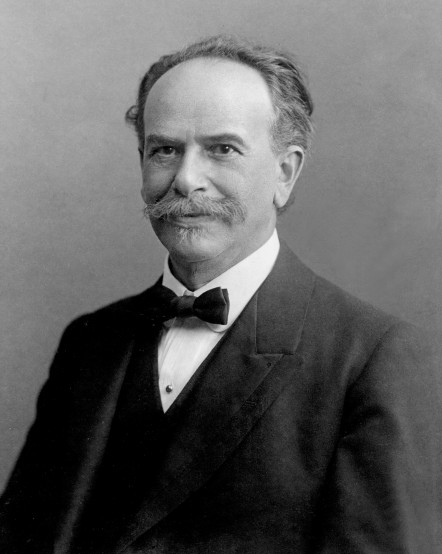
Boas begins Baffin Island fieldwork
Franz Boas conducted geographic and ethnographic fieldwork among the Inuit, pioneering the participant-observation method and cultural relativism. Source — Wikipedia:
Boas begins Baffin Island fieldwork By Unknown author - https://www.historymuseum.ca/cmc/exhibitions/tresors/barbeau/mb0588be.html, Public domain, https://commons.wikimedia.org/w/index.php?curid=400443
1891 CE
Dubois discovers Homo erectus
Eugène Dubois found fossils of Homo erectus on Java, providing crucial evidence for an early hominin outside Africa and advancing paleoanthropology. Source — Wikipedia:
Original fossils of Pithecanthropus erectus (now Homo erectus) found in Java in 1891. It was on display at the exhibition 'Dubois' in the National Museum of Natural History 'Naturalis' in Leiden, the Netherlands. Dutch anatomist Eugene Dubois had been fascinated with Charles Darwin's theories of evolution, so set out to find an early human.(1890s) He first described the species as Pithecanthropus erectus ("upright ape-man"), based on a calotte (skullcap) and a modern-looking femur found from the bank of the Solo River at Trinil, in central Java. (This species is now regarded as Homo erectus.) His find is commonly referred to as Java Man. By Peter Maas - Own work, CC BY-SA 3.0, https://commons.wikimedia.org/w/index.php?curid=5735274
1915 CE
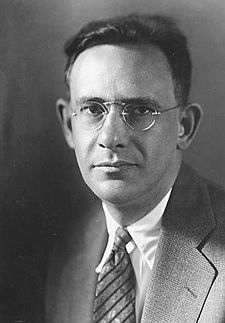
Sapir shapes linguistic anthropology
Edward Sapir's work on Native American languages established language's role in culture, forming the foundation of linguistic anthropology and the Sapir-Whorf hypothesis. Source — Wikipedia:
Edward Sapir (1884-1939), linguist, around 1910 By unnkown - http://www.nutquote.com/quote/Edward_Sapir/7, Public domain, https://commons.wikimedia.org/w/index.php?curid=12694253
1922 CE
Malinowski's Argonauts of the Western Pacific
Bronisław Malinowski published his Trobriand Islands study, establishing intensive participant-observation as the standard method in cultural anthropology. Source — Wikipedia:
Argonauts of the Western Pacific By Meggado - Own work, CC BY-SA 4.0, https://commons.wikimedia.org/w/index.php?curid=37237766
1924 CE
Dart describes Australopithecus africanus
Raymond Dart identified the Taung Child fossil as a hominin ancestor, establishing Africa as the cradle of humankind and transforming paleoanthropology. Source — Wikipedia:
Muséum d'Anthropologie, campus universitaire d'Irchel, Université de Zurich (Suisse) : Australopithecus africanus (Sterkfontein, Afrique du sud) By Guérin Nicolas (messages) - Own work, CC BY-SA 3.0, https://commons.wikimedia.org/w/index.php?curid=6517749
1928 CE
Yinxu excavations begin at Anyang
Chinese archaeologists led by Li Ji began systematic excavations at Yinxu, uncovering Shang palace foundations, royal tombs, and thousands of oracle bones documenting early Chinese civilization.
1949 CE
Evans-Pritchard on Nuer social complexity
E. E. Evans-Pritchard published his study of the Nuer's acephalous political system, demonstrating social complexity without centralized authority. Source — Wikipedia:
1959 CE
Leakey discovers Zinjanthropus
Mary Leakey found the Zinjanthropus boisei skull at Olduvai Gorge, confirming East Africa's central importance in human evolution and paleoanthropology. Source — Wikipedia:
Oldupai - this is a duplicate and should be deleted By Vinny Burgoo - Own work, CC BY 3.0, https://commons.wikimedia.org/w/index.php?curid=4479047
1962 CE
Lévi-Strauss's The Savage Mind
Claude Lévi-Strauss published his theory of structural anthropology, arguing universal cognitive structures underlie all human myth and classification systems. Source — Wikipedia:
1974 CE
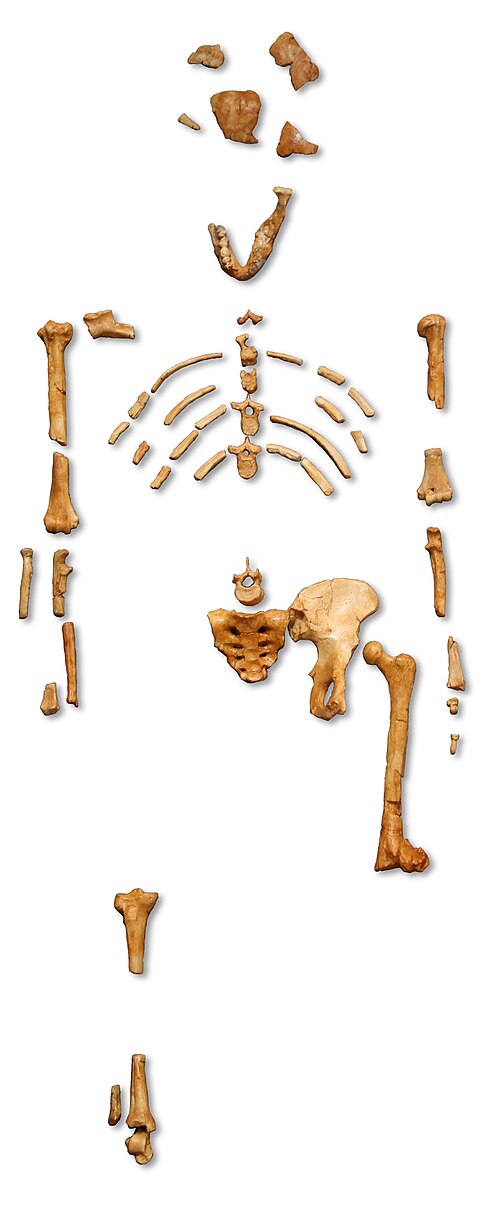
Lucy (Australopithecus afarensis) discovered
Donald Johanson's team discovered the Lucy fossil in Ethiopia, providing a key 3.2-million-year-old specimen illuminating bipedalism in human evolution. Source — Wikipedia: )
« Lucy » skeleton (AL 288-1) Australopithecus afarensis, cast from Museum national d'histoire naturelle, Paris By 120 - own picture worked with photoshop, CC BY 2.5, https://commons.wikimedia.org/w/index.php?curid=1818607The Lucy fossil, 50 years later
1979 CE
Sahlins critiques Western economic assumptions
Marshall Sahlins's work on the original affluent society challenged assumptions about scarcity in hunter-gatherer life, reshaping economic anthropology. #contemporary #science
1987 CE
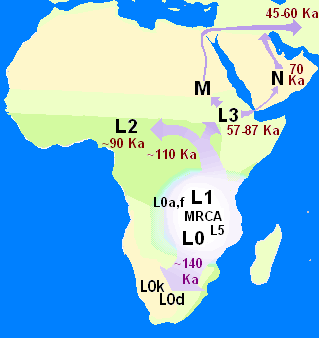
Mitochondrial Eve hypothesis published
Rebecca Cann, Mark Stoneking, and Allan Wilson published genetic evidence that all living humans share a common African maternal ancestor, integrating genetics into anthropology. Source — Wikipedia:
Based on Several studies, Behar et al. 2008, Gonder et al. 2007, Reed and Tishkoff. Two wiki maps of Africa were used as the basis but so heavily modified only the continental outline remains roughly the same. By Pdeitiker - Own work, Public domain, https://commons.wikimedia.org/w/index.php?curid=8741380
2003 CE
Flores hominin (Homo floresiensis) discovered
Fossils of a small-brained hominin were found on Flores, Indonesia, challenging assumptions about brain size and human evolutionary complexity. Source — Wikipedia:
A Homo floresiensis' skull By Rama - Own work, CC BY-SA 3.0 fr, https://commons.wikimedia.org/w/index.php?curid=58803889Discovery of Homo floresiensis, nicknamed the 'hobbit' - Witness History podcast, BBC World Service
2010 CE
Neanderthal genome sequenced
Svante Pääbo's team published the draft Neanderthal genome, revealing interbreeding between archaic and modern humans and founding paleogenomics. Source — Wikipedia:
Neanderthal Man: In Search of Lost Genomes | Svante Paabo | Talks at Google
2013 CE
Homo naledi discovered in Rising Star Cave
Lee Berger's team discovered a new hominin species in South Africa, raising questions about ritual behavior and the complexity of human evolution. Source — Wikipedia:
Dinaledi skeletal specimens. The figure includes approximately all of the material incorporated in this diagnosis, including the holotype specimen, paratypes and referred material. These make up 737 partial or complete anatomical elements, many of which consist of several refitted specimens. Specimens not identified to element, such as non-diagnostic long bone or cranial fragments, and a subset of fragile specimens are not shown here. The ‘skeleton’ layout in the center of the photo is a composite of elements that represent multiple individuals. This view is foreshortened; the table upon which the bones are arranged is 120-cm wide for scale. By Lee Roger Berger research team - http://elifesciences.org/content/4/e09560, CC BY 4.0, https://commons.wikimedia.org/w/index.php?curid=43071595Inside Rising Star cave where Homo naledi buried its dead
2024 CE
AI and computational anthropology advance
Computational methods and large-scale linguistic databases are transforming the study of cultural phylogenetics, language evolution, and social complexity. #contemporary #science



![The title page of volume 1 of Charles-Louis de Secondat, Baron de La Brède et de Montesquieu (1748) De l'Esprit des loix ou du rapport que les Loix doivent avoir avec la Constitution de chaque Gouvernement, les Moeurs, le Climat, la Religion, le Commerce, &c : à quoi l'Auteur a ajouté Des recherches nouvelles sur les Loix Romaines touchant les Successions, sur les Loix Françoises, & sur les Loix Féodales [The Spirit of the Laws, or the rapport that the Laws should have with the Constitution of each Government, the Customs, the Climate, the Religion, the Commerce, &c: to which the Author has added new research on the Roman Laws concerning Succession, on French Laws, and on the Feudal Laws], Geneva: Barrillot & Fils OCLC: 150438488.](https://upload.wikimedia.org/wikipedia/commons/thumb/e/e5/Montesquieu%2C_De_l%27Esprit_des_loix_%281st_ed%2C_1748%2C_vol_1%2C_title_page%29.jpg/500px-Montesquieu%2C_De_l%27Esprit_des_loix_%281st_ed%2C_1748%2C_vol_1%2C_title_page%29.jpg)