Encyclopedia/3. History, Societies & Civilizations/09. Modern Nations/02. Americas • Curated by Admin Timeline.sg
History of Venezuela (AI-generated, sourced to Wikipedia).
Chronological Storyline (37 Milestones)
15000 BCE
First human settlement
Hunter-gatherers arrived in the territory of present-day Venezuela during the late Pleistocene, leaving stone tools and rock art across the region. Source — Wikipedia, "Venezuela":
This picture of a "palafito" will help readers to understand what it is. I am from Venezuela and always explain my students the origin of the name. That is why I thought to be important. By Peter & Jackie Main - http://blog.shiito.es/wp-content/uploads/2011/08/pobladowarao.jpg, Public domain, https://commons.wikimedia.org/w/index.php?curid=4636547
Aug 1, 1498 CE
Columbus reaches Venezuela
Christopher Columbus explored the Orinoco Delta during his third voyage, realizing he had encountered a vast continental landmass. Source — Wikipedia, "Venezuela":
Viajes de Colón By Rezza Editores - Cartilla Geográfica Amphora, CC BY 3.0, https://commons.wikimedia.org/w/index.php?curid=175920849
1522 CE
Cumaná, first Spanish settlement
Spanish colonists established Cumaná, the first permanent European settlement in South America, initiating formal colonization of Venezuela. Source — Wikipedia, "Venezuela":
cumana sucre By BID Ciudades Sostenibles - https://www.flickr.com/photos/bid_ciudades/22215780232/, CC BY 2.0, https://commons.wikimedia.org/w/index.php?curid=120341800
Jul 25, 1567 CE
Caracas founded
Diego de Losada founded Santiago de León de Caracas in a fertile valley, establishing the future capital of Venezuela. Source — Wikipedia, "Venezuela":
Caracas from the mountain of Ávila By Olga Berrios - Flickr: caracas desde el ávila, CC BY 2.0, https://commons.wikimedia.org/w/index.php?curid=20787220
Jul 24, 1783 CE
Simón Bolívar born
The future Liberator of northern South America was born into a wealthy Caracas creole family, destined to lead independence movements. Source — Wikipedia, "Venezuela":
Simón Bolívar, 1st President of Bolivia By Luis Enrique Toro Moreno (1897-1933) - Palacio Legislativo, La Paz // Mesa Gisbert, Carlos D. (2003). Presidentes de Bolivia: Entre urnas y fusiles. El poder ejecutivo, los ministros de Estado. Editorial Gisbert., Public domain, https://commons.wikimedia.org/w/index.php?curid=112068420
Apr 19, 1810 CE
Caracas junta established
Caracas creoles deposed the Spanish governor and formed a junta, joining the wave of South American independence movements. Source — Wikipedia, "Venezuela":
Caracas junta established By Unknown author, Public domain, https://commons.wikimedia.org/w/index.php?curid=2187437
Jul 5, 1811 CE
Declaration of Independence
Venezuela became the first Spanish American colony to declare independence, though full sovereignty would require years of war. Source — Wikipedia, "Venezuela":
Spanish: Boceto para la Firma del Acta de Independencia.title QS:P1476,es:"Boceto para la Firma del Acta de Independencia."label QS:Les,"Boceto para la Firma del Acta de Independencia." By Martin Tovar y Tovar - http://www.cervantesvirtual.com/bib_autor/fmiranda/iconografia.shtml, Public domain, https://commons.wikimedia.org/w/index.php?curid=3453302
Jul 25, 1812 CE
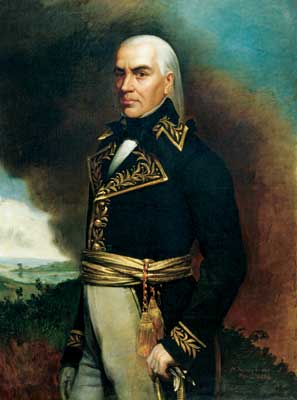
Miranda surrenders
Francisco de Miranda capitulated to Spanish forces at La Guaira after the young republic collapsed, ending the First Republic. Source — Wikipedia, "Venezuela":
Portrait of General Francisco de Miranda by Martín Tovar y Tovar By Martin Tovar y Tovar - http://www.cervantesvirtual.com/bib_autor/fmiranda/iconografia.shtml, Public domain, https://commons.wikimedia.org/w/index.php?curid=3453291
Jun 1, 1813 CE
Admirable Campaign begins
Simón Bolívar launched a military campaign from New Granada, liberating western Venezuela and briefly restoring republican government. Source — Wikipedia, "Venezuela":
Ruta de la campaña admirable,fue una acción militar enmarcada dentro de la Guerra de Independencia de Venezuela. By C arango - Own work, Public domain, https://commons.wikimedia.org/w/index.php?curid=3385931
Feb 15, 1819 CE
Angostura Congress
Bolívar convened a congress at Angostura, outlining his vision for a unified republic and laying groundwork for Gran Colombia. Source — Wikipedia, "Venezuela":
House of the Congress of Angostura By Guillermo Ramos Flamerich - Own work, CC BY 2.5, https://commons.wikimedia.org/w/index.php?curid=1538389
Jun 24, 1821 CE
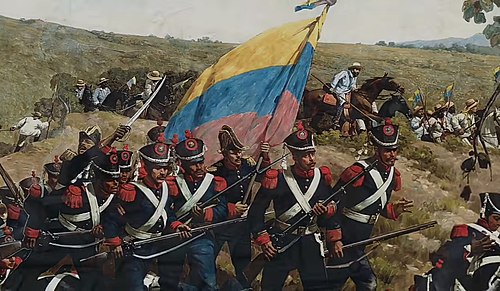
Battle of Carabobo
Bolívar's patriot army decisively defeated Spanish royalist forces, securing Venezuelan independence and enabling the creation of Gran Colombia. Source — Wikipedia, "Venezuela":
Battle of Carabobo By Unknown author, Public domain, https://commons.wikimedia.org/w/index.php?curid=2187437
Jan 13, 1830 CE
Separation from Gran Colombia
Venezuela seceded from Gran Colombia under José Antonio Páez, becoming an independent republic with Caracas as its capital. Source — Wikipedia, "Venezuela":
Flag of the Gran Colombia, used between December 17, 1819 and January 10, 1820, and in the Venezuela Department until July 12, 1821. By HansenBCN - Own workRepública de la Gran ColombiaGreat Colombia Federate Republic, CC BY-SA 4.0, https://commons.wikimedia.org/w/index.php?curid=9809765
Feb 20, 1859 CE
Federal War begins
A brutal civil war erupted between centralists and federalists, devastating the countryside and killing an estimated 200,000 people. Source — Wikipedia, "Venezuela":
The flag of Venezuela By Various, see File history below for details. - Bolivarian Government of Venezuela, Public domain, https://commons.wikimedia.org/w/index.php?curid=381097
Apr 12, 1863 CE
Federal War ends
The Treaty of Coche ended five years of civil war, establishing a federal system and granting significant autonomy to the provinces. Source — Wikipedia, "Venezuela":
The flag of Venezuela By Various, see File history below for details. - Bolivarian Government of Venezuela, Public domain, https://commons.wikimedia.org/w/index.php?curid=381097
Apr 27, 1870 CE
Guzmán Blanco takes power
Antonio Guzmán Blanco seized control and modernized Venezuela, building infrastructure, secularizing institutions, and centralizing authority. Source — Wikipedia, "Venezuela":
Antonio Guzman Blanco. Oleo sobre Tela. Ministerio de Relaciones Exteriores. By Martín Tovar y Tovar (1827 - 1902), restored version - File:Martin Tovar y Tovar 20.JPG, Public domain, https://commons.wikimedia.org/w/index.php?curid=158077381
Dec 20, 1902 CE
Venezuelan crisis blockade
Britain, Germany, and Italy blockaded Venezuelan ports to force repayment of debts, provoking international diplomatic intervention. Source — Wikipedia, "Venezuela":
Engraving by the German Willy Stower depicting the blockade of Venezuelan ports in 1902 By Willy Stöwer - http://www.galizacig.com/actualidade/200606/xmc_entrevista_a_rafael_uzcategui.htm, Public domain, https://commons.wikimedia.org/w/index.php?curid=3503317
Dec 19, 1908 CE
Gómez seizes power
Juan Vicente Gómez took control in a coup, ruling as dictator for 27 years and opening Venezuela to foreign oil investment. Source — Wikipedia, "Venezuela":
Juan Vicente Gómez in 1928. By Unknown authorUnknown author, Restored version by User:Wilfredor - File:Juan Vicente Gomez.jpg, Public domain, https://commons.wikimedia.org/w/index.php?curid=92579996
Dec 14, 1922 CE
Barroso well blows out
The La Rosa No. 2 well at Cabimas erupted with 100,000 barrels per day, launching Venezuela's transformation into an oil economy. Source — Wikipedia, "Venezuela":
Venezuela's historic inflation rate beside annual oil revenues. By Sorckas - Own work, CC BY-SA 4.0, https://commons.wikimedia.org/w/index.php?curid=79476241
Dec 3, 1935 CE
Gómez dies
The death of dictator Juan Vicente Gómez ended one of Latin America's longest dictatorships and initiated a period of gradual political liberalization. Source — Wikipedia, "Venezuela":
Juan Vicente Gómez in 1928. By Unknown authorUnknown author, Restored version by User:Wilfredor - File:Juan Vicente Gomez.jpg, Public domain, https://commons.wikimedia.org/w/index.php?curid=92579996
Oct 18, 1945 CE
October Revolution
A civilian-military coup overthrew President Isaías Medina Angarita, establishing a three-year period of democratic reform. Source — Wikipedia, "Venezuela":
Members of the Revolutionary Government Junta of Venezuela, from left to right: Mario Ricardo Vargas, Raúl Leoni, Valmore Rodríguez, Rómulo Betancourt, Carlos Delgado Chalbaud, Edmundo Fernández and Gonzalo Barrios. Miraflores Palace, 1945. By Unknown author - Archives of the Rómulo Betancourt Foundation, CC0, https://commons.wikimedia.org/w/index.php?curid=7920607
Nov 24, 1948 CE
Military coup
The armed forces overthrew the democratically elected government of Rómulo Gallegos, returning Venezuela to military rule. Source — Wikipedia, "Venezuela":
Militares en la azotea del congreso durante el golpe de estado en Venezuela de 1948 By Unknown author - http://mariafsigillo.blogspot.com/2013/10/en-imagenes-el-golpe-romulo-gallegos-en.html, Public domain, https://commons.wikimedia.org/w/index.php?curid=126820694
Jan 23, 1958 CE
Pérez Jiménez overthrown
A popular uprising backed by the military ousted dictator Marcos Pérez Jiménez, ending authoritarian rule and ushering in democratic governance. Source — Wikipedia, "Venezuela":
23 de Enero de 1958 By Wilfredor - Own work[1], Public domain, https://commons.wikimedia.org/w/index.php?curid=87374645
Oct 31, 1958 CE
Punto Fijo pact
Three major political parties signed a power-sharing agreement, establishing a stable democratic system that lasted four decades. Source — Wikipedia, "Venezuela":
Portada revista momento del 31 de enero de 1958, donde aparecen los líderes políticos venezolanos: Rafael Caldera, Jóvito Villalba y Rómulo Betancourt. By Revista Momento - Biblioteca Digital Rafael Caldera: www.rafaelcaldera.com, Public domain, https://commons.wikimedia.org/w/index.php?curid=87177941
Sep 14, 1960 CE
OPEC founded
Venezuela joined Iran, Iraq, Kuwait, and Saudi Arabia in founding OPEC in Baghdad, coordinating oil production policies among exporters. Source — Wikipedia, "Venezuela":
Flag of the Organization of Petroleum Exporting Countries By Zscout370 - English Wikipedia: en:Image:Flag_of_OPEC.svg, Public domain, https://commons.wikimedia.org/w/index.php?curid=1140939
Jan 1, 1976 CE
Oil industry nationalized
Venezuela nationalized its oil industry, creating PDVSA and asserting sovereign control over the nation's most valuable resource. Source — Wikipedia, "Venezuela":
Edificio principal de PDVSA ubicado en la Av. 5 de Julio, Ciudad de Maracaibo, Venezuela. By Wilfredor - Own work, CC BY-SA 3.0, https://commons.wikimedia.org/w/index.php?curid=7406414
Jul 20, 1979 CE
Miss Universe win
Maritza Sayalero became the first Venezuelan to win Miss Universe, inaugurating the country's reputation as a pageant powerhouse. Source — Wikipedia, "Venezuela":
Maritza Sayalero, Miss Universe 1979. By Associated Press - WorthPoint, Public domain, https://commons.wikimedia.org/w/index.php?curid=190330294
Feb 18, 1983 CE
Black Friday currency collapse
The bolívar was devalued sharply, triggering a devastating economic crisis and eroding decades of oil-funded prosperity. Source — Wikipedia, "Venezuela":
The flag of Venezuela By Various, see File history below for details. - Bolivarian Government of Venezuela, Public domain, https://commons.wikimedia.org/w/index.php?curid=381097
Feb 27, 1989 CE
The Caracazo
Riots erupted after IMF-backed austerity measures raised fuel and transport prices; the military crackdown killed hundreds, possibly thousands. Source — Wikipedia, "Venezuela":
The flag of Venezuela By Various, see File history below for details. - Bolivarian Government of Venezuela, Public domain, https://commons.wikimedia.org/w/index.php?curid=381097
Feb 4, 1992 CE
Chávez coup attempt
Lieutenant Colonel Hugo Chávez led a failed military coup, was imprisoned, but gained national prominence as a populist figure. Source — Wikipedia, "Venezuela":
The flag of Venezuela By Various, see File history below for details. - Bolivarian Government of Venezuela, Public domain, https://commons.wikimedia.org/w/index.php?curid=381097
Dec 6, 1998 CE
Chávez elected president
Hugo Chávez won the presidency in a landslide, promising a Bolivarian Revolution to redistribute wealth and reform the political system. Source — Wikipedia, "Venezuela":
Official portrait of President of Venezuela Hugo Chávez. By Presidency of Bolivarian Republic of Venezuela - https://www.instagram.com/p/DR7Sym4jd_W/, Public domain, https://commons.wikimedia.org/w/index.php?curid=184273067
Dec 15, 1999 CE
New constitution approved
Voters approved a new constitution renaming the country the Bolivarian Republic of Venezuela and concentrating executive power. Source — Wikipedia, "Venezuela":
Constitution of Venezuela (1999) By Government of Venezuela - Own work, Public domain, https://commons.wikimedia.org/w/index.php?curid=50943311
Apr 11, 2002 CE
Coup against Chávez
Military officers briefly ousted Chávez during mass protests, but loyalist forces restored him to power within 48 hours. Source — Wikipedia, "Venezuela":
Marcha hasta Chuao el 11 de abril de 2002 By Prensa Presidencial - Government of Venezuela - YouTube: https://www.youtube.com/watch?v=C9_U3ryAfXM – View/save archived versions on archive.org, CC BY 3.0, https://commons.wikimedia.org/w/index.php?curid=68544139
Mar 5, 2013 CE
Chávez dies
Hugo Chávez died of cancer after 14 years in power, triggering a presidential transition to his designated successor Nicolás Maduro. Source — Wikipedia, "Venezuela":
Funeral procession of Hugo Chávez. By Luigino Bracci - https://www.flickr.com/photos/lubrio/8561340762/in/album-72157633006941038/, CC BY 2.0, https://commons.wikimedia.org/w/index.php?curid=49996038
Feb 12, 2014 CE
Mass protests erupt
Nationwide demonstrations against Maduro's government were met with force, marking the start of years of political unrest. Source — Wikipedia, "Venezuela":
Peaceful protestors demonstrating in Caracas, Venezuela. Photo: Diego Urdaneta By durdaneta from Caracas, Venezuela - Bravo Pueblo #venezuela #12F #plazavenezuela, CC BY 2.0, https://commons.wikimedia.org/w/index.php?curid=31192297
Jul 30, 2017 CE
Constituent Assembly elected
Maduro convened a controversial constituent assembly to bypass the opposition-controlled legislature, drawing international condemnation. Source — Wikipedia, "Venezuela":
Logo of the 2017 Constitutional Assembly of Venezuela By Government of Venezuela - https://twitter.com/ANC_ve, Public domain, https://commons.wikimedia.org/w/index.php?curid=61728020
Jan 23, 2019 CE
Guaidó declares presidency
National Assembly president Juan Guaidó declared himself interim president, recognized by over 50 countries amid a constitutional crisis. Source — Wikipedia, "Venezuela":
Juan Guaidó na embaixada americana no Brasil By U.S. Embassy Brasilia - https://www.flickr.com/photos/embaixadaeua-brasil/47186452092/, Public domain, https://commons.wikimedia.org/w/index.php?curid=77299196
Jul 28, 2024 CE
Disputed presidential election
Maduro claimed victory in a presidential election widely considered fraudulent, sparking international condemnation and renewed protests. Source — Wikipedia, "Venezuela":
states of Venezuela without Essequibo By Boud - File:Venezuela Estados.svg, CC BY-SA 4.0, https://commons.wikimedia.org/w/index.php?curid=151294442