Jan 20, 1046 BCE
Battle of Muye
King Wu of Zhou (周武王, Zhōu Wǔwáng) defeated King Zhou of Shang (商纣王, Shāng Zhòuwáng), establishing the Zhou Dynasty and legitimizing it through the Mandate of Heaven (天命, tiānmìng).
Spanning 790 years (1046–256 BCE), the Zhou Dynasty is China's longest-lasting dynasty, evolving from a unified feudal state into a fragmented realm during the Spring and Autumn and Warring States periods.
King Wu of Zhou (周武王, Zhōu Wǔwáng) defeated King Zhou of Shang (商纣王, Shāng Zhòuwáng), establishing the Zhou Dynasty and legitimizing it through the Mandate of Heaven (天命, tiānmìng).
After King Wu's death, the Duke of Zhou (周公, Zhōu Gōng) served as regent, consolidating Zhou power, establishing rites, and laying the administrative foundations of the dynasty.
The Duke of Zhou built the eastern capital at Chengzhou (成周, Chéngzhōu, modern Luoyang) to control the eastern plains and house surrendered Shang nobles.
Following the expulsion of King Li (周厉王, Zhōu Lìwáng), the Gonghe Regency (共和行政, Gònghé Xíngzhèng) began, marking the first precisely dated year in Chinese history.
Quanrong (犬戎, Quǎnróng) nomads sacked the Western Zhou capital Haojing (镐京, Hàojīng), killing King You (周幽王, Zhōu Yōuwáng) and ending the Western Zhou period.
King Ping (周平王, Zhōu Píngwáng) moved the capital to Luoyang (洛阳, Luòyáng), initiating the Eastern Zhou (东周, Dōng Zhōu) era and the Spring and Autumn period (春秋时期, Chūnqiū Shíqī).
The Spring and Autumn period (c. 770 – c. 481 BCE[1][a]) was a period in Chinese history corresponding roughly to the first half of the Eastern Zhou (c. 771 – 256 BCE). The period's name[b] derives from the Spring and Autumn Annals, a chronicle of the state of Lu between 722 and 481 BCE, which tradition associates with Confucius (551–479 BCE). Source:
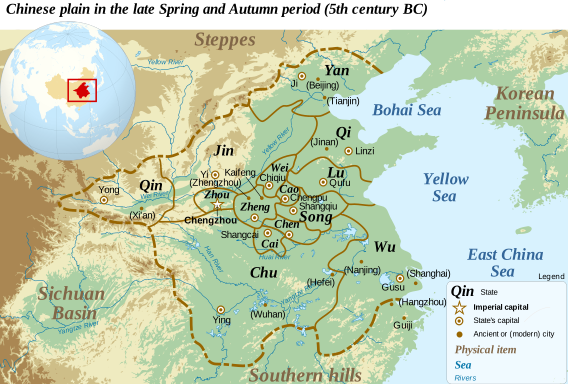
Duke Huan of Qi (齐桓公, Qí Huángōng) ascended, becoming the first Hegemon (霸主, bàzhǔ) with his minister Guan Zhong's (管仲, Guǎn Zhòng) economic and administrative reforms.
Confucius (孔子, Kǒngzǐ) was born in the state of Lu (鲁国, Lǔguó), later founding a philosophical school that profoundly shaped Chinese culture and governance.
The state of Zheng (郑国, Zhèngguó) cast its penal laws on a bronze vessel (铸刑书, zhù xíngshū), marking a shift from aristocratic custom to written, public law.
Wu (吴国, Wúguó) general Sun Tzu (孙子, Sūnzǐ) led a devastating surprise attack that shattered the powerful state of Chu (楚国, Chǔguó), a pivotal military event of the era.
The legendary Sword of Goujian (越王勾践剑, Yuèwáng Gōujiàn jiàn) was crafted for King Goujian of Yue (越王勾践, Yuèwáng Gōujiàn), renowned for its rust-proof properties.
The start of the Warring state period (according ot Sima Qian), largely corresponds to the second half of the Eastern Zhou period The term "Warring States period" comes from the Record of the Warring States, a work of history compiled during the early Han dynasty (202 BC – 220 AD). Source:
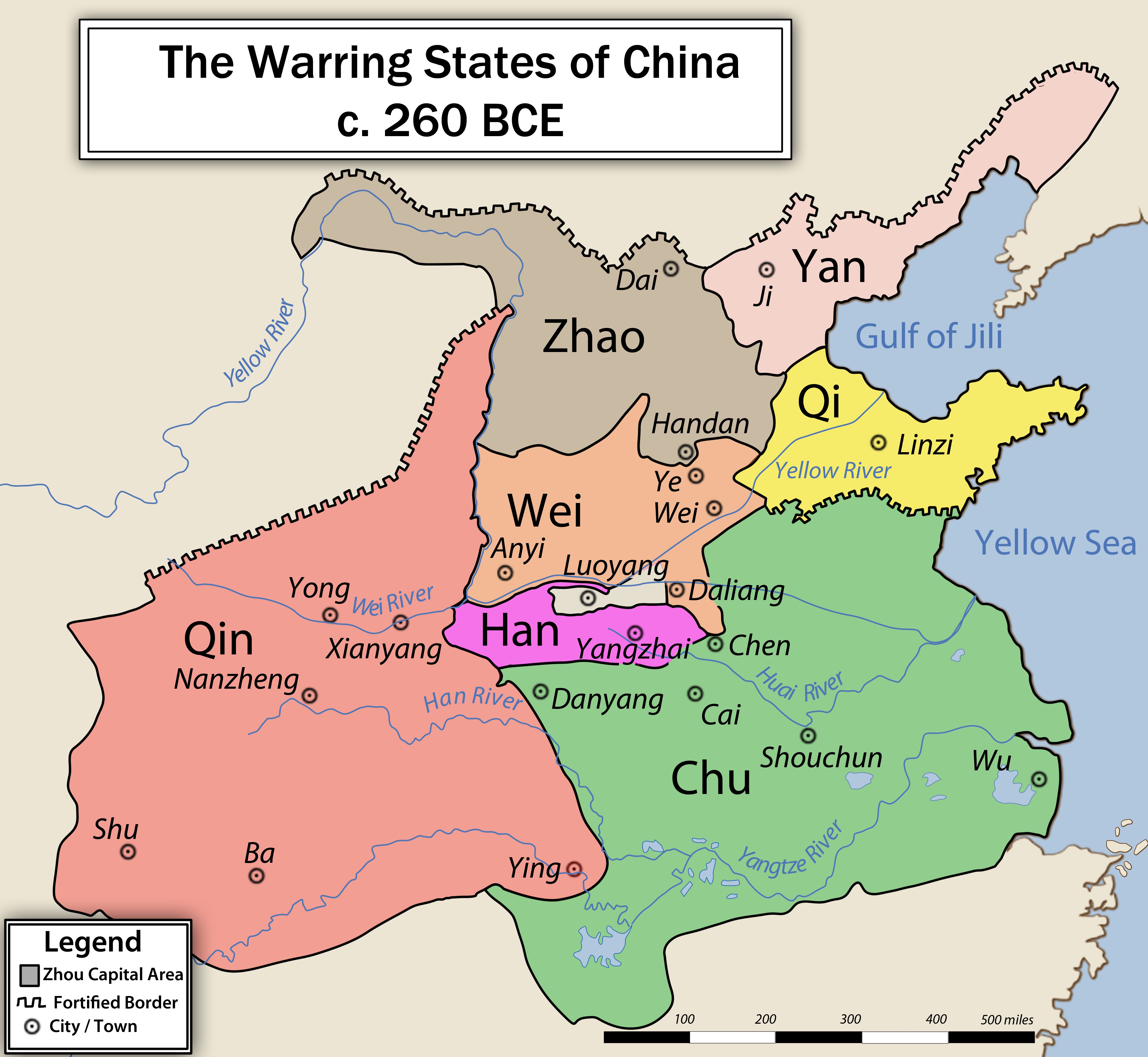
The state of Jin (晋国, Jìnguó) was divided into Han (韩, Hán), Zhao (赵, Zhào), and Wei (魏, Wèi) by noble families, formally marking the transition to the Warring States period (战国时期, Zhànguó Shíqī).
Mozi (墨子, Mòzǐ) established Mohism, advocating for universal love (兼爱, jiān'ài) and pacifism, directly challenging Confucian orthodoxy.
King Weilie (周威烈王, Zhōu Wēilièwáng) officially recognized Han (韩, Hán), Zhao (赵, Zhào), and Wei (魏, Wèi) as sovereign states, cementing the political fragmentation of the Warring States era.
Shang Yang (商鞅, Shāng Yāng) implemented legalist reforms in Qin (秦国, Qínguó), establishing a meritocratic, militaristic state that prioritized agriculture and warfare.
Alexander the Great was born in Macedon, a figure whose later conquests would open Central Asian contacts with the Zhou-era Chinese sphere.
Despite his successful reforms, Shang Yang (商鞅, Shāng Yāng) was executed by King Huiwen of Qin (秦惠文王, Qín Huìwénwáng), though his legalist framework remained intact.
Qin (秦国, Qínguó) annexed the Ba (巴, Bā) and Shu (蜀, Shǔ) states in the Sichuan Basin (四川盆地, Sìchuān Péndì), vastly expanding its resources and securing a strategic flank against Chu (楚国, Chǔguó). )
The state of Qi (齐国, Qíguó) invaded and sacked the capital of Yan (燕国, Yānguó), causing massive devastation that later prompted Yan's vengeful retaliation under Yue Yi (乐毅, Yuè Yì). )
King Wuling of Zhao (赵武灵王, Zhào Wǔlíng Wáng) adopted nomadic cavalry tactics (胡服骑射, húfú qíshè), revolutionizing Chinese warfare.
Yan (燕国, Yānguó) general Yue Yi (乐毅, Yuè Yì) led a coalition that nearly destroyed Qi (齐国, Qíguó), but Qi general Tian Dan (田单, Tián Dān) used the 'fire oxen' tactic (火牛阵, huǒ niú zhèn) to lift the siege of Jimo (即墨, Jímò).
Poet Qu Yuan (屈原, Qū Yuán) drowned himself in despair after Chu's (楚国, Chǔguó) capital Ying (郢, Yǐng) was captured by Qin (秦国, Qínguó), inspiring the Dragon Boat Festival (端午节, Duānwǔ Jié).
Qin (秦国, Qínguó) general Bai Qi (白起, Bái Qǐ) defeated Zhao (赵国, Zhàoguó), burying 400,000 surrendered soldiers alive, a devastating blow that crippled Zhao's power.
King Nan of Zhou (周赧王, Zhōu Nǎnwáng) died after Qin (秦国, Qínguó) captured his remaining territory, officially ending the Zhou Dynasty.
Qin (秦国, Qínguó) abolished the puppet state of West Zhou (西周国, Xī Zhōu Guó), extinguishing the last royal descendants of the Duke of Zhou and erasing Zhou's political identity.