Encyclopedia/3. History, Societies & Civilizations/09. Modern Nations/02. Americas • Curated by Admin Timeline.sg
History of Uruguay (AI-generated, sourced to Wikipedia).
Chronological Storyline (42 Milestones)
4000 BCE
First human settlements
Hunter-gatherer groups inhabit the region that is now Uruguay, leaving behind shell mounds known as cerritos along the Atlantic coast and wetlands. Source — Wikipedia, "Uruguay":
Flag of Uruguay By See File history below for details. - Design of the "Sun of May" copied from URL [1], which was copied by Francisco Gregoric, 5 Jul 2004 from URL [2] CONSTRUCTION SHEET: Vexilla Mundi: Uruguay See also:, Public domain, https://commons.wikimedia.org/w/index.php?curid=28388395
Jan 1, 1516 CE
Solís reaches Río de la Plata
Spanish explorer Juan Díaz de Solís arrives at the Río de la Plata, becoming the first European to reach the region. He and part of his crew are killed by indigenous Charrúa people. Source — Wikipedia, "Uruguay":
Flag of Uruguay By See File history below for details. - Design of the "Sun of May" copied from URL [1], which was copied by Francisco Gregoric, 5 Jul 2004 from URL [2] CONSTRUCTION SHEET: Vexilla Mundi: Uruguay See also:, Public domain, https://commons.wikimedia.org/w/index.php?curid=28388395
1603 CE
First Spanish missions
Jesuit missionaries establish the first reductions among the Guaraní in the Banda Oriental, beginning sustained European religious and cultural influence in the region. Source — Wikipedia, "Uruguay":
This is a photo of a monument in Brazil identified by the ID By Ian Storni Machado - Own work, CC BY-SA 4.0, https://commons.wikimedia.org/w/index.php?curid=43615314
1624 CE
San Antonio founded
Franciscan friars establish the San Antonio de Padua mission on the Río Negro, one of the earliest European settlements in what is now Uruguayan territory. Source — Wikipedia, "Uruguay":
Flag of Uruguay By See File history below for details. - Design of the "Sun of May" copied from URL [1], which was copied by Francisco Gregoric, 5 Jul 2004 from URL [2] CONSTRUCTION SHEET: Vexilla Mundi: Uruguay See also:, Public domain, https://commons.wikimedia.org/w/index.php?curid=28388395
Jan 1, 1680 CE
Portuguese found Colonia
Portugal founds Colonia del Sacramento on the Río de la Plata opposite Buenos Aires, sparking over a century of Spanish-Portuguese rivalry over the Banda Oriental. Source — Wikipedia, "Uruguay":
Basilica del Sanctísimo Sacramento, Colonia del Sacramento, Uruguay. By JGHowes, photographer (Canon AE-1 camera). - User:JGHowes, Attribution, https://commons.wikimedia.org/w/index.php?curid=12604557
Dec 24, 1726 CE
Montevideo founded
Spanish governor Bruno Mauricio de Zabala formally establishes Montevideo as a fortified settlement to secure the Banda Oriental against Portuguese expansion. Source — Wikipedia, "Uruguay":
Collage of the main landmarks of the city of Montevideo (Uruguay). By Coquimbo58, Gabboe, Marcos Mendizábal, Beatrizackermann, Michelle Maria, Eduardo Ruggieri, Ismael Cordero. - Derived by editing: File:Atardecer en el Palacio Legislativo.jpg by Gabboe, File:Teatro Solís, exterior 16.jpg by Marcos Mendizábal, File:Obelisco de los Constituyentes de 1830.JPG by Gabboe, File:El mam de Montevideo.JPG by Beatrizackermann, File:Montevideo Uruguay - panoramio (7).jpg by Michelle Maria File:PLAZA INDEPENDENCIA 03.JPG by Eduardo Ruggieri, File:Iglesia de las Carmelitas - Parroquia del Prado - Montevideo Uruguay.jpg by TitiNicola, File:MONUMENTO A LA CARRETA.jpg by Eduardo Ruggieri, File:Vista de Cerro de Montevideo, faro y bahía.JPG by Ismael Cordero., CC BY-SA 4.0, https://commons.wikimedia.org/w/index.php?curid=71646342
Feb 1, 1806 CE
British invasions begin
British forces launch invasions of the Río de la Plata, occupying Montevideo briefly in 1807 before being expelled by local militias, foreshadowing independence movements. Source — Wikipedia, "Uruguay":
"La Reconquista de Buenos Aires", portrait depicting the surrender of Beresford to Santiago de Liniers during the British Invasions to the Rio de la Plata By Charles Fouqueray (1869-1956) - The portrait is currently located in the National Historical Museum (Argentina), PD-US, https://en.wikipedia.org/w/index.php?curid=24968272
Feb 28, 1811 CE
Grito de Asencio
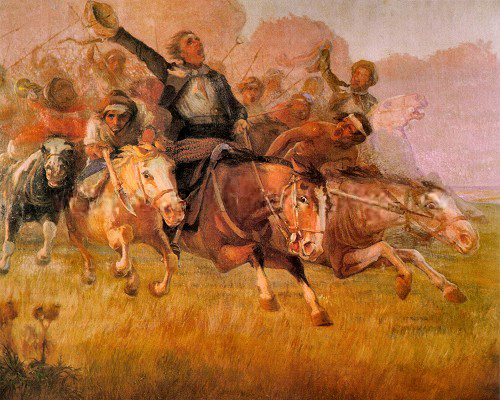
Rebels in the Banda Oriental rise against Spanish authority at the Grito de Asencio, igniting the independence movement led by José Gervasio Artigas. Source — Wikipedia, "Uruguay":
Begin of the Oriental Revolution, in the modern Uruguay. By Carlos María Herrera (1875 - 1914) - Carlos María Herrera, Public domain, https://commons.wikimedia.org/w/index.php?curid=15482588
May 18, 1811 CE
Battle of Las Piedras
Artigas defeats Spanish forces at the Battle of Las Piedras, the most significant patriot victory in the Banda Oriental's struggle for independence. Source — Wikipedia, "Uruguay":
Archivo provisto por el Museo Histórico Nacional de Uruguay en el marco de un proyecto GLAM entre esa institución y Wikimedia Uruguay. By Juan Luis Blanes - Imagen provista por el Museo Histórico Nacional de Uruguay, Public domain, https://commons.wikimedia.org/w/index.php?curid=74981828
1815 CE
Artigas forms Liga Federal
Artigas establishes the Liga Federal, a confederation of provinces seeking autonomy from Buenos Aires, and briefly controls the entire Banda Oriental as a federal stronghold. Source — Wikipedia, "Uruguay":
Bandera de Artigas. También fue la bandera del Partido Federal. By José Gervasio Artigas - No machine-readable source provided. Own work assumed (based on copyright claims)., Public domain, https://commons.wikimedia.org/w/index.php?curid=794159
Aug 1, 1816 CE
Portuguese invasion begins
Portuguese forces from Brazil invade the Banda Oriental, beginning a war that eventually defeats Artigas and his federalist forces after years of resistance. Source — Wikipedia, "Uruguay":
Obra da coleção Brasiliana Iconográfica. By Unknown - Brasiliana Iconográfica, Public domain, https://commons.wikimedia.org/w/index.php?curid=75741690
Jan 22, 1820 CE
Artigas defeated at Tacuarembó
Artigas is decisively defeated at the Battle of Tacuarembó, ending his rule and forcing him into exile in Paraguay, where he spends the rest of his life. Source — Wikipedia, "Uruguay":
Flag of Uruguay By See File history below for details. - Design of the "Sun of May" copied from URL [1], which was copied by Francisco Gregoric, 5 Jul 2004 from URL [2] CONSTRUCTION SHEET: Vexilla Mundi: Uruguay See also:, Public domain, https://commons.wikimedia.org/w/index.php?curid=28388395
Jul 1, 1821 CE
Annexed as Cisplatine Province
Portugal formally annexes the Banda Oriental as the Cisplatine Province, incorporating it into the United Kingdom of Portugal, Brazil and the Algarves. Source — Wikipedia, "Uruguay":
Merchant ensign of the Cisplatine Province of the Empire of Brazil By Variant of the flag designed by José Gervasio Artigas and José María de Roo - https://mhn.acervos.museus.gov.br/acervo-museologico/bandeira-80/, Public domain, https://commons.wikimedia.org/w/index.php?curid=193092643
Apr 19, 1825 CE
Thirty-Three Orientals land
A group of patriots known as the Thirty-Three Orientals, led by Juan Antonio Lavalleja, cross the Río de la Plata to launch a rebellion against Brazilian rule. Source — Wikipedia, "Uruguay":
Thirty-Three Orientals land By Juan Manuel Blanes - Museo Nacional de Artes Visuales, en exhibición en el Museo Municipal de Bellas Artes Juan Manuel Blanes en calidad de préstamo desde mediados de la década de los 70. Montevideo. Uruguay., Public domain, https://commons.wikimedia.org/w/index.php?curid=513420
Aug 25, 1825 CE
Independence declared
The Florida Assembly declares independence from Brazil and union with the United Provinces of the Río de la Plata, triggering the Cisplatine War. Source — Wikipedia, "Uruguay":
Flag of Uruguay By See File history below for details. - Design of the "Sun of May" copied from URL [1], which was copied by Francisco Gregoric, 5 Jul 2004 from URL [2] CONSTRUCTION SHEET: Vexilla Mundi: Uruguay See also:, Public domain, https://commons.wikimedia.org/w/index.php?curid=28388395
Aug 27, 1828 CE
Treaty of Montevideo
British mediation produces the Treaty of Montevideo, by which Brazil and Argentina recognize Uruguay as an independent state, ending the Cisplatine War. Source — Wikipedia, "Uruguay":
Flag of Uruguay By See File history below for details. - Design of the "Sun of May" copied from URL [1], which was copied by Francisco Gregoric, 5 Jul 2004 from URL [2] CONSTRUCTION SHEET: Vexilla Mundi: Uruguay See also:, Public domain, https://commons.wikimedia.org/w/index.php?curid=28388395
Jul 18, 1830 CE
First constitution adopted
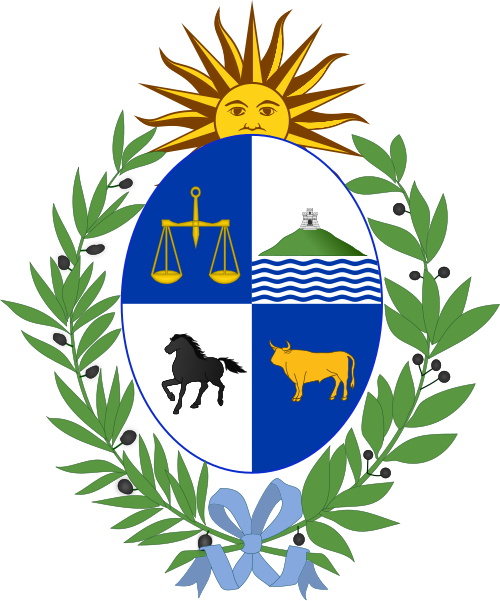
Uruguay's first constitution is promulgated, establishing a unitary republic with a strong executive and laying the legal foundation for the new nation. Source — Wikipedia, "Uruguay":
Coat of Arms of Uruguay. By Unknown (original 1829 emblem)User:Tatoute (SVG file) - File made and upload by Tatoute. Based in Image:Uruguay coa.png, Public domain, https://commons.wikimedia.org/w/index.php?curid=3511349
1838 CE
Guerra Grande begins
Civil war erupts between the Colorados and Blancos, the two dominant political factions, drawing in Argentina and Brazil in a conflict known as the Great War. Source — Wikipedia, "Uruguay":
Guerra Grande By KaasterMDK - Own work, CC BY 4.0, https://commons.wikimedia.org/w/index.php?curid=167435602
Feb 1, 1843 CE
Great Siege of Montevideo
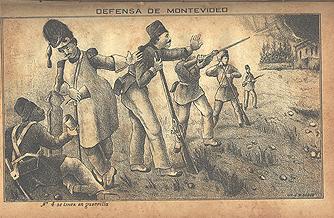
Blanco forces besiege Montevideo for nearly nine years during the Guerra Grande, with the Colorado-held city sustained by French and British support. Source — Wikipedia, "Uruguay":
Siege of Montevideo, Uruguay, during the Uruguayan Civil War (1839-1852) By w:User:Ineffable3000 - Defensa de montevideo.jpg and [1], Public domain, https://commons.wikimedia.org/w/index.php?curid=8789587
1851 CE
Guerra Grande ends
The civil war ends with the defeat of Blanco leader Manuel Oribe, establishing Colorado dominance and beginning a period of relative political stabilization. Source — Wikipedia, "Uruguay":
Guerra Grande By KaasterMDK - Own work, CC BY 4.0, https://commons.wikimedia.org/w/index.php?curid=167435602
Aug 1, 1864 CE
War of Triple Alliance begins
Uruguay joins Brazil and Argentina in the War of the Triple Alliance against Paraguay, a devastating conflict that reshapes the geopolitics of the Southern Cone. Source — Wikipedia, "Uruguay":
Escenas de la Guerra de la Triple Alianza. By Inkratt - Own work, CC BY-SA 3.0, https://commons.wikimedia.org/w/index.php?curid=28673128
May 24, 1866 CE
Battle of Tuyutí
Allied forces including Uruguayan troops win the Battle of Tuyutí, the bloodiest battle in South American history, inflicting massive losses on Paraguay. Source — Wikipedia, "Uruguay":
Episodio de la 2da División Buenos Aires en la batalla de Tuyutí, Mayo 24 de 1866, República del Paraguay (1876-1885) By Luis Candido Lopez - en:Image:Tuyuti.jpg, Public domain, https://commons.wikimedia.org/w/index.php?curid=1244375
Mar 1, 1903 CE
Batlle y Ordóñez presidency
José Batlle y Ordóñez begins his first presidential term, launching sweeping progressive reforms including labor rights, secularization, and expansion of public education. Source — Wikipedia, "Uruguay":
Batlle y Ordóñez presidency By Unknown author, Public domain, https://commons.wikimedia.org/w/index.php?curid=590587
Sep 1, 1905 CE
Battle of Masoller
Colorado forces defeat the Blancos at the Battle of Masoller, ending the last Uruguayan civil war and consolidating Batllista reforms. Source — Wikipedia, "Uruguay":
Flag of Uruguay By See File history below for details. - Design of the "Sun of May" copied from URL [1], which was copied by Francisco Gregoric, 5 Jul 2004 from URL [2] CONSTRUCTION SHEET: Vexilla Mundi: Uruguay See also:, Public domain, https://commons.wikimedia.org/w/index.php?curid=28388395
1917 CE
New constitution adopted
A new constitution creates a collegial executive (the National Council of Administration) alongside the presidency, reflecting Batlle's vision of shared power. Source — Wikipedia, "Uruguay":
Coat of Arms of Uruguay. By Unknown (original 1829 emblem)User:Tatoute (SVG file) - File made and upload by Tatoute. Based in Image:Uruguay coa.png, Public domain, https://commons.wikimedia.org/w/index.php?curid=3511349
Jul 30, 1930 CE
First World Cup hosted
Uruguay hosts and wins the first FIFA World Cup, defeating Argentina 4–2 in the final at Montevideo's Estadio Centenario, cementing the nation's footballing legend. Source — Wikipedia, "Uruguay":
Uruguay 1930 World Cup By Guillermo Laborde (1886–1940) - Here, Public domain, https://commons.wikimedia.org/w/index.php?curid=126555871
Mar 31, 1933 CE
Terra dissolves parliament
President Gabriel Terra carries out a self-coup, dissolving parliament and suspending the constitution, ending the collegial executive system and ruling by decree. Source — Wikipedia, "Uruguay":
Fotografía del Presidente Terra durante la Revolución de Marzo By Unknown author - La Verdad Histórica de Gabriel Terra (1962), Public domain, https://commons.wikimedia.org/w/index.php?curid=132221772
Jul 16, 1950 CE
Maracanazo World Cup win
Uruguay stuns Brazil 2–1 in the 1950 World Cup final at the Maracanã, one of the most shocking upsets in football history, securing Uruguay's second world title. Source — Wikipedia, "Uruguay":
Team of Uruguay, world champions. Standing: Obdulio Varela, Juan López Fontana (coach), Eusebio Tejera, Vazquez (staff), Abate (assistant coach), Schubert Gambetta, Matiás González, Roque Máspoli, Víctor Andrade, Juan Kirschberg (physiotherapist); lower row: Alvarez (staff), Alcides Ghiggia, Julio Pérez, Oscar Míguez, Juan Schiaffino, Rubén Morán, Figoli (staff) By Unknown author - El Gráfico, Public domain, https://commons.wikimedia.org/w/index.php?curid=12091223Video
1959 CE
Floods devastate countryside
Severe floods ravage Uruguay's interior, causing widespread destruction of livestock and farmland and triggering economic crisis and rural depopulation. Source — Wikipedia, "Uruguay":
Flag of Uruguay By See File history below for details. - Design of the "Sun of May" copied from URL [1], which was copied by Francisco Gregoric, 5 Jul 2004 from URL [2] CONSTRUCTION SHEET: Vexilla Mundi: Uruguay See also:, Public domain, https://commons.wikimedia.org/w/index.php?curid=28388395
Jun 1, 1968 CE
Emergency measures imposed
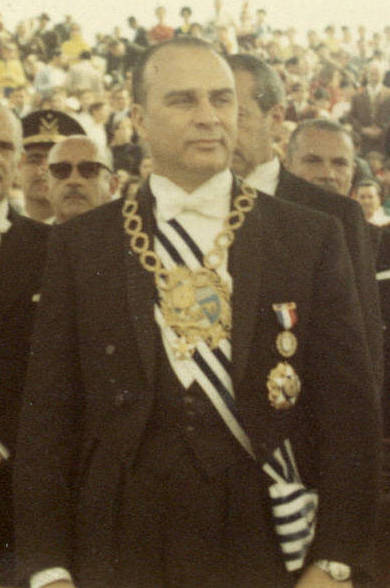
President Jorge Pacheco Areco declares a state of emergency, banning unions and censoring the press in response to growing labor unrest and Tupamaro guerrilla activity. Source — Wikipedia, "Uruguay":
Presidente de Uruguay, Jorge Pacheco Areco, en la Parada Militar en el Parque O'Higgins, Chile. By Biblioteca del Congreso Nacional - Chile - http://historiapolitica.bcn.cl/JPG/c/c6367b73fb76568180008520d400f136/FreiM_0016.jpg, CC BY-SA 3.0 cl, https://commons.wikimedia.org/w/index.php?curid=28248563
Apr 1, 1972 CE
Tupamaros crushed
The military defeats the Tupamaro urban guerrilla movement, arresting its leaders including Raúl Sendic, and increasingly takes control of internal security. Source — Wikipedia, "Uruguay":
Bandera dels Tupamaros, groupe armé d'extrême gauche, de guérilla urbaine en Uruguay actif durant les années 60 et 70. By Walden69 - Molt comuna a Uruguai, vista al FOTW i altres, Public domain, https://commons.wikimedia.org/w/index.php?curid=1264934
Jun 27, 1973 CE
Military coup d'état
President Juan María Bordaberry dissolves parliament and establishes a civic-military dictatorship, suspending civil liberties and beginning twelve years of authoritarian rule. Source — Wikipedia, "Uruguay":
Protesters marching against the Civic-military dictatorship of Uruguay in 1973 By Unknown author - https://rojoynegro.info/articulo/uruguay-23-de-junio-de-1973-golpe-de-estado/, CC BY 3.0, https://commons.wikimedia.org/w/index.php?curid=153622501
1976 CE
Disappeared during dictatorship
The military regime intensifies political repression; dozens of Uruguayans are disappeared and thousands imprisoned or exiled during the dictatorship's darkest years. Source — Wikipedia, "Uruguay":
Flag of Uruguay By See File history below for details. - Design of the "Sun of May" copied from URL [1], which was copied by Francisco Gregoric, 5 Jul 2004 from URL [2] CONSTRUCTION SHEET: Vexilla Mundi: Uruguay See also:, Public domain, https://commons.wikimedia.org/w/index.php?curid=28388395
Nov 30, 1980 CE
Referendum rejects regime
Voters reject a military-drafted constitution in a national referendum, a pivotal moment that forces the regime to negotiate a return to democratic rule. Source — Wikipedia, "Uruguay":
Coat of Arms of Uruguay. By Unknown (original 1829 emblem)User:Tatoute (SVG file) - File made and upload by Tatoute. Based in Image:Uruguay coa.png, Public domain, https://commons.wikimedia.org/w/index.php?curid=3511349
Mar 1, 1985 CE
Democracy restored
Julio María Sanguinetti takes office as president, marking the end of the military dictatorship and the restoration of democratic government after twelve years. Source — Wikipedia, "Uruguay":
Flag of Uruguay By See File history below for details. - Design of the "Sun of May" copied from URL [1], which was copied by Francisco Gregoric, 5 Jul 2004 from URL [2] CONSTRUCTION SHEET: Vexilla Mundi: Uruguay See also:, Public domain, https://commons.wikimedia.org/w/index.php?curid=28388395
Dec 1, 1989 CE
Amnesty law approved
A referendum upholds the Ley de Caducidad, granting amnesty to military and police personnel for human rights abuses committed during the dictatorship. Source — Wikipedia, "Uruguay":
Flag of Uruguay By See File history below for details. - Design of the "Sun of May" copied from URL [1], which was copied by Francisco Gregoric, 5 Jul 2004 from URL [2] CONSTRUCTION SHEET: Vexilla Mundi: Uruguay See also:, Public domain, https://commons.wikimedia.org/w/index.php?curid=28388395
Oct 31, 2004 CE
First left-wing president
Tabaré Vázquez of the Broad Front wins the presidential election, becoming Uruguay's first leftist head of state and ending decades of Colorado-Blanco alternation. Source — Wikipedia, "Uruguay":
The Prime Minister, Mariano Rajoy, held talks with the President of the Eastern Republic of Uruguay, Tabaré Vázquez, in La Moncloa. By Diego Crespo - https://www.lamoncloa.gob.es/multimedia/galeriasfotograficas/presidente/Paginas/2016/281116-tabare.aspx, Attribution, https://commons.wikimedia.org/w/index.php?curid=120112852
Oct 1, 2009 CE
Mujica elected president
Former guerrilla fighter José Mujica of the Broad Front is elected president, becoming one of the world's most unconventional and admired political leaders. Source — Wikipedia, "Uruguay":
Plenário da Câmara dos Deputados durante solenidade de posse da presidente da República, Dilma Rousseff e vice-presidente Michel Temer. Chefes de Estado e autoridades internacionais participam do evento. Em destaque, o atual presidente do Uruguai José Mujica. Foto: Marcos Oliveira/Agência Senado By Senado Federal - Solenidades. Homenagens, CC BY 2.0, https://commons.wikimedia.org/w/index.php?curid=83300507
May 3, 2013 CE
Same-sex marriage legalized
Uruguay legalizes same-sex marriage, becoming the second Latin American country after Argentina to do so and the third in the world at the national level. Source — Wikipedia, "Uruguay":
Flag of Uruguay By See File history below for details. - Design of the "Sun of May" copied from URL [1], which was copied by Francisco Gregoric, 5 Jul 2004 from URL [2] CONSTRUCTION SHEET: Vexilla Mundi: Uruguay See also:, Public domain, https://commons.wikimedia.org/w/index.php?curid=28388395
Dec 1, 2013 CE
Cannabis legalized
Uruguay becomes the first country in the world to fully legalize the production, sale, and consumption of cannabis under state regulation, under President Mujica. Source — Wikipedia, "Uruguay":
Leaf of Cannabis By Oren neu dag - Own work, CC BY-SA 3.0, https://commons.wikimedia.org/w/index.php?curid=4085127
Nov 24, 2019 CE
Lacalle Pou elected
Luis Lacalle Pou of the National Party wins the presidential runoff, ending fifteen years of Broad Front rule and returning the center-right to power. Source — Wikipedia, "Uruguay":
Official photo of President Luis Lacalle Pou, who began his presidential term on March 1, 2020. By Gastón Britos (agencia FocoUy) para Presidencia de la República Oriental del Uruguay; fotografía oficial - Presidencia de la República Oriental del Uruguay, CC BY-SA 4.0, https://commons.wikimedia.org/w/index.php?curid=98141899
Mar 1, 2020 CE
COVID-19 pandemic hits
Uruguay records its first COVID-19 cases; the country manages the pandemic with comparatively low mortality rates, avoiding strict lockdowns through early testing and tracing. Source — Wikipedia, "Uruguay":
Desinfección de espacios públicos por COVID19 en Montevideo. By Agustín Fernández / IM - Sala de Medios - Intendencia de Montevideo, CC BY-SA 4.0, https://commons.wikimedia.org/w/index.php?curid=145912408