Encyclopedia/3. History, Societies & Civilizations/09. Modern Nations/01. Africa • Curated by Admin Timeline.sg
History of Libya (AI-generated, sourced to Wikipedia).
Chronological Storyline (37 Milestones)
1000 BCE
Phoenicians settle coastal Libya
Phoenician traders establish trading posts along the Libyan coast, including the settlement of Leptis Magna, which would become a major commercial center. Source — Wikipedia, "Libya":
Leptis Magna (29) By joepyrek from Richmond, Va, USA - Leptis Magna (29), CC BY-SA 2.0, https://commons.wikimedia.org/w/index.php?curid=78505176
630 BCE
Greeks found Cyrene
Greek settlers from Thera establish the city of Cyrene in Cyrenaica, founding a prosperous colony that became a center of Hellenic culture and learning. Source — Wikipedia, "Libya":
The national flag of Libya. By Various The SVG code is valid. This vector image was created with a text editor. - File:Flag of Libya (1951–1969).svg, Public domain, https://commons.wikimedia.org/w/index.php?curid=344725
74 BCE
Cyrenaica becomes Roman province
The Roman Republic formally annexes Cyrenaica after the bequest of Ptolemy Apion, integrating eastern Libya into the expanding Roman Mediterranean empire. Source — Wikipedia, "Libya":
The national flag of Libya. By Various The SVG code is valid. This vector image was created with a text editor. - File:Flag of Libya (1951–1969).svg, Public domain, https://commons.wikimedia.org/w/index.php?curid=344725
46 BCE
Tripolitania organized as Roman province
After the Battle of Thapsus, Rome reorganizes the western Libyan coast as the province of Africa Nova, later part of Tripolitania. Source — Wikipedia, "Libya":
Tripolitania, historical definitions By Onceinawhile - Own work, CC BY-SA 4.0, https://commons.wikimedia.org/w/index.php?curid=123487096
439 CE
Vandals conquer Roman Libya
The Vandals under King Genseric capture Carthage and seize the Libyan coastal cities, ending centuries of Roman rule in the region. Source — Wikipedia, "Libya":
Münze: 50 Denari Silber, de:Gelimer, König der Vandalen, um 530, Münzstätte Karthago, Beschriftung: D N REX G-EILAMIR By Unknown author - [1], Public domain, https://commons.wikimedia.org/w/index.php?curid=26421215
533 CE
Byzantines reconquer Libya
Byzantine general Belisarius defeats the Vandals and reincorporates Libya's coast into the Eastern Roman Empire under Emperor Justinian I. Source — Wikipedia, "Libya":
Map of the operations of the Vandalic War in 533-534, including the rebellions on Tripolitania and Sardinia. Topography taken from from DEMIS Mapserver, which are public domain, other wise self-made. Sources: The History of the Wars by Procopius of Caesarea; J.B. Bury, History of the Later Roman Empire; James Allan Stewart Evans, The Age of Justinian: The Circumstances of Imperial Power, ISBN 9780415022095; Ian Hughes, Belisarius: The Last Roman General, ISBN 9781594160851. By Cplakidas - Own work, CC BY-SA 3.0, https://commons.wikimedia.org/w/index.php?curid=16243822
642 CE
Arab Muslims conquer Libya
Arab forces under Amr ibn al-As sweep through Cyrenaica and Tripolitania, bringing Islam and the Arabic language to Libya for the first time. Source — Wikipedia, "Libya":
خارطة تُبيِّنُ مسار الفُتوحات الإسلاميَّة لِبلاد المغرب. By Dr. Husein Mu'nis et al. - أطلس تاريخ الإسلام. ص 121, Public domain, https://commons.wikimedia.org/w/index.php?curid=45550809
1050 CE
Hilalian invasions devastate region
The Banu Hilal and Banu Sulaym tribes, sent by the Fatimids, migrate into Libya, disrupting agriculture and accelerating the Arabization of the interior. Source — Wikipedia, "Libya":
Historical tribal map of the Arabian Peninsula The image is a historical tribal map of the Arabian Peninsula, drawn by the English orientalist Harold Dixon approximately 100 years ago. The map depicts the distribution of various tribes across Arabia, including present-day Saudi Arabia, Yemen, Oman, UAE, Qatar, Kuwait, Iraq, and surrounding regions. Key Features of the Map: Towns and Cities: Major towns such as Mecca, Medina, Riyadh, Jeddah, Damascus, Baghdad, and others are marked in block letters and underlined. Tribal Boundaries: The boundaries of different tribes are indicated using fine dotted lines. Tribal Names: Various tribes, including Anizah, Ruwala, Mutair, Qahtan, Bani Yam, and others, are labeled in italicized text. Annotations & Notes: The map includes references and notes, explaining the tribal divisions and their approximate locations. This rough tribal map serves as a valuable historical document, offering insights into the tribal and socio-political landscape of the Arabian Peninsula in the early 20th century. By SPQR10 - Dixon, Harold. A Map of the Tribes of the Arabian Peninsula. Drawn by English orientalist Harold Dixon, approximately 1) Adaptation from https://commons.wikimedia.org/wiki/File:%D8%AE%D8%B1%D9%8A%D8%B7%D8%A9_%D9%82%D8%A8%D8%A7%D8%A6%D9%84_%D8%A7%D9%84%D8%AC%D8%B2%D9%8A%D8%B1%D8%A9_%D8%A7%D9%84%D8%B9%D8%B1%D8%A8%D9%8A%D8%A9_%D9%84%D9%85%D8%B3%D8%AA%D8%B4%D8%B1%D9%82_%D8%A3%D9%86%D8%AC%D9%84%D9%8A%D8%B2%D9%8A_%D9%82%D8%A8%D9%84_%D9%85%D8%A6%D8%A9_%D8%B3%D9%86%D8%A9_%D9%88%D8%B6%D8%B9%D9%87%D8%A7_%D8%A7%D9%84%D9%85%D8%B3%D8%AA%D8%B4%D8%B1%D9%82_%D9%87%D8%A7%D8%B1%D9%88%D9%84%D8%AF_%D8%AF%D9%8A%D9%83%D8%B3%D9%88%D9%86.jpg 2)https://en.wikipedia.org/wiki/File:Tribes_english.png by User Slackerlawstudent, CC0, https://commons.wikimedia.org/w/index.php?curid=161460231
1551 CE
Ottomans capture Tripoli
Ottoman forces under Turgut Reis take Tripoli from the Knights of Malta, establishing Ottoman rule over Libya that would last nearly four centuries. Source — Wikipedia, "Libya":
One of the several maritime flags of Ottoman Tripolitania used during Karamanli era (1711-1835). Based on Johnson's new chart of national emblems of 1868. A similar flag, with the crescents moved towards the hoist, is recorded in the 1750s as the naval flag of the "Turkish Emperors" (Türckische Kayser) in Flaggen aller seefahrenden Nationen.[1] By Bamse - Own work by uploader based on Tripoli. Johnson's new chart of national emblems, 1868.jpg, Public domain, https://commons.wikimedia.org/w/index.php?curid=5459055
1711 CE
Karamanli dynasty founded
Ahmed Karamanli, an Ottoman cavalry officer, seizes power in Tripoli and establishes a hereditary dynasty that ruled semi-independently for over a century. Source — Wikipedia, "Libya":
The national flag of Libya. By Various The SVG code is valid. This vector image was created with a text editor. - File:Flag of Libya (1951–1969).svg, Public domain, https://commons.wikimedia.org/w/index.php?curid=344725
1801 CE
First Barbary War begins
The United States fights Tripoli after the Pasha demands increased tribute, marking America's first overseas military conflict. Source — Wikipedia, "Libya":
U.S. en:Schooner ENTERPRIZE Capturing the Tripolitan en:Corsair TRIPOLI, 1 August 1801. From a drawing (circa 1878) by Captain William Bainbridge Hoff, U.S. Navy, in the collection of the Navy department. By William Bainbridge Hoff (died 1903) - https://www.archives.gov/research/military/navy-ships/sailing-ships.html, Public domain, https://commons.wikimedia.org/w/index.php?curid=5404387
1835 CE
Ottomans reassert direct control
The Ottoman Empire re-establishes direct rule over Tripolitania, ending the Karamanli dynasty and beginning a period of administrative reform. Source — Wikipedia, "Libya":
One of the several maritime flags of Ottoman Tripolitania used during Karamanli era (1711-1835). Based on Johnson's new chart of national emblems of 1868. A similar flag, with the crescents moved towards the hoist, is recorded in the 1750s as the naval flag of the "Turkish Emperors" (Türckische Kayser) in Flaggen aller seefahrenden Nationen.[1] By Bamse - Own work by uploader based on Tripoli. Johnson's new chart of national emblems, 1868.jpg, Public domain, https://commons.wikimedia.org/w/index.php?curid=5459055
1837 CE
Senussi movement established
Sayyid Muhammad ibn Ali al-Senussi founds the Senussi religious order in Mecca, which would become a powerful political and spiritual force in Cyrenaica. Source — Wikipedia, "Libya":
Senussi Dynasty Traditional Bannner, Similar to the Flag of Cyrenaica and The Stand of King Idris By BlinxTheKitty - File:الكولونيل هاردي قائد الجيش السنوسي البريطاني يمنح التواتي المنفي رتبة ملازم اول.jpg [1], CC0, https://commons.wikimedia.org/w/index.php?curid=88083470
Sep 29, 1911 CE
Italy invades Libya
Italy declares war on the Ottoman Empire and invades Tripolitania and Cyrenaica, launching the Italo-Turkish War and beginning Italian colonial rule. Source — Wikipedia, "Libya":
Collage of the Italo-Turkish War By File:Turkish prisoners Rhodes 1912.jpg: L'Illustrazione italiana, 16 June 1912. File:Atatürk 1912.jpg: Bilinmiyor File:Italian battery near Tripoli.jpg, File:Italian landing at Tripoli3.jpg, File:Guerra-di-Libia-1024x585.jpg, File:Ottoman gunboat Bafra sunk at Al Qunfudhah.jpg: Unknown but died more than 70 years ago - File:Italian battery near Tripoli.jpg File:Italian landing at Tripoli3.jpg File:Guerra-di-Libia-1024x585.jpg File:Ottoman gunboat Bafra sunk at Al Qunfudhah.jpg File:Turkish prisoners Rhodes 1912.jpg File:Atatürk 1912.jpg, Public domain, https://commons.wikimedia.org/w/index.php?curid=87855180
Oct 18, 1912 CE
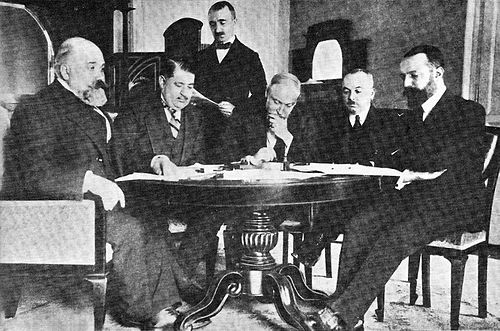
Treaty of Lausanne cedes Libya
The Ottoman Empire signs the Treaty of Lausanne, formally ceding Tripolitania and Cyrenaica to Italy, which consolidates the territories as Italian North Africa. Source — Wikipedia, "Libya":
Turkish and Italian delegations at Lausanne for the Treaty of Ouchy, also known as the 1912 Treaty of Lausanne. From Right to left : Giuseppe Volpi, Roumbeyoglou Fahreddin, Guido Fusinato, Mèhemmed Naby Bey, Pietro Bertolini. By Unknown author - Garyounis University; " The Martyr Omar al-Mukhtar Festival: Catalogue of Exhibition"; Arabic-English version; Benghazi; 1979; p.78, Mohammed Abdel Karim Al Wafi; “At Tariq Ila Lausanne: Al Khafaya ad Dublumasiya wal Askariya lil Ghazo al Itali li Libia”; Dar al Ferjani; Tripoli; Libya; 1977; P17, & Habib W. El-Hesnawi; “The Story the Libyans’ Jihad (Resistance) Against the Italian Colonialism 1911-1943”; Arabic-English version; Markaz Jihad al Libiyeen Did al Ghazo al Itali; Text and Documents Series; No. 7, 1988; P.179., Public domain, https://commons.wikimedia.org/w/index.php?curid=8285767
1922 CE
Senussi resistance intensifies
Omar Mukhtar leads Senussi guerrilla fighters in a sustained armed resistance against Italian colonization in the Cyrenaican interior. Source — Wikipedia, "Libya":
Omar Mukhtar By Italian colonial administration of Libya [1] - Dirk Vandevalle: A history of modern Libya. 2nd edition. Cambridge University Press 2012, p. 31, Public domain, https://commons.wikimedia.org/w/index.php?curid=599851
Sep 16, 1931 CE
Omar Mukhtar executed
Italian colonial authorities capture and hang the 73-year-old resistance leader Omar Mukhtar, symbolically ending organized armed resistance in Cyrenaica. Source — Wikipedia, "Libya":
Omar Mukhtar By Italian colonial administration of Libya [1] - Dirk Vandevalle: A history of modern Libya. 2nd edition. Cambridge University Press 2012, p. 31, Public domain, https://commons.wikimedia.org/w/index.php?curid=599851
1934 CE
Italy unifies colony as Libya
Italy formally unifies Tripolitania, Cyrenaica, and Fezzan into a single colony named Libya, reviving the ancient Greek name for the region. Source — Wikipedia, "Libya":
It is easy to put a border around this flag image By F l a n k e r - Regio decreto 1º gennaio 1890 [...] Art. 43 Le Corone della Reale famiglia hanno tutte la cxxx stessa base d'un cerchio d'oro coi margini cordonati, fregiato con otto grossi zaffiri (cinque visibili) attorniati ciascuno da dodici gemme cioè: quattro diamanti alternati con altrettanti rubini ed altrettanti smeraldi: i zaffiri sono divisi da otto nodi di Savoia (quattro visibili) d 'oro a sbalzo. Il cerchio è sormontato da quattro foglie d'acanto d'oro (tre visibili) caricate, in cuore, d'una perla; separate da quattro crocette di Savoia (due visibili) smaltate di rosa e ripiene di bianco, pomate con quattro perle ed accostate, ciascuna, da due perle collocate sopra una piccola punta; il tutto movente dal margine superiore del cerchio. Art. 44 Il Re usa due corone; quella Reale di Savoia e quella Reale d'Italia Art. 45 La Corona Reale di Savoia è chiusa da otto vette d'oro (cinque visibili) moventi dalle foglie e dalle crocette, riunite, con doppia curvatura, sulla sommità, fregiate all'esterno da grosse perle decrescenti dal centro, e sostenenti un globo d'oro cerchiato, cimato come Capo e Generale Gran Maestro dell'Ordine dei SS. Maurizio e Lazzaro, da una crocetta d'oro, trifogliata, movente dalla sommità del globo. [...] http://www.prassi.cnr.it/prassi/content.html?id=1669 Regio decreto n. 2072 del 24 settembre 1923 Norme per l'uso della bandiera nazionale convertito inlegge n. 2264 del 24 dicembre 1925 Art. unico È convertito in legge il R. decreto-legge 24 settembre 1923, n. 2072, concernente le norme per l'uso della bandiera nazionale con le modificazioni risultanti dal testo seguente: Art. 1 La bandiera nazionale, è formata da un drappo di forma rettangolare interzato in palo, di verde, di bianco e di rosso, col bianco coronato dallo stemma Reale bordato d'azzurro. Il drappo deve essere alto due terzi della sua lunghezza, e i tre colori vanno distribuiti nell'ordine anzidetto e in parti eguali, in guisa che il verde sia aderente all'inferitura. La bandiera di Stato, da usarsi nelle residenze dei Sovrani e della Reale Famiglia, nelle sedi del Parlamento, delle rappresentanze diplomatiche e consolari all'estero e degli uffici governativi, ha lo stemma sormontato dalla corona Reale. Art. 2 Per le bandiere nazionali usate dal Regio esercito, dalla Regia marina, dalla Regia aeronautica, come quelle usate dalla marina mercantile e dagli Enti che ne ebbero disciplinato l'uso da apposite disposizioni, nulla è innovato alle prescrizioni ora vigenti. Art. 3 Le bandiere nazionali degli Enti pubblici locali hanno lo stemma senza corona, e con la bordatura azzura. Art. 4 Gli Enti pubblici locali possono fare uso soltanto della bandiera nazionale e dei vessilli e gonfaloni tradizionali propri degli Enti, purché questi siano accompagnati alla bandiera nazionale, che avrà sempre il posto d'onore, a destra o in alto. L'autorità governativa può ordinare, secondo le consuetudini del Regno, che sui pubblici edifici delle Provincie, dei Comuni e degli Enti riconosciuti o vigilati dallo Stato sia esposta la bandiera nazionale. In caso di trasgressione, il Prefetto provvederà a termini di legge. Art. 5 In segno di lutto le bandiere degli edifici e quelle con sistemazione fissa devono essere tenute a mezz'asta; potranno anche avere due strisce di velo nero adattate all'estremità superiore dell'inferitura. Queste strisce sono obbligatorie invece per le bandiere che vengono portate nelle pubbliche cerimonie funebri. Art. 6 Nei festeggiamenti e nelle pubbliche funzioni la bandiera nazionale o di Stato deve avere la precedenza sopra tutti gli altri emblemi civili. Art. 7 Ferme rimanendo le norme e consuetudini di diritto internazionale per l'uso delle bandiere da parte delle rappresentanze diplomatiche e consolari estere, nessuno, cittadino o straniero, potrà nel Regno esporre bandiere di altri Stati, se non accompagnate alla bandiera italiana che occuperà sempre il posto d'onore, a destra, o in mezzo se le bandiere straniere sono più di una. In caso di trasgressione l'autorità di pubblica sicurezza provvederà alla immediata rimozione della o delle bandiere ed i colpevoli saranno puniti con multa da L. 1000 e 5000. Used colors: green rendered as RGB 000 140 069Pantone 17-6153 white rendered as RGB 244 245 240Pantone 11-0601 red rendered as RGB 205 033 042Pantone 18-1662 Savoy blue rendered as RGB 075 097 209Pantone ?, Public domain, https://commons.wikimedia.org/w/index.php?curid=1155686
Sep 13, 1940 CE
WWII North African campaign begins
Italian forces invade Egypt from Libya, launching the North African Campaign that would see fierce desert battles between Axis and Allied forces. Source — Wikipedia, "Libya":
Men of the Leicestershire Regiment man a Bren gun near Tobruk, 10 November 1941 By Keating G (Cpt), No 1 Army Film & Photographic Unit - This photograph E 6436 comes from the collections of the Imperial War Museums., Public domain, https://commons.wikimedia.org/w/index.php?curid=21859296
Jan 23, 1943 CE
Allies capture Tripoli
British Eighth Army under Montgomery enters Tripoli, ending Axis control of Libya and placing the territory under British and French military administration. Source — Wikipedia, "Libya":
Men of the Leicestershire Regiment man a Bren gun near Tobruk, 10 November 1941 By Keating G (Cpt), No 1 Army Film & Photographic Unit - This photograph E 6436 comes from the collections of the Imperial War Museums., Public domain, https://commons.wikimedia.org/w/index.php?curid=21859296
Dec 24, 1951 CE
Libya gains independence
The United Kingdom of Libya is proclaimed under King Idris I, becoming the first country to achieve independence through the United Nations. Source — Wikipedia, "Libya":
The national flag of Libya. By Various The SVG code is valid. This vector image was created with a text editor. - File:Flag of Libya (1951–1969).svg, Public domain, https://commons.wikimedia.org/w/index.php?curid=344725
1959 CE
Major oil reserves discovered
Esso Standard Libya discovers the Zelten oil field, transforming Libya into one of Africa's largest petroleum producers and a major oil exporter. Source — Wikipedia, "Libya":
The national flag of Libya. By Various The SVG code is valid. This vector image was created with a text editor. - File:Flag of Libya (1951–1969).svg, Public domain, https://commons.wikimedia.org/w/index.php?curid=344725
Sep 1, 1969 CE
Gaddafi seizes power
A group of army officers led by 27-year-old Muammar Gaddafi overthrows King Idris in a bloodless coup, ending the monarchy and establishing the Libyan Arab Republic. Source — Wikipedia, "Libya":
At an Arab summit in Libya in 1969, shortly after the September Revolution that toppled King Idris I and brought Colonel Mu’ammar al-Qaddafi to power. The new Libyan leader Mu’ammar al-Qaddafi sits in military uniform in the middle, surrounded by President Gamal Abd al-Nasser (left) and Syrian President Nur al-Din al-Atasi (right). By Unknown author - The Online Museum of Syrian History, Public domain, https://commons.wikimedia.org/w/index.php?curid=9731163
1975 CE
Green Book published
Gaddafi publishes the first volume of 'The Green Book,' outlining his political philosophy of direct democracy and Islamic socialism that would guide the state. Source — Wikipedia, "Libya":
Coat of arms of Libya (Gaddafi government from 1977-2011) -- the "Hawk of Qureish" with a green shield representing the national flag. By Tonyjeff, based on national symbol, with the help of AnonMoos. - national symbol adopted in 1977, according to here, here and here., Public domain, https://commons.wikimedia.org/w/index.php?curid=3493360
Mar 2, 1977 CE
Jamahiriya declared
Gaddafi proclaims the Great Socialist People's Libyan Arab Jamahiriya, a 'state of the masses' governed through people's committees, consolidating his revolutionary system. Source — Wikipedia, "Libya":
The national flag of the Libyan Arab Jamahiriya from 1977 to 2011. By Zscout370 - Own work, Public domain, https://commons.wikimedia.org/w/index.php?curid=23783184
Apr 15, 1986 CE
US bombs Libya
U.S. aircraft launch Operation El Dorado Canyon, bombing targets in Tripoli and Benghazi in retaliation for a Berlin discotheque bombing linked to Libya. Source — Wikipedia, "Libya":
A 48th Tactical Fighter Wing F-111F aircraft retracts its landing gear as it takes off from RAF Lakenheath, East Anglia England, to participate in a retaliatory air strike on Libya. By SSGT Woodward - U.S. DefenseImagery [1] photo VIRIN: DF-ST-88-02677 [2], Public domain, https://commons.wikimedia.org/w/index.php?curid=1309678
Dec 21, 1988 CE
Pan Am Flight 103 bombed
A bomb destroys Pan Am Flight 103 over Lockerbie, Scotland, killing 270 people. Libya is later implicated, leading to years of international isolation. Source — Wikipedia, "Libya":
Pan Am Flight 103, 21 December 1988. Lockerbie bombing Boeing 747–121, Clipper Maid of the Seas, Pan American World Airways, N739PA By Air Accident Investigation Branch - Air Accident Investigation Branch Report No: 2/1990 - Report on the accident to Boeing 747-121, N739PA, at Lockerbie, Dumfriesshire, Scotland on 21 December 1988 Report name: 2/1990 Boeing 747-121, N739PA http://www.aaib.gov.uk/publications/formal_reports/2_1990_n739pa.cfm Appendix B, Image B-9 "Photograph of nose and flight deck" http://www.aaib.gov.uk/cms_resources.cfm?file=/2-1990%20N739PA%20Append.pdf, OGL 2, https://commons.wikimedia.org/w/index.php?curid=30369951
1996 CE
Abu Salim prison massacre
An estimated 1,200 prisoners are killed at Abu Salim prison in Tripoli, one of the most notorious atrocities of Gaddafi's rule, kept secret for years. Source — Wikipedia, "Libya":
The national flag of Libya. By Various The SVG code is valid. This vector image was created with a text editor. - File:Flag of Libya (1951–1969).svg, Public domain, https://commons.wikimedia.org/w/index.php?curid=344725
Dec 1, 2003 CE
Libya renounces WMDs
Gaddafi announces Libya will dismantle its weapons of mass destruction programs, leading to the lifting of UN sanctions and reintegration into the international community. Source — Wikipedia, "Libya":
Among the nuclear weapons-related material that Libya permitted the United States to remove were these centrifuges acquired from Pakistan. By National Nuclear Security Administration - National Nuclear Security Administration Libya Renounces Weapons of Mass Destruction at the Wayback Machine Alternative sources: Libya Renounces Weapons of Mass Destruction at the Wayback Machine Libya Renounces Weapons of Mass Destruction at the Wayback Machine, Public domain, https://commons.wikimedia.org/w/index.php?curid=49008218
Feb 17, 2011 CE
Libyan Revolution begins
Anti-government protests erupt in Benghazi, inspired by the Arab Spring, quickly escalating into an armed rebellion against Gaddafi's 42-year rule. Source — Wikipedia, "Libya":
درگیری نیروهای انقلابی لیبی با نیروهای وفادار به قذافی By Diar Aladnani - https://www.farsnews.ir/photo/13900720001169/درگیری-نیروهای-انقلابی-لیبی-با-نیروهای-وفادار-به-قذافی, CC BY 4.0, https://commons.wikimedia.org/w/index.php?curid=135965980
Mar 19, 2011 CE
NATO intervention begins
A UN-mandated coalition led by NATO begins military operations to protect civilians, imposing a no-fly zone and conducting airstrikes against Gaddafi's forces. Source — Wikipedia, "Libya":
A map showing events of the coalition intervention in Libya. By Jolly Janner - File:A large blank world map with oceans marked in blue.svg for blank map. File:RAF roundel.svg File:RCAF-Roundel.svg File:French-roundel.svg File:Royal Danish Air Force Roundel.svg File:Roundel of the USAF.svg File:Roundel of Qatar.svg File:Roundel of the Italian Air Force.svg File:Roundel of the Spanish Air Force.svg File:Royal Norwegian Air Force Roundel.svg File:Roundel of the Belgian Air Force.svg File:Graney class SSN.svg File:Burke class destroyer profile;wpe47485.gif File:Arab Emirates AF roundel.svg File:Netherlands roundel.svg File:Operation Odyssey Dawn - No Fly Zone - Libya March 2011.jpg for no-fly zone outline, CC0, https://commons.wikimedia.org/w/index.php?curid=14657972
Oct 20, 2011 CE
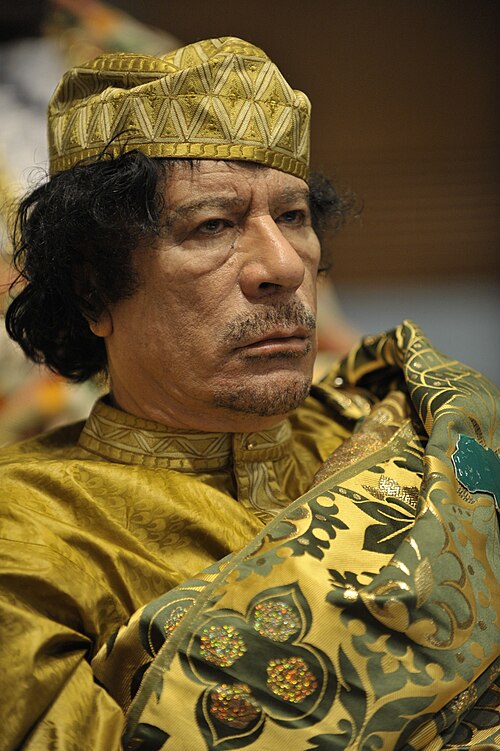
Gaddafi killed in Sirte
Gaddafi is captured and killed by rebel fighters in his hometown of Sirte, ending the eight-month civil war and his four decades in power. Source — Wikipedia, "Libya":
Muammar al-Gaddafi at the 12th AU summit, February 2, 2009, in Addis Ababa. By U.S. Navy photo by Mass Communication Specialist 2nd Class Jesse B. Awalt/Released - This image was released by the United States Navy with the ID 090202-N-0506A-402 (next). This tag does not indicate the copyright status of the attached work. A normal copyright tag is still required. See Commons:Licensing. العربية ∙ বাংলা ∙ Bahaso Jambi ∙ Deutsch ∙ Deutsch (Sie-Form) ∙ English ∙ español ∙ euskara ∙ فارسی ∙ français ∙ italiano ∙ 日本語 ∙ 한국어 ∙ македонски ∙ മലയാളം ∙ Plattdüütsch ∙ Nederlands ∙ polski ∙ پښتو ∙ português ∙ русский ∙ slovenščina ∙ svenska ∙ Türkçe ∙ українська ∙ 简体中文 ∙ 繁體中文 ∙ +/−, Public domain, https://commons.wikimedia.org/w/index.php?curid=14803201
Jul 7, 2012 CE
First democratic elections held
Libyans vote in the first free national elections in decades, selecting a General National Congress to guide the country's political transition. Source — Wikipedia, "Libya":
Cropped version of Mahmoud Jibril - World Economic Forum Special Meeting on Economic Growth and Job Creation in the Arab World.jpg for en:Libyan General National Congress election, 2012 infobox By Nader Daoud / World Economic Forum - derivatived from: Flickr: Mahmoud Jibril - World Economic Forum Special Meeting on Economic Growth and Job Creation in the Arab World This file was derived from: Mahmoud Jibril - World Economic Forum Special Meeting on Economic Growth and Job Creation in the Arab World.jpg, CC BY-SA 2.0, https://commons.wikimedia.org/w/index.php?curid=20642992
May 1, 2014 CE
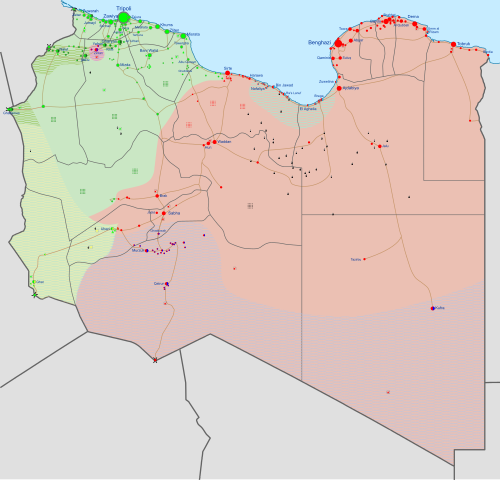
Second civil war erupts
Rival political factions and militias clash, splitting Libya between an internationally recognized government in Tobruk and a rival administration in Tripoli. Source — Wikipedia, "Libya":
Under the control of the House of Representatives in Tobruk and the Libyan National Army Under the control of the Government of National Accord and the Libya Shield Force Under the control of the National Salvation Government Controlled by the Islamic State of Iraq and the Levant in Libya Controlled by the Mujahedeen Councils of Derna, Benghazi and Adjabiya Controlled by local forces Controlled by Tuareg forces By Ali Zifan (vectorized map) - Derived from Template:Libyan Civil War detailed map, CC BY-SA 4.0, https://commons.wikimedia.org/w/index.php?curid=47087538
Dec 17, 2015 CE
Skhirat agreement signed
Rival Libyan factions sign the Libyan Political Agreement in Skhirat, Morocco, creating a Government of National Accord to unify the fractured country. Source — Wikipedia, "Libya":
The national flag of Libya. By Various The SVG code is valid. This vector image was created with a text editor. - File:Flag of Libya (1951–1969).svg, Public domain, https://commons.wikimedia.org/w/index.php?curid=344725
Oct 23, 2020 CE
Permanent ceasefire agreed
Warring parties sign a permanent ceasefire agreement in Geneva, ending major hostilities and paving the way for a unified government and elections. Source — Wikipedia, "Libya":
Under the control of the House of Representatives in Tobruk and the Libyan National Army Under the control of the Government of National Accord and the Libya Shield Force Under the control of the National Salvation Government Controlled by the Islamic State of Iraq and the Levant in Libya Controlled by the Mujahedeen Councils of Derna, Benghazi and Adjabiya Controlled by local forces Controlled by Tuareg forces By Ali Zifan (vectorized map) - Derived from Template:Libyan Civil War detailed map, CC BY-SA 4.0, https://commons.wikimedia.org/w/index.php?curid=47087538
Mar 15, 2021 CE
Unity government sworn in
A new Government of National Unity under interim Prime Minister Abdul Hamid Dbeibeh is sworn in, aiming to reunify Libya's institutions and hold national elections. Source — Wikipedia, "Libya":
Seal of the Government of National Unity of Libya By Government of National Unity of the State of Libya - Own work, based on logo from government website, Public domain, https://commons.wikimedia.org/w/index.php?curid=102415654


![One of the several maritime flags of Ottoman Tripolitania used during Karamanli era (1711-1835). Based on Johnson's new chart of national emblems of 1868. A similar flag, with the crescents moved towards the hoist, is recorded in the 1750s as the naval flag of the "Turkish Emperors" (Türckische Kayser) in Flaggen aller seefahrenden Nationen.[1]](https://upload.wikimedia.org/wikipedia/commons/thumb/8/84/Maritime_flag_of_Regency_of_Tripoli_%2818th_century%29.svg/500px-Maritime_flag_of_Regency_of_Tripoli_%2818th_century%29.svg.png)