Encyclopedia/3. History, Societies & Civilizations/09. Modern Nations/01. Africa • Curated by Admin Timeline.sg
History of Liberia (AI-generated, sourced to Wikipedia).
Chronological Storyline (31 Milestones)
1000 BCE
Early inhabitants settle region
Kru, Bassa, Grebo, and other linguistic groups establish communities in the forested coastal region of present-day Liberia, developing distinct political and cultural systems. Source — Wikipedia, "Liberia":
By 1856, Liberia was an independent country, recognized by the French but not by the United States. U.S.Congressmen did not want to be put in the position of having to receive a Black foreign ambassador. Policy was not reversed until Pres. Abraham Lincoln recognized Liberia. By Michael L. Dorn from Port Jefferson Station, New York, United States of America - Colton 1856 - Liberian Republic, CC BY-SA 2.0, https://commons.wikimedia.org/w/index.php?curid=18117139
1461 CE
Portuguese reach Liberian coast
Portuguese explorers under Pedro de Sintra arrive on the coast and name features such as Cape Mesurado and Cape Palmas, initiating European contact. Source — Wikipedia, "Liberia":
The flag of Liberia. By Government of Liberia - Construction sheet: [1] Version 1: SKopp Version 2: -xfi-Version 2 cleanup: SkyBon\Contributions, Public domain, https://commons.wikimedia.org/w/index.php?curid=343632
1600 CE
Dutch and British traders arrive
European traders establish sporadic commercial contacts along the Pepper Coast, exchanging goods for ivory, pepper, and later enslaved people. Source — Wikipedia, "Liberia":
Full title: 'Negroland and Guinea with the European Settlements, Explaining what belongs to England, Holland, Denmark, etc'. By H. Moll Geographer (Printed and sold by T. Bowles next ye Chapter House in St. Pauls Church yard, & I. Bowles at ye Black Horse in Cornhill, 1729, orig. published in 1727). [1] By Herman Moll - University of Florida, George A. Smathers Libraries, historic African maps: 1729 Herman Moll (#ALW1663), Public domain, https://commons.wikimedia.org/w/index.php?curid=3493328
Feb 6, 1820 CE
First ACS settlers arrive
The first group of freed African Americans sponsored by the American Colonization Society arrives at Sherbro Island in present-day Sierra Leone, though disease forces a relocation. Source — Wikipedia, "Liberia":
Emblem of the American Colonization Society By Felipe Fidelis Tobias - Own work File:American Colonization Society member certificate (color, Rev. S. R. Ely).jpg, CC BY-SA 4.0, https://commons.wikimedia.org/w/index.php?curid=138597745
Jan 7, 1822 CE
Monrovia settlement established
Settlers establish a permanent colony at Cape Mesurado, naming it Monrovia after U.S. President James Monroe, after negotiating land purchase from local chiefs. Source — Wikipedia, "Liberia":
Liberia, Africa By blk24ga - https://web.archive.org/web/20161027162409/http://www.panoramio.com/photo/93534276, CC BY 3.0, https://commons.wikimedia.org/w/index.php?curid=56674059
1824 CE
Colony named Liberia
The American Colonization Society formally names the colony Liberia, derived from the Latin word for freedom, reflecting its founding mission for freed slaves. Source — Wikipedia, "Liberia":
Emblem of the American Colonization Society By Felipe Fidelis Tobias - Own work File:American Colonization Society member certificate (color, Rev. S. R. Ely).jpg, CC BY-SA 4.0, https://commons.wikimedia.org/w/index.php?curid=138597745
1839 CE
Commonwealth of Liberia formed
The various ACS settlements along the coast are unified into the Commonwealth of Liberia, with a constitution and governor appointed by the Society. Source — Wikipedia, "Liberia":
Flag of Liberia (1827-1847) By Helt - Image:Flag of Liberia (1827-1847).png, Public domain, https://commons.wikimedia.org/w/index.php?curid=3196444
Jul 26, 1847 CE
Liberia declares independence
Liberia declares itself a sovereign republic, adopting a constitution modeled on that of the United States, with Joseph Jenkins Roberts as its first president. Source — Wikipedia, "Liberia":
The flag of Liberia. By Government of Liberia - Construction sheet: [1] Version 1: SKopp Version 2: -xfi-Version 2 cleanup: SkyBon\Contributions, Public domain, https://commons.wikimedia.org/w/index.php?curid=343632
1848 CE
Roberts elected first president
Joseph Jenkins Roberts, a freed Virginian, is formally elected as the first president of the Republic of Liberia, serving multiple terms and securing European recognition. Source — Wikipedia, "Liberia":
Photograph of Liberian president Joseph Jenkins Roberts By not stated - Library of Congress Prints and Photographs Division, Public domain, https://commons.wikimedia.org/w/index.php?curid=142929612
1857 CE
Maryland colony joins Liberia
The independent colony of Maryland, established by freed slaves, votes to join the Republic of Liberia after a conflict with local Grebo people, consolidating the nation's territory. Source — Wikipedia, "Liberia":
Location of en:Maryland County in Liberia By Derivative work: User:Profoss *Original work: Uwe Dedering - This vector image includes elements that have been taken or adapted from this file:, CC BY-SA 3.0, https://commons.wikimedia.org/w/index.php?curid=17241465
1875 CE
Greed and Grebo uprising
Grebo people in the southeastern region resist Americo-Liberian expansion, leading to military conflict that requires mediation and reshapes relations between settlers and indigenous groups. Source — Wikipedia, "Liberia":
By 1856, Liberia was an independent country, recognized by the French but not by the United States. U.S.Congressmen did not want to be put in the position of having to receive a Black foreign ambassador. Policy was not reversed until Pres. Abraham Lincoln recognized Liberia. By Michael L. Dorn from Port Jefferson Station, New York, United States of America - Colton 1856 - Liberian Republic, CC BY-SA 2.0, https://commons.wikimedia.org/w/index.php?curid=18117139
1904 CE
Interior declared part of Liberia
President Arthur Barclay formally extends Liberian sovereignty over the interior, declaring all indigenous peoples citizens, though effective administrative control remained limited for decades. Source — Wikipedia, "Liberia":
Arthur Barclay (1854-1938), 15th President of Liberia. By Unknown author - http://proekt-wms.narod.ru/states/liberia.htm Transferred from en.wikipedia to Commons by User:Jssfrk using CommonsHelper., Public domain, https://commons.wikimedia.org/w/index.php?curid=17386570
1926 CE
Firestone rubber concession granted
The Liberian government grants the Firestone Tire and Rubber Company a massive 99-year lease for rubber plantations, fundamentally reshaping the economy and tying it to American interests. Source — Wikipedia, "Liberia":
Harbel By Bwoart - Own work, CC BY-SA 4.0, https://commons.wikimedia.org/w/index.php?curid=45393979
1930 CE
Fernando Po scandal erupts
A League of Nations investigation reveals forced labor practices in Liberia, implicating high officials in shipping indigenous workers to Spanish plantations, causing international outrage. Source — Wikipedia, "Liberia":
The flag of Liberia. By Government of Liberia - Construction sheet: [1] Version 1: SKopp Version 2: -xfi-Version 2 cleanup: SkyBon\Contributions, Public domain, https://commons.wikimedia.org/w/index.php?curid=343632
Jan 3, 1944 CE
Tubman becomes president
William Tubman assumes the presidency and launches a 'Unification Policy' aimed at integrating indigenous Liberians into political and economic life, dominating the country for 27 years. Source — Wikipedia, "Liberia":
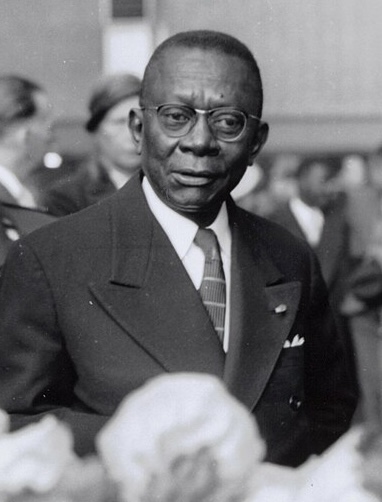
William Tubman on a state visit to the Netherlands By Anefo - cropped from File:Collectie Fotocollectiie Afdrukken ANEFO Rousel, fotonummer 157-1166, Bestanddeelnr 157-1166.jpg, CC0, https://commons.wikimedia.org/w/index.php?curid=134577307
1944 CE
Liberia declares war on Germany
Liberia enters World War II on the Allied side, allowing the United States to build military infrastructure including Robertsfield Airport, strengthening bilateral ties. Source — Wikipedia, "Liberia":
U.S. troops in Liberia during World War II By Office of War Information. Overseas Picture Division. - This image is available from the United States Library of Congress's Prints and Photographs division under the digital ID fsa.8b12866.This tag does not indicate the copyright status of the attached work. A normal copyright tag is still required. See Commons:Licensing., Public domain, https://commons.wikimedia.org/w/index.php?curid=4680976
1960 CE
Iron ore mining boom begins
Major iron ore concessions to foreign companies spark an economic boom, making Liberia one of Africa's fastest-growing economies during the decade. Source — Wikipedia, "Liberia":
Liberia, Africa By blk24ga - https://web.archive.org/web/20161027162409/http://www.panoramio.com/photo/93534276, CC BY 3.0, https://commons.wikimedia.org/w/index.php?curid=56674059
Jul 23, 1971 CE
Tubman dies in office
President William Tubman dies after 27 years in power, and Vice President William Tolbert succeeds him, promising reforms and a more open political environment. Source — Wikipedia, "Liberia":
Jimmy Carter and Cyrus Vance attend a luncheon hosted by William Tolbert, 04/03/1978. By Kightlinger, Jack E., Photographer - This image has been extracted from another file, Public domain, https://commons.wikimedia.org/w/index.php?curid=11108066
Apr 1, 1979 CE
Rice riots shake Monrovia
Protests against a proposed increase in the price of rice turn violent in Monrovia, with dozens killed, exposing deep economic and political tensions. Source — Wikipedia, "Liberia":
The flag of Liberia. By Government of Liberia - Construction sheet: [1] Version 1: SKopp Version 2: -xfi-Version 2 cleanup: SkyBon\Contributions, Public domain, https://commons.wikimedia.org/w/index.php?curid=343632
Apr 12, 1980 CE
Military coup overthrows Tolbert
Master Sergeant Samuel Kanyon Doe leads a bloody coup, killing President Tolbert and ending over a century of Americo-Liberian political dominance. Source — Wikipedia, "Liberia":
The flag of Liberia. By Government of Liberia - Construction sheet: [1] Version 1: SKopp Version 2: -xfi-Version 2 cleanup: SkyBon\Contributions, Public domain, https://commons.wikimedia.org/w/index.php?curid=343632
Oct 1, 1985 CE
Doe wins disputed election
Samuel Doe is declared winner of a presidential election widely regarded as fraudulent, consolidating military rule under a civilian facade amid growing repression. Source — Wikipedia, "Liberia":
Empty image. For use in templates that require images, but where none is available. By Mike bzh - Own work, Public domain, https://commons.wikimedia.org/w/index.php?curid=734781
Dec 24, 1989 CE
Civil war begins
Charles Taylor's National Patriotic Front of Liberia launches an armed rebellion from Ivory Coast, igniting the First Liberian Civil War and plunging the country into chaos. Source — Wikipedia, "Liberia":
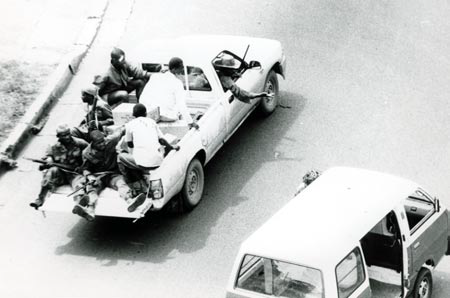
Armed Independent National Patriotic Front of Liberia soldiers drive past the American Embassy on United Nations Drive. By James G. Antal, R. John Vanden Berghe - On Mamba Station: U.S. Marines In West Africa 1990-2003, p. 8, Public domain, https://commons.wikimedia.org/w/index.php?curid=61205021
Sep 9, 1990 CE
Doe captured and killed
President Samuel Doe is captured, tortured, and killed by forces loyal to Prince Johnson, deepening the civil war and leaving Liberia without a functioning government. Source — Wikipedia, "Liberia":
Samuel K. Doe, Staatschef der Republik Liberia, 18. August 1982 in Washington DC By Photographer: Frank Hall, Treatment: Frank C. Müller - File:HD-SC-98-07558.jpg, Public domain, https://commons.wikimedia.org/w/index.php?curid=1440171
Jul 19, 1997 CE
Taylor elected president
Charles Taylor wins a special presidential election held after a peace agreement, campaigning on the slogan 'He killed my ma, he killed my pa, but I will vote for him.' Source — Wikipedia, "Liberia":
Results by county of the 1997 Liberian presidential election. By FelipeRev - Own work (based in), CC0, https://commons.wikimedia.org/w/index.php?curid=163264530
1999 CE
Second civil war erupts
Rebel groups including LURD launch attacks against Taylor's government from Guinea, beginning the Second Liberian Civil War and displacing hundreds of thousands. Source — Wikipedia, "Liberia":
Map of the Second Liberian Civil War in 2003 By User:BorysMapping - Own work See a full list of sources here: [1] Blank map from File:Topographic map of Liberia-en.svg, CC BY-SA 4.0, https://commons.wikimedia.org/w/index.php?curid=192089814
Aug 11, 2003 CE
Taylor resigns and goes into exile
Under intense international pressure and rebel advances on Monrovia, Charles Taylor resigns and accepts asylum in Nigeria, paving the way for a transitional government. Source — Wikipedia, "Liberia":
The flag of Liberia. By Government of Liberia - Construction sheet: [1] Version 1: SKopp Version 2: -xfi-Version 2 cleanup: SkyBon\Contributions, Public domain, https://commons.wikimedia.org/w/index.php?curid=343632
Oct 1, 2003 CE
UN peacekeepers deploy
The United Nations Mission in Liberia (UNMIL) deploys 15,000 peacekeepers to stabilize the country after 14 years of near-continuous civil conflict. Source — Wikipedia, "Liberia":
The emblem of the United Nations By Joowwww - Own work, Public domain, https://commons.wikimedia.org/w/index.php?curid=4453401
Nov 8, 2005 CE
Sirleaf wins historic election
Ellen Johnson Sirleaf defeats George Weah in a runoff, becoming Africa's first elected female head of state and ushering in a period of reconstruction and reconciliation. Source — Wikipedia, "Liberia":
Bilateral with the former President of Liberia By PMO Barbados - https://www.flickr.com/photos/pmobarbados/52379333646/, Public domain, https://commons.wikimedia.org/w/index.php?curid=123367183
Mar 1, 2014 CE
Ebola epidemic strikes Liberia
The worst Ebola outbreak in history hits Liberia, killing over 4,800 people and devastating the health system and economy before being declared contained in 2015. Source — Wikipedia, "Liberia":
Map of Liberia showing major cities. By CIA - CIA, The World Factbook, 2004, Public domain, https://commons.wikimedia.org/w/index.php?curid=110088
Dec 26, 2017 CE
Weah elected president
Former football star George Weah wins the presidency in a peaceful democratic transfer of power, marking the first transition between elected presidents since 1944. Source — Wikipedia, "Liberia":
Liberia First Lady Clar Weah, Liberia President George Weah, United States President Joe Biden, and United States First Lady Jill Biden in the Diplomatic Reception Room of the White House at the U.S.-Africa Leader Summit, Wednesday, December 14, 2022. (Official White House Photo by Adam Schultz) By United States Department of State Africa U.S.-Africa Leaders Summit: Photos and Videos - https://www.state.gov/africasummit/photos/, Public domain, https://commons.wikimedia.org/w/index.php?curid=154573773
Jan 22, 2024 CE
Boakai inaugurated as president
Joseph Boakai is sworn in as president after defeating incumbent George Weah, marking Liberia's second peaceful democratic transfer of power between elected presidents. Source — Wikipedia, "Liberia":
President Donald Trump greets President Joseph Nyuma Boakai of Liberia in the Oval Office, Wednesday, July 9, 2025, before a multilateral luncheon with African leaders. (Official White House Photo by Daniel Torok) By The White House - https://www.flickr.com/photos/202101414@N05/54644569610/, Public domain, https://commons.wikimedia.org/w/index.php?curid=169635361


![Full title: 'Negroland and Guinea with the European Settlements, Explaining what belongs to England, Holland, Denmark, etc'. By H. Moll Geographer (Printed and sold by T. Bowles next ye Chapter House in St. Pauls Church yard, & I. Bowles at ye Black Horse in Cornhill, 1729, orig. published in 1727). [1]](https://upload.wikimedia.org/wikipedia/commons/thumb/8/82/Negroland_and_Guinea_with_the_European_Settlements%2C_1736.jpg/500px-Negroland_and_Guinea_with_the_European_Settlements%2C_1736.jpg)