Encyclopedia/3. History, Societies & Civilizations/09. Modern Nations/05. Europe • Curated by Admin Timeline.sg
History of Luxembourg (AI-generated, sourced to Wikipedia).
Chronological Storyline (35 Milestones)
Nov 22, 698 CE
Willibrord founds Echternach Abbey
Anglo-Saxon missionary Willibrord established the Abbey of Echternach, which became a major center of Christian learning and culture in the region. Source — Wikipedia, "Luxembourg":
St. Willibrord Basilika, Echternach By Raimond Spekking - Own work, CC BY-SA 4.0, https://commons.wikimedia.org/w/index.php?curid=59566932
963 CE
Siegfried acquires Lucilinburhuc
Count Siegfried exchanged lands with the Abbey of St Maximin for a small castle called Lucilinburhuc, regarded as the founding act of Luxembourg. Source — Wikipedia, "Luxembourg":
Locator map of the en:County of Luxembourg in 1350. By Sir Iain - Based on the map 'Lage landen omsteeks 1350' in the De bosatlas van de geschiedenis van Nederland, p. 145 (2011)., CC BY-SA 3.0, https://commons.wikimedia.org/w/index.php?curid=17311698
Nov 27, 1308 CE
Henry VII elected King of Romans
Henry of Luxembourg was elected King of the Romans, elevating the county's rulers to imperial prominence for the first time. Source — Wikipedia, "Luxembourg":
Henry VII tomb By Sailko - Own work, CC BY 3.0, https://commons.wikimedia.org/w/index.php?curid=130714865
Jun 29, 1312 CE
Henry VII crowned Holy Roman Emperor
Henry VII was crowned Holy Roman Emperor in Rome, marking the peak of Luxembourg dynasty power in medieval Europe. Source — Wikipedia, "Luxembourg":
Henry VII tomb By Sailko - Own work, CC BY 3.0, https://commons.wikimedia.org/w/index.php?curid=130714865
1354 CE
Luxembourg elevated to a duchy
Emperor Charles IV raised the County of Luxembourg to the status of a duchy, consolidating its place among the great fiefs of the Empire. Source — Wikipedia, "Luxembourg":
Luxembourg elevated to a duchy By Unknown author, Public domain, https://commons.wikimedia.org/w/index.php?curid=558337
1443 CE
Burgundians conquer Luxembourg
Philip the Good of Burgundy captured Luxembourg, beginning nearly four centuries of foreign rule under Burgundy, Spain, and Austria. Source — Wikipedia, "Luxembourg":
Half length, facing right. He is dressed in black, wearing a jewelled collar of firesteels in the shape of the letter B, for Burgundy, and flints, holding the Order of the Golden Fleece, which he instituted. The work is after Rogier van der Weyden i.e. a copy of a lost painting, although in this case it may also have existed as a drawing or sketch. There are several such copies (Lille, Antwerp and Paris), of which the Dijon version is thought to be the best. By After Rogier van der Weyden - Web Gallery of Art: Image Info about artworkwga QS:P11807,"w/weyden/rogier/16portra/04philip", Public domain, https://commons.wikimedia.org/w/index.php?curid=9934
1556 CE
Luxembourg passes to Spanish Habsburgs
After Charles V's abdication, Luxembourg became part of the Spanish Netherlands under Habsburg rule. Source — Wikipedia, "Luxembourg":
Flag with the cross of Burgundy (saltire). Also named Cross of Burgundy flag. It was used in the Catholic Monarchy and in its viceroyalties such as New Spain and Peru. It was also used by Spain as a military or king's personal flag. Used by the Carlist movement. By Ningyou. - Own work, Public domain, https://commons.wikimedia.org/w/index.php?curid=617329
Nov 7, 1659 CE
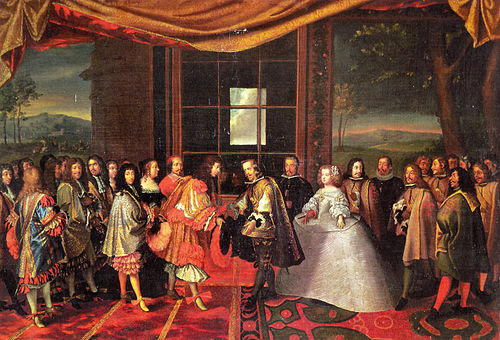
Treaty of the Pyrenees signed
France acquired the southern part of the Duchy of Luxembourg under the Treaty of the Pyrenees ending the Franco-Spanish War. Source — Wikipedia, "Luxembourg":
Entrevue de Louis XIV de France et de Philippe IV d'Espagne dans l'Île des Faisans en 1659. On distingue la fille de Philippe IV, future reine de France, derrière lui By Jacques Laumosnier - http://www.altesses.eu/imgmax/2d82273f8e.jpg, Public domain, https://commons.wikimedia.org/w/index.php?curid=715902
Jun 4, 1684 CE
Louis XIV captures Luxembourg fortress
French forces under Louis XIV besieged and captured the formidable fortress of Luxembourg after a prolonged bombardment. Source — Wikipedia, "Luxembourg":
Belagerung von Luxemburg im Jahr 1684 (Stadtgrundriss und Umgebung mit Belagerungsstellungen, farbige Handzeichnung), Originaltitel: Plan de la Ville et du Siege de Luxemburg By Unknown author - http://www.digam.net/dokument.php?ID=2160&, Public domain, https://commons.wikimedia.org/w/index.php?curid=18486583
Mar 7, 1714 CE
Treaty of Rastatt transfers Luxembourg
The Treaty of Rastatt assigned Luxembourg to the Austrian Habsburgs as part of the Spanish Netherlands settlement. Source — Wikipedia, "Luxembourg":
Map of Europe in 1714 By Rebel Redcoat - Own work, Public domain, https://commons.wikimedia.org/w/index.php?curid=10663732
Oct 1, 1795 CE
France annexes Luxembourg
After capturing the fortress, Revolutionary France formally annexed Luxembourg as the Forêts département. Source — Wikipedia, "Luxembourg":
Location of the former department of Forêts (in red) within France, 1812 By Excommunicato (original version by Naturals) - This vector image includes elements that have been taken or adapted from this file:, CC BY-SA 4.0, https://commons.wikimedia.org/w/index.php?curid=157388634
Jun 9, 1815 CE
Congress of Vienna creates Grand Duchy
Luxembourg was elevated to a Grand Duchy and given in personal union to the King of the Netherlands, while joining the German Confederation. Source — Wikipedia, "Luxembourg":
Europe 1815. Political situation after the Congress of Vienna in June 1815. Please don't alter the map when you think there is something not written or depicted correctly. Leave a message at the talk page of the file. After a verificiation and a possible discussion, I will upload a new map version with all new changes. This prevents an unnecessary waste of disk space and ensures a good result, aesthetically and content-wise. - The author. By Alexander Altenhof - Own work. Source of Information: Historical atlases – Map "1815 - L'Europe après le Congrès de Vienne" (Author unknown)(Link) – Ramsay Muir, George Philip (ed.): Philip's New School Atlas of Universal History, George Philip & Son, Ltd., London 1928 – Dr. Walter Leisering (ed.): Putzger Historischer Weltatlas, Cornelsen Verlag, Berlin 1992, ISBN 3-464-00176-8 – Bayerischer Schulbuch-Verlag (ed.): Großer Historischer Weltatlas, Dritter Teil, Neuzeit, Bayerischer Schulbuch-Verlag, München 1981, ISBN 3-7627-6021-7. – Prof. Dr. Hans-Erich Stier, Prof. Dr. Ernst Kirsten a. o. (ed.): Großer Atlas zur Weltgeschichte, Orbis Verlag, München 1990, ISBN 3-7627-6021-7Other publications – Reinhard Stauber: Der Wiener Kongress, Böhlau Verlag, Wien/Köln/Weimar 2014, ISBN 978-3-8252-4095-0 – Thierry Lentz: 1815. Der Wiener Kongress und die Neugründung Europas, Siedler Verlag, München 2014, ISBN 978-3-8275-0027-4, CC BY-SA 4.0, https://commons.wikimedia.org/w/index.php?curid=50255845
Oct 4, 1830 CE
Belg Revolution sweeps Luxembourg
Belgian revolutionaries seized much of Luxembourg; the western, French-speaking portion eventually broke away to join Belgium. Source — Wikipedia, "Luxembourg":
Men and women form a mound around a post in the streets of a city on the right of this painting. A tattered tricolour flag (of black, yellow, and red) is at the top, and beside this flag, a man stands with a paper in his hand. A man on his horse (on the left of the painting) is among the crowd at the base of the mound, and a dog capers just in front of his steed. The crowd bears swords, pikes, and guns affixed with bayonets. One of the women at the base of the mound cradles a baby, while two women and an old man grieve over a dead youth in their arms. The blue sky is overcast with grey smoke. By Égide Charles Gustave Wappers - This illustration was made by Antoine Motte dit Falisse alias M0tty but it is in the public domain because it is a faithful photographic reproduction of an original two-dimensional work of art and the work of art itself is in the public domain. English | français | +/−, Public domain, https://commons.wikimedia.org/w/index.php?curid=18494930
Apr 19, 1839 CE
Treaty of London partitions Luxembourg
The Treaty of London formally divided Luxembourg, ceding the western part to Belgium and leaving the Grand Duchy in personal union with the Netherlands. Source — Wikipedia, "Luxembourg":
Map of Belgium before the Treaty of London (1839) By Big Bad Dog - Own work, Public domain, https://commons.wikimedia.org/w/index.php?curid=5969938
1842 CE
Luxembourg joins the Zollverein
The Grand Duchy joined the German Customs Union (Zollverein), aligning its economy with German states for decades. Source — Wikipedia, "Luxembourg":
The German Confederation (Deutscher Bund) in 1820. By User:52 Pickup - Own work using: Data of the IEG-Maps project (Andreas Kunz, B. Johnen and Joachim Robert Moeschl: University of Mainz) - http://www.ieg-maps.uni-mainz.de. [1] [2] [3], CC BY-SA 3.0, https://commons.wikimedia.org/w/index.php?curid=1941185
May 11, 1867 CE
Treaty of London guarantees neutrality
The Second Treaty of London confirmed Luxembourg's independence and perpetual neutrality, and ordered the demolition of its fortress. Source — Wikipedia, "Luxembourg":
Traité de neutralité de Londres - acte final, Article VII et signatures By Archives nationales du Luxembourg. Published under licence PD-0 - Public domain. - TC-0043-01 Acte final et procès-verbal d'échange, 1867.05.11-1867.05.31 (Sous-dossier)., Public domain, https://commons.wikimedia.org/w/index.php?curid=36027925
Nov 23, 1890 CE
Independent Nassau-Weilburg dynasty
Upon the death of King William III without a male heir, the Luxembourg throne passed to Adolf of Nassau, ending the personal union with the Netherlands. Source — Wikipedia, "Luxembourg":
أدولف دوق لوكسمبورغ الأكبر By Unknown author - http://worldroots.com/brigitte/schlosshohenburg.htm, Public domain, https://commons.wikimedia.org/w/index.php?curid=2681694
1912 CE
First Grand Duchess crowned
Marie-Adélaïde became the first reigning Grand Duchess of Luxembourg and the first female sovereign since the Middle Ages. Source — Wikipedia, "Luxembourg":
Мария Аделаида, великая герцогиня Люксембургская By Bain News Service, publisher - https://mariro.livejournal.com/303057.html, Public domain, https://commons.wikimedia.org/w/index.php?curid=107299247
Aug 2, 1914 CE
Germany invades Luxembourg in WWI
German troops violated Luxembourg's neutrality by invading on their way to France, beginning a four-year occupation. Source — Wikipedia, "Luxembourg":
Flag of Luxembourg By Drawn by User:SKopp - Own work http://www.legilux.public.lu/leg/a/archives/1972/0051/a051.pdf#page=2, colors from http://www.legilux.public.lu/leg/a/archives/1993/0731609/0731609.pdf, Public domain, https://commons.wikimedia.org/w/index.php?curid=343636
1919 CE
Women's suffrage and double referendum
Luxembourg introduced women's suffrage and held a double referendum in which voters rejected an economic union with France in favor of Belgium. Source — Wikipedia, "Luxembourg":
Bulletin de vote utilisé lors du référendum luxembourgeois de 1919 By https://sudd.ch/doku.php?lang=fr&item=lu011919-zettel.png Beat Müller beat@sudd.ch, CC BY 4.0, https://commons.wikimedia.org/w/index.php?curid=84042342
1921 CE
Belgium-Luxembourg Economic Union
Luxembourg and Belgium established the Belgium-Luxembourg Economic Union (UEBL), creating a customs and monetary union that endures to this day. Source — Wikipedia, "Luxembourg":
Kuerz no der Ofwäertung vum Belsche Frang goufen et weider Wirtschaftverhandlungen tëscht der Belsch a Lëtzebuerg.Original caption: "A.Z. AKTUALITÄTEN -- Am 25. April fanden in Luxemburg belgisch-luxemburgische Wirtschaftsverhandlungen statt. Unser Bild zeit die belgischen zusammen mit den luxemburgischen Delegierten." By Unknown photographer - A-Z : Luxemburger illustrierte Wochenschrift, Nr 18 vum 5. Mee 1935Ouvrage numérisé par la Bibliothèque nationale de Luxembourg., Public domain, https://commons.wikimedia.org/w/index.php?curid=80823863
May 10, 1940 CE
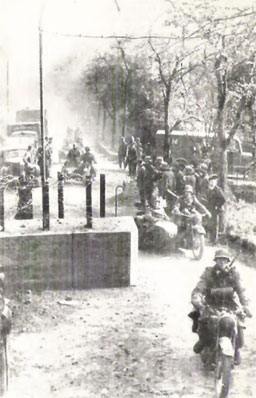
Germany invades Luxembourg in WWII
Nazi Germany invaded Luxembourg, ending neutrality and beginning a harsh occupation during which the Grand Ducal family fled to exile. Source — Wikipedia, "Luxembourg":
German motorized troops cross over the Luxembourg border on 10 May, 1940. By Unknown author - https://www.ibiblio.org/hyperwar/UN/Luxembourg/GreyBook/index.html#5, Public domain, https://commons.wikimedia.org/w/index.php?curid=47515556
Aug 30, 1942 CE
General strike against forced conscription
Luxembourgers launched a nationwide general strike protesting Nazi forced conscription; it was brutally suppressed with executions and deportations. Source — Wikipedia, "Luxembourg":
Flag of Luxembourg By Drawn by User:SKopp - Own work http://www.legilux.public.lu/leg/a/archives/1972/0051/a051.pdf#page=2, colors from http://www.legilux.public.lu/leg/a/archives/1993/0731609/0731609.pdf, Public domain, https://commons.wikimedia.org/w/index.php?curid=343636
Sep 10, 1944 CE
Allied forces liberate Luxembourg
American troops liberated Luxembourg City, though fighting continued in the north during the Battle of the Bulge months later. Source — Wikipedia, "Luxembourg":
Allied forces liberate Luxembourg By Weill - This image was provided to Wikimedia Commons by the German Federal Archive (Deutsches Bundesarchiv) as part of a cooperation project. The German Federal Archive guarantees an authentic representation only using the originals (negative and/or positive), resp. the digitalization of the originals as provided by the Digital Image Archive., CC BY-SA 3.0 de, https://commons.wikimedia.org/w/index.php?curid=5413981
Dec 16, 1944 CE
Battle of the Bulge strikes Luxembourg
The German Ardennes counteroffensive devastated northern Luxembourg in the largest battle fought on the country's soil during WWII. Source — Wikipedia, "Luxembourg":
Members of the 117th Infantry Regiment, 30th Infantry Division, move past a destroyed American M5 "Stuart" tank on their march to capture the town of St. Vith at the close of the Battle of the Bulge. St. Vith was largely destroyed during the ground battle and subsequent air attack. American forces retook the town on 23 January 1945. By U.S. Army - U.S. National Guard [1] photo [2] from the U.S. National Archives This image was released by the United States Armed Forces with the ID 450123-O-D0439-001M (next). This tag does not indicate the copyright status of the attached work. A normal copyright tag is still required. See Commons:Licensing. العربية ∙ বাংলা ∙ Bahaso Jambi ∙ Deutsch ∙ Deutsch (Sie-Form) ∙ English ∙ español ∙ euskara ∙ فارسی ∙ français ∙ italiano ∙ 日本語 ∙ 한국어 ∙ македонски ∙ മലയാളം ∙ Plattdüütsch ∙ Nederlands ∙ polski ∙ پښتو ∙ português ∙ русский ∙ slovenščina ∙ svenska ∙ Türkçe ∙ українська ∙ 简体中文 ∙ 繁體中文 ∙ +/−, Public domain, https://commons.wikimedia.org/w/index.php?curid=11180640
Apr 4, 1949 CE
Luxembourg co-founds NATO
Luxembourg became one of the twelve founding members of the North Atlantic Treaty Organization. Source — Wikipedia, "Luxembourg":
Authentication page for an official copy of the North Atlantic Treaty Organization treaty, signed and sealed by Secretary of State Dean Acheson. By Photo by Daniel Bright - Extracted from PDF version of Redefining the Seal's Use poster, part of a U.S. Diplomacy Center (State Department) exhibition on the 225th anniversary of the Great Seal. Direct PDF URL [1] (11MB), Public domain, https://commons.wikimedia.org/w/index.php?curid=5572817
Jul 23, 1952 CE
Luxembourg becomes ECSC seat
Luxembourg City was chosen as the provisional seat of the European Coal and Steel Community institutions, launching its role as a European capital. Source — Wikipedia, "Luxembourg":
Grand Ducal Palace in Luxembourg city. At the right: part of the Parliament building (Chambre des députés) By Cayambe - Own work, CC BY-SA 3.0, https://commons.wikimedia.org/w/index.php?curid=5879998
Mar 25, 1957 CE
Luxembourg signs Treaty of Rome
Luxembourg was among the six signatories of the Treaty of Rome establishing the European Economic Community. Source — Wikipedia, "Luxembourg":
The Flag of Europe is the flag and emblem of the European Union (EU) and Council of Europe (CoE). It consists of a circle of 12 golden (yellow) stars on a blue background. It was created in 1955 by the CoE and adopted by the EU, then the European Communities, in the 1980s. The CoE and EU are distinct in membership and nature. The CoE is an international organisation with 46 members, dealing with human rights and rule of law, while the EU is a quasi-federal union of 27 states, focused on economic integration and political cooperation. Today, the flag is mostly associated with the latter. It was the intention of the CoE that the flag should come to represent Europe as a whole, and since its adoption the membership of the CoE covers nearly the entire Europe by the number of states involved, although only a little over half of the European continent by territory. This is why the EU adopted the same flag. The flag has been used to represent Europe in sporting events and as a pro-democracy banner outside the European Union. By User:Verdy p, User:-xfi-, User:Paddu, User:Nightstallion, User:Funakoshi, User:Jeltz, User:Dbenbenn, User:Zscout370 - File created by various Wikimedia users (see "Author"). File based on the specification given at [1]., Public domain, https://commons.wikimedia.org/w/index.php?curid=2615952
Nov 12, 1964 CE
Grand Duke Jean ascends throne
Grand Duchess Charlotte abdicated in favor of her son Jean, who had served with Allied forces during World War II and would rule for 36 years. Source — Wikipedia, "Luxembourg":
Klaus HANSCH EP President, Grand Duke Jean of Luxembourg By European Parliament - https://multimedia.europarl.europa.eu/en/photo/ep-president-visit-to-luxembourg_19941000_017_017, Attribution, https://commons.wikimedia.org/w/index.php?curid=167261072
Jun 14, 1985 CE
Schengen Agreement signed
Five countries including Luxembourg signed the Schengen Agreement aboard a ship on the Moselle near the Luxembourg village of Schengen, abolishing internal border checks. Source — Wikipedia, "Luxembourg":
Schengen Agreement signed 1985-06-14, on display in the Schengen Treaty Museum in Schengen, Luxembourg By Zinneke - Own work, CC BY-SA 3.0, https://commons.wikimedia.org/w/index.php?curid=15543678
Feb 17, 1986 CE
Single European Act adopted
Luxembourg held the rotating Council presidency during the adoption of the Single European Act, a milestone in European integration. Source — Wikipedia, "Luxembourg":
The Flag of Europe is the flag and emblem of the European Union (EU) and Council of Europe (CoE). It consists of a circle of 12 golden (yellow) stars on a blue background. It was created in 1955 by the CoE and adopted by the EU, then the European Communities, in the 1980s. The CoE and EU are distinct in membership and nature. The CoE is an international organisation with 46 members, dealing with human rights and rule of law, while the EU is a quasi-federal union of 27 states, focused on economic integration and political cooperation. Today, the flag is mostly associated with the latter. It was the intention of the CoE that the flag should come to represent Europe as a whole, and since its adoption the membership of the CoE covers nearly the entire Europe by the number of states involved, although only a little over half of the European continent by territory. This is why the EU adopted the same flag. The flag has been used to represent Europe in sporting events and as a pro-democracy banner outside the European Union. By User:Verdy p, User:-xfi-, User:Paddu, User:Nightstallion, User:Funakoshi, User:Jeltz, User:Dbenbenn, User:Zscout370 - File created by various Wikimedia users (see "Author"). File based on the specification given at [1]., Public domain, https://commons.wikimedia.org/w/index.php?curid=2615952
1995 CE
Luxembourg City European Capital of Culture
Luxembourg City was designated a European Capital of Culture for the first time, highlighting its cultural heritage on a continental stage. Source — Wikipedia, "Luxembourg":
European Capital of Culture By European Commission - https://www.timisoara2021.ro/, Public domain, https://commons.wikimedia.org/w/index.php?curid=110014612
Oct 7, 2000 CE
Grand Duke Henri ascends throne
Grand Duke Jean abdicated in favor of his son Henri, the current reigning monarch of Luxembourg. Source — Wikipedia, "Luxembourg":
Grand Duke Henri and Grand Duke Guillaume of Luxembourg at the former's abdication ceremony on 3 October 2025. By Alexandors Michailidis - European Council - https://newsroom.consilium.europa.eu/events/20251003-president-costa-visits-luxembourg, Attribution, https://commons.wikimedia.org/w/index.php?curid=179687958
Jan 1, 2002 CE
Luxembourg adopts the euro
Luxembourg was among the first countries to adopt the euro as its currency, replacing the Luxembourg franc. Source — Wikipedia, "Luxembourg":
Euro Banknotes Europa series as of 28th May 2019 By The RedBurn - File:EUR 5 obverse (2013 issue).png, File:EUR 10 obverse (2014 issue).png, File:The Europa series 20 € obverse side.jpg, File:The Europa series 50 € obverse side.png, File:The Europa series 100 € obverse side.jpg, File:The Europa series 200 € obverse side.jpg, ECB decisions ECB/2003/4 and ECB/2003/5, https://commons.wikimedia.org/w/index.php?curid=190054230
2007 CE
Luxembourg and Greater Region Capital of Culture
Luxembourg and the Greater Region served as European Capital of Culture for a second time, spanning borders into France, Germany, and Belgium. Source — Wikipedia, "Luxembourg":
European Capital of Culture By European Commission - https://www.timisoara2021.ro/, Public domain, https://commons.wikimedia.org/w/index.php?curid=110014612